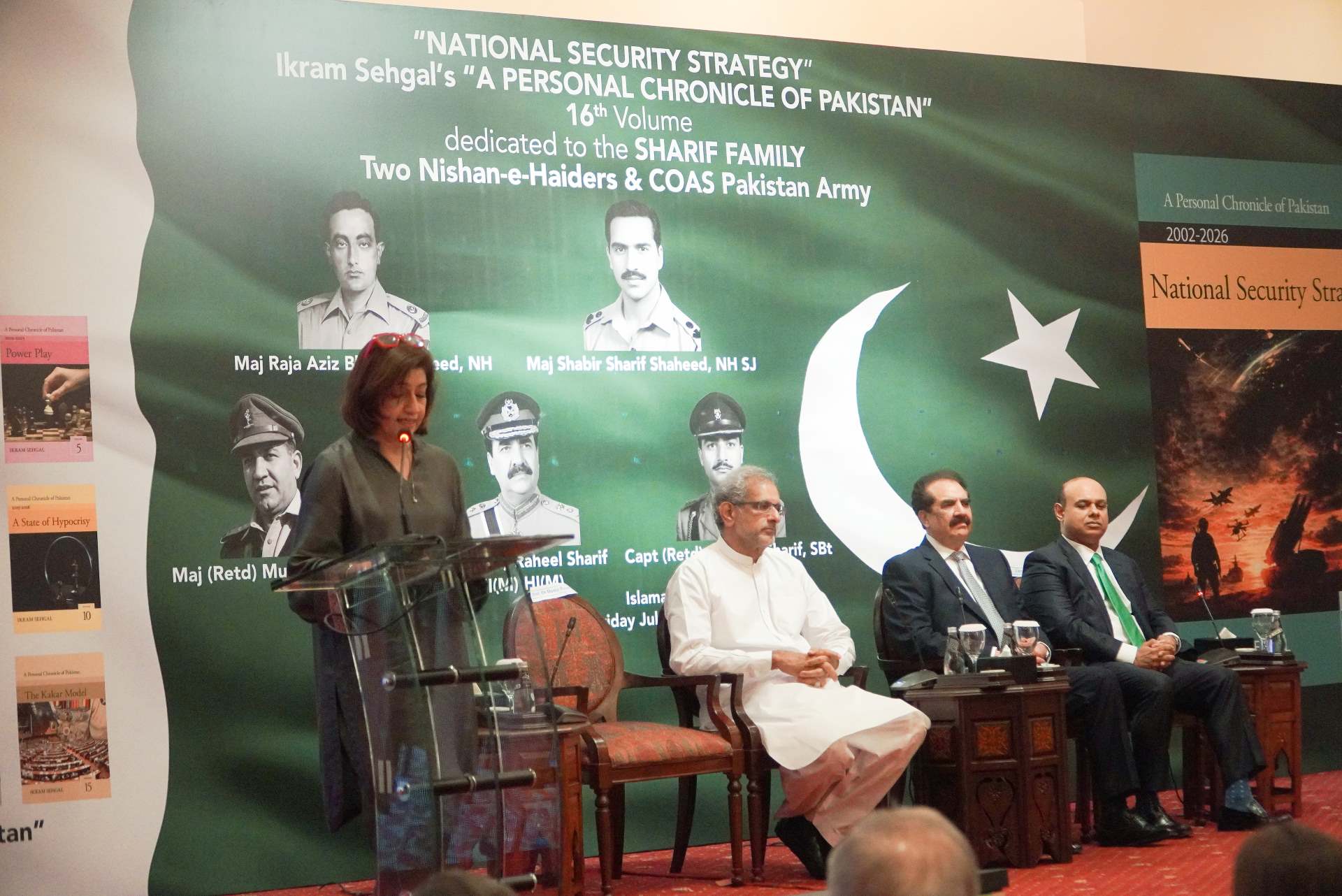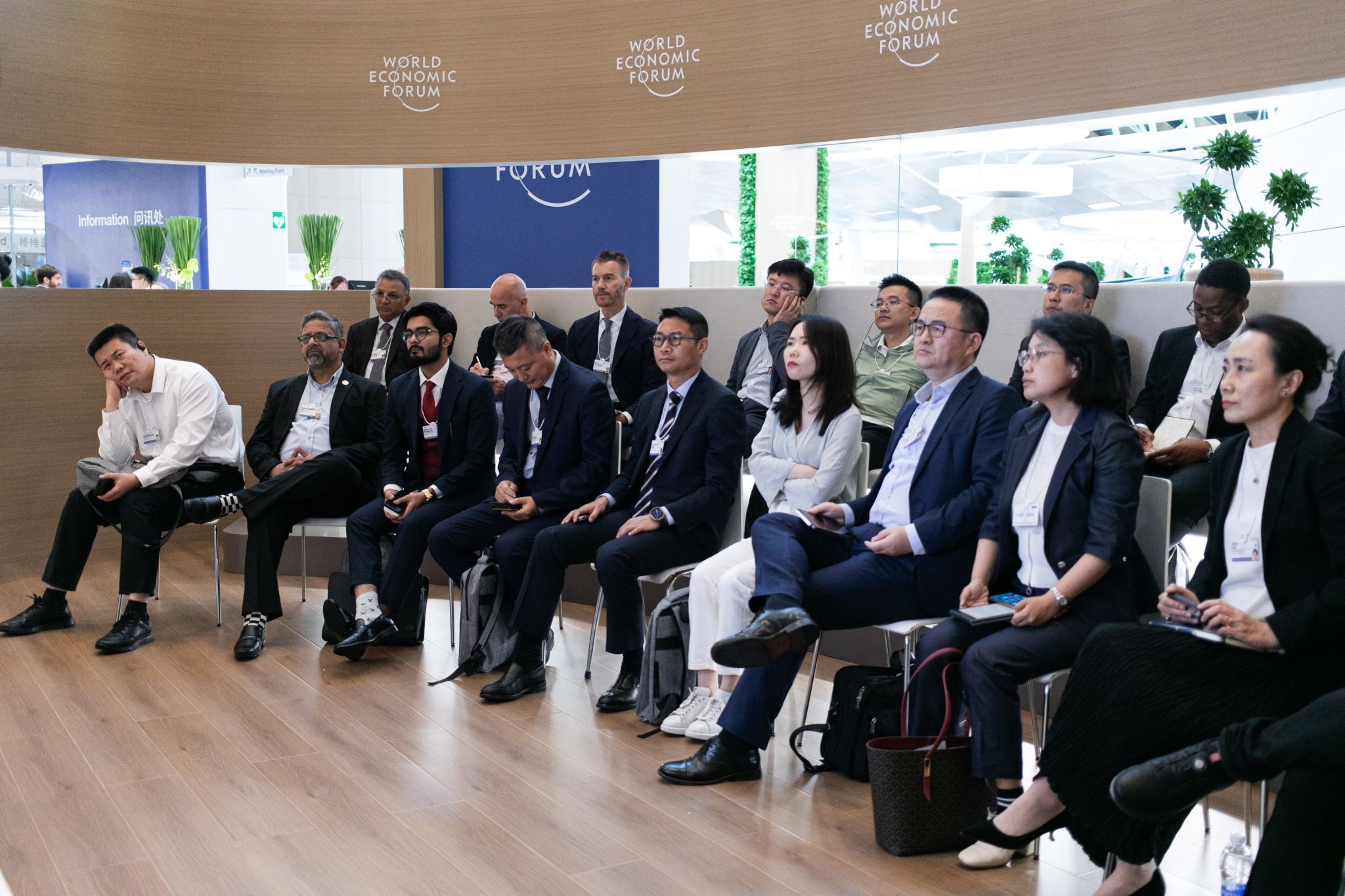




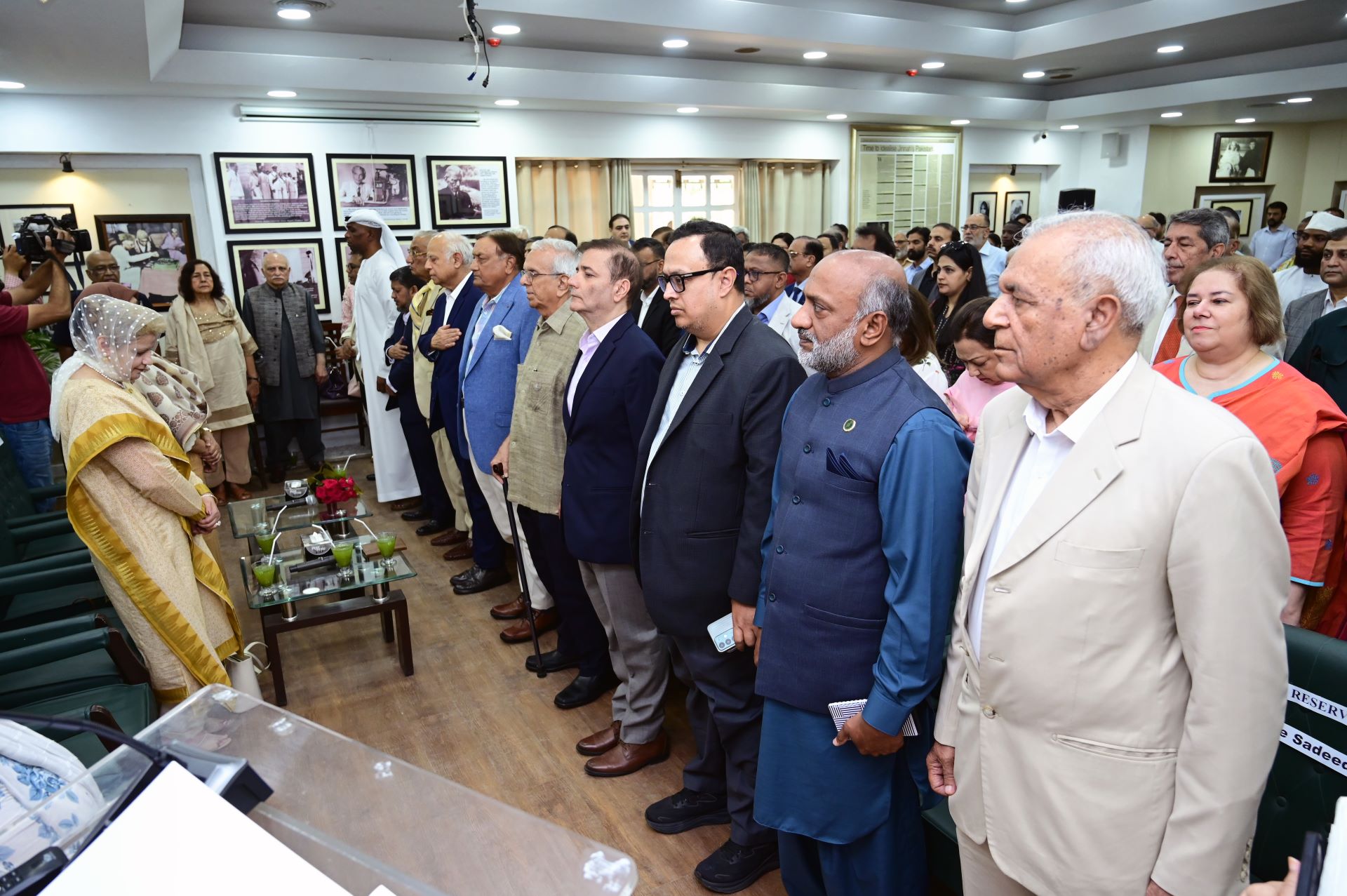
with Bangladesh Civil Service Officers visiting Pakistan
A Discussion organized by KCFR
Dr Huma Baqai, Senior Vice Chairperson, KCFR (Host):
Bismillahir Rahmanir Rahim. Thank you all for being here on a very hot afternoon. I believe, however, that our distinguished guests make it truly worthwhile, and I am confident you will enjoy this session. In many ways, today feels like a historic occasion, particularly for the Karachi Council on Foreign Relations (KCFR), for two important reasons. First, the KCFR, under the patronage of its Patron-in-Chief, Ikram Sehgal, has long invested in fostering collaboration between Pakistan and Bangladesh.
I recall a conversation with him back in 2019 during the launch of his book, In Different Shades of Green, at the Oxford University Press Literature Festival. That was when this idea of closer engagement was first discussed. Since then, there have been continuous interactions and collaborative efforts. Mr Sehgal also visited Bangladesh and delivered a talk at the National Defence University of Bangladesh, where he spoke about strengthening ties. At the time, however, the political environment, under Sheikh Hasina, was not particularly receptive. Since then, circumstances have evolved.
The idea of greater regional cooperation among Eastern South Asian states is not new; it was proposed decades ago. What we are witnessing today is the continuation, and perhaps the realization of that long-standing vision. A significant milestone occurred on April 17, 2025, after a gap of 15 years, when talks were held between Amna Baloch and Md. Jashim Uddin. These discussions took place in a cordial atmosphere and reflected a shared commitment to revitalizing bilateral relations.
What we are seeing today, the presence of senior Bangladeshi bureaucrats in Pakistan for collaborative training, is the culmination of those efforts.
There is another point I would like to highlight. Rafia Zakaria, a Washington-based attorney and commentator, recently wrote an insightful article. Allow me to paraphrase and expand slightly on her observation: Pakistan has moved forward, and I would add that both Pakistan and Bangladesh have. However, India, by contrast, appears to remain constrained by a Pakistan-centric mindset, the consequences of which include growing regional and global isolation. Ultimately, the position of each country today reflects the choices it has made.
With that, I have the distinct pleasure of inviting Ms Nadira Panjwani, Chairperson of the KCFR to deliver her welcome address.
Nadira Panjwani, Chairperson KCFR:
Bismillahir Rahmanir Rahim. Respected officials and diplomats of the government of Bangladesh, ladies and gentlemen, As-Salamu Alaykum, and warm greetings to everyone. Karachi Council on Foreign Relations is delighted to welcome our distinguished guests from Bangladesh to this highly significant venue, which was the Karachi residence of our Quaid-e-Azam, Muhammad Ali Jinnah.
Pakistan and Bangladesh are two nations born of the same struggle, the same aspirations, and the same dream. While time and circumstances have charted different courses for us, we remain grounded in a deeply interconnected past. Our countries established diplomatic relations in 1974. It has not been an easy relationship. The legacy of 1971 left a deep trauma that shaped our relations for decades. And for a long time, mistrust and unresolved grievances overshadowed the immense potential of our cooperation. While history remains an important part of collective memory, it does not have to dictate the future.
Today, Pakistan and Bangladesh have moved beyond the bitterness and the burdens of the past. Both nations have demonstrated the capacity to lead, to evolve, and to move forward. There is now a growing recognition that mutual respect, constructive engagement, and regional cooperation can offer far greater promises than revisiting old grievances. The Revolution of 2024, led by the youth of Bangladesh, was a turning point. It was not just a political upheaval. It was a call for the renewal and the reimagining of Bangladesh’s place in the region. This has provided both countries with an opportunity to open a new chapter of economic ties and people-to-people diplomacy. Collaboration in multiple sectors, like commerce, education, agriculture, aquaculture, maritime connectivity, technology, and heritage, is gaining traction. Some recent and notable examples of cooperation between us are the structure of bilateral talks through foreign and regional consultations, the revival of our joint economic movement commission after decades, Karachi port access to Bangladesh, scholarships for Bangladeshi students through the Pak-Bangladesh Knowledge Corridor Initiative, academic partnerships between research institutes, and high-level political engagement on important issues such as the revival of SAARC and the Rohingya crisis. And for us, the citizens of Karachi, the most pleasing aspect of this renewed cooperation is the restoration of direct links between Karachi and Dhaka since the beginning of this year.
The Pakistan-Bangladesh Economic Commission has discussed a vast array of topics, and both sides have agreed to ease business procedures and improve logistics and commercial connectivity within Karachi and Bangladeshi ports. Business forums organized in Dhaka and other cities have further highlighted the trade potential between our countries.
Presently, Pakistan exports cotton, rice, chemicals, salt, and industrial raw materials to Bangladesh, while Bangladesh exports juice products, pharmaceuticals, garments, and textiles to us. If banking channels, shipping routes, and territory structures continue to improve, the volume of our bilateral trade can rise significantly. Culture plays a quiet but powerful role in bringing people closer. Through music, literature, language, fashion, cuisine, and traditions, people recognize patterns of common human experiences, and this recognition makes culture a bridge connecting hearts and minds across borders. Our people have strong cultural similarities, starting from our shared faiths, affinities in poetry, music, food, festivals, cinematic expressions, apparel, customs, and a lot more. This close cultural resonance creates a natural platform for strong bilateral relations.
Ladies and gentlemen, we stand at a moment of profound transformation. History is turning a page, and the world is being remade before our eyes.Alliances that once seemed unshapable are being redrawn. Dependence on a single superpower for security and consumer markets is no longer visible, and the old order is giving way to new realities. This transition carries both peril and promise. On one hand, there is growing instability, erosion of trust, and a breakdown of systems in place, while on the other hand, there are fresh opportunities, new coalitions, innovative frameworks for cooperation, and a chance to craft a more inclusive and equitable global order. The challenge before us is not just to survive this wave of turbulent change, but to ride it with purpose towards progress and a better future. In this scenario, Pakistan and Bangladesh have an opportunity to redefine their place in the emerging global order through pragmatism and forward-looking strategies. As global blocs realign and supply chains are reconfigured, instead of just observing this geopolitical flux, both countries can position themselves as agile actors that prioritize economic resilience, regional connectivity, and strategic diversification. They can engage economically with multiple partners, engage diplomatically across blocs, and engage regionally through beneficial cooperation. The digital empowerment of hundreds of millions in this region, the growing impact of challenges like climate change and energy crunch, has led to greater economic maturity, where competition has been replaced by cooperation. So, staying on top of the global appeal will come through becoming more connected, more versatile, more responsive, and more innovative.
In conclusion, let us commit ourselves to a partnership that is not transactional, but transformational. May the bonds between Pakistan and Bangladesh grow stronger with each passing day, and may our shared journey inspire peace, prosperity, and hope for coming generations. On behalf of all members of KCFR, I extend many thanks to our esteemed Bangladeshi guests for accepting our invitation. We wish you a pleasant and memorable stay in Pakistan. Together, let’s write a new chapter, one of friendship, one of peace, and one of unity.
Dr Huma Baqai (Host):
I do not have much to add after such a comprehensive round of appreciation. However, as Aizaz Ahmad Chaudhry, Pakistan’s former Foreign Secretary has noted, shared grievances over India’s regional hegemony have encouraged Islamabad and Dhaka to rebuild their ties. Bangladesh has experienced Indian dominance in its own context, and Pakistan observed similar patterns during the May 2025 tensions.
Both nations now recognize the importance of maintaining a balance of power in South Asia. Adding to this is the role of China. China’s position as a strategic partner to both Bangladesh and Pakistan introduces another dimension, particularly through cooperation in infrastructure development and defense collaboration. This evolving dynamic has the potential to strengthen a broader strategic alignment in the region.
These developments have altered the regional balance of power, prompting India to reassess its diplomatic and military strategies. In fact, given the ongoing shifts in the global order, these changes are no longer confined to South Asia; they are increasingly global in scope.
With that, I have the distinct pleasure of inviting the Deputy High Commissioner of Bangladesh to Pakistan, Mohammad Sakib Sadaqat, a distinguished lawyer, to address us.
Mohammad Sakib Sadaqat. Deputy High Commissioner of Bangladesh to Pakistan:
As-Salamu Alaykum, distinguished guests, delegates, ladies, and gentlemen. It is an honor for me to speak before such a high-caliber audience. I would like to thank the Government of Pakistan, especially the KCFR, for organizing such a wonderful event for our delegation visiting Pakistan.
People-to-people contact plays a vital role in strengthening bilateral relations. This gathering marks an important first step in fostering such connections between the civil servants of Bangladesh and Pakistan.
I would also like to briefly highlight Bangladesh’s foreign policy. It is guided by the principle:
“friendship towards all, malice towards none.”
This approach is inclusive and naturally extends to Pakistan as well. We seek to build and strengthen friendly relations with Pakistan in line with this policy. Furthermore, Article 25(3) of our Constitution emphasizes the peaceful settlement of international disputes.
We appreciate Pakistan’s role in promoting peace, particularly in efforts to ease tensions between Iran and the United States.
Let me also highlight recent developments in our bilateral relations. Bangladesh is working to expand exports of pineapple and Paan (betel leaf) to Pakistan. Following the launch of direct flights between Dhaka and Karachi, efforts are underway to establish direct connectivity between Lahore and Dhaka as well. Additionally, we are working to increase the frequency of shipping routes between Karachi and Chittagong ports.
Bilateral trade between Bangladesh and Pakistan has grown by 20% in recent months, surpassing $1 billion. Insha Allah, this trade has significant potential for further growth, which we aim to realize in the near future.
Our Honorable Prime Minister, His Excellency Mr Tarique Rahman, has introduced several initiatives such as the Farmer’s Card, Family Card, and Health Card. These programs are designed to improve governance and bring essential services directly to the doorstep of the common people, greatly benefiting citizens across Bangladesh.
I would also like to mention that Bangladesh’s Foreign Minister, His Excellency Dr Khalilur Rahman, has put forward his candidacy for the presidency of the 81st session of the United Nations General Assembly. We respectfully seek your support for his candidacy and hope it will receive favorable consideration. Finally, I would like to express my appreciation for the warm hospitality extended by our Pakistani hosts, particularly the KCFR, and the distinguished participants here today. As has been rightly noted, Bangladesh-Pakistan relations are growing stronger and more vibrant with each passing day, Insha Allah. With these words, I conclude by once again expressing my sincere gratitude for hosting our delegation. We look forward to welcoming more delegations from Pakistan to Bangladesh, and from Bangladesh to Pakistan, in the near future. Thank you very much.
Dr Huma Baqai (Host):
Sakib Sadaqat Sahib, we look forward to these collaborations. Very happy to host you, and I would also like to tell you that KCFR allows you to speak to the best of the best, the best brains, the intellectual elite of Pakistan, all gathered here under this roof. We’re very happy to host you here.
Now I have the pleasure of inviting Ms Salma Siddiqua Mahtab, who’s the Additional Secretary, Health Services Division, Bangladesh, to come and say a few words.
Salma Siddiqua Mahtab, Additional Secretary, Health Services Division, Bangladesh:
Bismillahir Rahmanir Rahim. Distinguished guests, my dear colleagues, ladies and gentlemen, As-Salamu Alaykum.
Nadia and Sakib have articulated their thoughts so well that there is little left for me to add. However, I would like to briefly share a regional, South Asian perspective. As we see in other parts of the world, countries are forming regional frameworks and strategic alignments, such as the Indo-Pacific Strategy.
In our region, given the growing influence of China, we need to maintain a balance of power. Therefore, collaboration among countries is essential, not only for development, trade, and commerce, but also for our collective security and stability. I believe there are many avenues beyond trade and commerce through which Bangladesh and Pakistan can strengthen their bilateral relations.
Both countries possess rich cultural traditions, and there is great potential to promote cultural exchange and mutual understanding.
We can enhance exchanges by facilitating visits of officials and professionals between Bangladesh and Pakistan, just as we are visiting here today. In the health sector, in particular, where I am professionally engaged, there are numerous opportunities for cooperation. For example, I have learned that the liver transplantation center here is highly advanced.
This is a facility we currently lack, and we can benefit greatly by learning from your experience and expertise to develop similar capabilities in Bangladesh.
Many important points have already been highlighted by my colleagues, so I will not repeat them. However, I would like to assure you that we are committed to continuing this people-to-people collaboration, which will greatly benefit the citizens of both countries.
On behalf of my colleagues, I extend our sincere thanks and heartfelt gratitude for inviting us to this esteemed gathering. We are truly honored and delighted to be here. Thank you very much.
Dr Huma Baqai (Host):
Thank you, Madam Salma. And now I’d like to invite Md. Mustafa Jamal Haider, Joint Secretary, Ministry of Commerce, Bangladesh
Md. Mustafa Jamal Haider, Joint Secretary, Ministry of Commerce, Bangladesh:
Bismillahir Rahmanir Rahim. As-Salamu Alaykum and a very good afternoon. It is my great pleasure and a valuable opportunity to be here today. I would like to sincerely appreciate everything the Government of Pakistan has done for our delegation. From the very beginning, I recall the kind hospitality extended by His Excellency, the High Commissioner of Pakistan to Dhaka, who graciously hosted a dinner for us before Easter. On Easter Day, he was also present to see us off at the airport, which was a truly thoughtful gesture. Today’s invitation to this gathering is also a great honor for me.
Ms Nadira Panjwani has already eloquently described the historical, political, economic, and trade relations between Bangladesh and Pakistan. The message reflected in today’s banner—that we are “two countries, one nation”—is truly remarkable. Our shared history, culture, traditions, and attire reflect deep commonalities. In many ways, we remain closely connected despite being two sovereign nations.
There are immense opportunities to further strengthen relations between Bangladesh and Pakistan. While history has taken its course, we must now look forward and build on future possibilities. Bangladesh is actively exporting a wide range of goods and services to global markets, while Pakistan possesses strong expertise in textiles and fabrics. Pakistani brands such as Sana Safinaz, Maria B, Gul Ahmed, and Junaid Jamshed are very popular in Bangladesh. Bangladeshi women particularly admire these designs, while men appreciate the quality of Junaid Jamshed’s traditional wear.
At the same time, Bangladesh has made significant progress in sectors such as pharmaceuticals, leather, and jute. These areas offer strong potential for collaboration. By enhancing bilateral trade, strengthening political consultations, and promoting initiatives such as bureaucratic exchange programs and student exchange programs, we can serve our shared interests and bring tangible benefits to the people of both countries.
I would also like to commend Pakistan for its growing role on the global diplomatic stage. Today, Pakistan is emerging as an important diplomatic hub, and we sincerely appreciate these efforts. I personally pray that this success continues to grow from Islamabad, contributing to global peace and cooperation.
We all aspire for peace, harmony, and the protection of our people and our planet. Once again, thank you very much for inviting us. We look forward to greater collaboration and deeper integration between Bangladesh and Pakistan in the future.
Dr Huma Baqai (Host):
Thank you, Mustafa Jamal Haider Saab. That was truly very kind. Once again, all of us remain hopeful that Islamabad will witness a renewed wave of diplomatic activity, this time, hopefully leading to a clear and tangible pathway to peace. You are all seated in the historic Quaid-e-Azam House, and I believe many of you are already aware of its significance.
Now, I would like to invite Barrister Liaquat Merchant, Senior Vice President of the Board of Management, Quaid-e-Azam House, to share a few words.
Barrister Liaquat H. Merchant (SI), Senior Vice Chairman of the Board of Management for the Quaid-e-Azam House Museum:
Ms Nadira Panjwani, Mr Ikram Sehgal, our distinguished guests from Bangladesh, ladies and gentlemen, As-Salamu Alaykum The intellectual discussions you have heard so far have been quite enriching. I, however, will speak in a much simpler and more informal manner, nothing as intellectual as what Ms Nadira Panjwani and others have shared. I believe Ikram Sehgal will also continue in that spirit.
First of all, let me warmly welcome our Bangladeshi delegation and wish you a pleasant stay in Pakistan. We sincerely hope that such exchanges will continue in the future. You are seated in the historic Quaid-e-Azam House, one of the properties owned by Muhammad Ali Jinnah. This property was not covered under his will and, therefore, could not be distributed among the beneficiaries. I serve as one of the executors of Mr Jinnah’s will and the administrator of his estate in Pakistan. As a result, this house came under the control of the administrators, who later sold it to the Government of Pakistan. The government then developed it into a museum, fulfilling a valuable national vision, and they have done an excellent job. This facility is part of a broader initiative, and the museum located in the adjoining building is open to the public free of charge.
What I particularly want to highlight for this august gathering is the institutional framework behind this place. The Board of Management of Quaid-e-Azam House was established as a joint venture between the government and two institutions: the Karachi Council on Foreign Relations and the Jinnah Society. These institutions are represented by Mr Ikram Sehgal and me, alongside representatives of the Government of Sindh. This collaboration was formalized through a Memorandum of Understanding and an official government notification.
The primary purpose of entrusting this house to the Board of Management is nation-building. For this reason, the title Institute of Nation Building was added, not as a formal grant from the University of Karachi or the Government of Pakistan, but as a reflection of our mission.
Our focus is on the youth of Pakistan. Approximately 53% of our population is under the age of 20, and a significant portion of this group consists of students in schools, colleges, and universities. This is the segment we aim to engage. We regularly invite students here, organize programs, and educate them through films, discussions, and presentations about Pakistan’s history, the struggle for independence, the creation of the state, and the vision of Muhammad Ali Jinnah, and we encourage reflection on whether we have lived up to that vision.
Today, in the presence of our distinguished guests, I would also like to share an important development. While we continue to educate our youth about Pakistani leaders, we will now also include prominent figures from Bengal who contributed to the shared history. Personalities such as Maulvi Tamizuddin Khan and M. M. Alam will be highlighted. We will also revisit the cultural contributions of renowned artists like Runa Laila and Shahnaz Begum, whose music once inspired audiences across the region.
One memorable line that still resonates today is: “Mauj bharey ya aandhi aaye, diya jalaye rakhna hai.” It continues to live in the hearts of many Pakistanis.
Going forward, alongside discussions on Pakistani leadership, we will also educate our students about the contributions of Bengal to our shared past. From the role of Bengali figures in governance to military contributions in conflicts such as the 1965 war, these shared histories will form part of our narrative. While today Bangladesh and Pakistan are two separate countries, the idea of shared heritage remains significant.
This is the message I would like our visiting friends to take back home, that this institution, rooted in the legacy of Muhammad Ali Jinnah, continues to work for the betterment of the wider region, including Pakistan, Bangladesh, and beyond.
Before I conclude, I would like to express my support for the South Asian Association for Regional Cooperation (SAARC). It is an important regional platform with great potential. With Pakistan and Bangladesh seeking closer cooperation, both countries should work together to strengthen SAARC and ensure that it fulfills its promise of regional prosperity and collaboration.
With these words, I wish our distinguished delegation a successful visit and a pleasant stay in Pakistan. May this tradition of engagement continue. Thank you, and God bless you all.
Dr Huma Baqai (Host):
Now I’m going to invite someone who has a Bengali mother, has family buried in Bangladesh, and is personally invested in this collaboration, Mr Ikram Sehgal.
Ikram Sehgal, Co-Chairman, Pathfinder Group:
Bismillahir Rahmanir Rahim. I want to start on a personal note. First of all, thank you, Nadira Panjwani, for responding at very short notice. I rang her up, and the answer immediately was, “Yes, let’s do it.” And thank you, Saif, for reaching out to us. These things happen spontaneously. I also want to thank everyone who put this together on such short notice. Organizing everything within 48 hours, especially in this heat, is quite difficult, but they did it. I especially want to thank Gaity Khurram, Bilal Qamar, Taha, and Nadira from our side. Thank you very much for arranging this.
Liaqat, you are the embodiment of all that Quaid-e-Azam stood for. You don’t even allow us to pay for the tea; you insist that you will pay for it. As you know, Quaid-e-Azam used to make people feel that no one could get tea for free in his house. Huma, thank you very much for your kind words. We have always had many discussions on Bangladesh together.
I wanted to start on a personal note, so let me begin with your present Prime Minister. Not many people know that he was born in November 1968 at CMH Dhaka. Zia ur Rahman was the officiating CO of East Bengal, and I was his adjutant. I was one of the first people to see your new Prime Minister when he was born at CMH.
My father used to command the Second Bengal, and people also do not know that my mother carried the proposal for Begum Zia’s marriage. When the nikah was performed, she was very young, about 15 years old, so according to army regulations, the Rukhsati took place 3–4 years later, in 1964. She later came to Karachi. People also may not know that Zia ur Rahman’s parents are buried in the Sakhi Hassan graveyard here. He studied at D.J. Science College, joined the army, and later, when my father was commanding East Bengal, he served under him. There were two other adjutants as well, General Shafiullah and General Arshad. I had the honor of serving as Zia ur Rahman’s adjutant in Jaipur.
I know a little about Bangladesh, also because two of my grand-uncles were Prime Ministers of Pakistan, Mohammad Ali Bogra from my paternal side and Huseyn Shaheed Suhrawardy from my maternal side. I grew up, went back, and served in the East Bengal Regiment. I do not want to go into later history, but about six years ago, I was asked on television whether Pakistan and Bangladesh would come together again. I said yes, we will come together, but for the right reasons, not the wrong ones. And the reasons are very clear. The slogan “two countries, one nation” was coined by the Karachi Council on Foreign Relations.
I want to talk about Mohammad Ali Jinnah, the Quaid-e-Azam. In 1946, Fazlul Huq, Huseyn Suhrawardy, and Abul Hashim approached him and proposed two separate sovereign states, Pakistan and Bangladesh. Jinnah clarified that Bengal had not asked for Bangladesh and added that if such a plan proceeded, Assam would also come with them. Quaid-e-Azam agreed and said, “Go and try,” but for various reasons, which I won’t go into, it was later rejected.
We have also discussed the idea of the Association of Eastern States of South Asia (AESSA), Bangladesh, Assam, and the surrounding regions such as Manipur, Mizoram, and Bodoland. Together, they form a contiguous region. If you look at the geography, the proximity is natural. Why natural? We heard the song “Sonar Bangla.” Before 1757, nearly 27% of global trade originated from what is now Bangladesh and Assam. Later, for the benefit of textile industries in Birmingham and Manchester, local industries were destroyed, people were impoverished, famines were induced, and landholdings were lost. An artificial division was created, which is no longer relevant.
We can think about many initiatives, including SAARC. Zia ur Rahman first proposed it in 1977 when he visited Pakistan and suggested to Zia ul Haq that South Asia should have a trade organization. After his assassination, SAARC was eventually formed. It can still play a role—with or without India.
We should maintain good relations with India, provided it treats its Muslims properly. We must not forget our responsibility toward them, Pakistan and Bangladesh, both. As India realized on May 9, 2025, Pakistan is no longer a pushover. If we come together economically, the entire region stands to benefit. Tell me, among SAARC countries, which nation truly has good relations with India, except Bhutan?
We have talked about delegations and people-to-people contact. Why don’t we start with visa-on-arrival? If someone comes from Bangladesh, their government can stop them at Dhaka airport if needed. Similarly, if Pakistan does not wish to admit someone, they can be sent back. But there is no need for lengthy visa procedures.
The Bangladesh High Commission spoke about trade and tariffs. Why should there be tariffs on tea, cotton textiles, and jute? Imagine how competitive Bangladesh would become in international markets if such barriers were removed. Consider tea—here in Pakistan, it is a staple for many laborers, often consumed with chapati (bread) as a meal. Removing tariffs could reduce its cost by up to 50%. So why not eliminate tariffs?
Then there is Rupee–Taka convertibility. If we want to trade in rupees, we should be able to do so; likewise, in takas. There is no need to rely on third currencies. The two central banks can maintain a daily parity level.
I have my esteemed senior here, General Moin Uddin Haider, who has strong links with Bangladesh. He even shared an office with Zia ur Rahman as a Platoon Commander at the Pakistan Military Academy. Pakistan and Bangladesh do not need a lengthy mutual defense pact. A simple principle would suffice: any aggression against Bangladesh is aggression against Pakistan, and vice versa. This can be done without lengthy bureaucratic processes.
Let me add that one of my close friends, a former shipping minister, once suggested that Gwadar Port could be used for Bangladeshi trade with Central Asia. Goods could be shipped from Chittagong or China to Gwadar, and from there transported by road into Central Asia and even Europe. It is a highly practical idea, provided tariffs and bottlenecks are removed.
There are many more ideas, but I will conclude by saying this: I am proud to be a Pakistani. Bangladesh is a sovereign country with its own flag and identity, and I fully respect that. However, my mother, who was from Bogra, is buried here along with my father, near Abdullah Shah Ghazi Mazar. When my father passed away in 1983, they had property worth 20 crores in Banani and Gulshan in Dhaka. General Shah once suggested selling it so she could return, but my mother refused. She said, “My son, I am Pakistani. Whatever was mine is either buried here or stands before you.” That was the character of that generation.
I urge you to revisit those values, because the future is ours. There are no better youth than those of Pakistan and Bangladesh. The youth of Bangladesh demonstrated this through their resilience and transformation, and our Gen Z is equally capable. We must come together and create an impact on the global stage as two countries, but one people. Thank you very much.
Farhan Khawaja, Director, National School of Public Policy:
Bismillahir Rahmanir Rahim. Assalam-o-Alaikum to all the participants of today’s event.
At the outset, I would like to take this opportunity to thank the hosts of this event for organizing such a meaningful gathering in honor of the pioneering delegation of senior civil servants from Bangladesh who are here with us today. I would especially like to thank Ikram Sehgal and all his colleagues who have made this event possible.
It is very heartening to see such a large gathering on a Sunday afternoon in Karachi. I believe this is a testament to the hospitality extended by the people of Karachi, Sindh, and Pakistan to our distinguished guests.
I would also like to acknowledge and thank the Karachi Council on Foreign Relations as an institution for its role in organizing this event. I would like to take a moment to share with the participants that the Government of Pakistan, the National School of Public Policy, which I represent, and the Civil Services Academy, which I also have the privilege and honor of representing, are the key institutions selected by the Government of Pakistan to organize this unique executive leadership programme for our esteemed senior civil servants from Bangladesh.
I would also like to briefly highlight that this engagement between the Government of Pakistan and the Government of Bangladesh is taking place after 53 years. After more than five decades, we now have the opportunity, as sovereign and brotherly nations, to re-engage. The policy directives of the Government of Pakistan in this regard are very clear: we aim to learn from one another, grow together, and build mutual understanding and appreciation.
Furthermore, I would like to share that the Higher Education Commission of Pakistan has been designated as the core institution for a unique initiative titled the “Pakistan-Bangladesh Knowledge Corridor.” It is under this initiative that 12 senior civil servants from Bangladesh are visiting Pakistan. I am very pleased to see them here today.
They are in Pakistan for a 21-day, three-phase program. The first phase is being held in Karachi, where we are gathered today. From tomorrow onwards, the programme will continue under the leadership of the Director General of NIPA Karachi, Dr Saif-ur-Rehman, who is present here. NIPA Karachi, as a leading public-sector capacity-building institution, will play a vital role in this phase. I am grateful to Dr Saif-ur-Rehman and his entire team, as well as the National School of Public Policy, for their invaluable support in making the Karachi segment of this programme a success.
The second phase of the programme will take place in Lahore, where the delegation will engage with the Governor of Punjab, the Chief Minister, and the provincial government. More importantly, they will interact with various public-sector organizations that are undertaking innovative work in areas such as health and infrastructure. These initiatives are important examples that we wish to share with our colleagues from Bangladesh. The program will culminate in Islamabad, where the delegation will meet with constitutional officeholders and engage with various ministries and government organizations. This, in brief, is the structure of the programme.
I sincerely hope that institutions like the Karachi Council on Foreign Relations, along with other policy think tanks, educational institutions, and capacity-building organizations across civil society, will become partner organizations in similar initiatives under the Pakistan-Bangladesh Knowledge Corridor.
In conclusion, I would like to express my gratitude, first and foremost, to the Governments of Pakistan and Bangladesh for enabling this unique initiative. I would also like to thank the Higher Education Commission, the National School of Public Policy, and the Civil Services Academy.
I would once again like to thank the Karachi Council on Foreign Relations, and especially Mr Ikram Sehgal for organizing this event at such short notice. Finally, I extend my appreciation to all the participants present here today. Your presence in such large numbers reflects the strong interest in nurturing and strengthening these important and deeply valued relationships. I once again thank all of you, and especially our esteemed colleagues from Bangladesh.
Dr Huma Baqai (Host):
So full marks for innovation, creativity, visionary thinking, out-of-the-box thinking, and do it now. The floor is now open for Q&A.
Q&A Session
Audience (Major Aziz):
Two important points were not mentioned in the earlier speeches I have written.
First is very important population control. This is something we should learn from Bangladesh. Second is women’s empowerment and women’s employment, and how these policies have transformed the entire ecosystem. Today, Bangladesh is the export leader of South Asia, especially in garment exports, and women have played a major role in this success. Ikram Sehgal has already spoken about tariff-related issues, but more importantly, many non-tariff barriers also need to be addressed by the Ministries of Commerce of both countries.
Secondly, Bangladesh does not rely on free trade agreements in the traditional sense. Pakistan does have such agreements; however, what we could consider instead is some form of a non-discriminatory trade framework between the two countries. We often talk about people-to-people contact, but we must also recognize that many structural and procedural roadblocks need to be addressed as well. As a representative of the Karachi Chamber of Commerce and Industry, I would like to mention that our delegation is currently in Dhaka. When we talk about improving shipping and connectivity, why not establish more direct trade routes via Singapore and other regional hubs? We also need more direct export channels for several commodities, including clinker for the cement industry to improve efficiency and reduce costs.
Md. Mustafa Jamal Haider, Joint Secretary, Ministry of Commerce, Bangladesh:
Thank you very much for your fantastic question. First, you asked how Bangladesh has managed a population of more than 180 million people. Yes, it is challenging, but we have managed it quite effectively. Bangladesh is currently the world’s second-largest rice producer and the fourth-largest in fisheries production.
In terms of livestock, especially Qurbani cattle, we are largely self-sufficient and no longer dependent on imports from India. Overall, we are self-reliant in livestock products and to a significant extent in dairy as well.
With a very small land area and a very high population density, agricultural productivity and high-yield farming have played a key role in sustaining food security. However, this has also created pressure on urban centers. Dhaka, in particular, faces severe congestion and traffic challenges. Chattogram (Chittagong) also experiences similar urban pressures. These are among our main difficulties, but apart from that, indicators such as unemployment and education are at a relatively stable and improving level by global standards.
Second, you asked about women’s empowerment. A major policy shift took place in 1991 during the tenure of Prime Minister Khaleda Zia, when free education for girls was introduced. This became a turning point in women’s empowerment in Bangladesh.
Alongside government efforts, non-governmental organizations also played a major role. Microcredit programs and women entrepreneurship development initiatives were introduced on a large scale, which helped integrate women into the economic system.
Today, women’s empowerment and employment are central to our development model. We also observe that in Pakistan, especially in the civil service, a large number of women are entering, and in some cases, their participation is higher than that of men. This is a very positive development.
Similarly, in Bangladesh, women’s participation has significantly increased, particularly in sectors such as education, medicine, and the arts. In the public sector, which employs around six million people, a substantial portion of the workforce consists of women, and this has been crucial in strengthening our overall economic ecosystem.
Dr Huma Baqai (Host):
We need to learn from that. Just a quick thought on Bangladesh’s experience in women’s empowerment, I also mentioned earlier the introduction of free education for women as a key trigger in that transformation. We often wonder how countries like Iran have been able to build resilience and strategic capacity despite external pressure.
One of the important factors is their high literacy rate, particularly among women, which is very strong and close to universal at the youth level. In many such cases, women’s education and participation in technical and professional fields have played a significant role in strengthening national capacity, including in data, research, and public systems. So, the key lesson is this: invest in women, invest in education, and invest in human capital. That is where the future lies.
Question:
I am Dr Pir Ghulam Nabi Gillani. I have worked with the Ministry of Health for the last 30 years, and I am currently a member of the Subcommittee of the Standing Committee of FPCCI on Safety and Health. As Honorable Madam Salma has shown interest in liver transplantation, I would like to ask the honorable delegate a question. What fields of opportunity and areas of cooperation can we expect from Bangladesh in the health sector?
Dr Salma Siddiqua Mahtab:
We already have cooperation in medical education, particularly in the fields of medicine and dentistry. We also believe there is significant potential for further collaboration in areas such as liver transplantation, kidney-related diseases, and other specialized medical fields. In addition, there is a strong scope for cooperation in the pharmaceutical sector, including Active Pharmaceutical Ingredients (API) manufacturing and other related areas of the industry.
Dr Fariyal Salman:
How can we have an academic collaboration, such as a faculty or student exchange?
Muhammed Mustafa Jamal Haider: We already have collaboration with many countries, including Australia, the UK, and the USA. At present, this marks the beginning of a new journey after a gap of almost five decades. We hope to further expand cooperation, especially in medical education, the healthcare sector, and higher education. Recently, I read an article that a Pakistani-origin doctor from London has arrived here to develop a kidney- and liver-related hospital.
At present, due to visa-related challenges with India, many of our patients have shifted to destinations such as Singapore and Bangkok for treatment. If similar collaboration can be strengthened with Pakistan, it would be highly beneficial, as we share close historical and cultural ties. I therefore believe there is significant scope for expanded collaboration. We need extensive cooperation in health and medical sciences, as well as technical and engineering education.