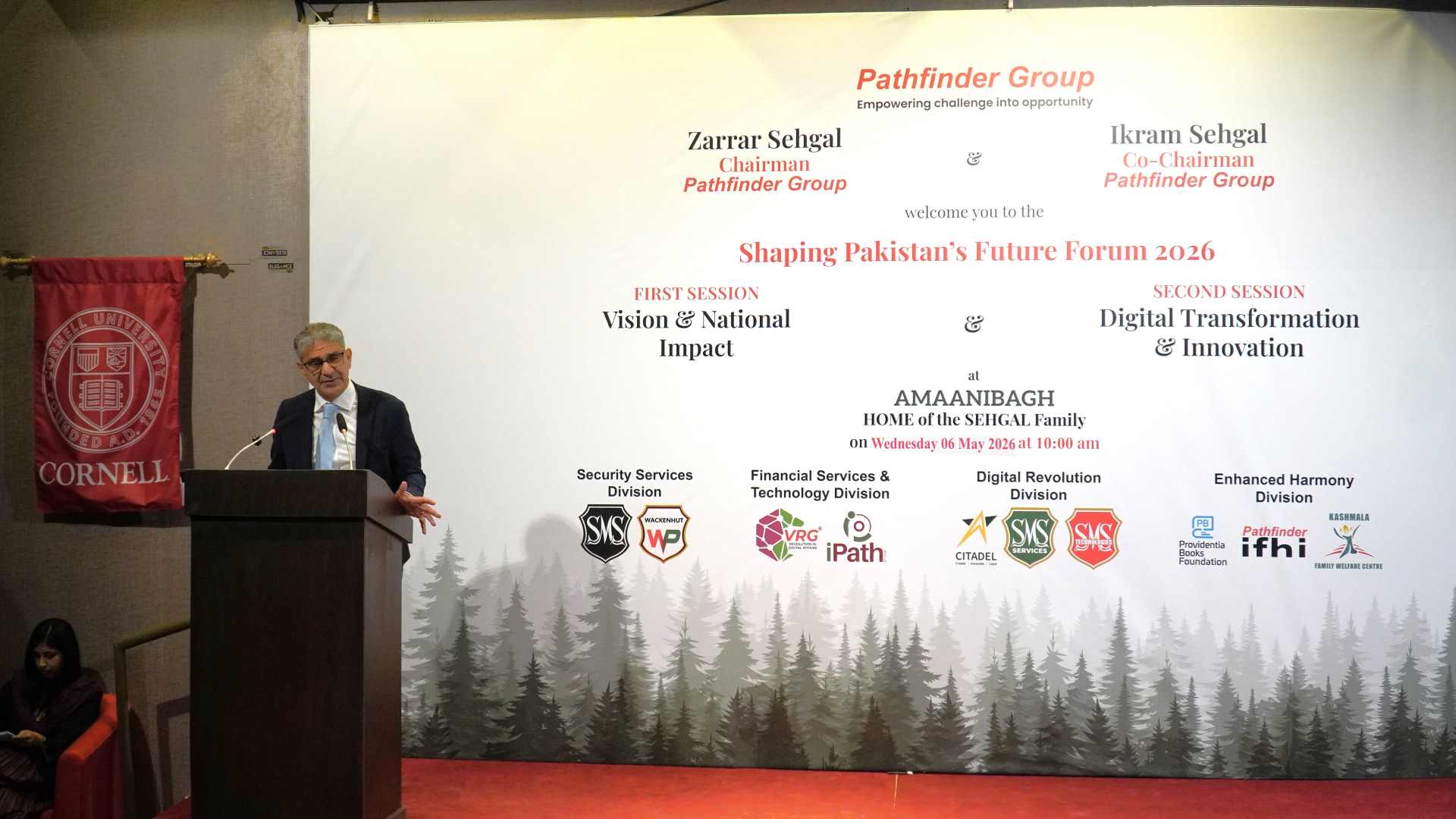






Second Session: Shaping Pakistan’s Future Forum 2026
Sehrish Mustafa (Moderator):
Before we move into our second session, which is digital transformation and innovation, I would like to invite Mian Imran Masood, president of the Pakistan Education Council, to the stage to say a few words.
Mian Imran Masood, President, Pakistan Education Council:
Excellencies, dignitaries, fellow teachers, researchers, students, ladies and gentlemen, Assalam-o-Alaikum. First of all, I would like to recognize Ikram Sehgal for his wonderful vision and for the remarkable CSR initiatives being undertaken by his company. We have a vast network of schools across Pakistan, covering all provinces of the country. I also represent Pakistan’s universities which are significant in number. We currently have nearly 280 universities in Pakistan, with approximately half in the public sector and half in the private sector. These institutions serve a very large segment of Pakistan’s youth through schools, colleges, and universities.
Today, universities are capable of playing many important roles in society. We do not simply wait for the government to initiate every program. Since we have resources within the education sector itself, we have independently launched many new programs that are in high demand. We aim to increase access to higher education in Pakistan.
Unfortunately, access to higher education remains very low. Only about 30 percent of students are able to enter the university sector. When compared with other countries in South Asia, many nations have already crossed the 35 percent mark in higher education access. Therefore, Pakistan urgently needs more universities, more colleges, and more schools because we have a very large and rapidly growing population. Half of this population is female, which makes the participation of girls in schools, colleges, and universities even more important.
One important fact I would like to share with the audience is that Pakistan has one of the highest school dropout rates in the world. In Punjab alone, the public education system consists of approximately 63,000 schools, a system larger than the entire educational infrastructure of many European countries. It is an enormous and highly complex sector. Out of approximately 10.8 million students enrolled, nearly 4 million drop out every year, which is among the highest dropout rates globally. In addition, Pakistan has nearly 25 million out-of-school children, one of the highest numbers anywhere in the world. Governments continue working to reduce dropout rates and increase enrollment in schools.
During my tenure as Minister for Education, I announced free education for every child in Punjab’s public schools. Today, free education policies have expanded across Pakistan. We also introduced free textbooks for all children in public schools, along with stipends and meal support programs to encourage attendance and help families keep their children in school.
As a result, the literacy rate increased significantly during my tenure. Punjab’s literacy rate rose from 42 percent to 62 percent over five years, while Pakistan’s overall literacy rate currently stands at around 51 percent. One of our key efforts was to convince the government that Pakistan needs more universities. However, obtaining a university charter is not easy. Charters require formal approval through legislative and parliamentary processes, including majority support. To address this challenge, we established coordination and consultation mechanisms with the Higher Education Commission (HEC), and we are now working collaboratively on the development and approval of new academic programs.
I would also like to emphasize that the private sector has enormous potential in higher education. Private universities have the ambition, the willingness, and the capacity to expand. Many are already opening additional campuses and even operating internationally. The HEC has now introduced a Transnational Education (TNE) Policy, which allows foreign universities to establish campuses in Pakistan and also enables Pakistani universities to establish campuses abroad.
At present, there are discussions regarding territorial jurisdiction and regulatory frameworks because Pakistani institutions wish to expand internationally and operate on a global scale. Pakistan’s Constitution, like all constitutions, is strict and operates within clearly defined legal frameworks. There are constitutional limitations that cannot simply be ignored. However, the Constitution also contains mechanisms that act as safeguards during times of political deadlock or institutional crisis. Whenever disagreements arise between political parties or constitutional institutions, these mechanisms allow for compromise and the search for a middle ground in order to resolve conflicts peacefully.
I believe the same spirit of dialogue and compromise is needed in today’s international conflicts as well. The ongoing tensions involving Iran, America, and Israel require a peaceful resolution. No one truly desires war, and Pakistan has historically played an important role in advocating for ceasefires and peace efforts around the world. I am pleased that ceasefire efforts continue to hold in many areas of conflict.
Universities, too, can play a major role in promoting global peace. Recently, I attended a conference in Türkiye where thousands of universities from around the world were represented. Together, we adopted a declaration committing universities to work toward global peace. So, let us continue working for peace, for education, and for the future of coming generations. Thank you very much.
Sehrish Mustafa (Moderator):
Thank you, sir. Pakistan’s innovation and potential lie at the heart of its future growth; driven by a young talent pool, emerging startups, and rapid digital transformation. With the right sport and ecosystem, these trends can be transformed into global competitiveness and sustainable economic progress. CITADEL is empowering Pakistan’s innovation potential to change the world through market-driven and investment alliance solutions.
To discuss this potential, I would like to invite AVM (Retd) Asad Ikram, President of Pathfinder CITADEL, who has been instrumental in establishing key organisations, including the navigation system department at the Advanced Engineering Research Organisation, the telecom and marketing department at LT Engineering Limited, and Aviation Research, Innovation and Development Initiatives at the Pakistan Aeronautical Complex, for his meritorious services over the years. The government of Pakistan has awarded him with the Sitara-e-Imtiaz and the Tamgha-e-Imtiaz. Ladies and gentlemen, please welcome AVM (Retd) Asad Ikram to the stage.
AVM (Retd) Asad Ikram, President Pathfinder CITADEL:
Excellencies, Sir Ikram Sehgal, distinguished guests, students, Assalam-o-Alaikum. One thing we do in education is repetition. When we want to explain something important, we repeat it again and again. So, in that spirit, I would like to repeat something you have been hearing since this morning: the best way to predict the future is to create it. The reason we keep repeating this message is that we want all of you to take charge of your future. That is extremely important. We have also been talking extensively about innovation. But why does innovation matter?
Innovation matters because the world is moving rapidly forward with artificial intelligence, renewable energy, digital revolutions, and emerging technologies. The nations that innovate are the nations that solve problems, not only for themselves, but for others as well.
In doing so, they create wealth, influence global narratives, and ultimately shape history. Pakistan, too, must move forward with the world and lead wherever it can. Now, let us look at the strengths we already possess. We often talk about our youth population; nearly 60 percent of Pakistan’s population is under the age of 30.
That represents tremendous energy and potential. We also have a booming digital ecosystem, with nearly 200 million people connected online. We possess a resilient entrepreneurial spirit. Even during difficult times and periods of conflict, Pakistanis continue to establish businesses and create opportunities.
I know of a Pakistani entrepreneur who, during the war in Iraq, went there and established hotels in Baghdad. Many people would call such a person crazy, setting up hotels in the middle of a war zone, but that entrepreneurial risk-taking ultimately became highly profitable. We also have a global diaspora that excels in technology, medicine, engineering, finance, and many other fields.
Remember this: Pakistan’s greatest resource is not its land, it is its people. This is true not only for Pakistan, but for many successful countries around the world. Take Japan as an example. Japan does not possess vast land or abundant mineral resources, yet it became an economic powerhouse because it effectively utilized and developed its human capital. Pakistan must do the same. We must focus on investing in the development of our people to prepare them for the challenges of the future.
However, we also encounter significant barriers. Many people question why we haven’t made more progress in developing indigenous technology or strengthening our industrial capabilities. A common explanation is the weak connections between academia and industry. Yet, very few people inquire about the reasons behind these weak linkages. The answer is straightforward: we do not invest enough in research and development. Universities conduct research and produce the human capital needed to run industries. But if industries themselves are not developing because of weak economic policies, then naturally the demand for advanced research and innovation also remains limited. If we continue importing cars, buses, aircraft, machinery, rail systems, and even large infrastructure solutions from abroad then our industries will never fully develop. Our money flows into other economies rather than strengthening our own. As a result, the demand for high technology within Pakistan remains weak, and therefore meaningful collaboration between academia and industry does not emerge. That is where the real problem lies. People also speak about brain drain. Realistically, a country of over 250 million people should not collapse because a few million leave. The real issue arises when the best and brightest continue to leave without sufficient opportunities at home. But remember this: barriers are not walling, they are hurdles, and hurdles are meant to be crossed. These challenges can be managed if we approach them seriously and strategically.
So, what is the way forward?
First, we need policy reforms. We must prioritize emerging technologies and sectors critical for the future. Artificial intelligence is, of course, central to today’s discussions. We also need agricultural technology to ensure food security, health technology to improve healthcare outcomes, and renewable energy to support industrial growth.
Above all, however, we must transform education. As the previous speaker rightly mentioned, without improving education, we cannot move forward as a nation. This transformation must begin at the primary level and continue all the way through higher education.
We must also build strong funding ecosystems. Whenever someone has an innovative idea, they need resources and financial support to develop it. That is where banks, angel investors, venture capitalists, and legal advisors become essential. Innovation is not driven by funding alone. It requires an entire ecosystem, a society that works together across multiple domains to help people innovate, build, and grow. We must also engage our diaspora and empower the 50 percent of our population: women.
Earlier today, we discussed vision and execution. Every achievement begins with a vision. So, what should our national vision be?
We should envision a Pakistan
- where farmers use AI to maximize agricultural productivity;
- where every child receives an education;
- where every citizen has access to healthcare;
- where renewable energy powers our homes and industries;
- where Pakistani startups compete globally; and
- where our universities focus not only on issuing degrees, but also on patents, innovation, and solving societal problems.
Remember: imagination is often more important than knowledge itself.
Before I conclude, I especially want the younger people here to understand one important point: innovation is not limited to technology. Innovation is about using available resources to solve problems in better ways.
Sometimes innovation lies in improving systems, workflows, and processes rather than inventing entirely new technologies.
The ultimate goal should always be improving the lives of citizens and benefiting society as a whole. With that, I would also like to inform everyone about the work we are doing at CITADEL. We are currently focused on two major pillars of innovation.
The first is upskilling graduates and students close to graduation. We are offering training programs in areas such as AI, cybersecurity, blockchain, and other emerging technologies, along with soft skills like teamwork, communication, and leadership.
The second pillar, which we are especially excited about, is supporting startups that already have minimum viable products (MVPs) and helping them scale through acceleration programs. Later in the day, my colleagues will share details about how we selected participants for Davos, what they achieved there, and what our plans are.
Before I leave the podium, let me ask the people sitting at the back: Can we predict the future? No, because the future is not meant to be predicted. It is meant to be created. So, are we going to predict the future, or create it? We are going to create it. Thank you very much.
Sehrish Mustafa (Moderator):
Thank you so much, sir, for believing in the youth of Pakistan. Artificial Intelligence, startups, and the future of work are reshaping Pakistan’s economic landscape, creating new opportunities for innovation and digital growth. Together, they are driving a shift toward a knowledge-based economy powered by technology and entrepreneurship. Next, to share insights on AI startups and the future of work in Pakistan, I would like to invite Imran Jattala. He’s the founder of the National Incubation Centre for Aerospace Technology and a prominent figure in the global innovation landscape. He’s recognised for establishing the first aerospace and deep tech incubation centre in South Asia and the Middle East and for leading major innovation programs across Pakistan and the MENA region.
Imran Jattala, Vice President, Pathfinder CITADEL:
Your Excellency, Co-Chairman, distinguished senior professors, fellows, students, Assalam-o-Alaikum and good afternoon. I will keep my remarks brief and focus on three topics: AI, startups, and the future of work, especially since we are heading toward lunch and I do not want to test your patience for too long.
For centuries, we believed that the fastest known phenomenon in the universe was the speed of light. That understanding has existed for nearly two hundred years. But perhaps the future is no longer limited by light itself. Today, Elon Musk speaks about taking humanity to Mars within this decade through Starship and advanced rocket technologies. However, if humanity is ever truly to become intergalactic, as imagined in films like Interstellar, then we will eventually need discoveries that go beyond our current understanding of physics and the speed of light itself. Ladies and gentlemen, humanity’s scientific journey is far from complete. There are still discoveries waiting to be made that could fundamentally transform civilization and perhaps one day make intergalactic travel possible.
Now, let us come to AI and how it is changing our lives. There are many professionals and knowledge workers present in this room. Think about what a typical working day looks like for most of us. We walk into our offices, read emails, receive instructions, attend meetings, listen to our supervisors, synthesize information, complete a set of assigned tasks, and by the end of the day, we call that work. I have some difficult but important news for all of you: software is increasingly going to take over many of these activities. These systems are called AI agents, and they are no longer part of some distant future; they are already here. In fact, by the end of this year, many IT departments may begin functioning more like HR departments for AI agents, managing intelligent software systems alongside human teams.
Now the question is: should we fear this future, where AI agents may perform many of the tasks humans perform today?
My answer is absolutely not. Instead of fearing AI, we should recognize that it has the potential to make us 10 times, 100 times, or even 1,000 times more productive than we are today. The real question is no longer what AI can do. AI will likely perform many routine and structured tasks extremely efficiently in the near future.
The more important question is: what can you do while coexisting and collaborating with AI agents? Five years ago, companies primarily hired human talent and rented software tools. Today, we are entering a completely different era, one where organizations will increasingly “hire” software systems and leverage human intellect in entirely new ways. Very soon, all of us will need to learn how to coexist and coordinate with intelligent software systems and smart machines. This represents one of the biggest tectonic shifts in human history. Never before have humans worked alongside intelligent digital co-workers in the way we are about to witness.
Now, let us talk about startups. Startups are the engines of change. They create industries and opportunities that often did not exist before. In the AI era, something remarkable has happened: the starting line has become almost equal for entrepreneurs sitting in Karachi and entrepreneurs sitting in California. AI has dramatically reduced barriers to innovation and execution. We have already seen inspiring examples from Pakistan.
Recently, three Pakistani friends founded a company called ImageArt and reportedly sold it for approximately $35 million, all built in Pakistan. Similarly, the AI coding company Cursor achieved extraordinary global recognition and included a young Pakistani co-founder from Karachi, only 26 years old.
These examples show that Pakistani entrepreneurs can compete globally at the highest level. This is truly the era of startups. And the secret weapon of startups is speed. In the AI era, that speed becomes exponentially greater. AI allows small teams to achieve outcomes that previously required massive organizations and resources. AI has effectively commoditized technical capability. Today, what once required highly specialized expertise and years of advanced education can now, in many cases, be accessed through AI-powered tools available for modest monthly subscriptions. Now, let us look at the future of work itself.
AI is not necessarily replacing all human work entirely; rather, it is replacing specific tasks, especially repetitive, structured, and process-driven tasks that humans currently perform manually. Very soon, all of us may have AI agents handling major portions of our daily workflows.
As a result, job descriptions themselves are likely to change dramatically. The future workforce will involve humans managing teams composed partly of people and partly of AI systems. Success will increasingly depend on our ability to supervise, coordinate, and collaborate with intelligent digital tools.
This also means that learning can no longer stop after graduation. The half-life of skills is now becoming shorter than the lifespan of many university degrees. Skills that are valuable today may become outdated very quickly. Therefore, all of us must become lifelong learners. We must continuously adapt, relearn, and evolve. The next five years are likely to bring more change than humanity has experienced in multiple previous decades combined. So yes, the AI era may seem intimidating at times, but it is also incredibly exciting. It is an era in which human beings may achieve more than ever before in history. Thank you very much.
Sehrish Mustafa (Moderator):
Thank you, sir, for sharing with us the scary and exciting future. Next to present the CITADEL Startup Challenge summary, I would like to invite Air Cdre (Retd) Farhan Ahmed, Director CITADEL. He has 32 years of distinguished service in the Pakistan Air Force and has been instrumental in shaping Pakistan’s space vision. He’s also the managing partner and innovator at Garage International, leading initiatives and innovation, human resource development, and project management. He’s the recipient of the Sitara-e-Imtiaz military and Tamgha-e-Imtiaz Military. Please welcome Director Pathfinder CITADEL Air Commodore (Retd) Farhan Ahmed.
Air Commodore (Retd) Farhan Ahmed, Director Pathfinder CITADEL:
Your Excellency, Co-Chairman, judges, distinguished guests, and most importantly, the founders who take dreams and turn them into reality, Assalam-o-Alaikum. Before I move to the main part of my talk, I would first like to address some of the concerns raised earlier by Imran regarding AI and the future of work, the “scary” part that may have worried some of us.
History teaches us that every major technological shift has initially created fear. During the Industrial Revolution, people believed machines would replace humanity entirely. Yet what actually happened was different: humans adapted, industries evolved, and society progressed. Machines enhanced productivity, but human beings remained at the center of progress. Then came the era of automation. Many of us witnessed automation replacing tasks that were once performed manually by people. Yes, automation changed industries and eliminated certain roles, but it also created new opportunities, improved efficiency, and pushed humanity toward higher levels of innovation and productivity. Humans remained at the top of the value chain. Now we are entering the AI era. I understand why some people find it intimidating. But as was said earlier, while it may seem frightening to some, it is also incredibly exciting, especially for the young people sitting in the back rows today. No matter how advanced technology becomes, its purpose is ultimately to augment human capability, not eliminate human potential. Just as people adapted during industrialization and automation, humanity will adapt again during the AI revolution. Even the World Economic Forum has stated that while some jobs may disappear, many more new opportunities and professions will emerge. That is what we believe at CITADEL. We do not scare people. We create pathways. We identify destinations and help people move toward them step by step. Our purpose is to guide young people on journeys that empower them and help them realize their potential.
With that, I would now like to speak about the Davos–Jeddah Challenge and what lies beyond it. Today represents the culmination of a long and meaningful journey. This evening, we will announce the finalists who reached the pinnacle of this challenge, and you will hear startup founders present their pitches here before all of you. But before that, I want to explain how we reached this stage and what this initiative truly represents. Certain moments in history define the future and create entirely new directions. I believe this gathering is one of those moments. This room is filled with builders, doers, and dreamers, people who refuse to sit back and wait for others to solve the problems around them. Today, we celebrate your courage.
Earlier this year, Pathfinder CITADEL carried Pakistan’s flag to the World Economic Forum Annual Meeting in Davos, where some of the world’s most important global discussions take place. We did not go there as passive observers. We went there as contenders.
At the Pakistan Pavilion, alongside eight brilliant young startup founders, we delivered a simple message to the world: Pakistan is open, Pakistan is ready, and Pakistan is moving forward.
Building upon that momentum, and driven by the conviction that this effort must expand beyond Pakistan’s borders, we established a partnership with COMSTECH, the leading body for science and technology cooperation across the Organization of Islamic Cooperation.
Together, we launched the CITADEL–COMSTECH Jeddah Startup Challenge 2026. This was not merely a competition; it was designed as a bridge connecting the innovative potential of the Muslim world. What followed exceeded all our expectations. Entrepreneurs from 15 OIC countries responded with tremendous enthusiasm and passion. We received a total of 337 applications, 283 from Pakistan and 54 from international participants across the Muslim world and beyond. From those 337 applications, a rigorous screening process began.
After the initial evaluation, the number was reduced to 88. It is important to emphasize that all evaluations were conducted independently. Neither CITADEL nor the Pathfinder Group participated in judging the startups. Every evaluator was external, ensuring complete transparency and fairness. Seventy-one founders then advanced to the next stage, where they defended their ideas, business models, and ambitions before a highly demanding panel of evaluators. There were no shortcuts, no favoritism, and no wildcard entries, only merit, standards, and performance. From those participants, 24 startups rose above the rest, and from those 24, today we will unveil the top 20 finalists, startups that have demonstrated beyond doubt that they are ready to compete on the global stage.
Before announcing those names, however, I must pause to acknowledge the people who made this process credible and meaningful: our judges. These individuals approached this challenge with only one goal: the relentless pursuit of excellence. They are operators, experts, and professionals who understand what it takes to build successful ventures. They know how to distinguish between an attractive story and a truly sustainable business. They asked difficult questions, upheld high standards, and ensured that only the most deserving founders advanced.
To all our judges, your integrity has been the moral backbone of this entire process, and we are deeply grateful for your contributions. To the finalists, let me say this very clearly: what you have won today is not the destination, it is merely the opening of a door. Beyond that door lies a world that very few founders ever get access to: international investors, global partnerships, world-class networks, and some of the brightest entrepreneurial minds in the world.
That opportunity is both a privilege and a responsibility. So, sharpen your numbers, strengthen your assumptions, and own your story with confidence and conviction. The rooms you will soon enter will demand your absolute best, and we believe you are capable of delivering it. I also want to address those participants who may not have reached the final stage. Not advancing today does not mean you are not capable or not ready.
Some of the world’s most successful companies were rejected many times before they eventually succeeded. What separates those who ultimately prevail is not merely talent; it is persistence and the refusal to stop. You stepped forward. You competed on a global stage.
That alone requires courage that many people never demonstrate. Learn from this experience, rebuild where necessary, and come back stronger. CITADEL will always stand ready to welcome you again on this journey.
And now, I would like to speak directly to the leaders, ambassadors, investors, and policymakers present here today, including Ambassador Georg Steiner and many others at the forefront of shaping the future. Pakistan is sitting on a generational opportunity, but opportunities do not wait forever. We have one of the youngest populations in the region, talented, ambitious, resilient, and eager to work. But talent alone is not enough. As Sehrish rightly pointed out earlier,
ideas without investment eventually fade away.
The founders standing before you today are not seeking charity. They are seeking partners, people willing to invest in the future of Pakistan through capital, mentorship, access, networks, and trust. The world’s greatest innovation ecosystems were not built by governments alone. They were built when the private sector decided to treat young entrepreneurs as strategic assets rather than risky experiments. Therefore, I urge every corporate leader, investor, and institution present here to become part of this transformation, open doors, share access, and invest in Pakistan’s future. When industry and youth unite around a shared purpose, nations do not merely grow, they transform. And that transformation has already begun.
Finally, as you leave this hall today, I encourage all of you to interact with one another, exchange ideas, and build relationships. Sharing knowledge and experience is what allows societies and ecosystems to grow. Whatever expertise you possess, share it. One person may build one part of the future, another person may build another part, but when those efforts are combined, they create something far greater than any one individual could achieve alone. That is the lesson I hope all of you will carry forward today. Thank you very much.
Sehrish Mustafa (Moderator):
I would like to hand the stage over to very promising and energetic colleagues at Pathfinder CITADEL, Uzair Alvi, Manager CITADEL, and Sarah Tims, Community and Events Manager, CITADEL. Please join us on the stage.
Pathfinder Jeddah Startup Challenge-2026 Finalist
Uzair Alvi, Manager, CITADEL:
Good afternoon, everyone, and a very warm welcome to all the startups, judges, partners, guests, and students present here today. We are delighted to welcome you to the final segment of the Pathfinder CITADEL cohort journey, where months of innovation, hard work, and evaluation come together. Today marks the culmination of an extensive process that has brought together talented founders, creative ideas, and impactful solutions from across different sectors and countries.
Sarah Tims, Community & Events Manager:
Before we move into the pitching session, we will first announce the finalists of the Startup Challenge. These selections are the result of a rigorous multi-phase evaluation process conducted independently by our esteemed panel of judges. Once the finalist announcements are complete, we will immediately proceed to the live pitching session, which will take place here in front of all of you. This will allow everyone present to better understand the quality, innovation, and potential upon which these startups have been selected.
Our first finalist is Al Fruit Yard, a startup focused on mushroom cultivation and value-added fruit products, delivering nutrient-rich and sustainable food solutions.
Next is Arogaa, a digital primary healthcare platform transforming healthcare accessibility in Bangladesh.
We also have Aqua Tech Fisheries, which is driving sustainable aquaculture through innovative and data-driven solutions.
Another finalist is InLights, a startup leveraging AI-powered smart signal systems to optimize traffic flow and improve urban mobility.
Printable.pk has also made it to the finals with its platform designed to streamline Pakistan’s design, printing, and packaging ecosystem.
Titano joins the finalists as well, building advanced AI-powered unmanned systems for critical and high-risk operations.
Another promising startup is NerdFlow One, an AI-powered operating system focused on intelligent movement coordination.
Haprow has also qualified with its AI-powered assistive robots designed for interactive learning experiences.
Next, we have CMOontheGo, followed by Yumkin Foods, which is creating clean-label, data-driven nutritional solutions specifically designed for children.
Kangaroo Care AI is another finalist, offering AI-enabled incubator systems aimed at improving critical healthcare outcomes for infants.
TBAI Incorporated has also advanced with its high-accuracy AI diagnostic system focused on tuberculosis detection.
Teknologe Solutions joins the list as an AI-powered all-in-one healthcare platform.
We are also proud to announce Eco Bricks, a female-led startup transforming plastic waste into sustainable construction materials.
IBVIS is another finalist, enabling intelligent CCTV analytics through low-power edge AI solutions.
Spinal Power has also qualified with its high-performance, military-grade battery solutions.
From Malaysia, Digit360 joins the finalists with its platform focused on digitizing jury management through transparent evaluation systems.
AI Evo Apps is another selected startup, empowering creators through AI-powered photo editing and design tools.
And finally, Proa AI completes our finalist lineup with its precision-driven platform for professional AI content creation.
Thank you all once again for your incredible support and participation throughout this journey. We would also like to extend our deepest gratitude and appreciation to our esteemed judges, who dedicated their time, expertise, and effort throughout this challenging evaluation process. Now, we will move forward with the pitching session. To give you a glimpse of why these startups were selected, we will begin with a few featured pitches. One of our leading startups is joining us online all the way from Bangladesh.
Ms Rosina Mazumder, Arogga:
Arogga is an online pharmacy and healthcare platform based in Bangladesh. Today, it has emerged as one of the leading health-tech platforms in the country. Founded in 2020, Arogga offers a wide range of healthcare services and products, including medicines, healthcare essentials, laboratory testing services, and digital healthcare solutions. The vision behind Arogga is to make quality healthcare accessible and affordable for the people of Bangladesh. Through the platform, the goal is to ensure that a significant portion of the population has access to reliable healthcare services from the comfort of their homes. One of the platform’s key strengths is its commitment to authenticity and affordability. Arogga provides 100% genuine medicines sourced directly from manufacturers. By purchasing in bulk and optimizing supply chains, the company is able to reduce costs and pass those savings on to consumers. Convenience is another major advantage of the platform. Customers do not need to visit physical pharmacies or laboratories, as medicines and healthcare products can be delivered directly to their doorstep. The platform also provides direct mobile access to laboratory reports, making healthcare more accessible and user-friendly. The healthcare market in Bangladesh presents enormous potential, with the sector valued at nearly $20 billion. Arogga aims to capitalize on this opportunity by continuously expanding its digital healthcare ecosystem. The company is also preparing to launch online doctor consultations next month, followed by health insurance services next year, further strengthening its integrated healthcare model. In terms of growth, Arogga has demonstrated remarkable traction over the years. In 2021, the company generated approximately $500,000 in annual revenue. By 2025, that figure had grown to $23.4 million, while current revenue stands at approximately $6.7 million. Today, Arogga is the third-largest e-commerce player in Bangladesh, and notably, nearly 80% of its growth comes from repeat customers, a strong indicator of customer trust and satisfaction. Looking ahead, the company aspires not only to strengthen its leadership position in Bangladesh but also to expand globally and become a major player in the international digital healthcare ecosystem. Thank you very much.
Muhammad Ali Abbas, Haprow:
Assalam-o-Alaikum. My name is Muhammad Ali Abbas, and I am the Founder and CEO of Haprow. Today, I am here to showcase our project and vision. Haprow develops AI-powered robots designed for autism support, classroom learning, retail engagement, and UV-C disinfection solutions. Our robots are built to serve multiple industries and introduce intelligent automation into sectors where interactive and assistive technologies can make a meaningful impact. We also see strong potential for deploying our robots in vertical industries, particularly within the banking sector. Haprow proudly stands as Pakistan’s first AI and robotics company, and our mission is to position Pakistan as an emerging player in advanced robotics and intelligent automation. Thank you.
Zunaira Omar Saqib, CMOontheGo:
My name is Zunaira Omar, and I have been working in marketing and communications for the last 20 years. I also run a marketing agency, and over the years, I have observed a major challenge faced by businesses. The companies that need marketing support the most are often the ones that cannot afford a full-scale Chief Marketing Officer or large marketing teams. This creates a difficult “growth versus cost” situation for many businesses. I believe AI is the equalizing factor. Therefore, I am building an AI-powered Chief Marketing Officer platform that can provide businesses with strategic marketing services at nearly one-tenth the cost of hiring a traditional human CMO. Our goal is to make a high-quality marketing strategy accessible and affordable for startups and growing businesses. Thank you.
Munir Hussain Shahu, Teknologe Solutions:
I am the CEO of Teknologe Solutions, a health-tech company focused on improving healthcare systems through technology and innovation. We have developed an Electronic Medical Record (EMR) product currently operating in the UAE and the United States. Our solution addresses critical healthcare challenges, including patient communication, accessibility for people with disabilities, and reducing the operational burden faced by healthcare professionals when using technology systems. Through the CITADEL platform, we are now planning to expand into additional healthcare divisions and collaborate with industry and market partners globally. Our company is backed by highly skilled health-tech analysts, software engineers, and technology specialists who are continuously working to improve healthcare delivery through innovative digital solutions. Thank you.
Khawaja Muqeet Hussain, Nerd Flow:
Most businesses believe that their biggest risk is competition. In reality, the biggest risk is operational inefficiency, work slipping through the cracks, delayed decisions, and poor coordination. I am the co-founder of Nerd Flow, an AI-driven operational intelligence platform designed to help businesses manage and automate operations more effectively. Today, many organizations lose customers after poor first experiences, while teams struggle with manual processes, communication gaps, and human error. The problem is not necessarily the people; the problem lies in outdated operational systems. At Nerd Flow, we are building an AI-powered workforce management and operational intelligence system that helps businesses streamline operations, improve decision-making, and scale more efficiently. We strongly believe that the future of businesses will be deeply integrated with AI-driven operations, and we are building the system that can help make that future possible. Thank you very much.
Ms Hira Mubeen, Yumkin Foods:
Assalam-o-Alaikum. My name is Hira, and I am the founder of Yumkin Foods. Yumkin Foods is Pakistan’s first nutrition-focused brand that transforms indigenous food ingredients into ready-to-eat, sugar-free, and chemical-free food products for children. In Pakistan, nearly 177,000 children die every year before reaching the age of one, while many others suffer from stunted growth and malnutrition. Despite the availability of baby food brands, eight out of ten children in Pakistan still lack access to the right type and quantity of nutrition. Most available products contain excessive sugar, preservatives, and artificial chemicals, which contribute to poor health outcomes. To address this issue, I developed Yumkin nutrition packs as part of my academic research and degree project. These products are made entirely from natural ingredients without preservatives or harmful chemicals and are specifically designed to help combat malnutrition among children. Our mission is to provide healthier, accessible, and nutritionally balanced food solutions for children across Pakistan. Thank you.
Sarah Tims, CITADEL:
That concludes our pitches for today. We would love for all of you to continue learning about the incredible work being done by our startups. We encourage you to follow our social media platforms, where you can explore more about these founders, their ideas, and the innovative solutions they are building. Thank you all very much for your participation and support.
Sehrish Mustafa (Moderator):
It is now my distinct honor to invite our guest of honor, Imtiaz Rastgar. He’s a distinguished Pakistani entrepreneur and export consultant currently serving as the chief strategist at PMX Consulting while also leading as the chairman of the Rastgar group. He’s widely recognized for his expertise in SM internationalization and for helping Pakistani industries access global markets, particularly in Europe. Over the years, he has played a pivotal role in strengthening Pakistan’s engineering and manufacturing sectors, including serving as CEO of the engineering development board. Please welcome Mr Rastgar.
Imtiaz Rastgar, Chairman, Rastgar Group:
Assalam-o-Alaikum. This is a very important occasion for me. There are a lot of opportunities in Pakistan. I was a young student when I started my business from my hostel room. At that time, I too could have gone abroad because my education gave me that opportunity, but I chose not to. In 1966, I graduated with an honors degree, but I never went to my convocation to collect it. Education was very valuable to me, but a degree, in those days, was mainly necessary to get a job. I never thought of doing a job, so I never felt the need to collect my degree.
After that, like every founder, I went through my own trials and tribulations. There was no capital and no support system. In our time, there was not the kind of hand-holding and guidance that you are providing today. Mashallah, things have progressed a lot. Back then, we did not even have telephones. When I started my business, I got my first telephone line after eight years. Otherwise, I had to go somewhere, book a call, and wait three hours just to speak to someone from Rawalpindi to Lahore. Life was very tough. Despite all these challenges, we started a manufacturing business. I never thought of leaving Pakistan, and today I do not regret that decision. Many Pakistanis living abroad often ask when conditions in Pakistan will improve because they want to return. But if all of us leave the country, then how will things ever get better? If we do not believe in our own country and keep thinking only about going abroad, then nothing will improve. By the grace of Allah, I stayed, and there are many others like me. Because of such people, Pakistan is what it is today. Mashallah, we have come a very long way. The opportunities you have today did not exist in our time. Even the roads were not like they are today. So, we have truly come a long, long way.
Unfortunately, there is a lot of negativity and badmouthing about Pakistan around us. The first thing we should do is recognize the good in our country and be grateful for it. We are sitting here today in a peaceful environment, and gradually, things are improving every day. The image that Pakistan is completely hopeless is often exaggerated, and sadly, our television channels contribute greatly to this demoralization. Whenever we watch the news, we only hear negative stories. It begins to feel as if there are only criminals and dishonest people in Pakistan. But that is not the reality.
Today, we are a nuclear power. The people who built this capability were ordinary Pakistanis educated in government schools with very limited facilities. From Abdus Salam to Abdul Qadeer Khan and many other nuclear scientists, none of them grew up with luxury or ideal conditions. Many studied in schools with minimal resources. Sometimes, students even had to make their own writing tools. Yet from those humble beginnings, we reached this stage. That is why I believe there is a systematic effort to demoralize us, and we must not fall into that trap.
My message to all of you is simple: stay committed and give your best. Opportunities will come, and Inshallah, success will follow. Easy success exists only in movies, where one day a person is struggling, and the next day, he becomes a boss. Real life does not work like that. In business and in life, you must stay patient, remain steadfast through difficulties, and continue working hard. Inshallah, you will never regret it. ~ Imtiaz Rastgar
Sehrish Mustafa (Moderator):
It is my distinct privilege to invite our chief guest, His Excellency Ambassador George Steiner, Ambassador of Switzerland to Pakistan. He has been actively engaged in strengthening the bilateral relations between Switzerland and Pakistan. His focus on promoting trade, investment, and development cooperation, along with his continuous engagement with Pakistan’s business and diplomatic communities, has played an important role in deepening mutual understanding and partnership between the two countries. Ladies and gentlemen, please join me in warmly welcoming His Excellency George Steiner to the stage.
H.E. George Steiner, Ambassador of Switzerland to Pakistan:
Thank you very much, Ikram Sehgal, for inviting my colleague and me once again to this important event, the Startup Challenge 2026. Based on what I have witnessed today, I am, in a very positive way, deeply impressed by what committed stakeholders in Pakistan can bring together. Valuing the competence that exists in this country has always been close to my heart. As you know, Switzerland is a highly industrialized country that invests significantly in research and development. We place strong emphasis on high-quality education for our young people, and we strive to implement innovation in a way that reflects the realities of a rapidly changing world. Over the past three years of my tenure in Pakistan, I have had multiple opportunities to appreciate the quality, talent, and potential of young students and professionals in this country. I have also seen this first-hand through our efforts to bring highly talented startup teams from Pakistan to Davos only a few weeks ago.
My message to you today is simple: continue to believe in your own strengths, your skills, and your potential. At the same time, continue to expect and advocate for the support you deserve from your country’s institutions and ecosystem. Pakistan has already made important progress in this direction, and the growing public–private partnerships we see in several sectors are, in my view, exactly the right way forward. I have also prepared more detailed remarks on Switzerland’s perspective on digital transformation and innovation. If any of you are interested, I would be very happy to share these insights with you. They cover areas such as digital infrastructure expansion, which is highly relevant for Pakistan, startup-driven economic growth, and broader innovation ecosystem development.
Before I conclude, I would like to add one final point. Whenever you believe that your startup, whether among today’s winners or among those still building their journey, could benefit from engagement with Switzerland, please do not hesitate to reach out to us at the Swiss Embassy. Very often, meaningful opportunities emerge from conversations that begin at events like this. If Switzerland becomes relevant for your journey, whether as a market or through support from the private sector or government-linked initiatives, we are open to exploring those possibilities. Those of you working in startups already have the courage and initiative required to take such steps, and in this space, courage, reflection, and timing are essential. I encourage you to reach out, and we would be glad to explore how we can support your growth and innovation journey. I sincerely hope that through initiatives like the Startup Challenge 2026, Pakistan will continue to demonstrate its position at the forefront of cutting-edge technology and emerging skills. It has been a pleasure to be here, and I remain very encouraged by what I have seen today. Thank you very much.
Ikram Sehgal, Co-Chairman, Pathfinder Group:
I would like to once again thank Ambassador Georg Steiner for being here with us today. I am genuinely impressed and grateful for his continued support, as he was one of the key individuals who helped initiate this process of taking Pakistani startups to Davos. It was through discussions and partnerships that began here that this vision started taking shape, and today we can clearly see its growing importance on the global stage. When you look around the world today, you see how rapidly things are changing.
Innovation, entrepreneurship, technology, and strategic partnerships are reshaping nations and economies. The strongest message that emerges from all of this is directed toward the young people sitting at the back of this hall today: you are the real future of Pakistan. You can achieve what previous generations, including ours, could not fully accomplish. What our generations managed to do, perhaps by circumstance more than by strategy, was to preserve Pakistan through difficult times and keep its identity intact. But the responsibility now lies with you to build a stronger, more progressive, and more united future. As relations between Pakistan and Bangladesh improve once again, we should remember that while both are sovereign and independent nations, there remains a shared historical and cultural legacy that connects the people of South Asia. It is now up to the younger generation to carry forward the broader vision that Muhammad Ali Jinnah had for the Muslims of South Asia.
I would also like to reflect on the remarkable strategic vision of Quaid-i-Azam Muhammad Ali Jinnah. During the Second World War, specifically in May 1942, the armed forces of British India consisted of approximately 20% Muslims. At that time, leaders such as Gandhi and Nehru launched the Quit India Movement, refusing support to the British war effort against Germany and Japan. Despite intense pressure, Quaid-i-Azam decided that, at the time which many people considered controversial. He stated that while Muslims of India sought independence from British rule, they would still support the British war effort during the global conflict. The consequences of that decision were historically significant. The proportion of Muslims in the armed forces rose substantially, increasing from around 20% to nearly 40% by the end of the war.
More importantly, when the war ended, and discussions about partition intensified, several British military officers argued strongly that Muslims, who had fought and sacrificed alongside them during the war, should not be abandoned politically or strategically. Many historians believe that this played a meaningful role in shaping British attitudes toward the eventual creation of Pakistan. The sacrifices of Muslim soldiers on the battlefields of Southeast Asia, North Africa, and Europe became part of the larger story that ultimately contributed to the emergence of Pakistan.
People often remember the Lahore Resolution in a simplified manner, but there were many complex strategic discussions taking place behind the scenes. In 1946, prominent Bengali Muslim leaders, including A. K. Fazlul Huq, Huseyn Shaheed Suhrawardy, and Abul Hashim proposed the idea of an undivided Bengal as a separate Muslim-majority state. They argued that a united Bengal, along with Assam and nearby regions, could emerge as a strong and viable Muslim state. Muhammad Ali Jinnah reportedly gave them the freedom to pursue this vision. However, political realities and opposition from Congress leadership resulted in Bengal ultimately being divided during partition.
History is full of such strategic turning points, and it reminds us how leadership, vision, and timing shape the destiny of nations. Today, the responsibility of carrying that vision forward lies with all of you, the younger generation, entrepreneurs, innovators, officers, professionals, and students.
People like AVM Asad, Brigadier Mujahid, Air Commodore Farhan, Gen Shakeel, Imran Jattala, and many others can only provide platforms, mentorship, and opportunities. Ultimately, it is you who must build upon them. And let me tell you, Allah provides for everyone.
I want to share one thing with you. When I left the army, I did not even have enough money to buy milk for my son. But Masha Allah, whatever I achieved happened with the help of Allah, and it happened in this country.
You will see that every new government comes with promises about business and development. People often ask me about my business and how it works. But the truth is, I have never depended on doing business with the government. We have always worked in the private sector, and there are immense opportunities there. You can achieve a great deal through hard work and commitment.
So once again, I encourage all of you to move forward with confidence. There is no nation better than Pakistan, and there are no people better than Pakistanis. I salute Pakistan, and I salute the people of Pakistan. I salute all of you.
If you saw my success then let me tell you why I consider myself fortunate: I have very good people working with me. Very dedicated people. When I ask them to do something, they do it wholeheartedly and without hesitation. Together, we are achieving many things. And you can do the same. You can succeed in your own way, according to your own ideas, your own vision, and your own passion.
Do your best in whichever field you choose. Build strong partnerships. And remember, a true partnership, whether in business, innovation, or nation-building, is never based solely on personal gain. A successful partnership requires mutual trust, shared growth, and a genuine commitment to supporting one another.