




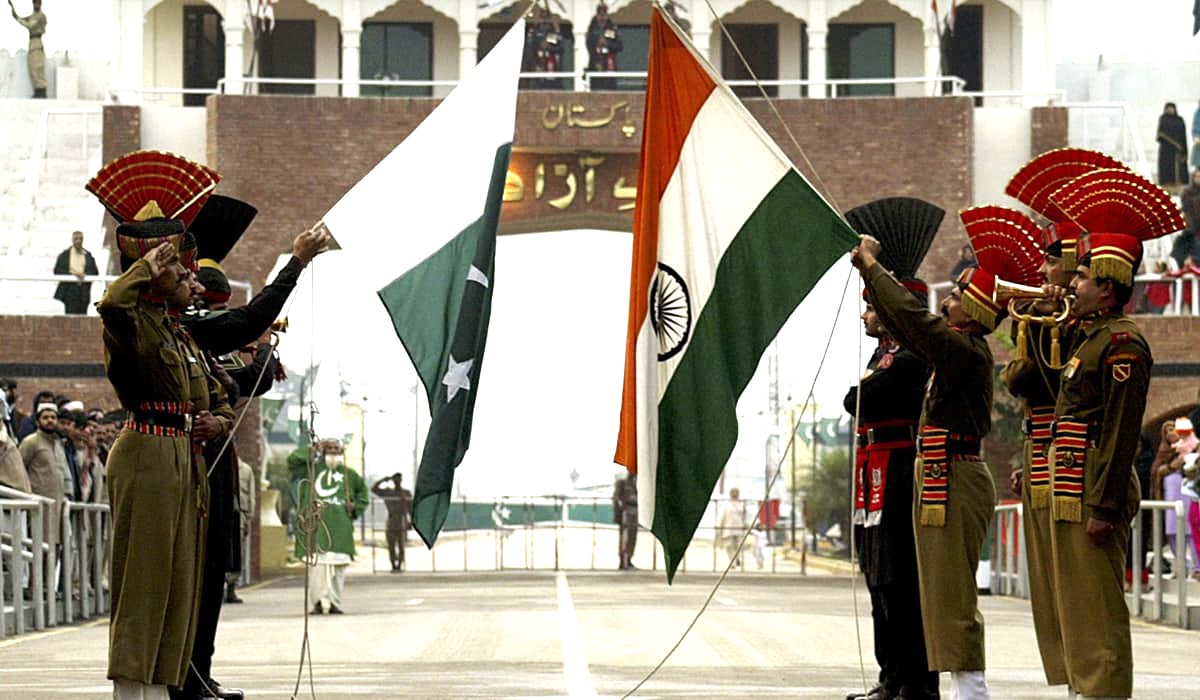
Pakistan and India have never been easy neighbours. They have nursed an agenda of otherness since their inception, as the bitter memoirs of Partition had kept them at bay. Irrespective of the fact that they have a shared history, culture and a geography that cannot be done away with, both the nation-states preferred antagonism over harmony.
Politically they lacked the tendency and the courage to start a new beginning. The societies that evolved on either side of the divide were indoctrinated with hate, and made sure that they capitalised on it to serve the vested interests of a few at the helm of affairs.
In doing so, they neglected a silent majority who awed for peace, reconciliation and a better tomorrow. The bounties of cooperation that were there in the sub-continent in the form of trade, socio-lingual and literary interactions, especially in arts, films, music and scholarly pursuits, were sooner than later become footnotes. Acrimony became the order of the day, and those who even did any lip-service for mending fences were termed as social outcasts, or even traitors, per se.
As American writer and actress of ‘Star Wars’, Carrie Fisher commented, “resentment is like drinking poison and waiting for the other person to die”. That was the modus operandi of bilateralism, making sure any and every step intended towards the other is synchronised with vendetta, and had an added element of playing to the gallery. They had a backlog of dismemberment in the form of territorial disputes, primarily the Jammu & Kashmir. The result was warfare, madness for armament, cross-border meddling and an unannounced suspension of statecraft that could, otherwise, have made 1.5 billion people on either side have a healthy socio-political and economic interaction. The outcome was obvious: four wars and piling up of confrontation that went on to also rupture international commitments like holding the 1960 Indus Waters Treaty in abeyance, and having little or no regards for bilateral landmarks such as the 1972 Simla Accord. The South Asian arch-foes, nonetheless, have come a long way, but literally failed in intimidating each other on their knees.
Pakistan, despite being smaller in geography and resources, has time and again proved its conventional warfare superiority. The nuclear deterrence is an added muscle that has ensured its survivability.
The latest warfare episodes, especially after the Pulwama and Pahalgam misadventures, have put Pakistan on a thumping note as it has deterred and thwarted Indian aggression twice.
The four-day duel between the two countries in May 2025 was a defining moment in their relationship, and this has changed for good the doctrines of confrontation. The air superiority exhibited by Pakistan, along with a target-precision military sophistication, has apparently sealed the path of anymore cross-border jingoism. Moreover, the tactful diplomacy on the part of Islamabad, and its quest for peace and security in the region and beyond is now aptly recognised. Now is the time to move ahead from Sindoor and Bunyān-um-Marṣūs and work together for regional serenity. The more both the countries dig their heels in rivalry, the more it is going to push them in a nexus of assured destruction. Politically both the countries are inept in addressing their disputes, and time and again prefer resorting to the barrel of gun. That is their bankruptcy at home and failure to lead from the front in portraying themselves as messiahs of peace.
The Congress-Indira, the BJP, and a host of nationalist and regional parties in India do not have a manifesto of reconciling with Pakistan in terms of their foreign policy. Rather, they exploit the ‘Pakistan card’ every time before they go to vote. In Pakistan too, it is a tit-for-tat. No Pakistani political party has ever talked of India as a foreign policy ingredient, and none had the courage to stand up and say good relations with the eastern neighbour are sine qua non for collective prosperity.
It goes without saying that arm-twisted political dispensations since 1988 were under an unwritten understating with the powerful military establishment that they would “not interfere in foreign and defence” realms!
The sole exception was PML of Nawaz Sharif, but that too was seen as obsessed with personal business interests, and not taking a stance when it comes to astutely sharing notes with the powers-that-be.
The February 1999 Prime Minister Atal Behari Vajpayee’s landmark visit to Pakistan’s sole rejoinder was Kargil War in May that year. That rest is history! Yet, they have a great diplomatic inventory to work on and given sincerity of purpose, something positive will surely emerge. To recall a few:
(a) The 2004 Islamabad Declaration, wherein it was resolved that extra-territorial elements will be refrained from using each other’s territories for nefarious designs, especially fomenting terrorism.
(b) President-General Musharraf’s backchannel four-point agenda (2004-2006); 1) softening of LoC; 2) self-governance/autonomy but not total independence of Kashmir; 3) demilitarization of borders; and 4) joint management and supervision by both the states.
(c) General Bajwa’s utterance at Islamabad Security Dialogue, 2021, to kick-start a broad-based dialogue with Kashmir coming up on agenda once goodwill is worked out.
These provide enough credence to make a good start, provided the process comes with a political prologue and not one that is solely bureaucratic in essence. Pakistan’s Foreign Office, while synergizing the crosscurrents of resilience on the first anniversary of the 2025 war, has voiced for ‘reconciliation’ by making a fresh start sans confrontation with India and called for “talking it out”. This is a laudable gesture and must find due reciprocation from New Delhi. The fact, nonetheless, is that Saffron is the rising trend in India and the BJP is there to stay and rule. Its recent victories in Assam, West Bengal, and Pondicherry, and elsewhere in previous state-elections too, are cases in point. The Congress of Rahul Gandhi with eloquent secular credentials is a non-starter when it comes to peace with Pakistan.
So is the case with Pakistan where talking of peace with India by political parties is a taboo, as they prefer to portray themselves “more loyal than the king” as they pin on small favours to stay afloat. The PPP, PMLN, ANP and the MQM who have perfect constituencies to talk of peace with India are seen trailing behind with lack of courage. The PTI’s Waterloo moment was August 5, 2019, when the Indian Parliament unilaterally abrogated Article 370 & 35A. Since then it is in fix, as it rightly wants India to rescind it to move ahead.
This drawback from political forces creates a perfect ground for radicals to thrive on, and that is what is in vogue in India and Pakistan. It is a moral debacle of political parties on either side of the great divide and confirms their visionless, fragmented, and imprudent mindset for their respective countries and the region. Thus, geo-economics worth trillions of dollars is at a naught, as they find excuses to fight on for the sake of staying in power.
India and Pakistan are acting as pariah states when it comes to furthering regional connectivity, stalling the multi-billion dollar Belt and Road Initiative (BRI) of Beijing, and also grounding several other transregional projects of logistics and energy pipelines. At the same time, both states are hypocritically ruthless to their citizens as they deprive them of travel and tourism, especially the divided families of Partition.
Suspension of visa services is tantamount to state-centric oppression. In seven decades, they haven’t found a voice in the Machiavellian-infected power corridors.
Of late, the doves surprisingly are making their presence felt. Former Indian army chief Gen Manoj Naravane and the Rashtriya Swayamsevak Sangh (RSS) Secretary-General Dattatreya Hosabale have called for opening a “window for dialogue” between Islamabad and New Delhi. Hosabale has a point, as he says:
“When friendship develops between the people of two countries, it naturally helps improve relations between the countries themselves.”
One hopes, the hierarchy in RSS and BJP are receptive to this welcome tone of rapprochement. Furthering people-to-people contacts by easing the visa regime and eulogising greater apolitical interaction, especially in sporting events, is the way to go. Time for the Pakistani intelligentsia too to step in to fill the void of civil bankruptcy in interstate relations. Taking a cue from Napoleon Bonaparte who said “neighbours have to live with geography”, it’s time for Pakistan and India to turn a new leaf and start believing in co-existence.
They have had enough brawls, and must now come forward to bury the hatchet. The least that they can figure out in congeniality and civility is an Élysée-type peace treaty for South Asia.
Germany and France after more than seven decades of hereditary enmity, spanning from the Franco-Prussian War in 1870 to the end of World War-II in 1945, took a leap forward to become the “twin engine” of growth and prosperity in Europe. Pakistan and India too have reasons to do so, but all they need to do is to take a break from their egocentrism. A timeless and unconditional dialogue will surely reap-in peace dividends. All it needs is political courage to start a new beginning.