



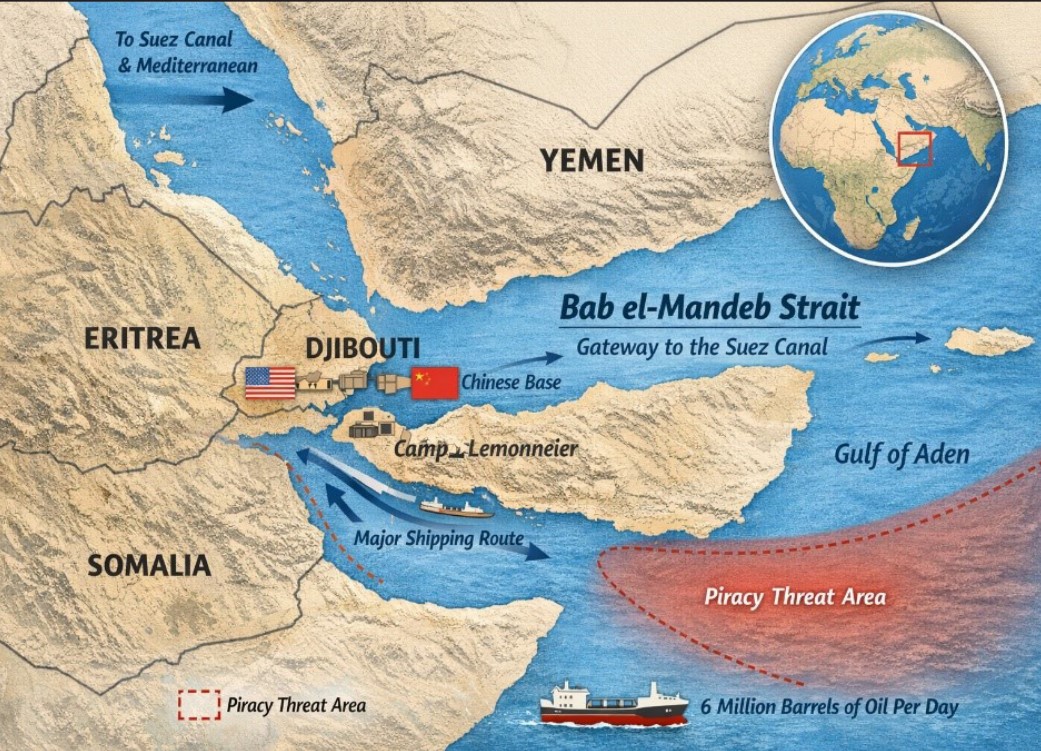
The Strait Now Commanding Global Attention
Abstract
Global trade depends on a handful of narrow maritime chokepoints. This article explores the ten most critical straits, tracing their history, vulnerabilities, and the economic shocks that follow when they are disrupted. From Hormuz to Gibraltar, these waterways are not just geographic features — they are the levers of globalization, shaping the flow of energy, goods, and power across continents. Today, as attention shifts beyond the Strait of Hormuz, the Bab el-Mandeb Strait emerges as a pivotal gatekeeper of global commerce, where regional instability and strategic competition carry worldwide consequences.
Introduction
Straits are narrow, naturally formed waterways that connect two larger bodies of water while separating two landmasses. Every day, ships laden with oil, liquefied natural gas, and manufactured goods squeeze through these narrow corridors barely visible on a world map.
Globally, there are hundreds of straits — maritime scholars often cite around 200 major straits and channels — but only a handful truly function as chokepoints where disruption could trigger global consequences. These straits, the natural chokepoints of commerce, are the hidden levers of globalization. They are places where geography dictates economics, and where politics can ripple across continents. From the Strait of Hormuz in the Persian Gulf to the Bab el‑Mandeb at the mouth of the Red Sea, straits have shaped the destiny of nations for centuries.
According to the United Nations Conference on Trade and Development (UNCTAD), nearly 90% of global trade moves by sea. In other words, the lifeblood of the world economy quite literally flows through a handful of narrow maritime passages. When one of these chokepoints is blocked or even threatened, the ripple effects are immediate and profound: oil prices surge, shipping costs escalate, supply chains stumble, and geopolitical tensions intensify.
These straits are not just waterways—they are pressure valves of globalization, where vulnerability and power converge.
Here is the list of the ten most consequential Straits in the world economy.
The World’s Top 10 Strategic Straits
1. Strait of Hormuz – Persian Gulf to Arabian Sea
2. Bab el‑Mandeb Strait – Red Sea to Gulf of Aden
3. Strait of Malacca – Indian Ocean to South China Sea
4. Bosporus & Dardanelles – Black Sea to Mediterranean
5. Strait of Gibraltar – Atlantic to Mediterranean
6. Panama Canal – Atlantic to Pacific (man‑made, but vital)
7. Danish Straits – Baltic Sea to North Sea
8. Bering Strait – Arctic to Pacific
9. Sunda Strait – Between Java and Sumatra
10.Torres Strait – Between Australia and Papua New Guinea
1. Strait of Hormuz: The World’s Energy Lifeline
The Strait of Hormuz, a 33‑kilometer-wide passage between Oman and Iran, is the most critical energy chokepoint on Earth. The International Energy Agency (IEA) estimates that about 20% of global petroleum and one‑third of liquefied natural gas exports pass through Hormuz. Saudi Arabia, Iraq, Kuwait, and the United Arab Emirates all rely on it to reach global markets.
History has shown how vulnerable this artery is. During the Iran‑Iraq War in the 1980s, the so‑called “Tanker War” saw both sides attack oil shipments, sending insurance premiums skyrocketing. In 1988, the U.S. Navy launched Operation Praying Mantis after Iranian mines damaged an American frigate — a clash that underscored how a single strait could drag superpowers into conflict.
More recently, in 2019, Iran seized foreign tankers in retaliation for sanctions, reigniting fears of a global energy shock.
Hormuz is not just a waterway; it is the fulcrum of the global energy system. Futures markets react instantly to rumors of closure. Insurance premiums for tankers spike whenever tensions rise. The United States maintains a strong naval presence in the region precisely because a closure of Hormuz would cripple the world economy.
2. Bab el‑Mandeb Strait: The Emerging Chokepoint
If Hormuz is the world’s most important strait today, the Bab el‑Mandeb Strait may be the next to rival it. Located between Djibouti and Eritrea on the African side and Yemen on the Arabian Peninsula, Bab el‑Mandeb connects the Red Sea to the Gulf of Aden — and by extension, the Suez Canal to the Indian Ocean.
The U.S. Energy Information Administration (EIA) notes that nearly 6 million barrels of oil per day transit Bab el‑Mandeb. But its importance goes beyond energy. Roughly 12% of global trade passes through the Suez Canal, and Bab el‑Mandeb is the southern gateway. If this strait were blocked, ships would have to reroute around the Cape of Good Hope, adding thousands of miles and weeks of travel time. The economic shock would be immense.
Bab el‑Mandeb is also uniquely vulnerable. Yemen’s civil war has spilled into its waters, with Houthi rebels targeting shipping. Somali piracy in the Gulf of Aden surged in the 2000s, forcing international navies to patrol the region. China, the U.S., France, and Japan all maintain military bases in Djibouti, underscoring the strait’s strategic importance.
In short, if the Strait of Hormuz is the world’s energy lifeline, Bab el‑Mandeb is the world’s logistics artery — and its fragility makes it a potential trigger for the next global crisis.
3. Strait of Malacca: Asia’s Artery
The Strait of Malacca, running between Malaysia and Indonesia, is one of the busiest shipping lanes in the world. Nearly a quarter of global trade passes through its waters, including most of China’s energy imports. This dependence has been dubbed the “Malacca Dilemma” by Chinese strategists, who fear that rival powers could blockade the strait in times of conflict.
Historically, Malacca was central to the spice trade, making it a prize for colonial powers. Portuguese, Dutch, and British fleets fought to control it, knowing that whoever held Malacca controlled the flow of nutmeg, cloves, and pepper to Europe. Today, it remains indispensable for East Asia’s economic engine. Efforts to develop alternative routes, such as pipelines through Myanmar or the Kra Canal in Thailand, also known as the Thai Canal, highlight the strategic anxiety surrounding Malacca.
4. Bosporus & Dardanelles: Europe’s Gates
Turkey’s control of the Bosporus and Dardanelles straits gives it immense geopolitical leverage. These waterways connect the Black Sea to the Mediterranean, making them vital for Russia, Ukraine, and other Eastern European nations. During the ongoing conflict in Ukraine, Turkey’s decision to restrict military traffic through the straits underscored their importance.
Historically, the straits were contested by Byzantines, Ottomans, and European powers. In the 19th century, European powers clashed over access, fearing that Russian control would tilt the balance of power. Today, they remain central to energy exports and grain shipments from the Black Sea region.
5. Strait of Gibraltar: The Atlantic-Mediterranean Link
The Strait of Gibraltar, only 13 kilometers wide, connects the Atlantic Ocean to the Mediterranean Sea. Since antiquity, it has been a gateway to Europe. Control of Gibraltar allowed Britain to dominate naval traffic for centuries. Today, it remains a vital passage for European trade and military strategy.
6–10: Other Strategic Straits
• Panama Canal: Though man‑made, it connects the Atlantic and Pacific, saving ships thousands of miles. Roughly 5% of global trade passes through.
• Danish Straits: Connect the Baltic Sea to the North Sea, vital for Northern Europe and Russia.
• Bering Strait: As Arctic ice melts, it may become a new frontier for shipping.
• Sunda Strait: Between Java and Sumatra, important for Indonesia’s domestic trade.
• Torres Strait: Between Australia and Papua New Guinea, shallow but strategically important.
Bab el‑Mandeb: Potential Impact and Global Preparedness
The Bab el‑Mandeb Strait deserves special attention because of its unique position as the southern gateway to the Suez Canal. Roughly 12% of global trade flows through this corridor, and nearly 6 million barrels of oil per day transit its waters. A closure here would force ships to reroute around Africa, adding weeks to journeys and billions in costs.
Potential Impact on the World Economy
• Energy Shock: Oil and LNG shipments from the Gulf to Europe would be delayed, spiking global prices.
• Supply Chain Disruption: Container ships carrying electronics, textiles, and food would face severe delays.
Insurance and Freight Costs: Premiums would soar, raising the cost of goods worldwide Global Inflation: Extended disruptions could trigger inflationary waves across Europe, Asia, and Africa.
Policy Responses to Chokepoint Shocks
When maritime straits like Bab el‑Mandeb are disrupted, the economic tremors can escalate into systemic crises. Oil price volatility, shipping delays, and supply chain breakdowns risk triggering runaway inflation and, in extreme scenarios, a global recession of historic proportions. To mitigate these dangers, countries can pursue several strategies:
• Diversification of Trade Routes: Invest in alternative overland corridors, pipelines, and regional ports to reduce reliance on single chokepoints.
• Strategic Reserves: Expand and coordinate energy and food reserves to cushion against sudden supply shocks.
• Collective Security Frameworks: Strengthen naval cooperation and multinational patrols to secure vulnerable straits like Bab el‑Mandeb.
• Financial Safeguards: Deploy monetary tools—such as targeted liquidity injections and currency stabilization measures—to counter inflationary spirals.
• Resilient Supply Chains: Encourage near‑shoring and regional production hubs to reduce exposure to distant disruptions.
• Global Coordination: Use institutions like the IMF, World Bank, and G20 to orchestrate rapid response packages, preventing localized crises from cascading into global collapse.
What Countries Could Do to Brace for Catastrophe
• Diversify Routes: Invest in alternative pipelines (e.g. Saudi Arabia’s East‑West pipeline) and rail corridors.
• Strengthen Naval Patrols: Expand multinational coalitions to deter piracy and secure shipping lanes.
• Diplomatic Engagement: Push for stability in Yemen and Horn of Africa to reduce risks.
• Strategic Reserves: Build and maintain energy reserves to cushion against sudden supply shocks.
• Technological Surveillance: Deploy drones, satellites, and AI monitoring to detect threats early.
Bab el‑Mandeb is not just a strait; it is a hinge upon which the global economy swings. Its fragility means that nations must prepare for the worst while hoping for stability.
Future-Outlook
The future of straits will be shaped by three powerful forces:
• Geopolitics: Rivalries in the Middle East, Asia, and Europe will keep straits at the center of strategy. China’s Belt and Road Initiative seek to diversify routes away from Malacca, while NATO strengthens its maritime posture in Gibraltar and the Bosporus. Regional conflicts — from Yemen to Ukraine — will continue to test the resilience of these narrow waterways. The Straits will remain the chessboard squares where great powers maneuver, and where local crises can escalate into global shocks.
• Climate Change: Melting Arctic ice may open new straits, altering global trade geography. Rising sea levels could threaten port infrastructure, while extreme weather may disrupt shipping schedules. The Bering Strait, once peripheral, could become central to Asia‑Europe trade, while low‑lying ports near Malacca and Bab el‑Mandeb may face flooding risks. Climate change will not only create new opportunities but also amplify vulnerabilities.
• Technology: Drones, satellites, and AI will enhance surveillance, reduce piracy but increase militarization. Autonomous ships may revolutionize logistics, but they also introduce cyber vulnerabilities. A cyberattack on navigation systems could paralyze traffic through a chokepoint as effectively as a blockade. Insurance companies and shipping firms are already modeling cyber‑risk scenarios alongside traditional piracy threats, showing how digital dangers are now as serious as physical ones.
Conclusion
Straits are more than geographic features; they are the arteries of globalization. Each chokepoint — whether Hormuz carrying the world’s energy, Malacca channeling Asia’s trade, or Bab el‑Mandeb hinging Europe‑Asia logistics — reminds us that the global economy rests on fragile foundations.
The lesson is clear: securing these waterways is not simply a maritime challenge, but a global economic imperative. Nations must invest in resilience — through diversified routes, strategic reserves, and cooperative security frameworks — while preparing for the disruptions of climate change, technological shifts, and geopolitical rivalries.
In the end, straits embody the paradox of globalization: they connect continents, yet their vulnerability can divide the world in crisis. To safeguard prosperity, the world must treat these narrow passages not as overlooked margins of the map, but as the very fulcrums of international stability.
References
- International Energy Agency (IEA). World Energy Outlook. Paris:
IEA Publications. - U.S. Energy Information Administration (EIA). World Oil Transit Chokepoints. Washington, D.C.: U.S. Department of Energy
- United Nations Conference on Trade and Development (UNCTAD). Review of Maritime Transport. Geneva: UNCTAD Reports.
- World Bank. Economic Impacts of Maritime Disruptions: Case Study of the Suez Canal Blockage. Washington, D.C.: World Bank Group.
- NATO. Maritime Strategy and Security Reports. Brussels: NATO Publications.
International Maritime Organization (IMO). Piracy and Armed Robbery Reports. London: IMO Secretariat. - Montreux Convention Regarding the Regime of the Straits (1936). League of Nations Treaty Series
- International Maritime Organization (IMO). Piracy and Armed Robbery Reports. London: IMO Secretariat.
- Combined Maritime Forces (CMF). CTF 151 Counter Piracy Operations Briefs. Bahrain: CMF Headquarters.
- National Snow and Ice Data Center (NSIDC). Arctic Sea Ice Decline and Shipping Routes. Boulder, CO: NSIDC Reports.
- Insurance Information Institute (III). Marine Insurance Premium Trends. New York: III Publications