

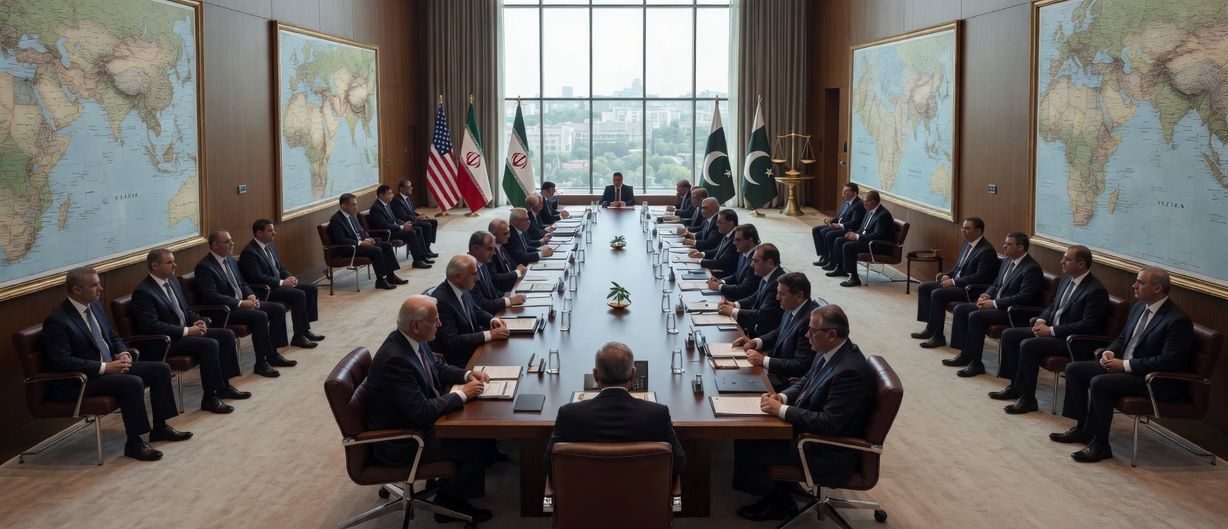
From A Fragile Truce to Regional and Equitable Reckoning
The protracted marathon in Islamabad did not produce a grand bargain. It did not need to.
Abstract
Beyond the Ceasefire takes us on a journey through the historic yet fragile truce brokered by Pakistan between Washington and Tehran, a dialogue unseen for 47 years. But this isn’t just about hitting pause on a long, bitter conflict; it’s about laying the groundwork for something far more enduring: peace built on the solid foundations of justice and equality. The article doesn’t shy away from the tough issues, control of the Strait of Hormuz, frozen Iranian assets, and the thorny question of nuclear enrichment. It argues that true peace isn’t just about stopping the bullets; it’s about addressing the deep-seated grievances and power imbalances that fuel the fire.
Imagine a world where confidence-building measures aren’t just empty gestures, but concrete steps towards mutual trust. Where a phased de-escalation ladder leads both sides down from the brink, step by cautious step. Where a regional security architecture isn’t a tool of hegemony, but a framework for equity and cooperation. The article paints this picture with clarity and conviction, proposing innovative solutions like a UN-backed Hormuz Levy to compensate for past damages, a tangible sign that justice isn’t just a lofty ideal, but a practical necessity. But the heart of his argument beats with a simple, powerful truth: peace without justice is just a fleeting intermission. Without addressing the underlying inequalities and injustices, any truce is doomed to crumble. That’s why it calls for patience, principle, and pragmatism, not just from the negotiators at the table, but from all of us who yearn for a world where lasting peace isn’t just a dream, but a reality.
But the heart of his argument beats with a simple, powerful truth: peace without justice is just a fleeting intermission. Without addressing the underlying inequalities and injustices, any truce is doomed to crumble. That’s why it calls for patience, principle, and pragmatism, not just from the negotiators at the table, but from all of us who yearn for a world where lasting peace isn’t just a dream, but a reality.
A Step Back from the Brink, But Not Yet Toward Justice
What it delivered was something increasingly rare in today’s fractured geopolitics: a deliberate pause. Pakistan’s role as facilitator was never to dictate terms or guarantee an outcome, but to convince two deeply entrenched adversaries to take a pause from hostilities, to conduct direct dialogue and negotiate a settlement by proposing a credible middle ground across the chasm that has long divided them.
In doing so, Islamabad achieved an unprecedented breakthrough: for the first time in 47 years, Washington and Tehran sat directly across from one another. All previous diplomatic efforts relied on intermediaries and indirect messaging; this was the first time the two sides shared a single table to address their grievances face to face. Whether they ultimately reach an agreement is not Pakistan’s responsibility as mediator. That decision rests entirely with two sovereign nations, free to chart their own course.
Pakistan’s mandate is strictly to coax the two parties toward reason, preserve the diplomatic channel, and urge the election of peace over war. The two week ceasefire was not an endpoint; it was a lifeline. For Pakistan, which hosted these historic talks at considerable diplomatic, economic, and security cost, the real work begins now. On April 22, 2026, President Trump extended the ceasefire indefinitely; but conditionally, lasting only until Iran submits a unified proposal and discussions conclude. The truce remains fragile, contingent on Tehran’s next move. The immediate priority must be consolidating this fragile truce, underpinning it with incremental confidence building measures (CBMs), a mechanism for restorative justice, and a broad, inclusive regional architecture that neither isolates Washington nor emboldens Tehran.
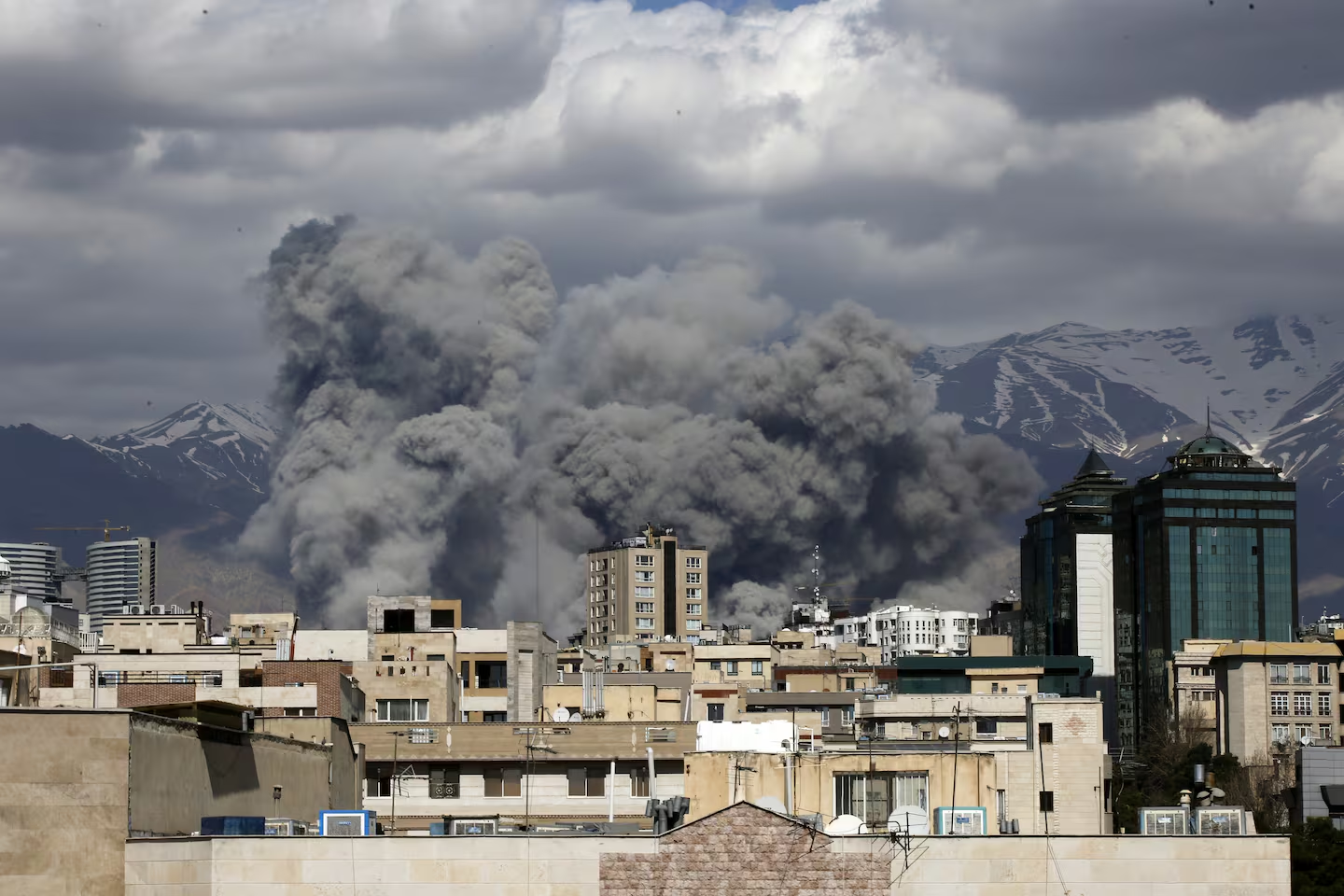
The Islamabad negotiations laid bare the familiar fault lines: control of the Strait of Hormuz, the status of frozen Iranian assets, and the nuclear enrichment question. Washington’s framing of a best and final offer, paired with Tehran’s insistence on rights and good faith, signals a negotiation still in first gear. Yet the very fact that both sides sat in the same room, under Pakistani mediation, marks a decisive step back from the trajectory of open escalation. The marathon of violence did not collapse into deadlock by accident; it emerged precisely because both capitals had absorbed enough strategic and economic pain to value a mediated pause over continued confrontation.
Recent public remarks reflect this calibrated posture. Vice President JD Vance emphasized that the administration’s priority remains verifiable stability, not perpetual confrontation, while President Donald Trump recently reiterated that any agreement must be ironclad, transparent, and put American security first.
On the other side, Iranian officials have stressed that diplomacy cannot succeed under the shadow of maximalism or unilateral ultimatums. Though rhetorically distant, these statements share a common denominator: neither side wants another war.
That is the foundation upon which an indefinite ceasefire can be built.
As of April 22, 2026, Tehran has not formally agreed to rejoin the Islamabad track, citing the ongoing US naval blockade as an illegal act of piracy, incompatible with good faith negotiations. Pakistan’s mediation continues, but the path to a second round remains contingent on de escalatory gestures from both sides. But let us be clear eyed: stability without justice is brittle. Iran’s infrastructure, including energy facilities, ports, and civilian networks, has suffered significant damage from unprovoked US and Israeli military actions over the past decade. To expect Tehran to engage in good faith negotiations while absorbing the costs of aggression is not realism; it is asymmetry dressed as pragmatism.
Truce Must Continue: Immediate CBMs and a De escalation Ladder
No bilateral arrangement or ad hoc confidence measure can sustain peace in isolation. What begins as a ceasefire must harden into a structured, rolling process. Expecting a comprehensive settlement within a fortnight is a diplomatic fantasy. The security dilemmas at play, nuclear latency, maritime control, proxy dynamics, regional deterrence, require surgical patience. What is feasible, and what must be pursued aggressively, is a rolling framework of small, verifiable steps.
Immediate Confidence Building Measures (CBMs)
These could be instituted within days or weeks, without demanding strategic surrender from either side:
1. Immediate reciprocal maritime de escalation – US suspension of vessel seizures and Iran’s commitment to allow neutral commercial transit through Hormuz, pending verification protocols.
2. Joint maritime deconfliction protocols in the Gulf to prevent accidental clashes and ensure safe commercial transit.
3. Phased humanitarian asset releases tied to transparent IAEA monitoring benchmarks.
4. Reasonable tranches of frozen Iranian asset releases and phased sanction relief, linked to reciprocal benchmarks and transparent monitoring.
5. Reciprocal military posture adjustments in contested zones, including withdrawal of US forces from the region, coupled with backchannel crisis communication hotlines.
6. Activation of the Hormuz Restorative Levy (detailed below) as a tangible commitment to restorative justice.
A Reciprocal De escalation Ladder: Phased Steps Toward Durable Peace
Sustainable peace cannot be achieved through unilateral concessions. What is required is a structured, reciprocal ladder; where each positive step by one party is met with a commensurate, verifiable response by the other. Such a framework builds trust incrementally while preserving face and strategic dignity for both sides.
Phase 1: Immediate Maritime De escalation
• US suspends naval blockade of Iranian ports and halts vessel seizures.
• Iran responds by reopening the Strait of Hormuz to neutral commercial traffic under joint monitoring protocols.
Phase 2: Asset Relief for Nuclear Confidence
• US unfreezes 40–50% of frozen Iranian assets and lifts sanctions on Iranian oil/gas exports.
• Iran responds by transferring custody of its enriched uranium stockpiles above 3.67% to a mutually agreed third party (e.g., China or Russia) under continuous IAEA safeguards.
Phase 3: Comprehensive Sanctions Relief for Long Term Constraints
• US removes all remaining economic sanctions and unfreezes all Iranian sovereign assets.
• Iran responds by formally codifying a 10–15 year cap on uranium enrichment below 5%, with enhanced IAEA access and real time monitoring.
Phase 4: Regional Security Integration
• All parties endorse the proposed regional architecture (Pakistan, Saudi Arabia, Türkiye, Egypt + China/Russia backing).
• Iran transitions from observer to full member status as CBMs yield verified results; the US and EU engage constructively with the framework.
Each phase would include transparent verification mechanisms, sunset clauses, and dispute resolution protocols. Crucially, the ladder is reversible: any violation triggers a proportional, pre agreed response; not automatic collapse. This design preserves incentives for compliance while acknowledging the fragility of early stage trust. A full resolution may take months, if not years. That is not a failure of diplomacy. It is the reality of complex security architectures.
The Nuclear Question: Equity, Not Exceptionalism
Addressing conventional and maritime asymmetry, however, is only half the equation. A peace architecture that compensates for damaged infrastructure while ignoring unverified strategic arsenals will inevitably collapse under the weight of its own contradictions. Any credible discussion of nuclear non proliferation in the Middle East must confront an uncomfortable reality: the region’s only undeclared nuclear arsenal lies outside international safeguards. Israel’s undeclared nuclear weapons and facilities, widely acknowledged but never formally inspected, represent a strategic asymmetry that fuels regional insecurity.
If Washington demands that Iran permanently forgo enrichment capabilities, then consistency and credibility require that Israel’s nuclear program be brought under the same international safeguards. This is not about equating states; it is about establishing a single standard for regional security. A non proliferation regime that applies rules selectively is not a regime at all: it is an instrument of hierarchy and injustice.
Should Israel decline to participate in regional safeguards, as appears probable, the framework must account for a conditional fallback: Iran would require a verifiable deterrence capability, whether conventional or latent, sufficient to credibly dissuade any external aggression. This is not an endorsement of arms escalation, but a pragmatic acknowledgment that regional stability cannot be secured through unilateral vulnerability.
Deterrence, in this context, serves as a stabilizing floor while diplomatic pathways remain open.
Furthermore, the integrity of verification depends on the neutrality of those who verify. Future IAEA inspection teams operating in the region must be composed of personnel from genuinely non aligned states: experts from Russia, China, Spain, Japan, Malaysia, or South Africa, rather than individuals with institutional or national ties to the US, Israel, or their closest allies. When stakes are this high, even the appearance of bias can unravel agreements.
While politically contentious, third-party custodial arrangements have precedent in safeguarded fuel-cycle proposals and could be structured under UNSC-backed guarantees.
Compensation Without Precedent: A UN Backed Hormuz Levy
Addressing nuclear equity alone does not heal the wounds of past conflict. That requires a separate, pragmatic mechanism for restorative justice; one that acknowledges the material damage inflicted on Iran without requiring the US or Israel to admit legal liability, something that is politically improbable and historically unprecedented.
There is a pragmatic, rules based middle path: a time bound, UN approved levy on commercial vessels transiting the Strait of Hormuz, earmarked exclusively for the reconstruction of Iranian civilian infrastructure damaged in conflict.
This mechanism would have three critical design features:
1. Limited Duration: Strictly capped at 3–5 years, with automatic sunset clauses and no possibility of extension without unanimous Security Council approval.
2. Multilateral Oversight: Funds collected would be held in a neutral escrow account administered by a consortium including UNDP, IAEA, and representatives from the proposed regional framework (Pakistan, Saudi Arabia, Türkiye, Egypt), with transparent auditing.
3. Strictly Civilian Use: Disbursements restricted to verified reconstruction of non military infrastructure: hospitals, power grids, water systems, ports, with third party monitoring to prevent diversion.
This is not a “toll” in the traditional sense of sovereign extraction. It is a restorative surcharge, authorized as a one time exception under Chapter VI of the UN Charter, aimed at healing wounds rather than rewarding coercion. It acknowledges a simple truth: sustainable peace requires addressing grievances, not merely silencing guns.
Critics will argue this sets a dangerous precedent. The response is equally simple: the mechanism’s exceptional, time bound, multilateral nature prevents precedent. It is a surgical instrument for a specific wound, not a new doctrine of maritime law. Moreover, by channelling compensation through a UN backed framework, it deprives any single actor of unilateral leverage.
The Economic Imperative: Why Global Trade Powers Will Back the Levy
A restorative mechanism gains traction not only from moral imperative but from material necessity. The very shipping lanes that would fund reconstruction are the same arteries that keep global supply chains intact. One of the most underappreciated dynamics of the current crisis is the growing awareness among EU and East Asian economies of their vulnerability to disruption in the Strait of Hormuz. For the EU, Japan, South Korea, and India, the Strait is not a distant geopolitical chessboard; it is the arterial route through which energy, components, and finished goods flow.
When US or Israeli military actions threaten to close or destabilise this chokepoint, the economic consequences ripple through supply chains from Hamburg to Hyderabad to Tokyo. This reality is reshaping strategic calculus. Many of these states, historically reluctant to challenge Washington on Middle East policy, now have a compelling material interest in any mechanism that guarantees safe passage, even if it entails a temporary, modest levy on transiting vessels.
This shift creates subtle but significant pressure on US policy. When key economic partners signal that stability trumps ideological alignment, hegemonic flexibility becomes a strategic choice, not a concession. The proposed 3–5 year Hormuz Restorative Levy, framed as a trade security insurance premium rather than a political tribute, aligns with this emerging consensus. It offers Tokyo, Seoul, Berlin, and Brussels a predictable cost to protect unpredictable flows; a rational trade off for economies built on just in time logistics.
The Case for a Regional Architecture, Rooted in Equity
The path forward cannot be bilaterally locked. The Middle East’s security environment has outgrown zero sum US Iran dynamics. A sustainable framework must be regionalised, inclusive, and rule based.
A viable model would bring together Pakistan, Saudi Arabia, Türkiye, and Egypt as core architects, with diplomatic and technical backing from China and Russia, and constructive engagement from Japan, South Korea, and India.
Iran’s initial participation as an observer is not a concession of weakness but a pragmatic acknowledgment of current trust deficits. Observer status allows Tehran to engage with the process, voice concerns, and gradually transition to full membership as CBMs yield tangible results.
Crucially, this framework must be designed as a stabilising mechanism, not an anti Western bloc; but nor should it be a vehicle for perpetuating hegemony. By aligning with UNCLOS maritime norms, IAEA safeguards, and existing Gulf security architectures, it can complement, rather than confront, US and European strategic interests while insisting on equity. It would offer Washington and the EU multilateral verification, economic predictability, and reduced escalation risk, while giving Tehran a structured pathway out of isolation, economic pressure, and unaddressed grievance.
Addressing Washington and Allies:
Realism Without Subservience Western capitals will demand ironclad verification and clear red lines. The regional framework can deliver this. Independent monitoring, multilateral asset escrow mechanisms, and transparent maritime reporting can satisfy Western security prerequisites while giving Tehran predictable relief from sanctions. When recent US statements warn against “negotiating with ambiguity,” the response should not be defiance but architecture. A regionalised, rules based process eliminates ambiguity by design. It replaces unilateral hegemonic pressure with collective oversight, making compliance harder to evade and incentives harder to ignore.
But let us also be candid: a peace process that ignores the material consequences of asymmetrical power will not hold. The Global South has watched for decades as security architectures are designed in capitals far from the conflict zones they govern.
This moment offers a chance to do better: to build a framework where sovereignty is not a privilege of the powerful, and where restitution is not dismissed as revisionism.
Conclusion: Patience, Principle, and Pragmatism
The Islamabad talks were never about solving everything at once. They were about stopping the bleeding. Pakistan’s facilitation has already achieved what decades of indirect diplomacy could not: placing two sovereign adversaries in direct dialogue after a 47 year hiatus. Yet it must be stated unequivocally that the outcome of these negotiations rests solely with Washington and Tehran. As independent nations, they alone hold the authority to accept or reject any settlement. Pakistan’s role is not to broker a dictated compromise, but to continually propose a viable middle ground, coax both sides toward pragmatic reason, and advocate unequivocally for the election of peace over war.
With the Strait of Hormuz closed, oil markets volatile, and both sides accusing the other of bad faith, the window for structured dialogue is narrowing, but not closed.
Pakistan’s continued facilitation, grounded in the principles outlined above, remains the most viable path to convert a conditional ceasefire into an enduring peace. The two week window must not be treated as a countdown to renewal but as a launchpad for permanence.
Coupled with an inclusive regional framework that respects both sovereignty and security, this approach offers the only realistic path from managed de escalation to durable stability. It is realistic because it acknowledges power asymmetries without surrendering to them. It is principled because it insists that peace without justice is merely intermission. And it is pragmatic because it offers all parties a face saving, rules based way forward; regardless of whether any single party accepts every element today. In a region where escalation has become the default, patience is not a sign of weakness. It is the only strategy left that works. The world has witnessed what happens when diplomacy fails. It is time to give it the space, the structure, the time, and the moral clarity it needs to succeed.
The proposals put forward in this article, from the confidence‑building measures and de‑escalation ladder to the nuclear equity framework, the Hormuz Levy, and the regional architecture, are offered as a legally coherent, morally defensible, and pragmatically structured pathway.
They represent the author’s considered opinion and suggestions, not a prediction of what Washington, Tehran, or any other party will accept. Whether any or all of these ideas are agreed upon is beyond the mediator’s control and, ultimately, beside the point. The purpose here is to outline what a just and durable peace could look like; not to forecast whether it will be chosen.