





The Dismantling of Israel’s Grand Strategy
How simultaneous failures on the battlefield, in Europe, within Washington, and at home are collapsing a state that has run out of fallbacks
There is a particular kind of collapse that announces itself not in a single catastrophic moment, but through the quiet, simultaneous failure of every system holding a structure upright. Bridges do not fall because one bolt snaps. They fall because corrosion spreads across load-bearing points until the structure can no longer bear its own weight. What is happening to Israel in 2026 is structural corrosion of exactly this kind – military, diplomatic, moral, and political rot proceeding in parallel, accelerating each other, with no single intervention capable of arresting all four at once.
What follows is a reading of observable data, historical precedent, and the testimony of scholars who have spent careers studying how states sustain themselves and how they fail. The diagnosis is stark: Israel has crossed the threshold from strategic asset to systemic liability, and the architecture supporting its position in the Western order is collapsing under the weight of contradictions it can no longer contain.
The Political Implosion – The Fall of AIPAC and the American Fracture
The tobacco industry spent decades presenting itself as an indispensable cultural and economic force. It purchased political protection at scale, neutralized critics with legal and financial retaliation, and constructed a public narrative that made opposition seem fringe, even eccentric. Then came the secondhand smoke argument – a conceptual pivot that reframed smoking not as a personal liberty but as an act of ambient harm inflicted on others without their consent. That reframing, once it entered the public consciousness, could not be unframed. The political protection evaporated within a generation.
The parallel to AIPAC and the Israel lobby is not rhetorical flourish. It is structurally precise. For decades, unconditional support for Israel was the secondhand smoke of American foreign policy: a cost imposed on the broader public – in blood, in diplomatic capital, in regional antagonism – while the benefits accrued to a narrow political class.
The 2026 conflict made that cost visible and undeniable. A recent Pew Research poll puts the number at 60% of all Americans holding an unfavorable view of Israel, with a five-to-one opposition ratio among young Americans – a cultural consensus hardening into political infrastructure.
The electoral proof arrived with remarkable clarity. Zohran Mamdani won the New York City mayoral race not despite his vocal condemnation of the Gaza campaign and his promise to enforce the ICC arrest warrant against Benjamin Netanyahu, but in substantial part because of it. Politicians across the country are now performing the political calculus AIPAC long made unthinkable and discovering that defying the lobby has transitioned from career-ending apostasy to a viable, often powerful electoral asset. Forty Senate Democrats voted to block a $300 million bulldozer sale to Israel. Thirty-six voted to block bomb transfers. These votes would have been inconceivable five years ago.
The fractures run in both directions. Inside the Democratic Party, a structural civil war over Israel funding has broken into the open. Representative Alexandria Ocasio-Cortez has committed to voting against all military aid packages, and she is not isolated – 67% of Democratic voters now express sympathy with the Palestinian position, a number that bridges generational lines in ways that party leadership can no longer manage through procedural delay. On the Republican side, the Iran war of 2026 produced a rupture within MAGA that the White House has not contained. Donald Trump ran on an explicit promise to end foreign military entanglements. When the administration followed Israel into a confrontation with Tehran, prominent figures within the movement branded it “Israel’s war” – a war that served Israeli territorial and ideological objectives while placing American service members and economic interests directly in the line of fire. Voices whose unconditional support was once assumed, including Tucker Carlson, Candace Owens, and Representative Marjorie Taylor Greene, have publicly pivoted from staunch Zionism to overt hostility toward the lobby. What was once a fringe position within the American right has become a structurally viable one, moving beyond media commentary and into direct electoral competition, evidenced by figures like James Fishback launching a campaign for governor of Florida on an explicitly anti-Zionist platform. The “America First versus Israel First” tension, long suppressed by the lobby’s financial reach, is now an open fault line in American politics, and the lobby no longer has the tools to close it.
The Military Quagmire – The Lawnmower’s Failure and the Three-Sided War
Israeli military doctrine for decades rested on a strategy its planners called “mowing the grass” -periodic, overwhelming campaigns against non-state actors designed to degrade their capabilities without triggering full occupation. The logic was elegant in its cynicism: permanent suppression without the political costs of permanent presence.
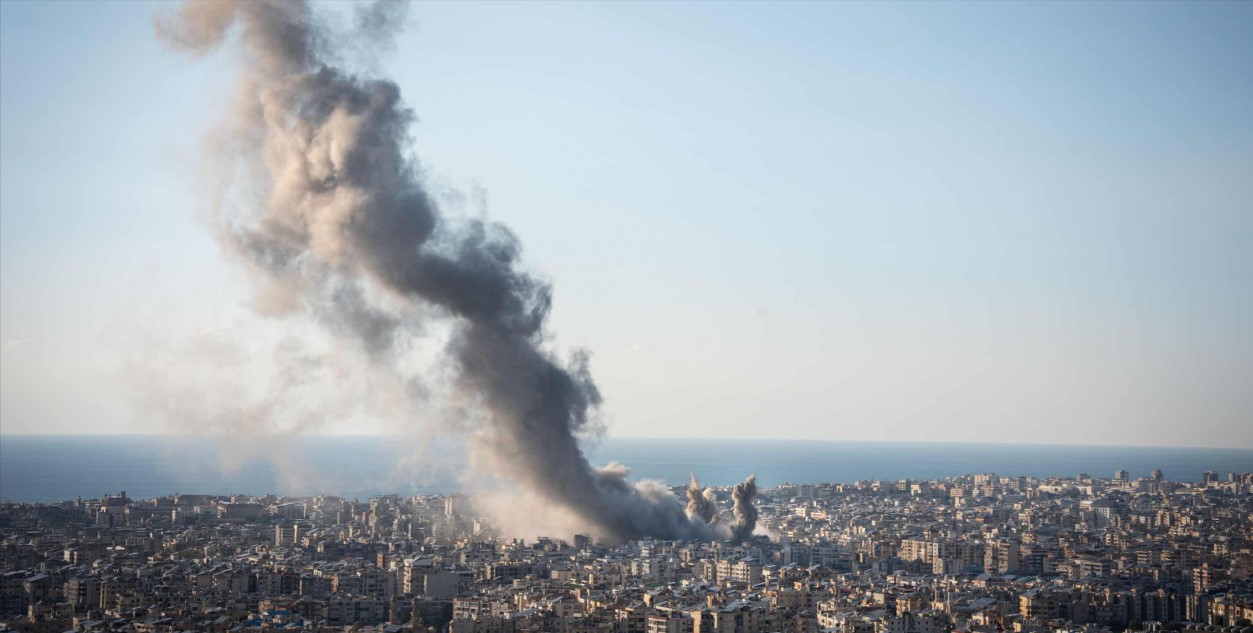
The Gaza campaign has not merely tested that doctrine. It has inverted it. Israel is now engaged in precisely the deep, multi-front entrenchment the strategy was designed to prevent, with a presence in southern Lebanon that returns the state to a pre-1994 strategic reality and a Gaza posture with no visible exit architecture. The Lebanon operation has introduced a vocabulary that historians of the 1948 Nakba will find grimly familiar.
IDF field commanders are employing the Hebrew word “lanot” – to cleanse – to describe the systematic demolition of civilian towns, villages, schools, and residential structures across the south. The word carries precise historical weight, documented by historian Benny Morris in his accounts of the ethnic cleansing operations conducted during Israel’s founding war. Its deliberate re-deployment by commanders in 2026 is not coincidental. It signals an operational logic and it has produced the predictable outcome: over 800,000 displaced persons in southern Lebanon, a humanitarian catastrophe unfolding in parallel with the ongoing Gaza genocide.
The broader strategic picture is worse still. What the administration initially framed as a bilateral confrontation with Iran is, in operational reality, a three-sided war between the United States, Iran, and Israel – with Israel functioning not as a cooperative ally but as an active antagonist to American war aims. The JD Vanceled diplomatic track opened in April 2026 represented a serious American effort to negotiate a managed de-escalation with Tehran. That track was destroyed. Israeli operations assassinated Kamal Kharazi and Ali Larijani – Iranian officials who had signaled openness to the negotiation framework – at the precise moment when back-channel contact was producing tangible results. The message was unambiguous: Israel’s objectives, which include regime change in Tehran and territorial consolidation across multiple fronts, are structurally incompatible with American objectives, which center on regional stabilization and the avoidance of a war the Pentagon has not been resourced or positioned to win cleanly.
At this point, the relationship functions less like an alliance and more like a unilateral arrangement, one in which America absorbs the costs while Israel pursues objectives Washington has not sanctioned and cannot afford.
The Moral Collapse – The Bartov Thesis and the Death of the Myth
The foundational narrative of the Israeli state rested on two ideological pillars: democratic legitimacy and the moral authority derived from the Holocaust. Holocaust historian Omer Bartov, whose scholarly record on genocide and state violence is among the most credible in the field, has argued with increasing urgency that both pillars have been structurally destroyed – not by external critics, but by the internal logic of the state’s own evolution.
Bartov’s thesis on ideological degeneration is precise: Zionism has transformed from a nationalist liberation movement into a state ideology organized around ethnonationalism and the violent domination of a subject population.
This evolution has been progressive – increasingly militaristic in orientation, increasingly expansionist in territorial ambition, increasingly racialized in its treatment of both Palestinians and Israeli Arabs, and now, in Bartov’s framing, increasingly genocidal in operational conduct. The coexistence of a Jewish state and a functioning democracy, he argues, has become a logical impossibility given the demographic and political realities on the ground.
The manipulation of Holocaust memory has been a central instrument of this degeneration. Israeli governments have systematically deployed the memory of European Jewish persecution to manufacture a permanent state of existential fear among their citizenry – a psychological condition that justifies exceptional measures and pre-empts rational cost-benefit analysis of military and political choices. Simultaneously, the accusation of antisemitism has been weaponized as a political tool, deployed not to protect Jewish communities from genuine hatred but to silence policy criticism that cannot be answered on its merits. The consequence of that weaponization is now arriving: when every critic of Israeli state policy is labelled an anti-Semite, the label loses its capacity to identify actual antisemitism. The inflation of the charge has bankrupted it.
The livestreamed genocide of Gaza has completed the moral implosion. Western populations did not require journalists or human rights organizations to tell them what was happening. They watched it directly, in real time, on platforms the Israeli military communications apparatus could neither control nor discredit. The behavioural evidence – the video documentation of IDF soldiers engaging in conduct that, posted by the soldiers themselves, made institutional denial impossible -permanently severed the “shared values” narrative that had anchored Western public support for generations. You cannot simultaneously claim to represent Western democratic values and livestream the evidence of their systematic violation.
Perhaps the most telling shift isn’t coming from Israel’s critics. It comes from the very people the state has always claimed to speak for. Israel has long grounded its hardline security policies in a simple argument: that it exists as the ultimate refuge for Jews everywhere. But that argument is losing its audience where it matters most. Polling from Pew Research and the ISPU shows Jewish American support dropping nearly ten points in a single year, and for the first time, a majority of young Jewish Americans are actively opposing Israel’s military campaigns. These aren’t distant critics. They’re the diaspora Israel has always said it protects. When the generation that was supposed to inherit that story starts seeing the “safe haven” as a source of shame rather than pride, the ideological compact between Israel and its most important external constituency is breaking down on the constituency’s own terms. The emotional and moral core of the Zionist case doesn’t just weaken. It starts to come apart from the inside.
The Diplomatic Isolation – European De-Coupling and the Collapse of the Fallback
Europe is Israel’s largest trading partner and, after the United States, its primary military supplier. The economic disruption produced by the 2026 conflict – specifically the closure of the Strait of Hormuz and its cascading effects on European energy markets and shipping lanes – transformed European diplomatic tolerance into active opposition with a speed that surprised even analysts who had tracked the gradual erosion of European public support.
The response has been institutional, not merely rhetorical. Belgium, Spain, Ireland, and Slovenia pushed formally for a comprehensive EU boycott. Belgium’s foreign minister publicly discussed implementing the trade sanction frameworks normally reserved for internationally designated rogue states. France closed its airspace to Israeli weapons transport flights – a de facto arms embargo achieved through administrative action rather than formal legislative process, and therefore harder to reverse through lobby pressure. Spain implemented an explicit embargo. The European de-coupling is no longer a diplomatic warning. It is an ongoing structural reality.
Anticipating Western abandonment, Israeli planners had developed what insiders described as the “Other Friends” strategy – a deliberate pivot toward right-wing illiberal democracies whose governments were presumed to be immune to the human rights frameworks driving European opposition. India, Brazil, and Hungary were the primary targets. The strategy has collapsed with unusual completeness. Brazil’s aligned government fell, its leader jailed. Hungary’s allied leadership lost power, replaced by a government that moved swiftly from rhetorical distancing to threatening the enforcement of the ICC arrest warrant against Netanyahu. The fallback architecture dissolved faster than the primary alliances it was meant to replace.
The Domestic Rot – The Implosion From Within
Every external pressure described above is being applied to a state already exhibiting severe internal decomposition. Israel holds the second-highest poverty rate in the OECD. Over two million Israelis live below the poverty line. The domestic poverty rate stands at 20.7% – a figure that, in an OECD context, represents a structural failure of the social contract rather than a cyclical economic downturn.
The fiscal mechanics of multi-front warfare have accelerated this decomposition in predictable fashion. Defense budget expansion has been funded through direct cuts to healthcare, education, and social services – the exact public goods that maintain social cohesion and citizen loyalty to the state. Israel is now experiencing a critical physician shortage as medical professionals emigrate to Europe. Veterans of the Gaza campaignsare committing suicide at rates that are beginning to force public acknowledgment. The 78% collapse in European tourism since 2023 represents not only a revenue crisis but a leading indicator: Israel is becoming a place that Western citizens and institutions are actively choosing to disengage from, in both the commercial and personal dimensions of that choice.
This disengagement now extends to the diaspora itself. The growing estrangement of young Jewish Americans has quietly damaged one of the state’s least-discussed dependencies: Aliyah, the immigration pipeline that sustains Israel’s demographic model. Any settler project depends on a steady intake of new arrivals to fuel expansion and absorb the losses from those who leave.
But that intake requires willing immigrants, and the pool is shrinking. Fewer young diaspora Jews see Israel as somewhere they want to build a life, let alone a cause worth uprooting for. When the people you’ve always counted on to arrive start choosing to stay away, you don’t have a recruitment problem. You have a foundational one.
Omer Bartov has drawn the historical parallel with deliberate precision: Israel is tracking toward the trajectory of apartheid South Africa. That state was not conquered by external military force. It was hollowed out by the simultaneous operation of mass internal protest,escalating armed resistance, comprehensive arms embargoes, and the progressive economic strangulation of international sanctions. Its political leadership made the same calculation Israeli governments are currently making – that security maximalism could outlast international pressure – and that calculation proved catastrophically wrong.
The domestic rot in apartheid South Africa did not reverse under pressure. It accelerated until the structure could no longer sustain itself.
Conclusion: The Anatomy of Terminal Failure
A geopolitical analyst assessing this situation without ideological precommitment is left with a set of empirical observations that point in a single direction.
Israel’s military doctrine has produced the occupation it was designed to prevent. Its diplomatic architecture is contracting on every front simultaneously. Its foundational moral narrative has been destroyed by the behaviour of the state apparatus itself. Its primary political protector – the United States – is experiencing bipartisan fractures that are structuring themselves, with increasing permanence, against unconditional support. And the domestic social contract is deteriorating under fiscal pressures the state has not developed a credible plan to reverse.
The tobacco lobby did not recover from secondhand smoke. The concept, once established in the public mind, could not be unestablished. The framing of unconditional support for Israel as a cost imposed on American and global citizens without their consent – a cost paid in strategic credibility, in regional stability, in lives, and in the erosion of the international legal frameworks the postwar order was constructed to maintain – is now the dominant public framing.
The political protection it once made possible is, by measurable evidence, withdrawing.
What comes next follows from what structural failures of this kind have consistently produced across historical cases.
The data does not suggest a path to stabilization. It suggests an acceleration toward the kind of reckoning that states in this condition have, without exception, eventually faced.