




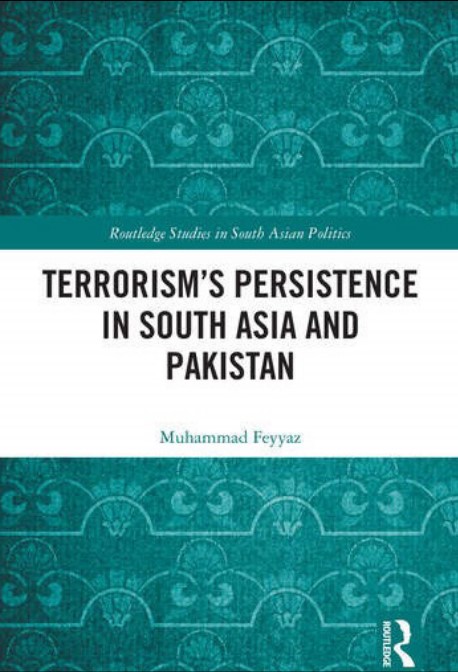
Muhammad Feyyaz (New York: Routledge, 2026), ISBN: 9781041218197 (Pages. 206)
The significance of intellectual debates on the global issue of terrorism and its South Asian directions cannot be marginalised in the changing contemporary patterns of great power politics. The varying viewpoints of different scholars on the South Asian version of terrorism always present a different picture of the region, where Afghanistan is the epicentre of multilevel terrorist activities.
It has posed a wide range of security challenges for Pakistan while forcing the Islamabad-based government authorities to take substantial counterterror operations through designing different indigenous military campaigns. It has led the international community to appreciate Pakistan’s national counterterror commitments, despite the country’s sufferings from a serious social and economic crisis. This scenario is discussed in the book Terrorism’s Persistence in South Asia and Pakistan by Muhammad Feyyaz, a prominent intellectual figure in Pakistan’s academic community. Professionally associated with a university’s faculty, Feyyaz has specialties in the field of terrorism and its changing dynamics in South Asia.
The book addresses the question of terrorism in South Asia and divides its debate into three parts: Global and South Asian Dynamics: An Introduction, Terrorism Longevity: Empirical and Theoretical Causes, and the Tenability of the Persistence-Efficacy Paradox. These three parts cover different topics respectively under the book’s central theme, which is originally the main idea of Feyyaz’s PhD dissertation completed at Queen’s University Belfast, United Kingdom.
After providing a brief introduction of the book’s core theme, rooted in the context of terrorism’s persistence, the first part began the discussion by examining the paradoxical nature of terrorism in the contemporary globalised world. It further underlines the nature of terrorism in South Asian regional security complexities, where Pakistan is severely suffering from this transnational issue.
The analysis in this part is supported by the conflicted history of South Asian political structure and its unprecedented growth under certain regional structural problems. A comprehensive outline of relevant literature on the evolution of terrorism in South Asia supports the author’s approach in the book’s introductory pages. The second part’s arguments emphasise the empirical findings to adequately conceptualise the persistence discourse of terrorism, while also highlighting the structural-material factors underlying cross-border terrorism’s persistence. It further offers a conceptual explanation of terrorism and its prevalent interpretations in theorising persistence while inspecting its application to Pakistan’s existing security issues.
The arguments in the book’s third part present a synthesis of the author’s findings by critically assessing the tenability of the central paradox of terrorism’s persistence. The most commendable part of these arguments across the chapters is their theoretical support, which the author derived from the Constructivist Grounded Theory (CGT) developed by Kathy Charmaz. The CGT is selected in the book as the preferred research strategy, grounded in qualitative approaches, to address the mainstream research questions of Feyyaz’s study.
The utmost fascinating part of the book lies in its research approach, which explains the author’s motivation for compiling his intellectual strength on the Global South’s perspective while considering it an area in need of appropriate scholarly attention.
It rationalises the author’s significant scholarly insight by focusing on an alternative narrative of terrorism to respond to existing Western descriptions of the issue, which are mainly structured by the academic communities of the Global North. It explained the lack of impartial analysis, laced with a selective Western framing of the issue, a major problem that has become a powerful narrative internationally, especially in the post-9/11 environment.
So, the author underscores a Global South perspective, expressed in three guiding beliefs (pragmatism, relativism, and constructivism), while focusing on the enduring problem of terrorism.
Apart from these praiseworthy features of the book South Asia was selected as the case study to develop a concise account of terrorism’s history in the pre- and post-9/11 era. It explained the genesis of this problem in colonial India, and its explicit evolution during the partition and post-independence crisis periods. Further concentration of the arguments on the status of Pakistan, one of the most adversely impacted countries globally by terrorism, is adopted in the book to symbolise the Global South’s interpretations tentatively.
In this way, the book is an academic endeavour to fill a critical, empirical, methodological, and theoretical gap in developing a logical comprehension of the paradoxical persistence of terrorism and its conceptual formulations beyond fixed Western intellectual frameworks. These unidirectional formats, depicting the Global North’s thinking patterns after the American launch of the global counterterrorism campaign, highlight the Western world’s priorities, rooted in its mainstream security apprehensions. Moreover, their prevalent security concerns treat terrorism as a serious security threat to stable nations, which is treated in the book as an epistemic imbalance, calling terrorism a complex problem that comprises intense state-non-state interactions. According to the author, this problem cannot merely be considered a serious security challenge but a social condition shaped by historical and structural forces, particularly in the post-colonial state system, where Pakistan is an appropriate example. Based on this description, the book could be considered as an appropriate addition to the existing literature that unfolds various dimensions of terrorism in mainstream academic debates on non-traditional security threats, which have unquestionably encircled the entire world. So, the examination of varying historical patterns of terrorism in the book deserves appreciation for its grounded, context-sensitive arguments that go beyond generalised intellectual frameworks. These descriptions make this book a careful examination of the phenomenon of terrorism and its evolution within historical, political, and societal contexts, intending to give voice to the Global South’s perspective, which is heavily dominated by the Global North’s scholarship. The overall framework of the book highlights an unnoticed aspect of terrorism’s conceptual understanding, urging the world’s leading academic and policymaking circles to rethink their counterterrorism approaches by departing from traditional Western perceptions.