




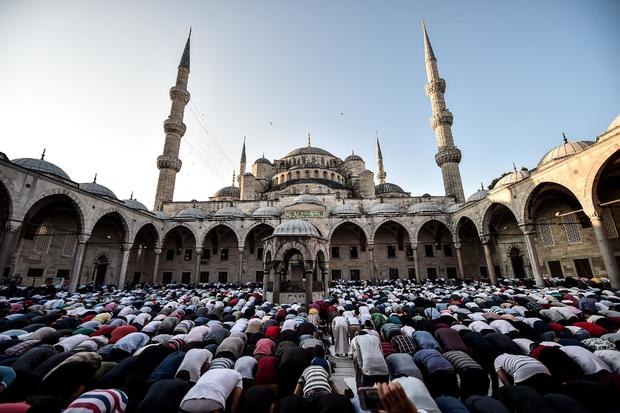
“In the eyes of history, religious toleration is the highest evidence of culture in a people. It was not until the Western nations broke away from their religious law that they became more tolerant, and it was only when the Muslims fell away from their religious law that they declined in tolerance and other evidences of the highest culture. [Pickethall]
Introduction
Presently it is a very common expression that Muslims as a community are not adjustable to the global environments with divergent cultures. The Muslims in Europe have failed to adapt to the European culture, which has become a bone of contention and Islamophobia. The Muslims settled in Europe and America come from different continents and countries, speaking different languages, belong to different races and colour but are all grouped as one cultural class due to their common values embedded by their faith in Islam. It is important that the Islamic Culture is understood in perspective for accommodating the Muslims in divergent cultures for peaceful coexistence.
Culture is a complex term, which may be defined in different ways. Cambridge English Dictionary states that culture is “the way of life, especially the general customs and beliefs, of a particular group of people at a particular time.” It may refer to all the ways in which human beings overcome their original barbarism, and through artifice, become fully human’. Terror Management Theory posits that culture is a series of activities and worldviews that provide humans with the basis for perceiving themselves as “persons of worth within the world of meaning” raising themselves above the merely physical aspects of existence, in order to deny the animal insignificance and death that Homo Sapiens became aware of when they acquired a larger brain. In the words of anthropologist E.B. Tylor it is “that complex whole which includes knowledge, belief, art, morals, law, custom and any other capabilities and habits acquired by man as a member of society.” A contemporary variant, “Culture is defined as a social domain that emphasizes the practices, discourses, and material expressions, which, over time, express the continuities and discontinuities of social meaning of a life held in common.”
Culture may also be defined as a set of patterns of human activity within a society or social group and the symbolic structures that give such activity significance. Customs, laws, dress, architectural style, social standards, religious beliefs, and traditions are all examples of cultural elements.
The word culture refers to the material products and spiritual values of a population. Then, in this situation, the values which were produced by societies with small population and even small groups could be classified as culture.
When we accept the broad spectrum of the words culture and civilization, we could say that it is possible for Islamic civilization to house more than one culture under its roof. Therefore, different societies and groups that have different languages, cuisine culture, birth and death customs, and etc., could live in unity under the Islamic civilization. However, in today’s globalized world, it is clear that cultures affect each other more and more and Islamic societies have started to show more similarity and adoption to Western cultures. In this situation, we have to discuss the possibility of Islamic culture transferring some characteristics from other cultures.
Cultures are externally affected via contact between societies, which may also produce—or inhibit—social shifts and changes in cultural practices. War or competition over resources may impact technological development or social dynamics. Additionally, cultural ideas may transfer from one society to another through diffusion or acculturation. In diffusion, the form of something (though not necessarily its meaning) moves from one culture to another. For example, hamburgers, fast food in the United States, seemed exotic when introduced into China. “Stimulus diffusion” (the sharing of ideas) refers to an element of one culture leading to an invention or propagation in another. “Direct Borrowing” on the other hand tends to refer to technological or tangible diffusion from one culture to another. Diffusion of innovations theory presents a research-based model of why and when individuals and cultures adopt new ideas, practices, and products.
Acculturation has different meanings, but in this context it refers to replacement of the traits of one culture with those of another, such as what happened to certain Native American tribes and to many indigenous peoples across the globe during the process of colonization. Related processes on an individual level include assimilation (adoption of a different culture by an individual) and transculturation. The transnational flow of culture has played a major role in merging different culture and sharing thoughts, ideas and belief.
Culture in the sociological field can be defined as the ways of thinking, the ways of acting, and the material objects that together shape a people’s way of life. Culture can be any of two types, non-material culture or material culture. Non-material culture refers to the non physical ideas that individuals have about their culture, including values, belief system, rules, norms, morals, language, organizations, and institutions. While Material culture is the physical evidence of a culture in the objects and architecture they make, or have made. The term tends to be relevant only in archeological and anthropological studies, but it specifically means all material evidence which can be attributed to culture past or present.

Islamic culture is a contentious term. Muslims live in many different countries and communities and it can be difficult to isolate points of cultural unity among Muslims, besides their adherence to the religion of Islam. Anthropologists and historians nevertheless study Islam as an aspect of, and influence on, culture in the regions where the religion is predominant. Islamic culture is a term primarily used in academia to describe the cultural practices common to historically Islamic peoples.
Because Islam originated and has developed in an Arab culture, other cultures which have adopted Islam have tended to be influenced by Arab customs. Thus Arab Muslim societies and other Muslims have cultural affinities, though every society has preserved its distinguishing characteristics. Islamic culture inherited an Arab culture born in the desert, simple but by no means simplistic. It has an oral tradition based on the transmission of culture through poetry and narrative. However, it has been the written record that has had the greatest impact on civilization. Islam civilization is based on the value of education, which both the Qur’an and the Prophet (Pbuh) stressed.
With the rapid expansion of the Islamic empires, Muslim culture has influenced and assimilated much from the Persian, Turkic, Pakistani, Mongol, Chinese, Indian, Bangladeshi, Malay, Somali, Berber, Egyptian, Indonesian, Filipino, Greek-Roman Byzantine, Spanish, Sicilian, Balkanic and Western cultures. Hence some of the cultural practices adopted by local Muslims like circumcision of females in some Arab and African countries, honour killing for marriage by choice, denying inheritance to women, etc. cannot be termed as Islamic culture but they are local in nature. Any cultural practice with the broad parameters of Islam are acceptable as part of Islamic culture while others rejected being un-Islamic.
The Spirit of Muslim Culture According to Dr. Muhammad Iqbal
Allama Dr. Muhammad Iqbal describes ‘The Spirit of Muslim Culture’, it can be summarized as:
• The unity of human origin, as a social movement the aim of Islam was to make the idea a living factor in the Muslim’s daily life, and thus silently and imperceptibly to carry it towards fuller fruition.
• It is one of the most essential teachings of the Quran that nations are collectively judged, and suffer for their misdeeds here and now.
• Divine life is in touch with the whole universe on the analogy of the soul’s contact with the body. The soul is neither inside nor outside the body… Yet its contact with every atom of the body is real.
• The finality of the institution of prophethood… The abolition of priesthood and hereditary kingship in Islam, the constant appeal to reason and experience in the Quran, and the emphasis that it lays on Nature and History as sources of human knowledge, are all different aspects of the same idea of finality.
• The idea (finality), however, does not mean that mystic experience, which qualitatively does not differ from the experience of the prophet, has now ceased to exist as a vital fact. Indeed the Quran regards both “Anfus” (self) and “Afaq” (world) as sources of knowledge. God reveals His signs in inner as well as outer experience, and it is the duty of man to judge the knowledge-yielding capacity of all aspects of experience.
• The inner experience is only one source of human knowledge. According to the Quran there are two other sources of knowledge – Nature and History.
• It is a mistake to suppose that the experimental method is a European discovery… Europe has been rather slow to recognize the Islamic origin of her scientific method. But full recognition of the fact has at last come. Let me quote one or two passages from Briffault’s Making of Humanity:
a. “… It was under their successors at the Oxford School that Roger Bacon learned Arabic and Arabic Science. Neither Roger Bacon nor his later namesake has any title to be credited with having introduced the experimental method. Roger Bacon was no more than one of the apostles of Muslim science and method to Christian Europe; and he never wearied of declaring that knowledge of Arabic and Arabic Science was for his contemporaries the only way to true knowledge… The experimental method of the Arabs was by Bacon’s time widespread and eagerly cultivated throughout Europe”
b. In the history of Muslim culture… we find that both in the realms of pure intellect and religious psychology, by which term I mean higher Sufism, the ideal revealed is the possession and enjoyment of the Infinite
[“Reconstruction of Religious Thought in Islam” Lecture-5, by Dr. Muhammad Iqbal, ‘The Spirit of Muslim Culture’]

Muhammad Marmaduke Pickthall [1875–1936]
He was a Western Islamic scholar, noted as an English translator of the Qur’an into English authorized by the Al-Azhar University and referred to by the Times Literary Supplement as “a great literary achievement.” A convert from Christianity, Pickthall was a novelist, esteemed by D.H. Lawrence, H. G. Wells, and E. M. Forster, as well as a journalist, headmaster, and political and religious leader. He declared his Islam in dramatic fashion after delivering a talk on ‘Islam and Progress’ on November 29, 1917, to the Muslim Literary Society in Notting Hill, West London. In 1927 Pickthall delivered a lecture on ‘Islamic Culture’ in Madras, even after almost a century, it remains fresh. It is being reproduced here due to its relevance and need this day.
Islamic Culture
Culture means ‘cultivation’ and, generally nowadays, when this word is used alone, it means ‘the cultivation of the human mind.’ Islamic culture differs from other cultures in that it can never be the aim and object of the cultivated individual, since its aim is not the cultivation of the individual or group of individuals, but of the entire human race. No amount of works of art or literature, in any land can be regarded as the justification of Islam so long as wrong, injustice and intolerance remain. No victories of war or peace, however brilliant, can be quoted as the harvest of Islam. Islam has wider objects, grander views. It aims at nothing less than universal human brotherhood, Still, as a religion, it does encourage human effort after self, and race, improvement more than any other religion and since it became the power in the world, it has produced cultural results which will bear comparison with the results achieved by all the other religions, civilizations and philosophies put together. A Muslim can only be astonished at the importance, almost amounting to worship, ascribed to works of art and literature (which one may call the incidental phenomena of culture) in the West; as if they were the justification, and their production the highest aim, of human life. Not that Muslims despise or ever should despise, literary, artistic and scientific achievements, but that they regard them in the light of blessings by the way, either as aids to the end or refreshment for the wayfarer. They do not idolize the aid and the refreshment.
The whole of Islam’s great work in science, art and literature is included under these two heads: aid and refreshment. Some of it, such as the finest poetry and architecture, falls under both. All of it recognizes one leader, follows one guidance, looks towards one Goal. The leader is the Prophet (Pbuh), the guidance is the Holy Qur’an, and the Goal is Allah.
By Islamic culture, I do not mean the culture derived from whatever source and attained at any given moment by people who profess the religion of Islam, but the kind of culture prescribed by a religion of which human progress is the definite and avowed aim.
No one who has ever studied the Qur’an will deny that it promises success in this world and the hereafter to men who act upon its guidance and obey its laws, that it aims at nothing less than the success of mankind as a whole; and that this success is to be attained by cultivation of man’s gifts and faculties.
If any development in Muslim society is not sanctioned by the Qur’an or some express injunction of the Prophet, it is un-Islamic and its origin must be sought outside the Islamic polity. The Muslims cannot expect success from their adoption of it, though it need not necessarily militate against success. If any development is contrary to an express injunction of the Qur’an, and against the teaching and example of the Prophet, then it is anti-Islamic. It must militate against success, and Muslims simply court disaster by adopting it.
Certain art forms were discouraged by Islam at the beginning, because of their association with the idolatrous worship of the pagan Arabs and its vicious orgies, the utter extirpation of which was necessary for the progress of the race. But the discouragement of certain art expressions and encouragement of others were both, like the works of art produced, regarded as subsidiary. The culture of Islam aimed not at beautifying and refining the accessories of human life, it aimed at beautifying and exalting human life itself. There is today a large and undoubtedly intellectual school of thought in the West which seems to hold that the production of fine works of art by a small minority of a community as sufficient reason for acclaiming the civilisation and culture of the community, even though the huge majority of its members may be forced by the social order under which they live to lead ugly and degraded lives. Nay, there is an intellectual school of thought which seems to hold that the production of fine works of art by a minority of many nations as sufficient justification for condemning the majority to conditions of perpetual ugliness, servitude and degradation.
Some of you will no doubt remember a discussion in the English press some years ago. The question was this: Suppose a famous and very beautiful Greek statue, unique of its kind and therefore irreplaceable, is in the same room with a living baby, and the room catches fire; it is only possible to save one or the other. Which should be saved? Very many correspondents, men of intellect and good position, I remember, held that the statue should be saved and the child left to perish. Their argument was that millions of babies are born every day, whereas masterpieces of old Greek art could never be replaced. That is a view no Muslim could have taken, the very latest, cultivated form of idol worship.

Islam foresees, and works for, a radiant future for the human race. And although every Muslim holds his own life cheap in the service of Allah, which is the service of humanity, he would never dream of sacrificing a human life, however seemingly insignificant, to the work of human hands. The adoration (it amounts to that) of works of art is due to disbelief in Allah’s guidance and His purpose of mankind. These things are the best that man has produced in the centuries. Beauty is decreasing, human beings are deteriorating, (so runs the argument) therefore, we must cling to those beautiful productions of the past as the one ideal left to us. That is pessimism, and Islam is optimistic – optimistic not with the “optimism” satirized by Voltaire in the character of Dr. Pangloss, the absurd philosopher, who kept exclaiming “Tout est pour le mieux dans le meilleur des mondes possibles.” (All is for the best in this best of possible worlds). That is the kind of remark which passes with the unthinking for optimism, but it is really fatalism, which is a form of pessimism, and Islam is not fatalistic. Yes, I repeat that statement. In spite of all that has been said and written of the fatalism of the Muslim Islam is not fatalistic in the generally accepted meaning of the world. It does not bid man accept the existing conditions as a necessary evil, but commands him never to cease striving for improvement.
Islam is a religion, which specifically aims at human progress, and shows the proper way of it in a number of commands and prohibitions covering every avocation of man’s daily life, his social life and politics as well as every prompting of his mind and spirit. These commands and prohibitions have been codified into a complete social and political system. It is a practicable system, for it has been practised with success, which is the great astonishment of history. Many writers have tried to explain away the amazing success of Islam by ascribing it to outside causes – weakness of the surrounding nations, free use of the sword, the credulity of the times, and so forth. But how would they explain away the fact that so long as the Muslim implicitly obeyed a particular injunction of the Sacred Law they succeeded in the sphere of that injunction, and whenever they neglected to obey . . . it failed. And who would they explain the fact that many non-Muslims, doing what the Muslims are enjoined to do, have always succeeded in that special direction, except by the supposition that the injunctions of the Qur’an and the Holy Prophet are laws for all mankind – natural law which men transgress at their peril, or rather at the peril of the race?
It was because those laws could not be found out by individual experiment, and could only partly be detected in the long run of history by a student and a thinker here and there, that thy required to be revealed by a Prophet. Otherwise they are as natural as the physical laws which govern our existence evidently and which none would dream of disputing.
Other religions promise success in another life to those who qualify themselves for it by privation and austerity on earth. Islam promises success and fruition in this life, just as much as in the other, to all men, if they will but obey certain laws and plain rules of conduct. The division between this world and the other vanishes for the true Muslim, since Allah is the Lord of the Heavens and the Earth, the Sovereign of this world just as much as of the others. The other life has its beginning now, and not at death for all who perform the act of Al-Islam, that Self-Surrender to the Will of God which the Holy Prophet meant when he advised us: “Die before you die.”
The success in this world promised by Islam is not the success of one human being at the expense of others, nor of one nation to the detriment and despair of others, but the success of mankind as a whole. Five times a day, from every mosque in the world, the call goes forth: “Come to falah! Come to falah!”
The Arabic word “falah” means success through cultivation. And there is another Arabic word, in common use among Muslims, of which the original meaning is often forgotten in its technical application: ‘Zakat’ meaning, “cultivation by pruning,” or “causing to grow straight” It is the name given to the Islamic poor rate, so frequently enjoined in the Qur’an as a duty equal to worship, which truly was a cause of cultivated growth to the community.
“A tax shall be taken from the rich and given to the poor,” said the Prophet (may God bless and keep him). When that tax was regularly collected, the condition of Muslim society became such that though the dispensers of “Zakat” sought far and wide, no proper objects of “Zakat” that is, destitute and ignorant Muslims, could be found and the money was expended upon works of public benefit.

In the Holy Qur’an we read:
“He is indeed successful who causeth it (the human soul) to grow aright,
And he indeed a failure who stunteth and starveth it.”
And again
“He is successful who groweth
And remembereth the name of his Lord, so prayeth.”
Some may think that these are mere religious aspirations and expressions apart from life. Islam is nothing if not practical, and the expressions have been no dead letter in Islam, since they were translated practically into a system of organized relief and charity upon the grandest scale ever attempted, and solved all social problems in the Muslim world for centuries. The Qur’an informs us that true religion is practical, not theoretical or formal.
“It is not righteousness that ye turn your faces to the East and the West, but righteous is he who believeth in Allah and the Last Day and the Angels and the Scripture and the Prophets, and giveth his wealth for love of Him to kindred and to orphans and to the needy and the homeless and to beggars and to set slaves free, and those who keep their promise when they make one, and the preserving in the adversity and tribulation. These are they who are sincere. These are they who keep from evil”
“Those who believe and do good.”
How often does that phrase occur in the Holy Qur’an?
“Those who believe and do nothing” cannot exist in Islam. “Those who believe and do wrong is inconceivable, for Islam means surrender to God’s will, and so obedience to His Law, which is a law of effort not of idleness. There was no distinction between secular education and religious education in the great days of Islam. All education was brought into the religious sphere.
To quote a recent European writer: “It was the glory of Islam that it gave to other sciences the same footing which it gave to the study of the Qur’an and the Hadith and Fiqah (that is, Muslim jurisprudence), a place in the Mosque.” Lectures on chemistry and physics, botany, medicine and astronomy were given in the mosque equally with lectures on the above named subjects. For the mosque was the university of Islam in the great days and it deserved the name of ‘university,’ since it welcomed to its precincts all the knowledge of the age from every quarter. It was this unity and exaltation for all learning, which gave to the old Muslim writers that peculiar quality which every reader of them must have noticed, the calm serenity of orbed [dauntless] minds.
In Islam, there are no such terms as ‘secular and religious,’ for true religion includes the whole sphere of man’s activities. The distinction drawn in the Holy Qur’an is between good (that which is helpful to man’s growth) and evil (that which is detrimental and noxious to it). Islam is a rational religion. It has no place for the man who can say, with St. Augustine: “Credo quia absurdum est”. I believe because it is incredible. Again and again the Qur’an denounces irrational religion as a religion that is evidently false. Again and again it appeals to man to use his reason and especially his common sense in religious matters. All historical experience goes to prove that a large measure of free thought is absolutely necessary to human progress, and at the same time that nations which lose faith in God, deteriorate. Are the two things, the living faith in God and the large measure of free thought, incompatible?
A considerable school of thought in the West seems to think that they are incompatible, yet Islam has proved that they are perfectly compatible. In the early and successful centuries of Islam, an intense faith in God was combined with free thought upon every earthly subject, for Islam held nothing upon earth so sacred as to be immune from criticism. There was only One Supernatural, only One Incomprehensible, Whose Unity, having been once accepted, admitted of no further discussion. He was One for all Beneficent and Merciful towards all alike, and He had bestowed on man the gift of reason, which is extolled by Muslim writers as the highest gift, to be used quite freely the name of Allah, that is to say, with the purpose of pursuing what is good and eschewing what is evil, for which the Sacred Law affords guidance and safeguards.
There is no priesthood in Islam. All the prerogatives and responsibilities which in other religions have been abrogated to priesthood, in the system of Islam are vested in the individual human mind. So the most wise and learned men became the natural leaders.
An unenlightened mind would be a sorry lamp to light the steps of any man or woman, and so this exaltation of reason carried with it the command for universal education. The Prophet himself said:
“To seek knowledge is a duty for every Muslim (male) and every Muslimah (female).”
Universal education both for men and women thus became the Sacred Law of Islam thirteen centuries before it was adopted by the civilisation of the West. He also is reported to have said (though the saying is not well authenticated:
“Seek knowledge though it to be in China.”
And the following well authenticated saying shows the importance not only of acquiring knowledge but of spreading knowledge among the people:
“Verily Allah doth not keep knowledge as a thing apart that He withholdeth from His servants, but He doth keep it in the grasp of men of knowledge, so that if He shall cause not a man knowledge to remain, mankind will make foolish heads, and they will be questioned and give fatwas, and they will err and lead others into error.”
The picture is too clearly of the present condition of Islam, when we have plenty of narrow theologians, for us to doubt, but that the meaning of the word ‘knowledge’ as here used in something wider and more human than the knowledge they possess.

He [the holy Prophet Muhammad, Pbuh] said:
• “The ink of scholar is more holy than the blood of martyr.”
• “An hour’s contemplation and study of God’s creation is better than a year of adoration.”
• “He dieth not who seeketh knowledge.”
• Whosoever revereth the learned, revereth me.”
• “The first thing created was reason.”
• “Allah hath not created anything better than reason. The benefits which Allah giveth are on account of it, and understanding is by it; and Allah’s displeasure is caused by it, and by it are rewards and punishments.”
• “To listen to the words of the learned and to instill into others the lessons of science is better than religious exercises.”
• “He who leaveth his home in search of knowledge walketh in the path of Allah.”
• “Acquire knowledge. In enableth the possessor to distinguish right from wrong; it lighteth up the path to Heaven. It is our friend in the desert, our society in solitude, our companion when friendless. It guideth to happiness, it sustaineth in adversity. It is an ornament among friends, and an armour against enemies”.
• “Lo! the angels offer their wings to the seeker of knowledge.”
• “Are those who have knowledge on an equality with those who have no knowledge?”
• “The preferment of the learned man above the devotee is as my preferment above the lowest of you.”
A man may have performed prayers, fasting, almsgiving, pilgrimage and all other religious duties, but he will be rewarded only in proportion to the common sense, which he employed. And he said that “he who has learning but knows not how to apply it to the conduct of life is “like a donkey carrying books.”
Neither the Holy Qur’an nor the Holy Prophet ever contemplated the existence of an ignorant Muslim. Indeed, “ignorant Muslim” is a contradiction in terms. In the great days of Islam, an ignorant Muslim, like an indigent Muslim, could hardly have been found.
Islam brought back religion into its proper sphere of action, which is daily life. The light of Allah, spoken of in the Qur’an, is known to everyone who follows Allah’s guidance, for it is the light of every day transfigured and glorified by the knowledge of His immanence. The aim of religion is not a far distant object situated in a future life; it is present here and now, in service of our fellow men. The idolaters of Arabia kept asking the Holy Prophet for some miracle that might enforce the truth of what he said:
“And they say: what manner of a messenger of God is this who eats food and walks in the bazaars? Why is not an angel set down to be a warner with him?”
“Or (why is not) a treasure bestowed on him? (Or why) hath he not a paradise from which he eat? The evil doers say: Ye are but following a man bewitched.”
And Allah answered the evil-doers in words, which plainly show that miracles are not a proof of the divine messenger, who must appeal to men’s reason, not their senses or their curiosity.
“We sent not before thee any messengers but such as verily did eat food and walk in the bazaars.”
That is to say, all those Prophets of old of whom the people thought as supernatural beings had been men appealing to the minds of others in God’s name.
Miracles, according to the teaching of Islam, are not the proof of divinity, much less do they violate the laws of nature which are themselves divine, being ordained of God. These are evidences of a certain stage of human progress towards the Goal, at which laws hidden from multitude become apparent. Many miracles are related of Muhammad (God bless him!) but no Muslim would think of quoting them as a proof of his divine mission. The message and the work achieved – the Qur’an and the Holy Prophet’s preaching, and their consequences – speak for themselves, and are above all miracles.
It is, of course, a fact that the majority of professed Muslims are ignorant and superstitious today, accepting a vast mass of legends and absurd beliefs. But where man’s mind is so exalted in the standing orders of the community, vain beliefs are always threatened with the sword of skepticism. Indeed a large proportion of this mass of legend and superstition merely represents the science of a bygone day. The spirit of Islam aspects it to be superseded by the science of today; for the Muslim’s mind is free in all affairs of the earth, provided that he complies with certain rules of conduct imposed with a view to his bodily, mental, and spiritual health; and it is his duty to explore the science of his day, and to accept what his mind approves of it. Aye, even though it dissipates beliefs or fancies long accepted among Muslims. It cannot touch his creed: “There is no god except Allah, and Muhammad is the Messenger of Allah” A creed which that grand old skeptic, Gibbon, pronounced to be “composed of an eternal truth and a necessary fiction.” Even he had to confess that the “fiction” had been justified in the historic sequel.
There is a great and growing tendency in the Muslim brotherhood to distinguish once and for all between the living body of Islamic teachings and the folklore, which has been thrown about it like a garment of an antique fashion. How little the discrimination of the robe affects the faith will astonish only those critics, who misled by the practice of Christianity, have identified the latter with the former, which Muslims never did.
In the Qur’an, men are bidden to observe the phenomena of nature, the alternation of day and night, the properties of earth and air and fire and water, the mysteries of birth and death, growth and decay – evidences of a law and order which man never made and which man can never bend or alter by a hair’s breath – as proof that man is not the sovereign of this world. His province of free-will, research and fruitful effort is but a delegated power within an absolute sovereignty, which absolute sovereignty belongs to Allah, the Creator and Sustainer of the Universe, the Lord of all the Worlds. Man does not, as a rule, realise the marvels of his nature condition and of the providence surrounding him, because they never fail him. Surrounded by a wonder of creative energy which never fails; placed in universe subject to a code of laws which are never broken; manifestly subject, being unable to inhale a breath, or lift a finger or speak a word or think a thought without obeying laws he never made; man in general thinks but little of such matters, absorbed in the interest of his own restricted sphere of energy, like any insect. Idolizing his own restricted sphere, he looks for a providence, which will back him in his special aims, oblivious of the needs of the whole creation and of the purpose of the Creator.
Obviously, if we admit that there is a Creator and purpose, we must not expect special treatment, but must seek to conform to the divine will and purpose in creation, then only can we hope for success.
“Nay, verily man is rebellious
That he deemeth himself independent
Verily unto thy Lord is the return.” [Qur’an 96:6-8]

Some years ago there appeared a book written by a Scottish divine – not a very interesting book, which made a little stir in the English-speaking world. It was called “The Natural Law in the Spiritual World.” I only mention it on account of the title, because the revelation of Islam might be more aptly described as: “The Natural law in the Spiritual World and in the Social world and in the Political world.” It is to the natural laws which govern man’s physical existence that Islam appeals for proof of Allah’s actual Kingship, and then goes on to show how laws precisely similar govern man’s spiritual and collective life. All the miracles related to all the Prophets and saints are held so unimportant that belief in them is not obligatory. All that is obligatory is belief in Allah’s universal sovereignty and in the mission of Muhammad (may God bless and keep him!) and all other Prophets as His human messengers. It was this natural and reasonable basis of Islam which made the greatest of German poets, Goethe, exclaim, after reading a translation of the Qur’an: If this is Islam, then every thinking man among us is a Muslim.
A section (the most vocal section) of the modern world would object to Islamic Culture on the grounds that it is unsuitable to modern thought and conditions. Being founded on principle, not democracy or aristocracy or plutocracy or any other system which has been tried in modern times, but is founded on the principle of pure theocracy.
It is not a remote ideal of theocracy to be contemplated only at hours of worship and forgotten at all other hours; but it is an actual, practical, complete theocracy acknowledged and obeyed at all times. A great European statesman is credited with having said: “The Almighty has no part in practical politics,” and the chief defect in European politics is, evidently to those who study recent history, that it makes no allowance for the unforeseen event, the Act of God, upsetting careful plans.
Allah’s law of consequences still operates; the consequence of good is still good and the consequences of evil is evil in the long run, however much men close their eyes to the fact that the Russian Revolution and the failure of the Greek attempt in our own time upon the life of Turkey are two out of many instances of the unforeseen event (the act of God) frustrating ambitions and well laid plans of statesmen, which seemed to be certain of success humanly speaking.
Indeed, to me it seems that, the position of the modern world is not at all different from that of the mediaeval world with regards to the Kingdom of Allah as preached and, to some extent, established by Islam. The objectors simply argue on a false analogy. Because the ideal of theocracy which prevailed in Europe in the Middle Ages happened to be associated with miraculous legends and church ceremonies and regarded as refuge from a wicked world. Those people postulated that all theocracy must be impractical, a hermit’s or fanatic’s dream. Miracles have been discredited by modern science, and men have come to think of the exploitation of the riches of this world and of the improvement of their own position in it as a duty.
The best think less of improving their own condition, than of improving the condition of their fellow men. Thus an ideal of theocracy based on the miraculous, and so remote from actual human needs (which was in its very nature pessimistic) regarding this world as the devil’s province and bidding all who sought salvation flee from it, may truly be regarded as antiquated and unsuitable to modern circumstances. Not so an ideal of theocracy based upon the natural and the actual.
Such an ideal is the crying need of modern life to check its suicidal selfishness – an ideal of which the foundations cannot be shaken by the discoveries of science or the thought of man, for they are in nature itself. The greater the wonders of the natural world as revealed by the progressive work of science, the more triumphantly is Allah’s Majesty and Providence and Sovereignty made clear to the true Muslim. So long as natural laws stand firm, and certain consequences (good or evil) follow certain acts of men and nations. So long must stand the need for man to recognise a higher will in human life and a purpose of his own. So long must stand the need of man’s surrender to that higher will and purpose – which is Islam, as the Qur’an teaches – if he would succeed.
Islam offers a complete political and social system as an alternative to socialism, fascism, syndicalism, bolshevism and all the other ‘isms’ offered as alternatives, to a system which is manifestly threatened with extinction the system of Islam has great advantage over all those nostrums, that it has been practised with success – the greater the success the more complete the practice. Every Muslim believes that it must eventually be adopted in its essentials by all nations, whether as Muslims or non-Muslims in the technical sense, because its laws are the natural (or divine) laws which govern human progress, and men without the revelation of them, must find their way to them in course of time and painfully, after trying every other way and meeting failure.
The system of Islam promises peace and stability where we now see the strife of classes and of nations and nothing steadfast. It would surely be mere folly on the part of any one to refuse even to study the advantages or disadvantages of such a system merely because it is a system founded on the thought of God, and claiming to have been revealed by a Messenger of God. That would be sheer bigotry of atheism.

But it is not only because it is theocratic that the Islamic system of human culture is despised. It is because of the position and conduct of the Muslims in the world today and yesterday and for many yesterdays Christendom in the Middle ages could not consider it because Christendom was then in bondage to the priests who then, as to day, called Muhammad (may God bless him!) “the false Prophet,” and would not allow anyone even to think that his religion might hold anything good and useful to mankind. And the tradition of war between the followers of the two religions has been a mighty barrier until the present time, perpetuating intolerance. Today, when the barrier is practically down, the position of the Muslims in the world its not such as to lead outsiders to suppose that such men know the secret of the way of human progress. The conduct and condition of Muslims now is very bad advertisement for the teaching of Islam. It is not astonishing if people, seeing it, should turn away and think Islam to blame far their abasement. The point is, that Islam is not to blame for this, any more than ecclesiastical Christianity is to be praised for the present material progress of Christendom. Christianity had a priesthood and no freedom of thought. The centuries in which the Christian Church was supreme are now referred to as Dark Ages. Islam had no priesthood, it had freedom of thought, and the ages when Islam prevailed in all its purity were the ages of a singularly clear and brilliant light. It is their falling away from pure Islam which has brought ruin to the Muslims, their acceptance to something indistinguishable from a priesthood. Or in the words of the Qur’an, their “taking others for their idols besides Allah”, their pleasure in the scholastic quibbles, their neglect of advice to seek knowledge everywhere as a religious duty, their denial of free thought and their distrust of reason. At a certain period of their history, they began to turn their backs upon a part of what had been enjoined to them, they discarded half the Shar’iah – the part which ordered them to seek knowledge and education, and to study God’s creation. And the Christians of the West about the same time, began to set according to that portion of the Shar’iah which the Muslims were discarding, and so advanced in spite of all the anathemas of their priesthood. The reason why it was ordained that there should be no priesthood in Islam is because ecclesiasticism is an enemy to human progress, and, therefore, opposed to true religion, of which the aim is shown in the Qur’an to be the progress and the liberation of humanity, not its stagnation and enslavement. Muslims all over the world are now awake to this; they knew that their humiliation is their own handiwork, and they see that they can only regain a noble status in the world by a return to Islam.
You may think that in this lecture I have wandered from my appointed subject, which is culture into the religious field. Islamic culture is so intricately bound up with religion, so imbued with the idea of Allah’s universal sovereignty that I could not treat the subject properly without first giving you the indications I have given in this first address. In its grandeur and in its decadence, Islamic culture (whether we survey it in the field of science, or of art, or of literature, or of social welfare) has everywhere and always this religious inference, this all-pervading ideal of universal and complete theocracy. In all its various productions (some of them far from being what is visually called religious) this is evident. It is this, which makes Islamic nationalism one with internationalism. For, acceptance of the fact of Allah’s universal sovereignty entails acceptance of the complementary fact of universal human brotherhood. [Extract from an abridged version of the 1927 Lecture of Muhammad Marmaduke Pickthall,]
The Turkish Cultural Transformation Experience
Turkey, a Muslim country for centuries, located at the gate of Europe has gone through a unique experience of transforming from Christian East European Byzantine empire to Ottoman Muslim Empire, spread over three continents (Europe, Asia and Africa) having Muslim, Christian, Jewish and people from other religions, different races speaking different languages as citizens. After the collapse of the Ottoman Caliphate, secular Turkey emerged, which tried to divorce the past, changed alphabets from Arabic to Latin with intentions to integrate with Europe. But it failed to convince Europe, now reconsidering its Islamic heritage and culture in secular environments. Dr. Sinan Ylmaz is Assist. Professor and Head of Department of Sociology at Karabuk University – Turkey delivered a talk on “The Uniqueness of Islamic Culture”, excerpts:
The Uniqueness of Islamic Culture
Culture and civilization are two words that sometimes are mistaken for each other even though they are two completely different terms. Sociologists and historians still have not reached a settlement on the scopes of these words. The famous Muslim historian and sociologist Ibn Khaldun had used the Arabic word “Umran” means both civilization and culture. On the other hand, Turkish scholar Ziya Gokalp inserted that the word “Harth” meant culture, making a differentiation between the words; culture and civilization and supported that a culture in the circle of Islamic culture can join the circle of Western culture. Gokalp has taken the word “harth”, which he had used to define culture, from Qur’an:
“And when he is in authority, he runs about in the land to create disorder in it and destroy the crops and the progeny of men; and Allah loves not disorder.” (Al-Baqarah, 206)
In this verse, the word “harth” stands for “crop”. The crop of a population is its culture and if the culture of a country were to decline a disorder or chaos takes place.
It seems a better approach to say that civilization has a wider usage range than culture does considering that a civilization brings different people from different cultures together. The word culture refers to the material products and spiritual values of a population. Then, in this situation, the values which were produced by societies with small population and even small groups could be classified as culture. On the contrary, the world “civilization” has a broad usage area and could include all the cultures that show common characteristics in a civilization.
When we accept the broad spectrum of the words culture and civilization, we could say that it is possible for Islamic civilization to house more than one culture under its roof. Therefore, different societies and groups that have different languages, cuisine culture, birth and death customs, and etc… could live in unity under the Islamic civilization.
However, in today’s globalized world, it is clear that cultures affect each other more and more and Islamic societies have started to show more similarity and adoption to Western cultures. In this situation, we have to discuss the possibility of Islamic culture transferring some characteristics from other cultures. Here focus is on the unique values of Islamic culture and the relationship between Islamic culture and Western culture.

Islamic Culture and its Qualities
The Islamic culture is different from other cultures, and it is a unique culture. The reason of this is its challenging to the all of the cultures with the claim of being the representative of the justice and truth. There are some verses indicating the uniqueness of the Islamic culture in the Qur’an. We can exemplify the following verses:
“Do they seek a religion other than Allah’s …..” (Âl-Imrân, 84) “And who seeks a religion other than Islam, it shall not be accepted from him, and in the life to come he shall be among the losers.” (Âl-e Imrân, 86)
“He it is Who has sent his Messenger with guidance and the religion of truth, that He may make it prevail over all other religions.” (Al-Fath, 29).
When we analyze these verses, we cannot see a word bringing culture or civilization to mind in them. The common point of these verses is their emphasis on the truth and uniqueness of Islam. Even if the word “religion” does not have a meaning bringing the meanings of culture and civilization to mind, this word has an important relation with culture and civilization. When we look at the culture and civilization classification of sociologists and historians, we can see that there is no agreement between them. However, when we look at the valuation criteria of those categorizing culture and civilization, in addition to the main factors as geography, language, ethnicity, and common history, religion is definitely involved in these criteria. Moreover, it can be said that religion is the most important one among these factors. It is expected that people sharing the same geography resemble each other. However, a person’s living in any place does not mean that he/she adopts the dominant culture of that region. Today, the regions especially allowing immigrants can be exemplified for this. Similar things can be stated for common language and common ethnicity origin. However, even if their residence, language and ethnicity are different, it is expected that people having the same religion share many things common with each other.
This set forth the uniqueness of the Islamic culture. As the verses mentioned above indicate that Islam is the only valid religion, the Islamic culture should also be the only valid culture among the other cultures. It is also possible that we can evaluate this claim according to rules of logic.
According to rules of logic, an inference has more than one truth values. The inference’s having only one truth value in all of the truth values means that it is true. However, in order for this inference is considered valid, all of the truth values should be true. Similarly, in order to consider any cultural factor as Islamic, it should not conflict with the rules and values established by Islam. On the other hand, it is certain that the other cultures conflict with the Islamic culture in some aspects. This is what causes the Islamic culture being unique among the other cultures.
The claims stated here bring the question to mind that in case the Muslims behave improperly according to Islamic faith (due to non adherence to the core values and practices of Islam) how this case can be explained by means of the Islamic culture. In order to overcome this problem, we need to distinguish the Islamic culture and the cultures of the Muslims.
The Cultures of Muslims and Islamic Culture
Even if the statement of “the cultures of Muslims” seems like the statement of “the Islamic culture” at first glance, in fact; it is not correct. Just as the other people who do not believe in God, the Muslims are human beings too and they sometimes may make individual mistakes. However, the mistakes that the people had made individually concern themselves and other members of their groups or the religion that they believe in cannot be held responsible for those mistakes; because Allah would not order people to do wrong. There are many verses of Quran expressing such cases:
“Verily, Allah enjoins justice, and the doing of good to others, and giving like kindred; and forbids indecency, and manifest evil and wrongful transgression.”(Al-Nahl, 91)
And so, although culture is stated as set of material and moral values that a society produces, cultural values that Muslims have produced non-compliantly to the spirit of faith and the rules of Islam cannot be described as Islamic. Therefore, some Western journalists’ effort of harmonization of Islam and terrorism is an injudicious one. This effort is a rhetoric form of dispraising Islam by combining the word of Islam and with a negative meaning word, terrorism. However, it is proved to be nothing more than fallacy when analyzed.
To be able to keep away from this fallacy, it is required to differentiate between the concept of Islamic culture and the culture of Muslims. The cultural values of the Muslim societies produced only those values which are in harmony and not in conflict with the spirit of Islam and compatible with the rules of Islam are considered as part of Islamic culture. The cultural elements that are seen in Muslim societies, but are against the rules and spirit of Islam can be called the culture that belongs to some Muslims not Islam. Therefore, in the overall assessment of the culture of Muslim societies, it should be preferred to use the concept of ‘Muslim Culture’ or the ‘Cultures of Muslims’ instead of the concept of the Islamic culture.
The concept’s being used in this way also paves the way for cultures being different and varied in the face of oneness and universality of Islam. When we take the Prophet Muhammad’s (peace be upon him) statement: “The diversity of the Ummah is God’s compassion”; into consideration, it highlights that being diverse is not an obstacle for being Islamic, and cultural factors belonging to the Muslims having different thoughts can be assembled under the same roof. The best method to explain this situation is the usage of the words; culture and civilization together. Here, civilization corresponds to religion and Islam. For this reason, just like the religion, which is indivisible, the civilization is also the same and unique. In that case, it is possible to mention that there are Arabic Culture, Turkish Culture, Persian Culture, Indonesian Culture and Indian Muslim Culture under the umbrella of Islamic civilization.

Relationship between Culture and Civilization-Turkish Experience
We can evaluate the relationship between culture and civilization taking the Turkish example which has passed through transformation. Let us consider the thoughts of the founder of sociology in Turkey, Ziya Gokalp, known in Turkey as the founder of sociology. The time in which he lived was the time period in which Islamic societies had shown the worst decline against the Western societies around the World War-1. Not only Gokalp but also other intellectuals of the Ottoman Empire were looking for a solution to this decline. Arguments they had were focused on modernization, Westernization and Islamization. While some of the thinkers suggested that the society should hold on tightly to their Islamic values to end the decline while some suggested that the society should take Western countries as examples.
The main focus of the arguments they had in those times was how Western culture and Islamic culture or Western civilization and Islamic civilization could blend together. Those who were in favor of Islamic values clearly knew that this blend could never happen. In addition, they did not think this was necessary. However, those who were in favor of Westernization thought that being Muslim could in no way act like a barrier to Westernize. One of the greatest representatives of this argument was Gokalp, who expressed his opinions by saying” I am from the nationality of Turks, the Ummah of Islam, the civilization of West. Gokalp tried to explain the Westernization process of his time with the division of culture and civilization. According to him, a culture belongs to a nation, but a civilization belongs to the nations or societies.
Furthermore, with the establishment of the republic in Turkey, as it started to become modernized, it also became Westernized. Modernization actually has the same meaning as Westernization (in Turkish context). The main reason why Western civilizations have succeeded over the past two centuries is that they had exported their culture into other nations. This cultural export has happened, because people adapted to Western cultural values, whether forcefully or willingly, as they started to adopt the Western culture as a role model. Thus, nations which do not belong to the Western civilization have Westernized as they having modernized.
The question arises as to how a culture could be affected by another one and is this possible or not. In order to find an answer, we first have to talk about the theories of disappearance of cultures and civilizations over time, because, some sociologists think that this is possible but the other not.
Turkdogan, after asserting that nations having weak cultures will join the circle of nations with strong cultures, says that Turks have changed their circle of civilization twice in the history. Turks, firstly, belonged to the Far-East (European) civilization after which they had jointed the circle of Eastern civilization (civilization of Islam). Lastly, they have (again) tried to join the circle of Western civilization. [Even in Christian Byzantine (East) their East Orthodox Church remained different to Roman Catholics. The traditional variant of Orthodox Christianity present in Turkey is the Eastern Orthodox branch, focused mainly in the Greek Orthodox Church.]
Even though, saying that Turks have tried to join the circle of Western civilization would be inappropriate for Turkish society, we cannot deny that first governors of Turkish Republic carried this aim. However, after nearly a century had passed, today we can see that it has not happened. The Turkish nation had left the circle of Far Easter European civilization because they converted to Islam. However, they could not join the circle of Western civilization, because they did not convert to Christianity. This problem of cultural incompatibility is one of the main reasons why Turkey is not being accepted into European Union, considering its high potential labor force and strong economy. Scientists like Toynbee, Danilevsky and Spengler analyze cultural change on the basis of civilization. However, their approach is being criticized by Sorokin. Sorokin claims that these three sociologists have mixed up civilization or culture with various social groups. Social groups have a finite lifespan. Their life spans, according to their characteristics, can last as short as only a few centuries, or, in some rare cases, a few millennium.
However, a social group disintegrating does not mean that its members are dead or that the civilization it was a part of has collapsed. Culture or a part of civilization can be passed down to other social groups (Sorokin-Toynbee, 1964). Sorokin asserts that even though ancient Egypt, Sumeria, Babylonia and Roman Empire had collapsed, the civilization and culture these countries had developed is still visible in the socio-cultural world in an original or modified way. We shall examine the arguments about culture and civilization with the current situation of Islamic culture and civilization.
To be continued
References
http://AftabKhan.page.tl