
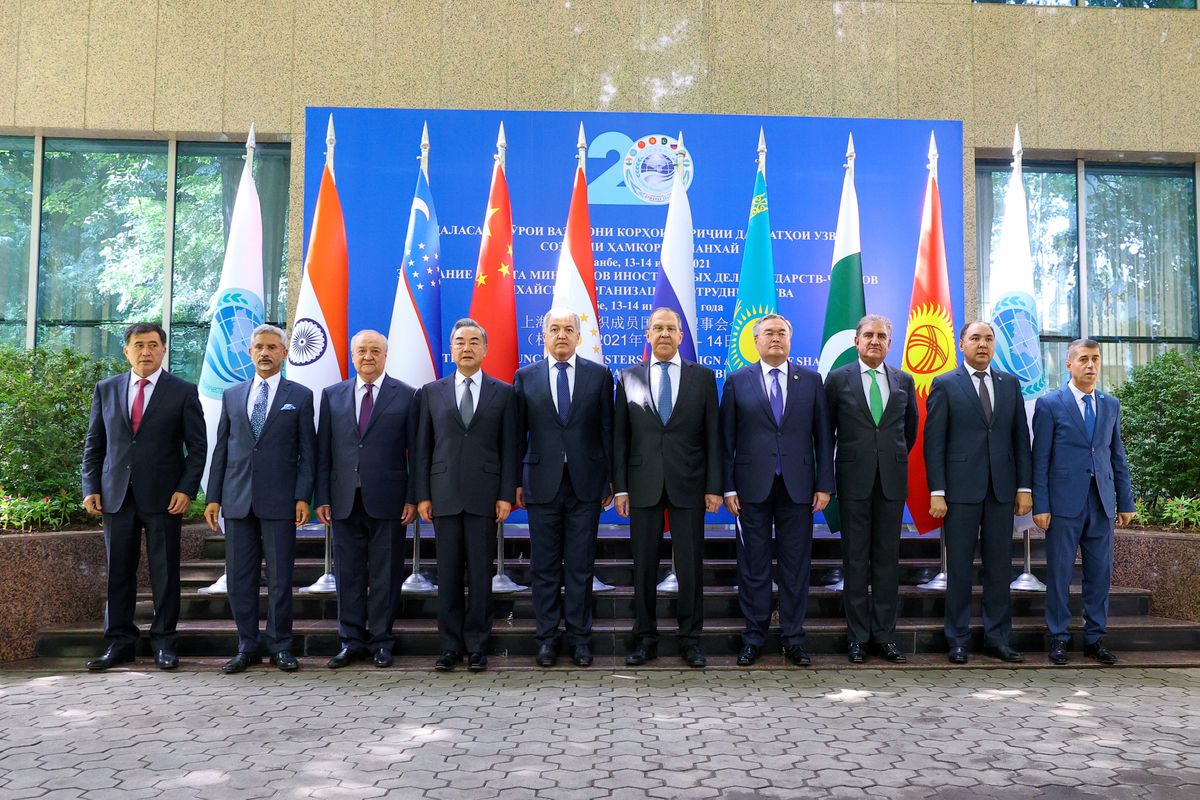
The recent Shanghai Cooperation Organisation (SCO) summit occurred in the shadow of sudden and dramatic events in Afghanistan that resulted in the emergence of Afghan Taliban rule after 20 years. It can’t be said for certain whether any of the SCO member countries and western stake holders were prepared for such a scenario. This un-expected re-emergence of the Taliban in Afghanistan shocked the world community because everyone was expecting some sort of resistance from Afghan National defense forces. But it is said when the leadership is corrupt, the common people on the street are usually least bothered about them and people are prone to welcome any change that is exactly what happened in Afghanistan when Ashraf Ghani fled along with other high-ranking officials including Hamid Ullah Mohib and Amr Ullah Salih. The collapse of Afghan forces within a matter of days demonstrates clearly the mega corruption, while creating a three hundred thousand plus strong military force many were ghost soldiers. These events led to development of mistrust and disloyalty for the ruling leadership amongst the rank and file of Afghan forces. Many were expecting some stiff resistance from Ahmad Masood in Panjshir valley, but here too the situation turned out to be not much different than the rest of Afghanistan. The bottom line is that Afghanistan is now under Taliban rule.
The real first challenge for the Taliban upfront is to form an Inclusive government that could be representing all groups in Afghanistan. Although Pashtun faction is a major reality but other minorities make up a significant portion of the country. One of the outcomes of the SCO summit is that different factions in Afghanistan are now in talks with Taliban under the facilitation of Tajik President Emomali Rahmonov and Pakistan’s Prime Minister Prime Minister Imran Khan. This is one of the major diplomatic wins for Pakistan for facilitating such mediation. We may expect more world acceptance to the new realties in Afghanistan after the successful formation of an inclusive government.
Handling the terror outfits in Afghanistan is one of the major challenges for the Taliban government. There are many regional and international terror outfits in Afghanistan such as TTP, ISIS, BLA, and others. Considering BLA and TTP were supported by India, in the past Ghani and Karzai era regimes, intentionally or unintentionally, did not understand the sensitivities between India and Pakistan, they rather stressed that Afghanistan is free to choose when it comes to foreign relations thus totally ignoring the fact that India is using Afghan soil against Pakistan. The Indian role in Afghanistan is quite disturbing to Pakistan’s interests. It is known fact from various resources that India was supporting TTP & BLA terror networks with help from the notorious ex-Afghan National Directorate of Security (NDS).
ISIS is the major threat to peace and stability in the region and Afghanistan itself. It has been said frequently by intelligence and diplomatic resources that some dominant forces are intentionally brining ISIS in Afghanistan so that Russian, Iranian and Afghan Taliban influence could be countered. This claim could be evident from recent ISIS attacks in neighboring countries and particularly against the Shia and Hazara community. The role of Indian RAW cannot be ruled out in igniting and financing ISIS efforts in the region because it is in the sole interest of India to promote ISIS in the region so that greater objectives under new strategic blocs could be fulfilled. The region is experiencing the worst type of intelligentsia warfare and the center stage is Afghanistan.

ISIS is mainly active in the eastern side of Afghanistan near Pakistan-Afghanistan border. Basically, same old TTP terrorists showed allegiance to the Islamic State and became part of Daesh. We already know that the TTP terror group is basically RAW and ex-NDS sponsored elements who were based in eastern Afghanistan under their umbrella. It cannot be a coincidence that ISIS emerged by itself with remote sponsorship, in fact, various reports suggest an active RAW hand in converting TTP groups into ISIS with help from some other agencies. So, the creation of ISIS in Afghanistan, especially in the eastern side with the Pakistan border is part of the greater agenda. For any inclusive government in Afghanistan, ISIS is the major challenge to be handled in months and years to come.
The Durand Line issue is another international issue between Pakistan and Afghanistan that has to be settled since this is the border between the two. Pakistan inherited the Durand Line agreement after its independence in 1947 but there has never been a formal agreement or ratification between Islamabad and Kabul. The previous Afghan government has not formally accepted the Durand Line as the international border between the two states, claiming that the Durand Line Agreement has been void in the past. This complicated issue is very sensitive to both the countries. The Afghan government worries that if it ever ratifies the agreement, it will permanently divide the 50 million Pashtuns and thus create a backlash in Afghanistan. Pakistan feels that the border issue had been resolved before its birth in 1947. This complicated border has always served as the main trade route between Afghanistan and the South Asia, especially for supplies into Afghanistan. Shortly after Pakistan gained independence in 1947, Afghanistan crafted a two-fold strategy to destabilize the frontier regions of Pakistan in an attempt to take advantage of Pakistan’s post-independence instability. All previous Afghan regimes strongly aligned with Pakistan’s rival, India and then the USSR, which later invaded Afghanistan in 1979.
After the Soviet withdrawal from Afghanistan in 1988 and then the collapse of the USSR Afghanistan was engaged in internal civil war for a few years and witnessed power struggle between various Mujahideen groups. The Pakistan Embassy in Kabul also came under attack and was burnt while the Ambassador was also badly injured when Afghan groups attacked the Embassy during that lawlessness period. Around September 1994, the Taliban movement captured Kandahar and began its long conquest, they claimed that they wanted to clean Afghanistan of warlords and criminals. In late 1996, the Islamic Emirate of Afghanistan emerged and established close relations with neighboring Pakistan. However, even with good relations the Taliban refused to endorse the Durand Line despite pressure from Islamabad, arguing that there shall be no borders among Muslims. When the Islamic Emirate of Afghanistan was toppled and the new Afghan government was formed, President Hamid Karzai began repeating the previous Taliban statement. So, for the current Afghan government under Taliban, the Durand line issue will be one of its international challenges.
Pakistan has a lot of opportunities in the current Afghan situation and with the Taliban government to deal with and resolve many lingering issues of the past. It is very important for Pakistan to analyze the Afghan population racially and see what is best to convert it into friendly nation. Eastern Afghanistan is Pashtun and are in line with our Pashtun population, but we need to pay attention to other races living in Afghanistan like Tajik, Uzbeks and Turkmans. Of course, their native nations Tajikistan, Turkmenistan and Uzbekistan should have some influence on these races so we must also engage with Central Asian States in order to get their support to try and neutralize 40% of non-Pashtun Afghans. This is the huge diplomatic challenge we will have to overcome. The ECO bloc can play a key role in this regard as well as initiative taken by Moscow recently to help resolve the Afghan issue in which Pakistan and China are key players along with Russian and Iranian involvement. Pakistan must provide utmost economic benefits to Central Asian States so as to create some leverage and influence for strengthening in the areas of economic zone. Our diplomats must be aggressive and proactive in order to gain influence over these land locked states. Afghanistan cannot be living isolated if Central Asian States engage strongly with Pakistan.

Pakistan should encourage Pakistani businessmen investing in Afghanistan by means of building highways and infrastructure thereby achieving more influence to keep the Afghan people on its side. This will help revert the negative image that some lobbies have created about Pakistan. Afghanistan is a war-torn country and badly needs infrastructure development. India gained huge advantage by investing massive amount of dollars in a bid to show their inclination and interest towards Afghanistan, although their real intention was always to curb Pakistan from the western side.
Pakistan should effectively maneuver the land-locked status of Afghanistan for the benefit of both countries and avoid further hostility. This is an important area and should be used with sagacity and diplomatic means. For example, when Pakistan stopped NATO supplies after the 2011 Abbottabad raid thus leveraging the land locked status of Afghanistan for diplomatic maneuvering. Recently Pakistan closed all borders with Afghanistan because of terrorist attacks, subsequently and law and order situation improved after this closure. While the economy of Afghanistan felt a tough and strained period during this border closure resulting in prices of utilities peaked and resulted in an impression on Afghan society that Pakistan is vital for Afghanistan’s prosperity and matters concerning day to day Afghan lifeline. Pakistan’s Rupee is a powerful tool and is being utilized widely inside Afghanistan. This is again an area to ponder about and enhance the zone of influence inside Afghanistan. Keep in mind that Indian currency is not being utilized at all in the manner Pakistani currency is being used in day-to-day Afghan business transactions.
Pakistan also must pay attention towards image and perception building amongst the people of Afghanistan. In fact, Afghanistan did not accept Pakistan since its creation and always kept itself involved with those States that were traditionally hostile to Pakistan. Moreover, Pakistan is being highlighted as a hostile nation in Afghan syllabus taught in schools, colleges and even universities. This is one reason of the hostility and must be dealt with aggressive diplomatic engagement with any Kabul regime on how to modify Afghanistan’s educational curriculum for positive elaboration. As an example, Turkey is the key ally of Pakistan and its people have great love and respect for Pakistan one reason is Turkish literature tells its people how people from the western sub-continent (now Pakistan) had suffered fighting the British government in favor of the Ottoman Caliphate. It is the same with China where there is a saying from Prophet Muhammad that “travel to China for the sake of knowledge”. Also, Pakistan’s poet Muhammad Iqbal mentioned China as a rising sun from east that must be followed. These historic sayings and events leave long term impression amongst nations’ relationships with each other. Pakistan has to work with the Afghans on how to change this hostile image and try convert the minds of academics and intellectuals. This is a diplomatic task and will have to be taken care of very carefully but aggressively.
Afghanistan and Pakistan must engage through Parliamentary delegation interactions. All high-level issues like the Durand Line border status, visa and refugee issues and future relation building must be addressed with a strict timeline and deliverables. We have observed that some interaction took place recently between two parliaments and dialogue is in progress as well, but it must be time and result oriented. The Indian RAW and ex-NDS alliance against Pakistan can be discussed in this forum as well in order to create realization amongst Parliamentarians to watch such spoilers in future.

Finally, an effective border management is acutely necessary in order to control and regulate the law and order situation in Pakistan since it was established that main TTP and JUA terrorists entered Pakistan from the free Afghan border crossings during previous regime’s tenure. Good steps have been taken by Pakistan like building gates on the border to regulate visa entries and building fence across the western border. This is very important and will create an image and sense of realization amongst Afghans that Pakistan is as tough to enter without proper visa as any other country in the world. Moreover, Pakistan should look into pockets of people amongst the Afghan refugees who are friendly towards Pakistan, since two generations were born in Pakistan from 1980 till today. This can be a source of strength rather than weakness. All we need is to identify these pockets of people, our intelligence agencies must have information about who is trustable and who is not. This shouldn’t be difficult. Moreover, Pakistan can offer education visas to deserving Afghan students and also reward Afghan intellectuals who want harmony between the two countries and use the media strength of both countries to elaborate it. This is bound to create a sense of trust between the two. There should be many in the Afghan political system who may want strong links with Pakistan rather than with India. We must leverage those favorable groups of Afghan society on all fronts with care and utmost attention.
I am optimistic if above mentioned steps are taken into serious consideration, things might revert, and the table may start reversing slowly as far as people-to-people interaction is concerned. With the US/ NATO departure, the emergence of ECO and SCO blocs and the Taliban government, the strategic and socioeconomic paradigm has totally changed. The question is, how this change will be digested by the QUAD is yet to be seen.