






Bridging Pakistan’s Last-Mile Financial Gap
– Agent Interoperability & The Strategic Rise of Third-Party Agent Network Service Providers (TPANSPs)
Pakistan’s financial landscape is at a critical juncture. In the last fiscal year, the country witnessed a staggering 6.2 billion digital transactions, signalling a rapid shift toward a “Digital First” economy. However, beneath these headline figures lies a persistent challenge: a substantial portion of the population remains outside the formal financial net.
To bridge this “Access and Usage” gap, the State Bank of Pakistan (SBP) has introduced a transformative vision—the Agent Interoperability (AIO) Switch.
Operated by the Virtual Remittance Gateway (VRG), this initiative serves as a cornerstone of the National Financial Inclusion Strategy (NFIS) 2024–2028. The NFIS strategy aims to increase financial inclusion from 64% in 2023 to 75% by 2028, with a specific focus on reducing the gender gap. To achieve these ambitious targets, Pakistan is moving away from fragmented, bank-specific silos toward a unified ‘One Network’ approach.
The Paradox of Progress: Why Digital Needs Physical Touchpoints
Despite the surge in mobile wallets, Pakistan remains a cash-heavy retail economy. For millions of citizens, particularly in rural areas, the ‘digital’ journey begins and ends with a physical touchpoint. Cash-In/Cash-Out (CICO) points are the vital organs of the branchless banking ecosystem. As of early 2025, SBP data shows over 722,000 registered agents across the country. Yet, until recently, these agents were largely restricted to serving customers of their own specific bank or mobile money provider.
This fragmentation created a ‘convenience tax’ on the unbanked. A customer might walk miles to an agent, only to find that the agent does not support their specific bank. The Agent Interoperability Switch dissolves these barriers, allowing any customer to walk into any participating retail outlet and access their funds, regardless of where their account is held.
The Vision: A Network Without Silos
The AIO Switch is designed to deliver full, seamless connectivity across all networks. By making foundational services network-agnostic, the industry is creating a shared ecosystem that is both sustainable and commercially viable for all players.
The initial scope of the switch focuses on three high-impact, core services:
1. Account Inquiry: Instant balance checks across networks to build user trust.
2. Inter-Bank Cash Transactions: Seamless Cash-In and Cash-Out (CICO) operations.
3. Biometric Verification: Secure, NADRA-linked identity authentication at the agent point, ensuring that even high-value transactions remain safe.
The Strategic Rise of Third-Party ANSPs
A critical driver of this revolution is the integration of Agent Network Service Providers (ANSPs). These are non-licensed entities—such as fuel station chains, kiryana store aggregators, and community-based retail networks—that already manage extensive footprints.
In the traditional model, a bank had to build its agent network from the ground up, a process that is both capital-intensive and slow. By leveraging ANSPs, the ecosystem can achieve ‘mass onboarding’ via existing aggregators.
In this scenario, VRG will be responsible for onboarding these entities onto its regulated platform, subject to rigorous due diligence. To qualify, ANSPs must meet several criteria:
● Legal Status: Must be a recognized legal entity fulfilling VRG’s operational guidelines.
● Operational Readiness: Proven ability to manage field operations, including agent training and monitoring.
● Compliance: Strict adherence to SBP standards regarding AML/CFT (Anti-Money Laundering and Countering the Financing of Terrorism), data privacy, and information security.
● Technical Integrity: Secure system connectivity with VRG’s platform via updated IT architecture.
This shift represents a fundamental change in the business case for branchless banking:
● Traditional Model (Bank-Led): Characterized by high CAPEX and slow individual agent onboarding.
● Agent Interoperability Model: Characterized by low CAPEX, rapid scalability, and the ability to leverage existing retail loyalty.
Operational Framework and Security
The division of labor ensures both efficiency and regulatory safety. While the ANSP manages field operations and agent acquisition, VRG acts as the regulated platform operator. VRG’s responsibilities include:
● Platform Management: Operating the gateway for domestic routing and processing.
● Reconciliation: Submitting daily reports detailing transaction volume and status to member institutions.
● Dispute Resolution: Managing customer grievances through integrated software channels.
Technical Architecture: Security at the Core
For a national switch to succeed, security cannot be an afterthought. The AIO Switch employs AES 128-bit encryption for sensitive data, including biometric finger templates and One-Time Passwords (OTPs).
One of the most important aspects of the VRG platform is its ‘Switch Only’ architecture. To protect customer privacy and bank sovereignty, no customer data is stored on the VRG switch. All accounts, wallets, and transaction records reside solely within the customer’s primary bank. The switch acts as a secure router, facilitating the communication between the agent and the bank without ever ‘owning’ the data.
Furthermore, the system is built for 24/7 reliability. Hosted on high-availability PTCL Cloud infrastructure, the switch features automatic rerouting to a Disaster Recovery (DR) site in the event of a primary site failure, ensuring that the ‘digital bridge’ never goes down.
The Journey of Agent Interoperability: From Agreement to Action
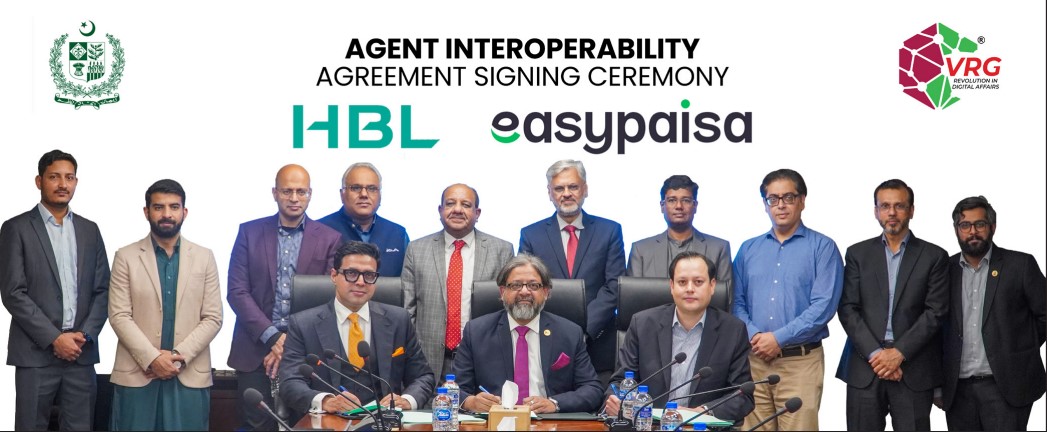
The path to interoperability was formalized on January 15, 2025, with a historic agreement between Virtual Remittance Gateway (VRG), HBL Konnect, and Easypaisa. This partnership established the framework for a unified platform, proving that even fierce competitors can collaborate when the goal is national financial health.
Following a successful pilot phase, a consultancy session on November 21, 2025 introduced the framework to the wider industry. Experts highlighted that the AIO framework is particularly vital for the ‘middle of the pyramid’—those who have a phone but still rely on human interaction for complex financial tasks.
Settlement: The Engine of Trust
Behind every retail transaction is a complex financial process that ensures therelevant commission of the agent, the bank, and the customer are all settled at the end of the day. The AIO Switch utilizes the SBP RTGS (Real-Time Gross Settlement) System to handle settlements on a T+1 basis.
This process is split into two critical streams:
1. Liabilities Settlement: Ensuring that the fund transactions at the agent level are accurately reflected in the net balances between the issuer and acquirer banks.
2. Acquirer Fees Settlement: A transparent mechanism for distributing transaction fees among the participants, ensuring that even small retail agents are incentivized to provide high-quality service.
Economic Impact and NFIS 2024-28 Alignment
The implementation of the AIO Switch aligns perfectly with the five strategic pillars of the NFIS 2024-28:
● Digital Innovation: By using USSD (via the Asaan Mobile Account) and interoperable switches, the strategy reaches users without smartphones or expensive data plans.
● Consumer Protection: Integrated dispute resolution software within the VRG platform ensures that grievances are handled transparently.
● Access Point Expansion: Moving banking services into everyday retail environments (the ANSP model) solves the ‘last mile’ problem that traditional brick-and-mortar branches cannot.
● Gender Inclusion: Providing banking services at local community stores makes it easier for women to access financial services in a culturally familiar and safe environment.
Commercial Viability of Third Party ANSPs: The ‘Aggregator’ Advantage
The business model for TPANSPs in Pakistan is now more viable than ever due to several shifting market dynamics:
● Diversified Revenue Streams: Unlike a single-bank agent (who only earns from one bank’s transactions), a TPANSP agent earns from cross-platform utility:
● CICO (Cash-In/Cash-Out): Deposits and withdrawals for multiple banks/EMIs.G2P Payments: Handling government disbursements (like Benazir Income Support Program payments) alongside private remittances.
● Bill Payments & Subscriptions: Serving as a physical touchpoint for Netflix, Spotify, or local utility payments.
● Asset-Light Growth for Banks: Traditional banks are currently aggressively reducing ‘brick-and-mortar’ costs. Instead of building their own kiosks, they are outsourcing the ‘last mile’ to TPANSPs. This creates a steady B2B revenue stream for the TPANSP via ‘network-as-a-service’ contracts.
● Merchant Onboarding (P2M): Under recent 2025 SBP circulars, all banks are mandated to digitize their merchants. TPANSPs are the primary beneficiaries, as they provide the hardware (POS) and software (QR) that allow a small ‘Kiryana’ store to accept payments from any bank app.
Contribution of TPANSPs to Interoperable Services
The TPANSP is the physical manifestation of Interoperability. While Raast provides the digital rails, the TPANSP provides the human interface.
● Breaking ‘Walled Gardens’:
Historically, if you had an EasyPaisa account, you had to find a EasyPaisa agent. TPANSPs are dismantling this. In 2026, a single TPANSP-managed agent acts as a ‘Universal ATM’, allowing a SadaPay user to withdraw cash from an agent primarily branded by a different provider.
● Raast Integration:
TPANSPs are now integrating directly with Raast’s P2M (Person-to-Merchant) and P2P (Person-to-Person) APIs. This allows them to offer real-time, low-cost transfers across different financial institutions at the storefront level.
● Standardization of KYC: By using third-party networks, the industry is moving toward a biometric-first standard (linked to NADRA). This means a customer can be verified once by the TPANSP and then perform transactions for any of the 30+ member banks.
The Road Ahead: A Global Benchmark
Pakistan is not alone in its quest for interoperability. Global success stories from India’s ‘UPI’ and Brazil’s ‘Pix’ show that when a regulator mandates a common ‘rails’ system, the entire economy benefits from increased transaction velocity and reduced costs.
However, Pakistan’s model is unique in its focus on Agent Interoperability. While other nations have focused heavily on person-to-person (P2P) digital transfers, Pakistan recognizes that physical cash will remain a reality for the foreseeable future. By ‘digitalizing the cash point’ through the AIO switch, the country is creating a hybrid model that respects the current economic reality while building the infrastructure of the future.
Conclusion
The ‘One Network’ revolution is more than just a technical upgrade to Pakistan’s financial landscape. It is a social mission. By turning every neighborhood store into a potential bank branch, the Agent Interoperability Switch is democratizing access to capital and financial security.
As we move toward the 2028 NFIS targets, the collaboration between the SBP, VRG, and third-party ANSPs will be the deciding factor in whether Pakistan can finally close the gap between its digital potential and its physical reality. The message to the fintech world and the decision makers is clear: in Pakistan, the future of banking isn’t just in your pocket—its at your corner store.