
A Complex History of Cooperation and Confrontation
Abstract
The importance and future of Afghanistan for the US strategic and economic forces has shaped the ongoing strategic dialogues. Whereas, strategic and economic forces in Pakistan are busy in negotiating their interest with the US officials to achieve not only the economic prosperity that has been affected by playing a frontline state role for the ongoing war on terror but also a strategic loss that US and NATO interference has provided to Pakistan by supporting unfriendly forces in Afghanistan. The clash of interests and priorities between US and Pakistan will remain a bone of contention in the success of ongoing strategic dialogues which is in fact a bridge and an effort to define the future of Afghanistan. What kinds of clash and priority interests are on the table of both sides? Interestingly the interests are the same with different orientations. For example, it seems clear with the tone and strategic attitude of the US that their priority goal is to promote India and to counter China’s interest in Afghanistan, which is not in the list of Pakistan’s strategic thought. These are not the only objectives or policy priorities for both actors involved but compromise on these issues is something invisible and most controversial aspects of strategic dialogues. Economic aid, military support, and developmental projects are something normal procedures to help facilitate the states to promise and ensure long-term commitment in bilateral relations so that the nations should feel more close and warm relations with each other. But here the context and definition of strategic dialogue is not a traditional orientation of relations. Pakistan is a country that is suffering the most out of its partnership with US and NATO’s ‘global war on terror’. It is very difficult to predict who will get what but the most predictable thing in international politics is its unpredictability especially when it comes to deal with strategic interests of states. This paper will highlight and try to analyze the cooperation of US and Pakistan in the context of ‘Strategic Dialogues’ and the nature of relationship between Pakistan and Afghanistan with an ideological orientation.
US-Pakistan Strategic Dialogues and Nature of their Cooperation
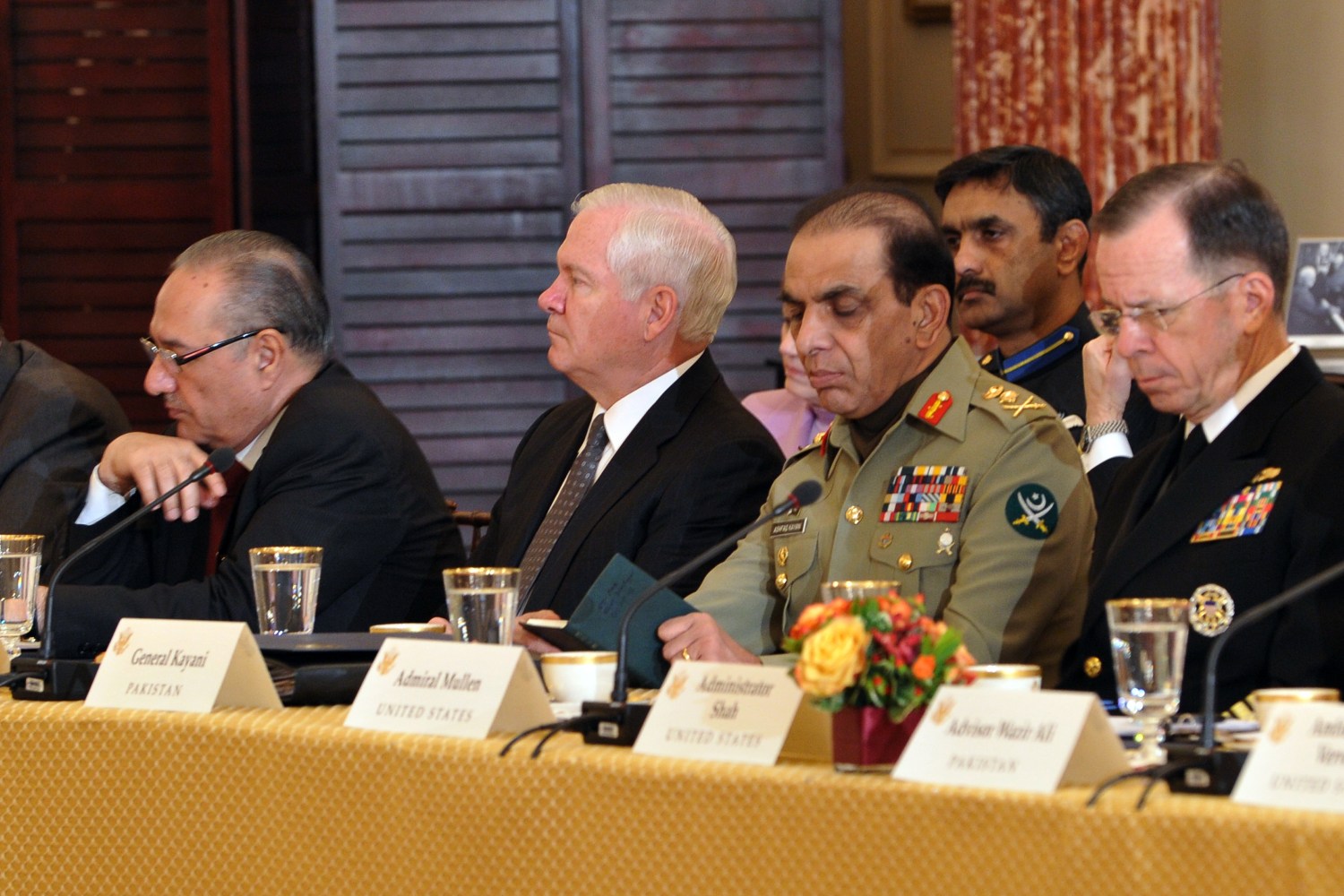
(i) First Round of Strategic Dialogue: In the month of March 2010, the United States and Pakistan started their first Strategic Dialogue at the Ministerial level in Washington, DC. Pakistan’s Foreign Minister Makhdoom Shah Mahmood Qureshi and Secretary of State Hillary Rodham Clinton co-chaired the talks that included high level officials to discuss the planned issues. The nature of the discussion topics were not strategic in its nature but based on common concern and shared responsibilities such as economic development, water and energy, education, communications and public diplomacy, agriculture, and security. The key demands and expectations connected with the dialogue were somewhat ambiguous and over exaggerated although economic aid and military assistance was ensured. For example the US promised to provide an annual $1.5bn aid package to Pakistan’s civil sector for the next five years. Although Islamabad did not get approved a key demand to revive its declining industry to use US trade access for its textile exports, something that would be more effective than aid. Pakistan military was also compensated around $1bn in outstanding dues for fighting the war against militant and promised to receive future military funding and new weapons including F16s, helicopters and naval frigates on a faster pace. On the issue of civil nuclear deal, US rejected Pakistan’s plea to facilitate, a deal which is very important for Islamabad to meet her energy needs.1
(ii) Second Round of Strategic Dialogues: The thirteen separate working groups were made after the first meeting of the strategic dialogue who met regularly over a three month period of times to discuss the technicalities of the issues. In continuation of those Ministerial level meetings, Foreign Minister Makhdoom Shah Mahmood Qureshi and Secretary of State Hillary Clinton participated in the plenary session of 2nd meeting of Strategic Dialogue that took place at the Foreign Ministry in Islamabad on July 19 where co-chairs of the thirteen working groups presented opening remarks followed by readouts.2
(iii) Third Round of Strategic Dialogues: In continuation to the ongoing strategic dialogues the third and latest round of talks were held in Washington, DC in the month of October where $2 billion were pledged by the US to purchase US-made arms, ammunition and accessories from 2010 to 2016 in military aid to Pakistan.3 The package will complete in a five years of time framework and is subject to the congressional approval.4
(iv) Issues of Cooperation and Confrontation: There are many issues that have direct influence over decisions and policies developed by Islamabad and their counter-parts in USA that need in-depth analyses. Even though Pakistan may be a crumbling state unable to provide its people with electricity, water, security or jobs, the army’s bargaining power with the US has increased dramatically. That is due to increases in its nuclear arsenal, its stepped-up fight against the Pakistani Taliban after years of dithering and its influence over the Afghan Taliban as the US and NATO prepare to start pulling out of Afghanistan next year.5 Other than above mentioned strengths and weaknesses one need to understand issues of concern that people in Pakistan have projected time and again.
Issues of Priority for Pakistan
(i) Drone strikes,
(ii) Transfer of civil nuclear technology,
(iii) US trade access for textile exports,
(iv) Increasing Indian influence in Afghanistan,
(v) Kashmir issue and Indian human rights violations,
(vi) Overdue presence of CIA in Pakistan, etc.
Historical Understanding of the US Strategic Thought
The March 2010 strategic review in U.S. foreign policy objectives had unveiled US policy for Pakistan, and Afghanistan to disrupt, dismantle, and defeat the Al-Qaeda. That confused and ambiguous strategic thought based on a failed intelligence stated that the Al-Qaeda was actively planning attacks on US from safe havens in Pakistan. Unfolding a new US strategy to defeat Taliban and Al-Qaeda, Obama said Pakistan must be ‘stronger partner’ in destroying Al-Qaeda safe havens. In that connection, he said Pakistan would be provided financial assistance of $1.5bn each year for the next five years. Was Obama trying to meet with increasing challenges of terrorism or he was promoting the very best interests of U.S. in the region? Both questions are not time-tested as today political means have nothing to do with statements or actions. The important thing is to understand U.S. interests in the region with its long history.
The end of the Cold War, with the demise of the Soviet Union, has led to a drastic restructuring of the great powers priorities in the international system. The shift from a bipolar world, with competing ideologies and economic systems, has given way to a loose multi-polar system, due to the victory of the dominant western ideologies liberal capitalism. But the question we have to find answer is how a developing country like Pakistan is affected by these global changes especially after 9/11. During the Cold War era, due to the geo-strategic position of Pakistan it’s foreign and defence policies have been determined by global conflicts within the system, shaped by the victor states of the Second World War. With the end of the Cold War system, the constraints and opportunities for Pakistan have undergone to a significant changes.
There were constraints and opportunities for Pakistan during the Cold War but the world political system is now controlled by economic strength. Pakistan has been exploiting the opportunities offered by the Cold War international system to solve its security dilemma. It was able to use rivalries between the global powers to its advantage, like some other Third World countries, under the global policies of containment of communism, formation of military and security alliances, arms races and interventions. To counter the security threats from the region first of all Pakistan was entered into alliances with the Western camp, then adopted the non-alignment stance and once again pursued policy of active alignment as a front-line state in the US fight against communism in Afghanistan. In this way Pakistan was able to protect its territorial integrity and pursue a foreign policy which permitted it to modernization of its military muscle, exploiting conventional as well as nuclear options.
Post-Cold War world scenario has increased constraints than opportunities for Pakistan. Perceived Indian dominance threatens Pakistan’s security and this time the global environment is not able to compensate for its regional weaknesses. The decade of 1990s have brought a lack of foreign policy options for Pakistan…
i) The continued problem of Kashmir,
ii) The stoppage of US economic and military aid,
iii) Continued American pressures to forego Pakistan’s nuclear program and,
iv) Not signing the nuclear non-proliferation treaty (NPT) unilaterally has brought a limit
to options for Pakistan foreign and security policies.
Particularly after 9/11, options for Pakistan has not only limited but failed because of weak diplomacy. Economic condition and ongoing tensions with our neighboring countries like India are further destabilizing political options for Pakistan. The questions which need our careful attention are:
(i) Can Pakistan overcomes global constraints by solving regional problems?
(ii) Does the answer lies in solving regional problems through a greater degree of self-reliance and usage of regional organizations like the South Asian Association for Regional Cooperation (SAARC), Organization of Islamic Conference (OIC) and Economic Cooperation
Organization (ECO)?
(iii) Can Pakistan rely on the Muslims of West and Central Asia to fulfill its goals of its
self-reliance policy?
Pakistan’s objectives have not changed with the transformation of the international political system from bi-polarity to lose multi-polarity but the challenges we got need new means to meet international stakes and concerns.
The United States Policy Role in South Asia
The post-1945 U.S. South Asian policy was guided by the fact that the region, which contained one-fifth of the world’s population; would be a valuable asset in the struggle of the “Free World” against Communism.6
The U. S. National Security Council (NSC 5409) laid down the following four objectives for the U.S. policy towards South Asia:
1) The first objective contained three components:
(a) strong, stable governments,
(b) friendly to the U.S, and
(c) with the will and ability to resist Communism within and outside.
2) The second objective also contained three components:
(a) greater cooperation among the South Asian countries,
(b) greater cooperation between them and the Free World,
(c) full recognition that their interests are served thereby.
3) A third objective was the improvement of the basic economies of the South Asian nations.
4) The fourth objective contained two components:
(a) military strength contributing to area stability and
(b) contributing to the stability of the Free World.
The U. S. policy towards South Asia was reviewed in 1957 (NSC 5701). It laid down that the U. S. operations in the region should be developed in accordance with the objectives which are: the continuance of non-Communist governments willing and able to resist Communist blandishments or pressure from within and without, an increased association and identification with the South Asian governments, and people, and with the Free World community, lessening of tensions in the region, stable, strong and, if possible, popularly-based governments, increasingly sound and stable economies, and a posture of military strength contributing to area stability and appropriate to the defence of the Free World.
In the Cold War era, the US perception of India was influenced by its global imperatives. The fundamental premise of the US post-1945 India policy originated from the fact that India being the largest country in South Asia (which contained one-fifth of the world’s population) would be a valuable asset in the struggle against Communism. It was also considered one of the leading powers of the world and prominent among the Asian-African countries.
The Current Phase & US Post Afghan War Policy
Until 1989, when the Soviet troops withdrew from Afghanistan, Pakistan played a critical role in the Reagan Administration policy of confronting the Soviet Union. Much of the equipment and arms for Mujahedeen were routed through Pakistan. Pakistan also carried out political campaign against Moscow in UNO, OIC and the non-aligned movement. In February 1989, the Soviet Union completed the withdrawal of its forces from Afghanistan. It was then that the US policy completely changed. A Bush-Gorbachev summit towards the end of the year proclaimed the end of Cold War.
As far as South Asia is concerned, the importance of the region lessened for the US and Pakistan ceased to be a frontline state.
Generally describing the US policy in the post-Cold War era in South Asia has changed particularly depending on the international politics. Some of the following challenges facing the US in South Asia can be identified:
1. War Against Terror,
2. Search for regional peace, stability and security,
3. Reducing proliferation of weapons of mass destruction,
4. Maintaining & advancing democracy in the region,
5. Combating narcotics traffic,
6. Stemming Islamic extremism,
Furthermore, US also wanted to maintain its pressure in the Gulf. Beside these shifts there are certain elements in the American foreign policy that remained unchanged. These are:
1. Maintaining global and regional balances of power favorable to US,
2. Promoting a trading and monetary system conducive to American prosperity,
3. Supporting democratic, political systems, rule of law and human rights,
4. And lastly managing change and instability in such a way that American interests are safeguarded.
In South Asia the US encouraged India to play the role of a regional leader. Furthermore, Pakistan faced immense pressure from the international community about its ongoing nuclear development, which becomes an irritant between Washington and Pakistan after the end of Cold War. Meanwhile Washington’s was pursuing 3-D agenda for Pakistan included de-ideolisation, de-militarisation and de-nuclearisation of the country. The end of the Cold War proved an everlasting opportunity for India to strengthen her political and economic say in the world affairs. To work such regional in particular but global political objectives the government provided refueling facilities to the US aircraft, transiting from Far East to the Gulf through India. As a consequence an IMF loan of $1bn was cleared through US backing and India was permitted to purchase a second super computer from US. Further loans from the IMF and World Bank followed as a reflection of Washington’s support.
Hence in 1992, India became the second largest recipient of World Bank loans that totaled $2192 millions. In April, 1992, a deal to sell India some defence equipment, of a type already supplied to Pakistan was finalized. However, by a series of developments over the subsequent months the US gave an impression that it mistrusted Indian intentions. A New York Times editorial on 28th April, 1992 stated that “not only had India abandoned the ideals of Mohtama Gandhi but it had built up formidable armed forces and used them to starting more war in the past 40 years, than any other country. Nevertheless at the same time US also realized the role of India as a potential partner in the Indian Ocean.
US Policies towards Pakistan followed an opposite course. Its support for Pakistan completely finished. Instead what followed was the suspension of aid under Pressler Amendment, and expression of dis-satisfaction over drugs control and accusations of terrorism. The US shift towards India had caused dis-satisfaction and resentment in Pakistan. After the stoppage of aid in October, 1990, Robert Oaklay issued another formal letter, informing the Pakistan government that if dialogue of renewal of US aid is not finalized by May 31, then American assistance to Pakistan will be finally cancelled. This letter put a seal on the political, economic and military assistance between the two states.
Senator Larry Pressler visited India in May 1992 and declared that India & USA “are beginning to write a new chapter in the history of their relationship,” and he said he believed “it will be a more positive relationship.”7 Such a cordial relationship in the process of development is still obviously because of the fact that India has military and political resources and it can use these, in a manner useful, or harmful to USA, and thirdly it is close and moderate enough to be influenced. Therefore, the USA would encourage India to normalize Indo-Pak relations, encourage her to continue dialogue with China and thirdly persuade her to accept a non-proliferation agreement. One can define U.S. relations with India based on cooperation, pressure, and persuasion, which further depends on political intensions of India.
It was clear that Washington’s relations with Pakistan in the 1990’s would not be the same as in the 1980’s. In 1989 President Bush had certified to the Congress that Pakistan did not posses a nuclear device; however he failed on October 1, 1990 to do so and the nuclear question invited some decline. Under the Pressler Amendent of 1985, this stated that US President has to certify annually to Congress that Pakistan does not possess a nuclear explosive device. Washington’s view was that Pakistan had crossed the nuclear threshold. Washington to cease production of highly enriched uranium, and production of weapons components. Pakistan offered many times the inspection of its nuclear installations and to sign NPT if India does the same. It also wants declare of the Indian Ocean and South Asia as a nuclear free zone. On the other hand, China’s accession to NPT in March 1992 brought new pressures upon Pakistan to become a party to NPT.
US nuclear policy towards India, however was more flexible. Leonard Spector made the disclosure that between 1983 to 1985, India clandestinely imported 250 metric tons of heavy water and commissioned 3 of its plutonium plants that form the backbone of its capability.8 However, since 1992 USA is pressuring both India and Pakistan to roll back their nuclear weapons programs. In my view US is willing to tolerate nuclear-armed India, with medium ranged missiles but it will not allow India to have ICBMs.
No doubt War against terror is a top U.S. strategic objective but in addition to that nuclear issue, the issues of self-determination, democracy and human rights are vital issues. However, the US seems to be acting quite opposite to what it preaches. For instance, the recent movement of self-determination in Kashmir has attracted US President Barrack Hussain Obama attention during his political campaign even his recent statements raised suspicions in Indian minds. The US denial not to put pressure on India and to play her due role in solving the Kashmir issue is a sign of total dissatisfaction for the peace loving people. The Noble Peace Laureate is neglecting the Kashmir issue and also Indian human rights violations in the occupied territory will not be acceptable for the people of Pakistan. Over the years and particularly in the current phase, the US does not seem to support the Kashmiri right of self-determination. Instead, it is only pressurizing India and Pakistan to engage in a dialogue. This shows that on one hand Washington accepts Kashmir as a disputed territory and on the other hand it acts as though Kashmir is already an integral part of India. History shoes us dual face of U.S. policy on Kashmir as they wanted to declare Pakistan a terrorist state on her support for Kashmir.9 This meant that US put Pakistan in the category of Syria, Libya and Sudan. The US policy over Kashmir has largely been a policy of negligence because accepting the Kashmiri cause would also assure self-determination movements all around the world which would destabilize the status quo and hence US clings to the policy of crisis dissipation.
Post 9/11 USA
Post 9/11 United States of America is a declining power economically but still maintains her image of sole superpower militarily. Can US economy sustain its role of dominant world power as it has been playing during the Cold War period? This is the major question in the minds of the Americans and is being asked all around the world. The Americans are frightened of the global isolation because of ongoing economic recession all around the world. Paul Kennedy in his famous book The Rise and Fall of the Great Powers argues that great powers of the past expanded militarily to the extent that their economies could no longer supported their military adventures and gave rise to defence dilemma.10 He calls it “Imperial over-stretch.” This imperial over-stretch caused the decline of the great powers of the past. Similarly, to that viewpoint US power is declining day by day and its presence in Afghanistan is a biggest challenge confronting its superpower identity if it failed to achieve what it want.11
The US economy in the post-Cold War era is in a very bad shape. The economic warfare is being waged among the industrialized nations on the world. Japan, China and European Union are emerging economic lions of the world and are engaged in economic warfare against the United States of America. Tokyo is going to become the financial capital of the world and Japans relations with its neighboring countries will improve as their domestic pressure is not allowing U.S. political wills to define their future.
The withdrawal of the former Soviet Union forces from Afghanistan and the signing of Geneva Accord by Junejo government in 1988 were historic achievements and major diplomatic victories for the UN, the US, and Pakistan. The Geneva Accord had generated hope for peace in the country but with the 9/11 incident and ongoing war against terror, the infighting in Afghanistan seems to be nowhere nearing its termination. In the post Cold War geo-political realities the Afghanistan issue has assumed enormous significance for the world.
What precise factors would lead to a debacle of the US foreign policy in this region in the context of the Afghan imbroglio are very obvious but it would be naive to expect that the resurgence of nationalism and sub-nationalism would not reactivate the otherwise dormant politico-religious traits in the region as well as on the globe. These traits would be further reinforced by the general feeling amongst a section of the world populace that the New Strategic Order wants to bring them into a permanent state of subjugation of those who adhere to a different set of politico-religious values. If the US does not take into consideration this factor, it is going in for a flawed approach toward these people. If the US is banking on India as its regional pillar of power to contain or to counter this trend, this is not a wise choice either. Such a decision would be counter-productive because India itself is likely to break into several ethno-national entities which would go against the tenets of the US New Strategic Order. Iran, Russia, Pakistan, and China are included recently for long term strategic balance but will it work practically has lots of initiatives to do.
Afghanistan, Pakistan and the Peace Process: Analysis in the Light of Ideological History
Peace in Afghanistan is in larger interests of the region as well as the world. Pakistan’s role in ongoing Afghanistan imbroglio is mediatory but had been perceived as being the central importance. This is because it was assumed that in view of the relationship Pakistan developed with various ‘Afghan Mujahedeen’ outfits in the course of their struggle against the former Soviet intervention. Many experts of the Afghan situation believed that “…foreign interest in and access to Afghanistan could only be mediated through Pakistan.” Pakistan had a keen interest in the resolution of Afghan conflict as it was rooted in legitimate concern for the development and progress of Afghanistan. There were over three million Afghan refugees on Pakistan soil, whose presence further increased terror activities in Pakistan. Moreover, in view of the traditional friendly relations of successive Afghan regimes with India, Pakistan wanted to ensure that any regime established would be friendly to Pakistan. Because friendly and stable Afghanistan could ensure Pakistan’s overland access to the newly independent states of Central Asia and promise of strategic depth for Pakistan’s security vis-à-vis India.
In a world of strategic competition where leading powers of international politics are always negotiating and adjusting their objectives, dialogues between economic liberals (USA) and ideological champions (Pakistan) has developed a unique importance. Since their direct interaction and cooperation in Afghanistan against the former Soviet Union both had developed a unique relationship. The US was helping Pakistan to counter its economic and strategic competitor the Soviet Union whereas Pakistan was involved in Afghanistan purely on the basis of ideological interpretation of ‘Muslim Brotherhood’. Obviously there were many other factors also involved to fight against a communist Soviet Union but the main force to mobilize the war was ideological and often remembered as ‘Afghan Jihad’. During those times ‘Afghan Mujahedeen’ were not only recognized but projected as ‘saviors of the world’. Why they were recognized and what they have done for the World? The international appreciation and recognition was purely on the basis of their fight against ‘Communist Empire’, because the so-called ‘Capital Empire’ labeled the Soviet Union a threat for the world. The disintegration of the Soviet Union and Pakistan backed Mujahedeen’s victory emerged as an unbelievable strategic success since the Second World War. The fruits of this so-called success were not seen within Cold-War competitors but also Germany and Afghanistan itself were liberated from a communist threat. Is that true?
After the demise of Soviet Union as an economic and strategic competitor the US emerged as a sole super-power in the affairs of international politics. During that time lot of other ideological connections were being established by the victors of ‘Afghan Jihad’ on the same pattern when after the Second World War the victors developed a world system and divided ‘Veto Powers’ between them. The competition of power divided them into two ideological blocks, the Capitalism and Communism that ended after the episode of ‘Afghan Jihad’. Jihadist forces in Pakistan, Saudi Arabia, United Arab Emirates, and scattered in other part of the Muslim and Western world formed an ideological identity based on the principles of USA. After the ‘Afghan Jihad’, these ideological forces concentrated on the cause of Kashmir and Palestine because for them India and Israel were also threat for humanity because they are killing innocent people by occupying their territories. Although this ideology was not supported and facilitated by any single Muslim state including Pakistan, Saudi Arabia, and United Arab Emirates other than recognizing ‘Taliban Regime’ during 90s. Presence of such forces mainly in Afghanistan remained unchecked and free to develop their own version of political Islam which with the passage of time was exploited by many internal and external actors involved to project and to crush their causes.
Immediately after the incident of 9/11 when United States of America launched a military campaign against the so-called Al-Qaeda and to through ‘Taliban Regime’, all ideological forces came together to fight against the US and NATO forces based on the same principle when Afghan Mujahedeen started their confrontation against Communist Soviet Union. It is important to mention here that Muslim states were not in a position of supporting them or stopping them not to fight against US and NATO forces in Afghanistan mainly because of strong religious affiliations present in their societies. Starting from Turkey to Indonesia, from a clean-shave Muslim to beard-one, every Muslim society has strong affiliation with religious forces when it comes to deal a clash or competition with a non-Muslim society. Religious forces and affiliation does not mean their relationship with Al-Qaeda, which to my knowledge has no grounds and recognition anywhere in the Muslim world other than exploited segment of Muslim youth. In other words Al-Qaeda is not their true representative and is disliked by the 99% Muslim population in the world. But more than 90% Muslim population around the world do support and feel comfortable with the religious interpretation of social and political life. That is why Muslim societies around the world are conscious about ‘War on Terror’ and how Muslim states are playing their cards/role make them aggressive or suppressive to rogue elements. The main demand from their side is not to help any force in the world that is trying to malign Muslims and Islam as a religion of terrorism. This popular demand from the Muslims is increasing the gap between Islamic states and their societies. That is why states with majority Muslim population do not try to push the idea of ‘Global War on Terrorism’ as a war against Islam, but on the other hand because of international pressure mainly by the Western countries these states are in a situation of total paralyses.
Among those majority Muslim states, Pakistan is the most strongest and religiously a vulnerable country. Other than Israel Pakistan is the only country that is known as an ideological country in the world that got birth on the map of the world based on the ‘two nation theory (Muslim vs. Hindus)’. That ideological interpretation of Islamic Pakistan got another dimension during the period of ‘Afghan Jihad’. This success and international recognition by the US gave rise to the religious forces in Pakistan. Immediately after the disintegration of Soviet Union; Pakistan as a state was stacked between three different philosophies of international politics; strategic, political, and ideological. Politically Pakistan was a partner of USA and a strong member of China’s strategic thought but ideologically its foundations got a new religious orientation that aligned its social roots with Saudi Arabia and Iran; an affiliation not in favor of economic liberals in the world. That is why when USA moved its concentration after the Soviet withdrawal from Afghanistan, Pakistan was the only country that has to deal with emerging situation of Afghanistan to secure its strategic, political, and ideological interest in the region. In the wake of lawlessness in Afghanistan, Taliban emerged as a recipe of peace against war-lords. The political and religious interpretation given by Taliban was not only a threat for Pakistan but their strong social connections in Pakistan raised strong suspicions in Islamabad. Pakistan has to formulate a policy to either counter the Taliban phenomenon or to bring them into a mainstream of international politics. So, Pakistan, Saudi Arabia, and United Arab Emirates recognized the Taliban regime to help them formulate a government in Kabul. That is how they were restricted and legally convinced not to expand their ideology beyond Afghanistan borders.
Pakistan’s strategic relationship with Taliban regime continued with a mixed approach because the international world was not willing to accept the Taliban regime and to bring them into a mainstream politics. The 9/11 incident, global war on terror phenomenon, the expansion of global security on the name of weapons of mass destruction and human rights has changed everything on the tables of states other than those who managed to happen these changes. After ten years of continues distress and failed strategies, once again the managers and craftsmen’s of ‘new world order’ are trying to fix unfixed strategic blunders in Afghanistan. Pakistan is a leading player who has the capacity and capability to fix everything because of its cultural, linguistic, strategic, political, religious, and ideological ties with Afghan nation. The most important affiliation of Pakistani nation with Afghan nation is not territorial based but a legacy of brotherhood is the most powerful unit between them. If Pakistan is sidelined then the future of Afghanistan will be totally chaotic.
Concluding Remarks
The real trouble with the US is the resurgence of Islamic philosophy in Afghanistan. As US perceives Islamic ideology and religion a credible threat to her interests in the region. Being a frontline state in war against terror Pakistan should not forget about the national objectives related with friendly ‘Afghan State’. Afghanistan can be a national security objective for the USA but for Pakistan it is a legitimate strategic objective. Although there is trust deficit between US and Pakistan but one thing is clear that the success of ‘war on terror’ is highly dependent on Pakistan’s support. Keeping this strategic gap in her view, Islamabad should be realistic in its future policy goals and options. A single step without calculation can throw us into the darkness of history. Pakistan is not getting a very ‘special treatment’ vis-à-vis India and is being asked to submit to US interests by compromising on strategic issues. In other words Pakistan is being forced and pressurized to surrender its sovereignty and accession to the US-India security arrangements in the region, which should not be accepted by Islamabad. We have our own priorities and national objectives, Pakistan should bargain every dimension before committing its support towards regional and international political maneuverabilities.
End Notes
1. Please see for more details, “US-Pakistan dialogue with a difference”, BBC (April 2, 2010). Available online at: http://news.bbc.co.uk/2/hi/south_asia/8592472.stm {Accessed on October 18, 2010}.
2. Please see for more details, “U.S.-PAKISTAN STRATEGIC DIALOGUE”, US Embassy Islamabad (July 19, 2010). Available online at: http://islamabad.usembassy.gov/uspakstrategicdialogue.html {Accessed on October 17, 2010}.
3. See for more details, “US announces $2 billion military aid to Pakistan”, Daily Times (October 23, 2010). Available online at: http://www.dailytimes.com.pk/default.asp?page=2010\10\23\story_23-10-2010_pg1_1 {Accessed on October 23, 2010}.
4. Please see for more details, “US offers Pakistan $2 billion in military aid: Clinton”, Dawn (October 23, 2010). Available online at:http://www.dawn.com/wps/wcm/connect/dawn-content-library/dawn/news/world/03-us-offers-pakistan-two-billion-dollars-in-military-aid-clinton-ss-04 {Accessed on October 23, 2010}.
5. For more details please see, “US-Pakistan dialogue with a difference”, BBC (April 2, 2010). Available online at: http://news.bbc.co.uk/2/hi/south_asia/8592472.stm {Accessed on October 15, 2010}.
6. Department of State, FOREIGN RELATIONS OF THE UNITED STATES (FRUS): 1955-1957, Vol. VIII, South Asia, (Washington, U.S. Govt. Printing Office, 1987), pp. 11-15.
7. Special report, Friday Times, Press Review, Vol. IV, Issue: VI/1992 May-June, p. 53.
8. Ghani Eirabi, “US Switch on Kashmir”, in The News, Islamabad, 15th July 1992. p. 8.
9. It was in May 1992 that US Ambassdor Nicholas Platt gave a letter to P.M. Nawaz Sharif from James Baker, which threatened to declare Pakistan as a terrorist state, unless Pakistan ceases to support the freedom struggle in Kashmir.
10. Paul Kennedy, The Rise and Fall of Great Powers (London: UNWIN, 1988).
11. Ibid.