

Extract from Volume 6 (Passage to Nowhere) of Ikram sehgal’s
“A Personal Chronicle of Pakistan”
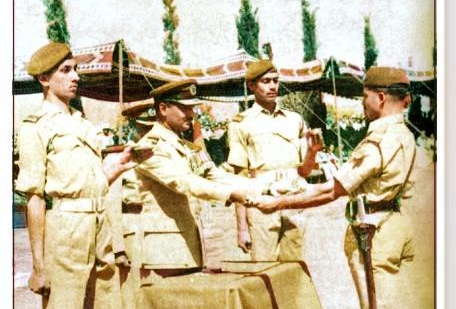
Lt Gen Lehrasab Khan did not know he was a ‘Volunteer’ for Operation Gibraltar until he reached HQ 12 Division in Murree. It is difficult to get much out of him about what happened in those fateful months but from time to time he does part with his recollections, a story of grit and survival, it had to be once you were sent in without proper training, logistics, communications, adequate maps, etc. Lehrasab Khan came back from Occupied Kashmir with only a few of the contingent he left with. Those men lying in unmarked graves on lonely mountain tops and distant valleys still brings lumps to his throat.
Once 2 EB had come back to peacetime location in Jessore from the Forward Defended Localities (FDLs) in 1966, we came to know that we were to swap places with 1 EB in Lahore. I met Capt. (later Lt Gen) Lehrasab Khan for the first time in my life when he came with the 1 EB advance party taking over all our stores and equipment. Since everyone else had gone on leave, it fell to my lot to hand those over to him. Although he outranked me by miles, this did not deter me from shuffling all our deficiencies e.g. the gas masks. After a few days he asked me, ‘youngster, how many gas masks are you short?’ I decided to tell him the truth, about ‘125’ which we were short of. He said, ‘let me sign for the lot well received but please, youngster, do not steal the gas masks back every night’. We have been good friends since, I have never ever seen him do anything that I would not be proud of. I cherish his friendship today as much as I did 55 years ago. He is as upright today as he was then.
Lt Gen Lehrasab Khan was born at Jajja, a village, 50 km southeast of Islamabad on 7 April 1940. With two generations already having served in the army, he was groomed in an environment where the profession of soldiering continued to be a priority because in classic rural environment, in an undeveloped area, there was very little scope to explore any other avenue.
Lack of educational facilities and economically starved, the region was encouraged to provide common fodder for the British war machine during the First and Second World Wars. While Independence for the Indian subcontinent was being affected by the simmering residual effect of the Second World War.
In such circumstances, he attended a primary school 5 kms away from his village. This was taken as a blessing for the young ones of the area. After primary education, he joined an ex-Khalisa school in a town known as Sukho. It is now named Islamia High School. This town was again also 7-8 kms away from his village but was the only school in the area where before partition non-Muslims could study and were privileged to learn English.
In 1956, he did his matric from this school, and joined Government Degree College for further education. During the 4th year he was selected for a commission in the army, joining PMA, Kakul in 1960. On commissioning he was posted to 1st Battalion of the East Bengal Regiment (1 EB). In 1965, he was an active participant in Operation Gibraltar and later during the Indo-Pak September war as a young infantry officer. Lehrasab Khan was recommended for Sitara-e-Jurat as he was battle hardened early in his career.
During the 1971 war, he was at Jessore in East Pakistan and went through the hazards of anti-guerrilla warfare operations and was eventually awarded Sitara-e-Jurat.
Later, in the same area, he was critically wounded and evacuated after initial treatment to West Pakistan. Meanwhile, his new unit also moved to West Pakistan and he joined them at Peshawar to participate in the final stage of war in December 1971 as low medical category officer, not yet fit to wear uniform. He then participated in Dir Operations that was conducted in 1976, when the law and order situation in Sheringal Valley started deteriorating.
After Dir Operations he worked in the CMLA Secretariat. On promotion to the rank of brigadier he served as Private Secretary to the Vice Chief of Army Staff for a period of three years before proceeding for RCDS course in UK. He had an opportunity to serve his alma mater as Commandant PMA 1990-1992. He revived some of the old traditions of PMA that he had experienced in 1960s.
He was then posted as GOC Hyderabad where he was tasked to conduct anti-dacoity operations against Sindh’s notorious dacoits. This continued when he later became Commander 5 Corps from 1994-1997.
As Secretary Defence Production Division, he did his best to provide critical services to the country for a period of four years. In 2001, despite insistence of his superiors to continue, he chose to retire and continued with his philanthropic work on full time basis. He then established Jajja Education Complex, he also manages Al-Noor Welfare Trust where boys and girls are being taught and groomed as future leaders to serve humanity and the Armed Forces of Pakistan.
This project has impacted the local community and socio-economic conditions of the area and hearts and minds of the youth by providing them facilities for high quality education at their doorsteps right in the heart of a rural area. The project is a role model to motivate other successful Pakistanis to gravitate back to the area where they came from.
Many of us are led to believe that the hatred between East and West Pakistan that developed in 197 that raises itself periodically like a hydra-headed monster in 1971 and is there to stay. What does the aforementioned narrative suggest? Gen Lehrasab is a living example that two nations, Pakistan and Bangladesh, are really one country.
I don’t think I can describe Gen Lehrasab anymore.
I want to enclose a self-explanatory narrative Tale of a Senior Tiger written by Brig Mohammad Noor ul Haq of the Bangladesh Army, when he was commanding an infantry battalion in Dhaka in 1992: