Complexity to Facilitation & Broader Mediterranean Stability
Historical & Strategic Perspective: Historically, Libya-Turkey relations are deeply rooted around many centuries of common history that goes back to Ottoman Empire stretch in the Mediterranean that ruled Libya from 1551–1912. This long centuries-based rule along with shared culture and values had an everlasting impact in terms of cultural and political ties. After Ottoman Empire and the emergence of Modern Türkiye, now mutual relations are driven by increased economic partnership, specifically in construction and energy sectors.
The latest development occurred in recent years evolving into a critical geopolitical alliance through Türkiye’s military intervention in the Libyan Civil War (2019-2020) in which Türkiye supported the Tripoli-based central government and have a strong military presence there. With the rapidly changing situation in the Middle East following the Gaza crisis, it is essential to increase the economic and military presence across the region in all directions. Libya-Turkey relations in 2026 are defined by a strong, strategic, and deeply entrenched partnership, with Ankara maintaining a significant military and economic presence in Libya to protect its Mediterranean maritime interests. Turkey continues to support the Tripoli-based Government of National Unity (GNU) through security agreements, while simultaneously engaging with eastern factions led by Khalifa Haftar to secure energy and economic opportunities.
In order to achieve bigger and broader strategic objectives, Türkiye’s meetings with East Libyan commander Khalifa Haftar in 2025 signify a major pragmatic shift from military confrontation to engagement. This approach is multidimensional aiming to secure above mentioned maritime and energy interests. By engaging Haftar, Ankara seeks approval for its 2019 Exclusive Economic Zone maritime agreement from the eastern parliament and aims to stabilize its influence across both divided Libyan regions and mutual access to hydrocarbon resources. Moreover, as a diversifying pragmatic approach, Ankara is shifting from exclusively supporting the Tripoli government to fostering ties with the eastern-based Libyan National Army (LNA), acknowledging them as a major power player.
The policy of diversifying and rapprochement potentially aims to solidify Turkey’s influence in the Eastern Mediterranean by building a relationship with the Haftar ruling family and potential military cooperation, such as training or equipment and major potential deals, after years of being in direct conflict. By engaging the eastern Libya, Türkiye seeks to stabilize the country, potentially balancing its interests between the rival governments in Tripoli and Benghazi. This strategic move demonstrates a departure from Turkey’s previous role as a direct backer of the Western-based government against Haftar’s, forces. While Turkey has recently taken steps to develop relations not only with the Tripoli administration, which it has long supported in Libya, but also with the Benghazi administration, it is on the agenda for the House of Representatives loyal to Khalifa Haftar and in control of the eastern part of the country, to approve the 2019 maritime jurisdiction agreement. Milli İstihbarat Teşkilatı (MİT) Chief İbrahim Kalın met with Khalifa Haftar near Benghazi on Aug 2025; this meeting was the first high-level contact Turkey has established with Haftar. The Officials from the Libyan National Army loyal to Haftar also attended the meeting, where Turkey-Libya relations and recent developments with the Haftar administration were discussed. The MIT Chief’s visit took place just as the Haftar-controlled House of Representatives was preparing to approve the maritime jurisdiction agreement signed between Türkiye & Libya in 2019.
The level of engagements Türkiye is pursuing across the board in Libya and beyond points to the fact that Türkiye now wants to be an influential actor in Libya that talks not just to one side, but to all the Libyan power centres. Some scholars from Türkiye suggest that controlling instability and security risks in Tripoli is becoming increasingly difficult. Therefore, there are three main motivations behind getting closer to Haftar: to achieve a more sustainable balance instead of controlled instability; to expand economically, particularly in infrastructure, energy, and defence industries, towards eastern Libya; and to protect maritime jurisdiction areas in the Eastern Mediterranean.
This policy is an extension of Türkiye’s pragmatic normalization strategy in recent years with Egypt, the United Arab Emirates (UAE), and Saudi Arabia. On the other hand, the softening of Haftar’s attitude toward Türkiye is due to the reality that the war cannot be won militarily, Türkiye becoming a permanent actor in the international conjuncture, and the predominance of pragmatism. The softening stance from Haftar is also due to the fact that Russia’s support has significantly weakened following the Ukraine war, that is why Egypt and the UAE are acting more cautiously in Libya. Moreover, although Haftar appears fragmented and weak, he was not successful in taking control of Tripoli. This pushed Haftar to seek new strategic partners like looking across the board for alliances to strengthen defence needs.
What Türkiye offers is not only military training and defence industry products that have become quite popular, but also a broader manoeuvring space both politically within Libya and regionally.
Pakistan and Khalifa Haftar Mega Defence Deal:
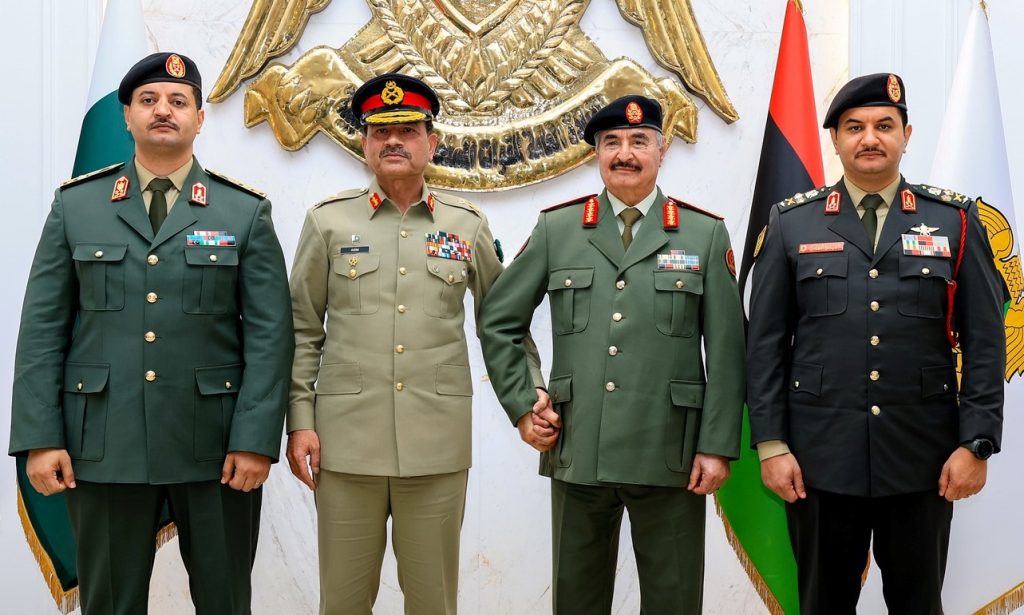
In December 2025, Pakistan finalized a landmark defence agreement worth between $4 billion and $4.6 billion with the Libyan National Army (LNA), commanded by Field Marshal Khalifa Haftar. Pakistan’s high military command visited Benghazi and endorsed this deal. This deal is considered one of the largest weapons export agreements in Pakistan’s history. The agreement would be spread over two and a half years, with land, sea and air equipment included.
This landmark agreement focuses on modernizing the Libyan national Army (LNA’s) air and land capabilities over a 2.5-year delivery period. This deal includes 16 JF-17 Thunder multi-role fighter jets, 12 Super Mushshak basic trainer aircrafts, equipment for land and naval forces, joint military training, and potential joint manufacturing.
With this land mark deal, and by supplying the defence equipment to LNA, Pakistan is establishing a significant footprint in North Africa, potentially shifting the military balance in the region. Pakistan’s presence in the North African region was long being awaited since the 1967 and 1973 Arab-Israel wars. Some international voices are being heard echoing that the deal has drawn scrutiny due to the ongoing UN arms embargo on Libya.
Pakistani officials have maintained that the agreement does not violate UN resolutions, citing improved relations between Benghazi and the West. To strengthen this deal further In February 2026, Khalifa Haftar and Saddam Haftar made a follow-up visit to Pakistan, meeting with military leadership at Noor Khan Air Base to discuss the “new phase of strategic military cooperation” and concrete timelines for deliveries. This deal between Pakistan and LNA (Khalifa Haftar) points to a broader paradigm shift in the regional geo politics – this is a new axis developing between Türkiye, Pakistan and “ONE Libya.”
As said earlier that controlling instability and security risks in Tripoli is becoming increasingly difficult, therefore, it is important engaging and getting closer to Khalifa Haftar from both sides (Pakistan and Türkiye) so that common strategic objectives could be achieved. The main pillar of this strategic paradigm is that the partnership between Pakistan (a major military ally of Turkey) and Libyan factions, particularly under Turkish influence, creates a new power dynamic. This partnership may enable a “triangle” of cooperation between Türkiye, Pakistan, and eastern Libyan authorities, potentially stabilizing the region through shared influence. Türkiye plays a central role, having entrenched its influence in western Libya since 2019 and now shaping a Turkey- Pakistan-Libya axis/ alliance to advance regional interests. Pakistan is actively expanding its footprint in North Africa through its 2019 “Engage Africa” policy, aiming to boost trade, security, and diplomatic ties, thus Pakistan will be capitalizing on the need for affordable, combat-relevant equipment in Libya which is the main objective of engage Africa Policy.
One of the important parts of this Türkiye Pakistan and Libya axis is to counter the Greece-Cyprus-Israel-Egypt axis in the Mediterranean.
Pakistan – Türkiye Strategic Alignment:
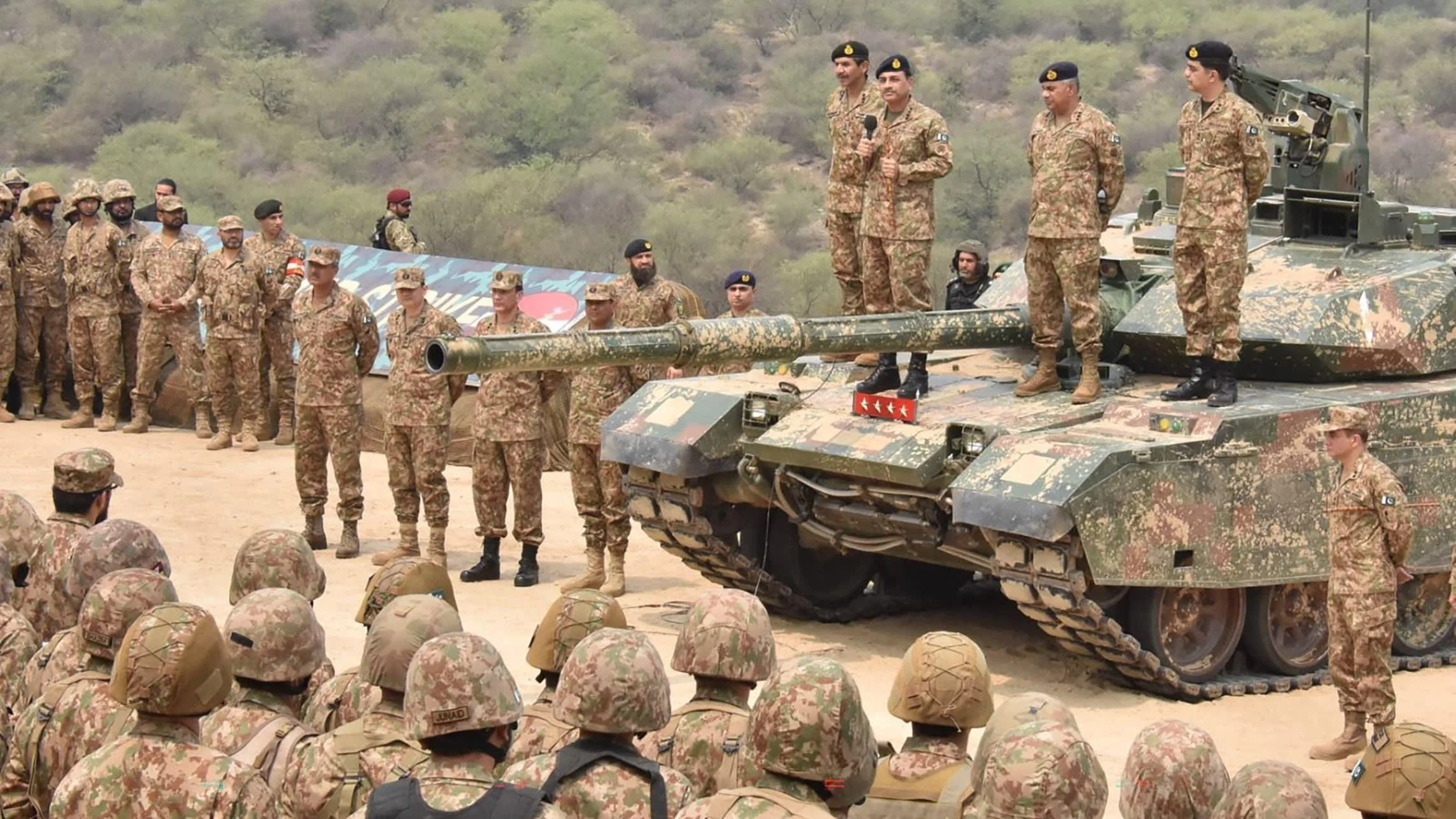
Pakistan must leverage Turkey and its influence as a vital and fundamental tool of its foreign policy. Turkish – Pakistan military and naval alliance and strategic partnership can be a rock-solid element in multiple domains keeping in mind the situation with India in IOR, Kashmir and on diplomatic fronts as far as Arab Middle East politics is concerned. I am totally convinced that Türkiye is one of the friendly countries that will come to support Pakistan in time of needs and a very recent example is 96-hour war between Pakistan and India during which Türkiye sent its powerful naval vessel that was stationed at Karachi during the tenure of this war. Pakistan has many tools and manoeuvres in many aspects, and alignment with Turkey should be another strategic manoeuvre that will be beneficial not only for both countries but also for regional stability. Türkiye has influence on many countries and Pakistan can leverage such influence with close strategic and diplomatic alignment. The joint Pakistan-Turkish Partnership will serve as a strong strategic power balancer for the Middle East and IOR. Elaborating further, Türkiye has expansion plans to promote and reclaim its influence keeping in mind the historical Ottoman Empire factor, so Pakistan must help Türkiye in this domain. The strategic goals of Türkiye will always merge with Pakistan’s interest one way or another. The joint development of military hardware, research and development and economic investment on each other’s side will help boost the relations and partnership between these two brotherly countries. The diplomatic stance of Türkiye on Kashmir has always been in favour of Pakistan.
Pakistan is a nuclear power so we must be prepared to show our muscles wherever and whenever required. Many countries have defence or semi defence pacts with Pakistan, so we can leverage these opportunities for boosting many sectors for further betterment. For example, Pakistan is taking active part in the 34-nations Saudi led Military Alliance, this platform can be used for selling military equipment, bilateral relations for trade, visa on arrival agreements, military training, and other economic deals. Pakistan must work aggressively for getting military access to IOR and North Arabian Sea Islands from Yemen, Somalia, Maldives, Oman, Sri Lanka, and Brunei.
If Türkiye and Pakistan join hands for development of such a strong bloc, many Muslim countries will follow and that will be the beginning of the fault lines that should exist in case any escalation takes place in the Middle East or in our dominion of influence.
Conclusion:
Ankara’s involvement in Libya is driven by its “Blue Homeland” doctrine (Mavi Vatan), aimed at securing its influence and EEZ in the Mediterranean, while acting as a mediator to unite the fragmented Libyan state. Despite being a key ally of the Tripoli government, Türkiye has been improving ties with Haftar and also has strong military cooperation with Pakistan.
The bottom line is, since Pakistan and Türkiye are good friends it is highly plausible that Türkiye had to involve its strongest partners and ally like Pakistan to engage with Haftar to solidify this arms deal and in this way, the strategic and geopolitical objectives would be achieved successfully one way or another. Strategically, this new partnership in the Mediterranean region between Türkiye, Pakistan and Libya is to counter other maritime adversaries.
In all the mentioned above scenarios, the deal between Pakistan and Khalifa Haftar now makes perfect sense for broader strategic objectives.