






During the recent standoff, the Pakistan Navy (PN) proved the quiet strength of preparation. Two decades of steady modernization, submarines, missile boats, and maritime aviation have created an A2/ AD shield that denies any aggressor freedom of ploy. The inability of India’s carrier task force to impose its will was not merely an operational failure; it was a strategic setback, exposing the hollowness behind New Delhi’s claim to be the “net security provider” in the Indian Ocean. Pakistan’s sea lanes remained secure, its deterrent credible, its defenses interlinked with air and land. The mere presence of Pakistan’s submarine wing forced India’s carrier, INS Vikrant, and its supporting fleet to remain distant, neutralizing any southern front for the enemy. By keeping maritime arteries secure and maintaining deterrence without firing a shot, the Navy ensured the Army and Air Force could fight on with uninterrupted logistics, quietly proving itself the unblinking guardian of Pakistan’s survival.
Admiral Naveed Ashraf, Chief of the Naval Staff, has provided exemplary leadership in steering the Pakistan Navy towards modernization, self-reliance, and regional cooperation. He has underscored the strategic importance of the Indian Ocean and the Arabian Sea, ensuring Pakistan’s maritime frontiers remain secure while also advancing initiatives that strengthen the blue economy. The Navy has enhanced its operational readiness and fostered partnerships that reflect Pakistan’s role as a responsible maritime nation. Admiral Ashraf’s commitment to maritime security and naval diplomacy reflects foresight and statesmanship, aligning national security imperatives with economic aspirations.
Pakistan’s defense relies on the operational unity of the Army, Air Force, and Navy to function as one combined entity with calm and professionalism. This synergy, built on sacrifice and discipline, is our true strength. History shows that sovereignty is upheld by spirit and resolve rather than size and rhetoric. The future of warfare lies in asymmetric strategies. Recent conflicts have demonstrated how low-cost unmanned systems can effectively counter advanced fleets. Consequently, the Pakistan Navy is shifting from platform-centric approaches to integrated “kill-webs,” leveraging satellites, UAVs, and robust communication networks for quicker decisions and multi-domain targeting. Success will depend on sustained readiness, adaptability, and seamless integration of assets.
The strength of a nation lies not only in safeguarding its borders but also in cultivating the minds and values of its future generations. Classrooms, libraries, laboratories, and interfaith forums are as vital as forts and arsenals, as they shape the knowledge, character, and resilience of society. Carrying this spirit of foresight and adaptation, the Pathfinder School of Excellence, Centre for Innovation,
Technological Advancement, Digital Entrepreneurs & Leadership (CITADEL) hosted another Seminar at Amaanibagh Angoori, this one titled “Gen Z – Corporate Leadership Dialogue: Building the Future of Work”. The event gathered leaders from the IT and Telecom industries, academia, the Armed Forces, and students from NUST, The Millennium Universal College (TMUC), Lawrence College Murree, and Quaid-i-Azam University. I am thankful to my friends in the IT industry and colleagues, AVM (Retd) Asad Ikram, Air Cdre (Retd) Khalid Banuri, Air Cdre (Retd) Farhan Ahmed, and Imran Jattala, for making this event a success. What was amazing were the ideas shared by young minds participating from the leading universities of Pakistan, the intergenerational exchange on the tech-powered IT industry and corporate culture in the Telecom Sector was original and enthusiastic. Experts from the IT sector, Muneeb Rabbani (Head of IT, Transworld) and Ather Imran Nawaz (CEO, Sybrid Pvt Ltd.), highlighted the transformative role of Artificial Intelligence. Sheikh Taimur Nawaz (Director Marketing, Transworld) and Ms. Tahira Khattak (VP HR, Telenor) emphasized generational shifts in workplace culture and the rising importance of soft skills. We are well (and thankfully) reminded that Pakistan’s youth are not just witnesses to change but drivers of it. Their aspirations, when met with the guidance of experienced leaders, can redefine Pakistan’s corporate and social landscape. I am grateful to the Chairman of Nutshell Group, Azfar Ahsan, and Abu Bakar, CEO at Pakistan Software Export Board, for their valuable remarks. Their detailed thoughts are given in the transcript of the Seminar (reproduced in this issue of DJ).
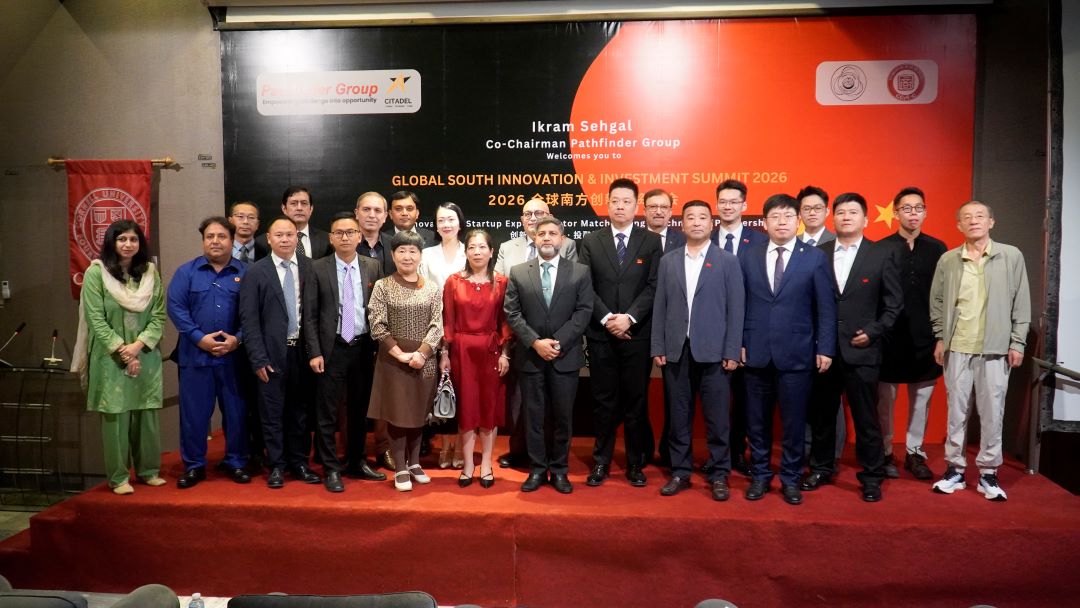
Living up to our innovative tradition, I believe, it’s time to take and unleash our innovative potential on the global stage. In this regard, I am extremely delighted to announce Pathfinder CITADEL Startup Challenge: DAVOS 2026, a national competition to select Pakistan’s top SIX startups to pitch on the global stage at PAKISTAN PAVILION during WEF Davos 2026 (January 19–23). Aligned with CITADEL’s vision to empower Pakistan’s innovation to establish itself at the global stage and its mission to convert talent into jobs and ideas into scalable ventures, the challenge targets market-ready founders in AI, Fintech, Climate, Health, DeepTech, and other high-impact domains. The two-round competition runs nationwide from 04 Oct to 25 Oct this year. Winners will gain visibility with global leaders and investors, international media exposure, and access to Pathfinder CITADEL’s acceleration, mentorship, and corporate linkages—creating a clear pathway from Pakistan’s innovation ecosystem to global markets.
While driving Pakistan’s future through bold ideas and startups, young voices like my granddaughter, Elena Sehgal, whose brainchild PIHI is, are leading the charge in promoting interfaith dialogue and peaceful coexistence. Pathfinder Interfaith Harmony Initiative (PIHI) was born from the vision of 15-year-old Elena Sehgal, studying at Brearley Girls School, Manhattan, who had earlier established a similar initiative in New York. I had the honour of chairing the inaugural Advisory Council meeting, which represented the culmination of her vision taking root in Pakistan. The Advisory Council, comprising six women and eighteen men, reflects broad inclusivity: nine Christians from various denominations, three Sikhs, two Jews, two Hindus, one Parsi, and seven Muslims from different sects. The honourable members of the Advisory Council are: Jewish faith: Dr Marc H. Siegel, Dr Linda Zangwill, Hindu faith: Mr Subhash Chander, Ms Neelum Kumari, Parsi faith: MNA Isphanyar M. Bhandara, Sikh faith: Mr Sardar Ranjeet Singh, Mr Sardar Anoop Singh, Ms Manmeet Kaur, Christian faith: Ms Asiya Nasir, Ms Anne Bolyne Rubina, Dr Zeerak Samuel Christian, Rt Rev Nadeem Kamran (Bishop), Rev Samson Sohail, Father Adnan Ghani, Mr Sarfraz Shahid, Mr Saleem Shahzad, Capt (Retd) Babar Bernard Massey, and Muslim faith: Ms Huma Akhtar Chughtai, Dr Amy (Aisha) Winslow, Mr Syed Firasat Shah, Maj Gen (Retd) Shakeel Hussain, Brig (Retd) SSG Kiani, Brig (Retd) Mujahid Alam. Capt (Retd) Babar Bernard Massey, a Christian, will serve as the Secretary to the Advisory Council.
I am truly indebted to Brig (Retd) Mujahid Alam, CEO of the Providentia Books Foundation and CEO Designate PIHI, for conducting the session immaculately. He introduced the initiative and its core objectives with great clarity. PIHI aims to promote mutual respect, peaceful coexistence, and cooperative action among the diverse religious and spiritual communities in Pakistan. I am grateful to MNA Isphanyar Bhandara, CEO of Murree Brewery, and I support his idea that we must make conscious efforts to make non-Muslim friends.
I reaffirmed Pathfinder’s mission to foster dialogue, innovation, and inclusivity. Just as our armed forces safeguard the nation with vision and discipline, it is equally vital that we cultivate a culture where our younger generations are empowered to lead with creativity, integrity, and resilience.
Ikram Sehgal