



Quos Deus vult perdere, prius dementat. This is Greek for literally, “those whom God wishes to destroy, he first deprives of reason”. In the recent past, this adage was transposed to English literature as “whom the gods would destroy, they first make mad”. In both cases, it is a stark reminder of how social order is destroyed – i.e. lack of reason, which translates to people being mad enough to abandon the good values upon which upright societies are based! Are good values important for the success of any citizenry? Most definitely! Do morals and ethics also play a pivotal role in societal accomplishment? Very heavily! Consider.
While values, morals and ethics are closely related, they are not the same. It is a classic chicken and egg scenario where some grey areas of overlap may exist but it is still reasonable to ascertain which comes first in a general order of things and how to compartmentalise the three.
“Our generation is probably a lost cause when it comes to embodying good values. Let’s not make the same mistake with the generations that come after us!
Values are the rules by which we – as individuals and as societies – make a judgement about right and wrong, good and bad, and should or shouldn’t. These are a deep-rooted system of beliefs that guide personal decisions and collective direction and influence general behaviour. They also allow us to choose between two competing values if and when a need arises to do so. For example a person who values friendship will sacrifice workout time – which may be important as the individual values a healthy lifestyle – to help out a friend in need.
Morals are decisions that society takes in order to gauge whether an act is good or bad based on personal or collective values described above. It is a widespread motivation based on the idea of good and bad and as such morals project values onto society and tend to have very wide acceptance. That is why we judge others more acutely on morals than values. For example the value of honesty is judged ‘good’ in someone who adheres to it and thinks cheating is bad, in contrast with someone who values success more than honesty and believes cheating is fine.
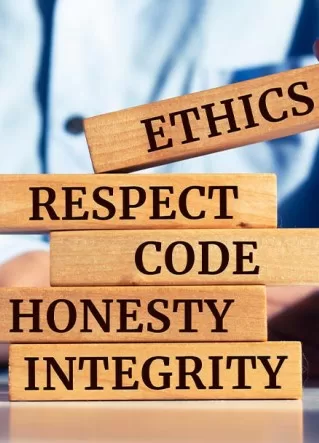
Though ethics are similar to morals, they differ in one key way. While morals are the feeling of ‘good or bad’, ethics clearly regulate which deeds are ‘right or wrong’. In that way, ethics can be deemed as the codification of morals into a specific system and adopted by the majority! For example doctors have medical ethics and lawyers have legal ethics. Thus, one can have professional ethics but rarely professional morals.
“As governments, families, clans we need to get away from the idea of poor values and embark upon the good values that will last, along with the change that comes with them
The above clearly demonstrates that values – the rules we live by – are the critical underpinning of morals and ethics and very much will determine the rise and fall of society! Have good values enshrined in people and the nation will flourish. Have valuelessness as a guiding policy in society and the nation will flounder and consequently perish. It has happened to many civilisations in the past! And that is the crossroads where we find ourselves in the developing world including Pakistan today – a swath of valuelessness has taken grip of all facets of life! Kofi Annan – the former UN Secretary General – said that “if tolerance, respect and equity permeate family life, they will translate into values that shape societies, nations and the world.” Imagine the importance attached to good values! And then take a look around you, “does it look like we are society driven by good values?” The answer may be as plain as day! We are not!
Laws, enforcement agencies, accountability bureaus, anti-corruption drives, disciplining com mittees, parliamentary rebukes, presidential decrees and jail threats will not work an iota if there are no good values perpetuating through society. No matter how hard ones tries – if the inner compass is amiss, external motivators – good or bad – will only work temporarily at best and not at all at worst!
“While morals are the feeling of ‘good or bad’, ethics clearly regulate which deeds are ‘right or wrong
As governments, families, clans we need to get away from the idea of poor values and embark upon the good values that will last, along with the change that comes with them. Although leaders and politicians must lead but even at the family and clan level all of us can make a difference by instilling great values, for example honesty. And what did Prophet Muhammad (PBUH) say to the person who asked which ones of his bad values should he give up? He (PBUH) said, “give up telling lies first and always speak the truth”! In our current scenario, the un-intended policy of valuelessness permeates though our culture at all levels! Society encourages people to beg, borrow and steal to get ahead! It teaches them to succeed at all costs and by hook or by crook! It tells everyone to throw away the rule book in pursuit of material and commercial gain!
Our generation is probably a lost cause when it comes to embodying good values. Let’s not make the same mistake with the generations that come after us! There is still time to teach the young ones the values of integrity, excellence and humility – something that I try to instill in my children and those around me. We educate our children but only in curriculum and not in values and for that C.S. Lewis said,
“education without values, as useful as it is, seems rather to make man a more clever devil”. This should be an eye opener – good values must come before anything else! Or else we will keep firefighting societal upheaval as we are doing today!