
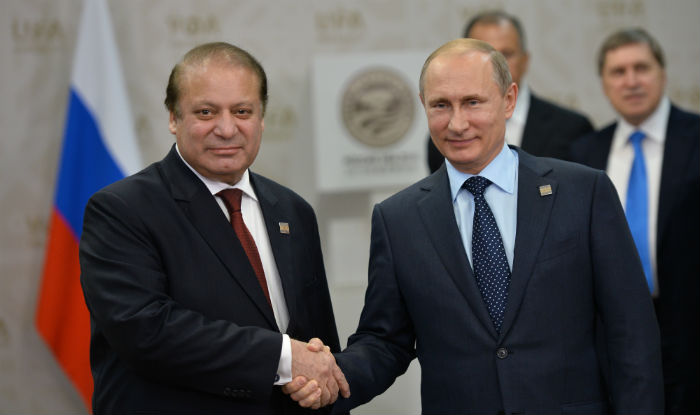
The new phase of Russo–Pakistani bilateral ties based on joint military exercises has added a new chapter in the history of evolving South Asian regional politics and launched an international debate. The first joint strategic venture as a result of bilateral agreements signed in December, 2014 adds two hundred military personnel to strengthen the cooperative ties between forces of both states. The turning point of Moscow–Islamabad diplomatic values caused by military collaboration was termed as Friendship 2016. The two- week joint counter–terror exercise (24 September–10 October) with Pakistan is perceived to be a rather adroit reaction of Russia against the India/US friendly policy. After a gap of forty five years, the diplomatic discrepancies between Russia and Islamabad were greatly reduced by a defence pact for joint military exercises, which could probably change the inter–regional dynamics of Northern and Southern Asia, the presence of changing geo– political and geo–strategic milieu of South Asia. Russia’s shared borders with Northern Eurasia and Eastern Europe can further provide several new avenues for Pakistan. The decision of the world’s largest country to boost its diplomatic bonds with Islamabad will launch a new era of friendship.
The changing dynamics of South Asian subcontinent and its undeniable association to rapidly changing world politics has decreased diplomatic incongruences between Moscow and Islamabad. In order to fulfill the security needs of Islamabad, Moscow has taken the lead in crafting new opportunities and augmenting the existing status of Pakistan in world politics. The first ever joint military collaboration between Moscow and Islamabad proved to be a milestone for politically normalizing of bilateral ties. The military initiative is advanced by the Kremlin and it also finalized a deal for the sale of four helicopters to Pakistan. The defence deal between Moscow and Islamabad was a landmark step to provide multirole Mi–35 ‘Hind E’ helicopters to Pakistan. In this way, Russia had tried to fulfill the security demands of Pakistan by decreasing Islamabad’s dependency on the supplies of supersonic F16 fighter aircraft. Moreover, the Russian officials warmly welcomed Islamabad’s inclusion in the Shanghai Cooperation Organization (SCO) when Islamabad signed memorandum of obligations to become a full member of SCO in June 2016. The next meeting of Astana in 2017 will improve Islamabad’s status in SCO positively. Furthermore, under commercial agreement the governments from both sides finalized a gas deal in October 2015 for a 1,100 kilometres gas pipeline. The north–south gas pipeline project with $2 billion Russian investment on Liquefied Natural Gas (LNG) will complete its initial phase by December 2017. In addition to defence, the energy cooperation will help Islamabad to overcome its rising energy crisis effectively by supporting 30% of Pakistan’s population.
Apart from Cold War disparities based on divergent interest and contradictory national interests, Pakistan was the first state in accepting the Russian Federation as a successor state of the Soviet Union. Pakistan visualized the economic strength of former Soviet States of Central Asia and accepted their addition in inter-governmental setup under Economic Cooperation Organization (ECO). The post–Cold War situation laid an appreciable foundation for reinvigorating Islamabad–Moscow bilateral ties and started warming the diplomatic potential of both states. In 1999, the Nawaz administration paid a first visit of post-Soviet Russian Federation, and Mikhail Fradkov, Prime Minister of Russia conducted his first visit of Pakistan in 2007. Russian Army War Games of 2015 greeted Pakistan’s energetic role in the six nations under Masters of Air Defence Battle Competition.
The swiftly developing Indo–US strategic partnership has turned Russian direction toward Pakistan, this could be a more productive move of Kremlin. The engagement with Islamabad will not only erode New Delhi’s offensive ambition of regional expansionism, it will also successfully counter Washington’s expanding influence in Russian surroundings. Russian rapprochement with Pakistan based on multidimensional economic and strategic associations will minimize the strategic advantages of extra–regional powers in Moscow’s adjoining regions. The emerging reliability between state authorities from both sides will bring a proportional relationship equivalent to the emerging New Delhi–Washington strategic nexus.
Islamabad was unable to enjoy close ties with Moscow during the decades–long period of the Cold War. Now the combination of military and political values will probably prevail between the two sides to bridge the historical gap that previously existed in bilateral relations. The actual potential of missed opportunities of the past has now been realized by both state authorities. Mutual aims of overseeing the incompatible standards and their curable way forward required responsible attention and serious response of leadership from both sides to understand accurately the each other’s position in world politics.

The contemporary political trends of evolving unending competition of the great powers and its impact on developing parts in the international system are altering the strategic landscape of world politics. The strategic culture of South Asia is disturbed by the rising Indo–US multifaceted relations and has forced Pakistan to seek support in the international community by enhancing bilateral ties with Russia parallel to China. The New Delhi–Washington nuclear deal and India’s exceptional status for Nuclear Supplier Group (NSG) have profoundly fractured the vision of regional peace, security, cooperation, progress and stability in South Asia. Because of the worrisome regional dynamics in the presence of protracted Indo–Pak hostility, Islamabad is in search of new opportunities to improve its position in South Asian regional politics.
Pakistan’s full subscription to SCO can bring in Russia into Chinese mega economic projects for the construction of Gwadar Port under China–Pakistan Economic Corridor (CPEC). Islamabad’s geo–strategic potential that is realized by Beijing can be beneficial for Moscow under transnational economic plan of One Belt, One Road (OBOR). The Belt–Road initiative contains sufficient incentive to spark the transcontinental economic potential of the world which could radically change the present structure of international relations. Kremlin’s active support to CPEC coupled with its vigorous participation in China’s corridor project with Pakistan can stretch Moscow’s access to the Arabian Sea specifically, and Indian Ocean broadly. Therefore, the contemporary realigning patterns of world politics are intended to revise the rules of the game between great powers, in which the realignments of states and rearrangements of reginal politics will decorate the world politics differently. The transit trade connection between Central and South Asia under Russia–Pakistan trade agreements can make Islamabad a leading beneficiary of energy–rich Central Asian Republics.
The upward modifications in traditional foreign policy norms of both states broadly show the willingness of both governments to design new directions of their future. The vanishing of diplomatic inconsistencies of the past and their replacement with extended collaborative endeavours can manifest a bright future for them. Moscow’s extended interaction and that of Islamabad can produce numerous platforms to achieve the untapped potentials of both sides. The persistent growth of people–to people contacts in additions to exchange visits of leading state representatives can activate the citizens from diverse fields in both nations. The prosperous diplomatic future of Russia–Pakistan friendship needs a more coordinated approach to initiate different social, cultural, educational, and economic projects. The paramount attention toward the aforementioned will help both nations to effectively comprehend the social, political, and economic strengths of each other, which will guarantee the long-lasting effects by ensuring high cooperation in areas of mutual interest such as countering extremism, neutralizing the threats of terrorism, preventing illicit trafficking of small arms and light weapons, and rooting out clandestine networks of cross border drug trafficking and organized criminal networks.
A consistently stable pattern of fostering diplomatic connexions can further discover the bilateral potential in the fields of research and development, science and technology, agriculture and industry, and culture and society. The desires to improve bilateral relationship and advancement of cordial relations on official level has become an urgent demand of the time. Optimistic visualization of main impediments that create hurdles in improving diplomatic intentions and pragmatically analysing the strategic position of both states in evolving configurations of world politics can help Moscow and Islamabad to leave their traditional state of reluctance. Therefore, timely adaptation of apposite policies for widening of cooperation and reducing of contradictory areas can introduce numerous diplomatic channels which will ultimately diminish the trust–deficit of the past. A high level of confidence grounded in two-sided facilitating environment can chalk out comprehensively a multipronged plan of inter–governmental engagement which will further enlarge the scope of proposed plan of economic development and strategic strength.