
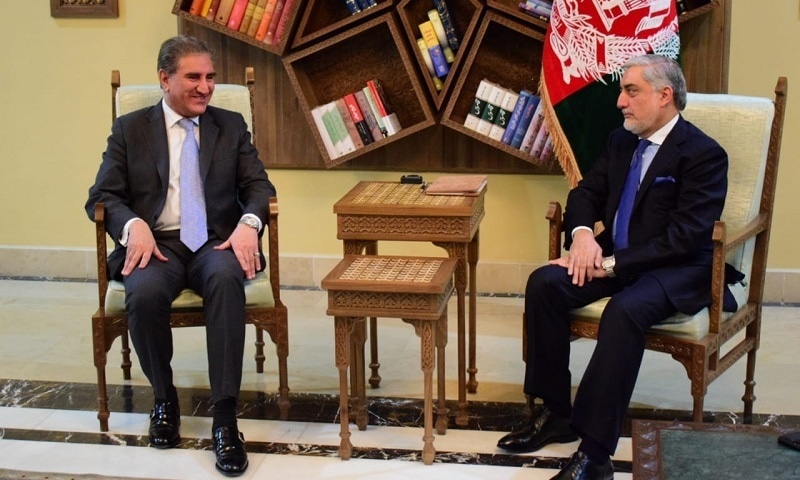
Foreign Minister Shah Mehmood Qureshi visited Afghanistan on September 15, the statement released by the foreign office is quite optimistic about the outcome. “He assured the Afghan leadership that Pakistan, along with other partners of Afghanistan, remained ready to play constructive role in facilitating an Afghan-led and Afghan owned peace process and reconciliation. He underscored the importance of cooperation and coordination between the two countries in the areas of counter-terrorism and security and offered to train Afghan police and law enforcement agencies in Pakistani institutions”.
According to Indian Express, Dr. Abdullah Abdullah expressed optimism over Pakistan being able to bring the Taliban to the negotiating table with the US. In the meanwhile, Pakistan has closed its consulate in Jalalabad citing security concerns and undue intervention by Governor Hayatullah. While the Afghan peace process is at a cross roads, Afghanistan should refrain from interfering in the functioning of Pakistan Mission in Afghanistan. Such interference is a blatant violation of Vienna Convention of the consular Relations 1963. It is time for Afghanistan to look inwards towards its own deplorable state of law and order. The two foreign ministers have spoken on the issue and the matter is likely to be resolved amicably, but it speaks of a spoiler mind-set.
Sustained direct Taliban-US talks are the current reality of the Afghan peace process, though to the chagrin of the Afghan government who had been insisting to remain the front face of peace negotiations. At least for now, it is Taliban steered peace course. Latest inputs indicate that Taliban are preparing to send a delegation for further talks with the IJS officials about ending the conflict in Afghanistan, this would be the second round where the Taliban are likely to put forward substantive proposals. Supposedly a lot of mileage was covered during three sessions of the first round. Taliban are ready for a second round, possibly this month, which is likely to focus on prisoner exchanges, confidence building measures, and ways to move from back-door meetings to formal negotiations, said Taliban officials in separate interviews.
Taliban leaders are in a preparatory session to discuss the delegation composition consisting of 3-4 persons, alongside finalization of discussion points. Sher Mohammad Abbas Stanakzai, the head of the group’s Qatar-based political office is likely to lead the Taliban side. He was deputed in the Qatar office on acting charge basis and the top leadership is now planning to appoint someone else in his place. The Taliban would discuss the lingering issue of exchange of prisoners and could hold another meeting soon if the other side showed seriousness in talks by releasing prisoners. The upcoming meeting is also expected to define the framework for further talks.
The first round of talks was held in Doha in July, where Taliban officials had met Alice Wells, Principal Deputy Assistant Secretary of the US for South and Central Asia. Prospects of peace talks were later stuttered due failure to agree a repeat of Eid cease-fire in June that saw unarmed Taliban fighters mingling with security forces in Kabul and other cities. Though the Afghan government had announced a ceasefire, Taliban leadership declined to go along.
The upcoming talks reflect a noteworthy shift in Washington’s approach which hitherto had always pushed for an Afghan-led and Afghan-owned dialogue in such peace talks. At the same time the Afghan government has reconciled to centrality of Taliban. And through these talks, former Afghan President Sibghatullah Mujaddadi wants a review of Bilateral Security Agreement (BSA) between Afghanistan and the US. He is deeply concerned about the growing insecurity and instability in the country and has asked all political parties and leaders to join hands to deal with the situation.
The call by Afghanistan’s influential politicians and some political parties to review the BSA with the US has been met with mixed reactions by the Afghan government, members of parliament and political experts. Chief Executive Officer Abdullah Abdullah said on September 17 that some politicians were pushing for the review of the BSA in pursuit of their own interests. “They once again brought it up for debate for their personal objectives, I don’t think that this will help the security situation of our country. In the wake of a sharp increase in fatalities among security forces in numerous provinces, MPs called for the BSA to be assessed. They said the agreement has not been successful in the fight against insurgency and that the US has failed to enforce the agreement when it comes to the mobilization of Afghan Security and Defence Forces (ANDSF). General Abdul Raziq, the police chief of southern Kandahar province said that the BSA had been approved by over 5,000 members of the Loya Jirga who represented the people of Afghanistan from all provinces. First vice-president, General Abdul Rashid Dostum said on September 13 that the ongoing war in Afghanistan was in no one’s interest and called for a responsible end to the conflict. He also asked the Taliban to be responsible in ending the four decades of war and join the peace process for the protection of national interests. He said the war was in no one’s interest and was harming the Afghans.

Reportedly, negotiations are stuck over the issue of maintenance of US military bases in the country, according to Waheed Muzhda, a former Taliban official in Kabul. The U.S. wants the Taliban to accept at least two military bases, Bagram and Shorabak. High-level sources in Washington have confirmed that maintenance of certain military bases in Afghanistan was a top priority for the US government. Christopher Kolenda, a retired colonel and former Pentagon adviser who held informal talks this year with the Taliban in Doha said the insurgent group considers US com bat troops an occupying force and wants them out. “Their No. 1 reason for war, their casus belli, if you will, is the occupation. So, they’re not going to just simply say, ‘We’re OK with US combat troops running around Afghanistan.’ Because that’s what they’re fighting to prevent from their point of view.” He said Taliban did show some willingness to allow foreign troops to train Afghan forces, but only if a new government formed after a negotiated settlement, that would likely include the Taliban, agreed to their presence. The third major demand, an implementation of Shariah, or Islamic law, is more for the optics. The Taliban accept 80 percent or more of the current Afghan constitution, he added, but think that current constitution was formed under what they term the US occupation of Afghanistan, and hence needs a thorough revision.
In latest combat related occurrences, a suicide bomber targeted a protest in Mohmand Dara district in Nangarhar province on September 12. The Provincial public health directorate said at least 32 people were killed and 128 were wounded in the explosion. Earlier, on September 09, chaos gripped Kabul as thousands of gunmen took to streets on Ahmad Shah Mehmood’s anniversary. The Capital witnessed civil war like scenes when hundreds of armed men drove in a convoy of dozens of vehicles while firing thousands of bullets throughout the capital city. At least 7 people were killed when a suicide bomber riding a motorcycle targeted the convoy whereas more than 20 people were injured as a result of aerial firing by the demonstrators. These incidents are not a good reflection of governance and refute the tall claims of Afghan government and occupation forces about peace and stability in Kabul.
Monish Tourangbam and Swati Sinha reported for Reuters on September 12: The direct talk between the US and Taliban, per haps, is a result of the recognition that the “Afghan war is in a military stalemate, necessitating steps that were undesirable in Washington before”. Violent battles are ongoing in over 20 provinces in the country and at least 10 districts went under the control of insurgents though were later recaptured by security forces.
A string of Taliban attacks began on August 10, 2018, with a highly coordinated attempt to overtake the city of Ghazni, located 75 miles south of Kabul. The Taliban attack on Ghazni killed an estimated 100 security forces and 20 civilians. The Baghlan province attack was the second huge Taliban strike on a military base. Nine policemen and 35 soldiers were killed in this attack. Taliban militants overran an armed force construct in north-western Faryab district on August 11, following a two-day assault. In Faryab province, 17 soldiers were killed and 19 others wounded when Taliban overran the military base. Taliban are also engaged in earning goodwill of people by promising them that they will stop suicide bombings in non-military regions, and that the Afghan soldiers who surrendered would be unharmed.
Spates of deadly violence over shadow peace prospects in Afghanistan. The security situation in Afghanistan continues to be uncertain and violence has taken an increasingly lethal profile. Whether or not the peace talks will gain momentum in the midst of increasing violence and the Taliban’s propensity to undermine the government in Kabul remains an open question. Negotiating peace, reconstruction and a stable polity in Afghanistan amid a raging violent conflict continues to be an uphill accomplishment.