




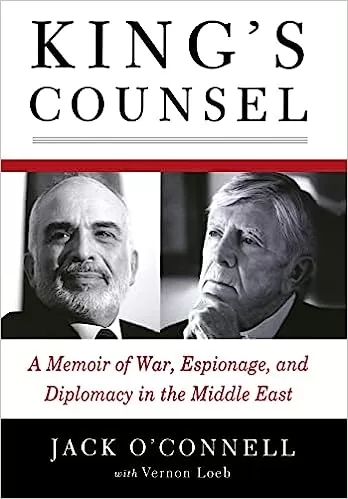
King’s Counsel by Jack O’Connell is a fascinating account of important events of Middle East by someone who was involved in different capacities. This book was published in 2011 after Jack’s death. A brief biography of author is important to understand his role. Jack earned well rounded qualifications in different fields before joining Central Intelligence Agency (CIA). He earned a bachelor’s degree in Foreign Service and a law degree from Georgetown University. He had an interesting connection with Pakistan. He earned a Master of Islamic Law degree from Punjab University in Lahore in early 1950s. His mentor asked him to write his masters thesis on whether it was possible for an Islamic country to be a democratic state. Jack concluded that there was nothing in Islam that would prevent an Islamic country to be a democratic state. His idea was convincing enough that head of the department arranged for Jack to present a paper to the Constitutional Committee then working on writing the constitution of the newly independent Pakistan. Jack was also selected for the 1952 Pakistan Olympic basketball team. However, due to lack of funds Pakistani team never made it to Helsinki. After joining CIA, he worked at Pakistan desk and the Near East Operations Division.
Jack joined the Middle East Division of CIA in 1950s and worked at the headquarters. He first met King Hussain of Jordan in 1958 when Jack was thirty two and King Hussain twenty two. Jack’s mission was to appraise King about a possible coup attempt. This relationship developed into a life long friendship until King Hussain’s death. Jack served as deputy chief of Beirut station from 1960 to 1963 and station chief of Amman from 1963 to 1970. He had the front row seat to two most important events of that time period; 1967 Arab-Israeli war and 1970 Jordanian military action against Palestinian guerrillas. Jack left CIA in 1972 and joined a law firm in Washington. He was Jordan’s attorney right until his death in 2010 and in this capacity was engaged with both Jordanian and American officials in back room diplomatic channels.
Jack provides many interesting details about some important events. Jack’s first encounter with King Hussain was in 1958 when he was working on a case of possible coup attempt against King. Federal Bureau of Investigations (FBI) taped conversations between Egyptian and Jordanian military attaché’s in Washington. Jack played these tapes to King Hussain and later twenty two conspirators were arrested. Jack discloses a previously unknown fact about 1967 Arab-Israeli war. He states that Jordan got the information about Israeli attacks from Americans. He states that U.S. military attaché’s office in Tel Aviv obtained the timing and nature of the attack and this information was forwarded to Washington as well as a military assistant in U.S. embassy in Amman about twelve hours before the attack. Jack was informed and he rushed to inform the King. Jack told King Hussain the timing and nature of the attack with the advice that “Your majesty should know, the CIA estimate is that the Israelis can defeat all of the Arab armies in one week. You don’t want to get involved in this war; you will lose”. King Hussain in turn warned President Nasser the same night twice. Nasser ignored this crucial information at his own peril. Israeli Prime Minister Levi Eshkol sent messages to King Hussain through United Nations and U.S. embassy that if Jordan stayed out of war, Israel would not attack Jordan. It was too late for Jordan as it had already put its armed forces under the command of Egypt and an Egyptian General had arrived to supervise the defeat of another army. Jordan’s gamble resulted in loss of West Bank and Jerusalem.
Jack gives us a lesson about relations between countries and that they are not based on emotions and rhetoric and even die hard revolutionaries are pragmatic. A CIA officer Miles Copeland was the background channel between Gamal Abdul Nasser and the brother duo of CIA director Allan Dulles and Secretary of State John Foster Dulles from 1952 to 1956. In 1967, Nasser broke diplomatic relations with Washington with lot of fanfare. At the same time, behind the scene he asked the Americans that he wanted to continue a back channel preferably through CIA. CIA assigned its best Arab hand, Eugene Trone. Trone worked in Spanish embassy at Cairo under diplomatic cover from 1967 to 1972.
In Pakistan, there has been lot of confusion regarding role of Pakistani armed forces in Jordan. I have done some work on this subject in the context of history of relations of Pakistani armed forces with Arab countries. Pakistani training mission to Jordan consisted of only about two dozen army and air force officers and no combat troops (only exception was an Anti-Aircraft detachment sent in June 1970 at King Hussain’s request as he was worried that Syrian and Iraqi air forces may intervene in support of Palestinians). Pakistan military mission was headed by Major General Nawazish Ali while Air Commodore Anwar Shamim (later Air Chief Marshal and Pakistan air force chief) was in charge of air force officers. During main Jordanian offensive in September, Pakistani ambassador to Amman Nawab Rahat Ali Chattari as well as head of military mission Major General Nawazish were not in the country. Brigadier Zia ul Haq was in charge of the military mission. King Hussain asked Brigadier Zia to take over the command of a Jordanian division. Pakistan’s charge de affaires got approval of this move from the Ministry of Defence.
In Amman, main formation was 4th Mechanized Division commanded by Brigadier Kasab al-Jazy and 60th Armored Brigade of the division commanded by Colonel Alawi Jarrad was at the forefront. After 1967 war, 3rd Iraqi Armored Division had stayed back in Jordan and was deployed in Zarqa. Jordan deployed 99th Brigade commanded by Colonel Khalil Hajhouj of 3rd Jordanian Armored Division near Iraqis to keep them in check and prevent them from acting in support of Palestinians. A crafty intelligence coup by Jordanians described later neutralized Iraqis with finesse.
2nd Jordanian Infantry Division was based in Irbid near the Syrian border. Palestinian guerrillas had taken control of the town. Syria entered the fray in support of Palestinians by sending 5th Division commanded by Brigadier Ahmed al-Amir. This was a reinforced division consisting of 67th Mechanized, 88th Armored and 91st Armored Brigades of Syrian army and Hittin Brigade consisting of Palestinians. Commanding officer of 2nd Jordanian Infantry Division Brigadier Bahjat al-Muhaisen (he was married to a woman from a prominent Palestinian family) went AWOL and Brigadier Zia took command of the division at the request of King Hussain. 2nd Jordanian Infantry Division was shaky after desertion of Jordanian commander and Zia helped to keep the formation intact. This division helped to take back control of Irbid. Syrian armored thrust near Irbid was tackled by 40th Armored Brigade commanded by Colonel Atallah Ghasib of 3rd Jordanian Armored Division. Major damage to Syrian armor was done by Royal Jordanian Air Force. Inside Syria, a power struggle between Saleh Jadid and Defence Minister and Air Force commander Hafiz al-Asad was at its peak and Asad decided to keep Syrian Air Force out of conflict. He had shrewdly calculated that if Syrian forces were unsuccessful, it will result in the fall of the government. In the absence of air cover, Syrian forces were mauled by Jordanian air force and within two days, battered Syrian troops retreated back. Jadid’s government got a mortal wound and two months later, Asad took control of the affairs of the country sending Jadid to prison.
A Pakistani post script to this event is the fate of Zia. In 1970, Nawazish gave a bad Annual Confidential Report (ACR) to Zia although details of it are not available. It is not clear whether report was written before or after September 1970. Apparently, report was bad enough to possibly end Zia’s career at the rank of Brigadier. Zia asked his former Commanding Officer (CO) of Guides Cavalry Colonel (R) Pir Abdullah Shah for help. Abdullah asked then Chief of General Staff (CGS) Major General Gul Hassan Khan (Zia had also served under Gul Hassan) and report was quashed by army chief General Yahya Khan on Gul’s recommendation. Book provides details of operation of Jordanian forces against Palestinian guerrillas in September 1970. Jack does not provide any details of role of Pakistanis but gives an amusing story about Zia. Zia had done his armor course in United States and picked up American slang. Jack was asked to help decipher Brigadier Zia’s assessment from the frontline as they could not understand some of Zia’s slangs. When Prime Minister Zaid Rifai asked about the situation at the front, Zia replied ‘I’m shitting green’. Jack explained to Jordanians that it meant, “Things are very bad”.

Jack provides another version of role of Henry Kissinger in 1973 Arab-Israeli war based on the first hand information from a former Cairo station chief Eugene Trone. Throughout 1972, Egypt had been haggling Americans to work on a peace process and return of Egyptian territories lost in 1967 war. In the spring of 1973, Kissinger met with Chief of Egyptian intelligence, Hafiz Ismael in a farmhouse near in France. Trone was also there. Immediately after one to one meeting between Ismael and Kissinger in the garden, Trone who was right outside the garden met a visibly shaken Ismael. Ismael told Trone; “Gene, do you know what Kissinger told me? ‘If you want us to intervene with Israel, you’ll have to create a crisis. We only deal in crisis management. You’ll have to spill some blood”. He wants us to start a war with Israel”. Ismael sat down by a brook with head in his hands crying. Jack is of the view that Egypt may have interpreted Kissinger’s words as green light. Abraham Rabinovich is an Israeli military historian and author of many authoritative accounts of 1973 war. He provides many details of the internal dynamics of Israeli side.
Book gives some glimpses of the world of intelligence and operatives of this art. Jack paints the portrait of one of such characters from the Arab world. General Abud Hassan was the head of Jordanian Military Intelligence (MI) in 1970. Abud was an Iraqi air force officer who defected by flying his MIG to Egypt. He joined the exiled Baathist group in Cairo where Saddam Hussain was his room mate. He became life long friend of Saddam. He moved to Jordan and ended up head of military intelligence of Jordan. He was an astute intelligence player and played his cards well. He had recruited a European military attaché that went on to work at NATO headquarters. Abud was able to get from him NATO’s military plans for Middle East and used it for its own purpose. He doctored the plan to look like an American military contingency plan in support of Jordanian forces. Plan was given to Iraqis through a double agent by a carefully crafted move. Abud now arranged the stage for the next phase. Iraqi military attaché was invited for a meeting with Chief of Jordanian armed forces General Zaid Bin Shakir. While the military attaché was waiting, Abud joined him explaining to him that he knew about Iraq’s plan to help Palestinians in the coming show down but Jordan was prepared. When military attaché was in Shakir’s office, Abud entered and announced that an American military team had landed and wanted to meet him. Shakir hushed him saying that ‘we’ll talk about it later’. When Iraqis connected the events of the military attaché’s meeting with the doctored plan they already had in their possession, they concluded that the plan was in the implementation phase. All Iraqi soldiers were ordered to move close to Iraqi border to prevent them being cut off by imaginary U.S. troops. Deception plan worked and Iraq stayed out of the fray and later pulled all the troops out of Jordan.
King’s Counsel provides some details of the Political Action (PA) staff of CIA. This was the covert action arm of CIA that operated separately with its own direct channels to Washington. They had access to all diplomatic and intelligence resources of the embassy but they worked independently of both the ambassador and CIA station chief. This group was created by CIA director Allen Dulles at the height of Cold War to extract more funds from Congress for big budget covert operations especially engineering coups and counter-coups. PA staff consisted of former Office of Special Services (OSS) officers when they were absorbed in CIA. Richard Helms who later became Director of CIA was one of the pioneers of PA. Most professional intelligence people thought this activity as counter productive in the long run.
Jack was close to King Hussain for decades and in a position to understand him better than anyone else. He knew about King’s strengths, his wishes and especially his efforts for a peaceful coexistence with Israel. The most painful decision for King was relinquishing claims on West Bank. He felt that Palestinians were ungrateful and Israelis not interested in giving up West Bank. King came to the conclusion that Israel will not give West bank to anyone therefore it was futile to keep Jordan entangled in this mess. King had taken many risks in going out of his way to accommodate Israelis but in the end, King was a disappointed man. He told Jack about Israelis that, “I have talked to them all alone, all of them. I’ve offered them everything they want, in terms of peace, and they still can’t bring themselves to withdraw from the West bank. All they do is talk in circles”. King’s Counsel is a must read for anyone interested in Jordan and history of peace negotiations between Arabs and Israelis.