


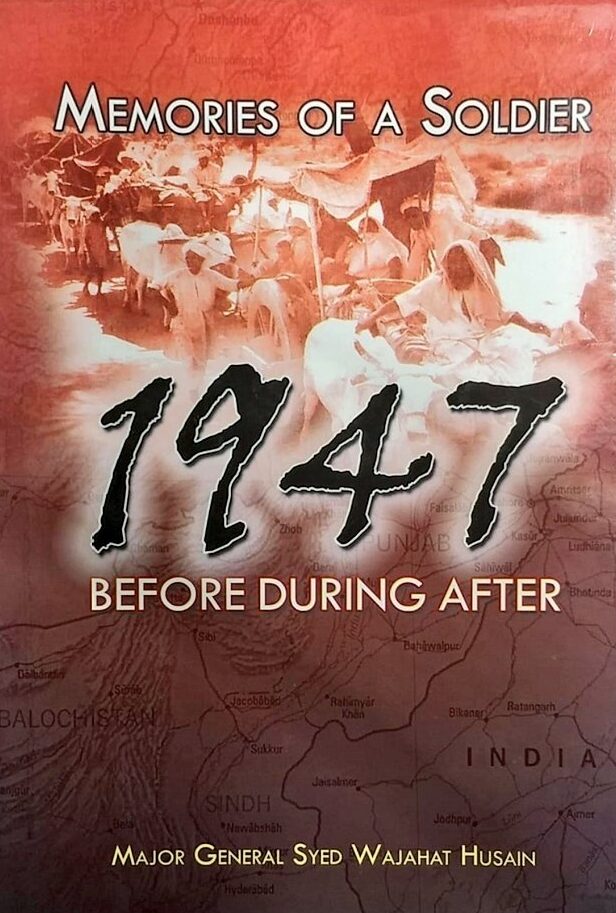
by Maj Gen Syed Wajahat Husain I Ferozsons (Pvt) Limited, Lahore, 2010
Maj Gen Wajahat Husain’s narrative of events that occurred before, during and after the 1947 Partition to which he was witness, is extremely readable. The lucidity and clarity of the commentary is especially pleasing.
The Partition of 1947 set in motion an orgy of rioting and brutal violence that left more than 1.5 mil-lion people dead and millions more displaced. There was rape, molestation and abductions of thou-sands. This was one of the darkest moments of the last century. Gen Wajahat gives an eye-witness account of the madness and may-hem that followed Partition and describes the role he played as an Officer in the Indian Army, as part of his professional duties, in the great exodus of Muslims to their newly created Pakistan. Gen Wajahat then opted for the Pakistan Army and despite persuasion from his superiors to stay he refused to budge, all the more after having seen the carnage brought upon the Muslims in East Punjab that was also fast spreading into Delhi.
Readers get rare insight into the 1965 Indo-Pak war and in the Chawinda sector where Gen Wajahat was in the thick of the battle personally directing the complete Corp artillery fire of all available guns on the enemy thrusts. When the cease fire took place on 23rd September there was great disappointment in the ranks as plans for a counter-offensive, called Operation Wind-up were made to launch a comprehensive operation on the morning of 22nd September.
Having joined the Army in its most formative years Gen Wajahat holds the Pakistan Army as an institution in great esteem – this is evident from his writings. Nonetheless he has the courage to call a spade a spade and is quite critical about the actions of some top military leader-ship (and politicians) both in times of war and peace throughout Pakistan’s short history but specifically in the 1971 debacle that led to the dismemberment of Pakistan and the birth of Bangladesh. Indeed, some top officers who harboured political ambitions and politicians of that time were responsible for the political problems in East Pakistan. Gen Wajahat is critical of Gen Niazi, who, when the enemy was poised to encircle Dacca, “dispersed his forces in penny packets along the border and instead of concentrating on defending Dacca, left the capital defenceless against the fundamental rules of defence”. The fallacious and strategic political myth of ‘East Pakistan’s defense lay in West Pakistan’ was in tatters, the writer recalls poignantly. In this one short sentence, Gen Wajahat exposes everything that was wrong about the policy adopted for East Pakistan. The title of the chapter – ‘Murky Politics, Miscalculations and Debacle: 1971’ – and the intensity of his narrative are clear indicators of the torment and sorrow that he felt on the breakup of Pakistan.
Another aspect that becomes clear upon reading the book is the author’s love for Pakistan and his belief that the future of the country lies with the younger generation. He strongly rejects the ‘failed state’ or ‘failing state’ comments that are frequently encountered in relation to Pakistan. “It must be stated here that the fundamentals of Pakistan are strong: it is the fifth largest country in the world, with one hundred seventy million people; a strong military; a nuclear power; a strong agriculture base; a growing middle and entrepreneurial class; a large number of engineers, scientists, bankers, doctors etc and a large population of educated Pakistanis abroad remitting almost 8 billion dollars every year in foreign exchange recently four young Pakistani girls and boys were inter-nationally selected to form the team to scientifically test the Big Bang Theory in Physics. This is no mean achievement… this speaks well of the new generation on whom so much depends in the future.”
In acknowledging the advice, support and encouragement from many sources, including family, friends and colleagues that made this book possible, Brig Wajahat writes “All these people’s keen-ness to know the country’s critical political, historical and turbulent events “before, during an after Partition”, prevailed upon me and I decided to narrate the experiences as personally observed by a lucky survivor”. Brig Wajahat’s recollections of momentous national events over a period of almost seventy years starting from 1940 when he passed his Matriculation Examinations and culminating in 2009 are a compelling and moving look into two historical events that reshaped South Asia’s identity, one – the Partition of the sub-continent and two, the breakup of Pakistan. The personal accounts in the book are powerful, at times heartbreaking and at others, extremely uplifting.
Many books have been written on the theme of the Partition, some of them are excellent, and ‘1947 -Before, During and After’, that skill-fully weaves together the selected experiences of the writer who has taken pains to portray them in their true historical perspective, is an absorbing work of history. This book is a work of extraordinary effort and immense dedication. Recalling events from memory is never easy, especially when one has to retrace steps spanning six decades and more; peeling away painstakingly at the dust that fogs human recollection, layer by layer, determining fact from figment, is never an ordinary achievement. A significant amount of courage and resolution has gone into the making of this book and this has been possible because Gen Wajahat held centre stage during the times these monumental events unfolded all around him.