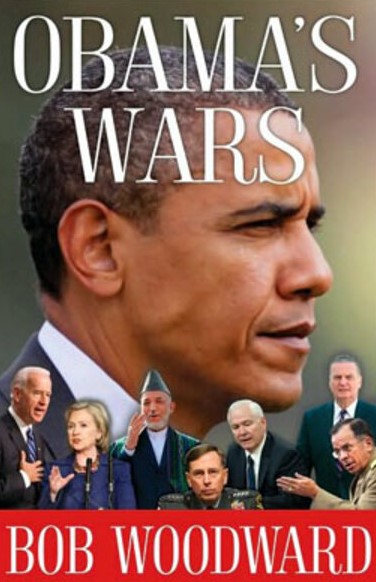

1. General: Obama’s Wars under review tells the inside story of Obama making the critical decisions on Afghanistan War, the clandestine missions in Pakistan and the worldwide fight against terrorism. The books is a chronological compilation of quotes and paraphrases that Woodward has selected to demonstrate how the decision making process in this case actually worked. The book portrays the complicated process that led to President Obama to increase the level of U.S. troops deployed to Afghanistan in support of the so-called “surge strategy.”
At the core of Obama’s Wars is the unsettled division between the civilian leadership in the White House and the United States military as the president is thwarted in his efforts to craft an exit plan for the Afghanistan War.The book gives an insight into the ‘Review of Afghan Strategy’ by US President Obama, and the underlying currents and frictions between civilian administration and military hierarchy. It also highlights the complexities of war and the emerging feelings and fears of failure of fighting a war initiated without specific aims and objectives.
Salient Aspects of the Book: Revolve around the setting up of aims and objectives, in the backdrop of existing situation prevailing in Afghanistan which is dismal and pathetic. The failure being attributed to non-cooperation by Pakistan, and bad governance by the Afghan President. The whole scenario being depicted to cover the failure of US intelligence agencies, and inaptitude of the NATO forces. Time and again, Pakistan is being viewed and projected as the core problem, and supplemented by bad governance and total dependence of Afghan government on NATO forces for its safety and security. The book also reveals the confusion and uncertainty about the mission, and additional commitment of forces. It also highlights Obama’s predicament about choosing between limited options; or indeed only one option of serge to the tune of 40,000 more troops. Yet no one including the militancy command offers a sure guarantee for success. Ironically, there is even a difference of opinion on what precisely should constitute a successful strategy. Defeating the Taliban is considered to be far-fetched and unachievable. After several review sessions, Obama’s team agrees on degrading Taliban and denying them access to the major population and production centers and lines of communication. Asserting control over the entire country is discarded as an impossible option. Lot of discussion takes place on fixing the date by which the thinning out of troops will start. US President insists on building the Afghan Government’s capacity to take over the cleared areas for self-governance. The mission thus formulated aims at ‘Clear, hold, build and transfer’. However, the military is non-committal on the dead line by which the drawing down of forces will commence. The military sets a target of building 400,000 Afghan military and police force to enable them to take over. This looks like a tall order given the fact that their attrition rate by way of causalities and defections is much higher than the rate of enlistment. That coupled with the Afghan’s lack of capacity, preparedness and willingness to take over the cleared areas makes the mission well nigh impossible. After a lot of review sessions, Obama agrees on 18 – 24 months of time period for withdrawal. The situation on ground indicates that even this period is ambitious and unachievable. While Obama is fixated on the time frame, there is a general feeling of dismay. However, December 2010 is fixed for review of the situation to determine the effectiveness of the strategy.
3. Assumptions. The strategy is based on following assumptions:
* No counter insurgency because that would require many more surges, only clearance and control of major population centres held by Taliban. Kandahar shall be the pivot of attention.
* Improve governance by Karzai administration. Assistance shall be extended only to important ministries such as Defence and Interior.
* Deny Al-Qaeda and Taliban an access to sanctuaries in Afghanistan.
* Persuade Pakistan to carryout operations against Al-Qaeda and Taliban to wipe out the sanctuaries used by Quetta Shura allegedly based in Balochistan and Haqani network in North Waziristan. Moreover, ask Pakistan to do intelligence sharing with NATO including passing of passengers list bound for US and Europe.
* Drawing down of forces by June 2010. The aim is to convey to the Afghans that the US & NATO forces are not their for indefinite period and that the Afghan Government must seriously consider to increase their capacity and reduce their dependence on US & NATO forces.
* Raise the capacity of Afghan forces and police to 400,000. During the process, degrade Taliban sufficiently so that they can be managed by the Afghan forces.
4. Analysis of the Strategy
* Intelligence Operations.
Intelligence gathering by CIA and DNI is aimed at collecting precise information about Al-Qaeda and hard core Taliban for covert as well as overt operations. US administration and NATO forces rely heavily on intelligence collection. This seems to be a difficult task given the fact that both these intelligence agencies are at odds with each other, and openly try to undermine each others capabilities. In the absence of intelligence sharing, which is limited and vague, both these agencies cover their failings by fabricating false information and invariably throwing the blame on Pakistan’s ISI of harbouring and supporting Al-Qaeda and Taliban. They generally concoct false and outrageous stories of Taliban crossing en masse into Afghanistan. While they indiscriminately carry out drone attacks on targets inside Pakistan, they fail to convince why they can not carry out similar strikes against the trucks and vehicles allegedly carrying Afghan Taliban. The authenticity of intelligence collection, or lack of it, can be gauged from the false reporting of WMD in Iraq. The recent embarrassment of negotiating with a fake Taliban leader for months is another proof of intelligence failure. NATO forces, which are boxed in with multi layers of defences around them, also join the US intelligence agencies in the Pakistan bashing only to cover their ineptitude. Their only aggression is limited to indiscriminate aerial strikes on innocent Afghans. The reports of mass killings of Afghan wedding congregations bear testimony to their merciless and ruthless operations. The fact of the matter is that all those involved in the formulation of review strategy, be it the political elite, or the intelligence agencies or the military, all the stake holders were fearful of the failure of their strategy even before its adoption. Hence, a meaningless war is being perpetrated without any possible gains.
* Political Fall Out. Obama inherited the war but wants to finish it on a favourable note. He is wary of more deployments, and wants lesser troops in Afghanistan than he inherited before the next general elections; hence setting June 2010 as the time frame for drawing down of troops. Considering the impracticable conditions for thinning out such as assuming control of major population centers, raising the capacity of Afghan security forces, improving the governance, and degrading Al-Qaeda and Taliban, the US can clearly for see their objectives in serious jeopardy. The recently held NATO Summit announcing 2014 as the time for pull out while still retaining major bases in Afghanistan amply highlights the nature of their flawed strategy. It is not difficult to fathom the adverse impact of this long war on the economies and social conditions of Europe as well as US causing negative political fall out ultimately resulting in desperate actions detrimental to the world peace and total chaos in the region. Obama, would therefore, do well to constitute a committee of ‘Think Tanks’ comprising experts (moderates and visionaries) to rethink the strategy revolving around the core issues of ‘exit, interim UN deployment and formation of broad based Afghan Government’ acceptable to all sections of Afghanistan including Taliban. Strategy once formulated can be negotiated with the major Afghan stakeholders through a third party mediation.
* Neighbouring StakeHolders. Pakistan has been the worst victim of Afghan war, notwithstanding its negative impact on its other neighbours. Hence, giving stakes to countries other than its neighbours only to appease them or to project their global power status is incongruous, and speaks of the US disregard to the sensitivities of the neighbouring countries. Pakistan would like a free, neutral Afghanistan independent of the imposing influence of its major adversary. Asking Pakistan to lower its guard against its eastern neighbour and set its own area on western border ablaze with indiscriminate operations is simple madness. Expressing surprise over Pakistan being India centric while turning a blind eye to the core issue of Kashmir is at best naïve and childish. US must allay unfounded fears of China’s growing influence and stop preparing and projecting India as its counterweight. US must instead work towards the resolution of conflicts in the region for lasting peace.
* Subordination of Military. US has bases all over the world. This has resulted in the over assertiveness of military in decision making. The rigid- ness displayed by the military during the review meetings with regard to the surge option clearly showed the vulnerability of Obama’s administration to the dictates of military command. The lesson learnt is not to overstretch your deployments to the extent that the civil authorities become subservient to the will of the military.
* Intensity of Drone Attacks. CIA openly declares increased drone strikes into Pakistan as the most effective weapon against terrorists. This mindset is totally naive given the fact that it is violating the sovereignty of a country with which it is not at war and which it ironically considers as its front line ally. More importantly, this approach is counter productive in the sense that the collateral damage caused by it has resulted in the ever increasing enlistment of recruits by Taliban; hence it has turned out to be a strategy of expansion of Taliban force, rather than its elimination. The oft repeated allegations of Quetta Shura are only meant to provide a casus belli for launching drone attacks into Balochistan. Reportedly, Pakistan is being increasingly pressurised to allow predator strikes against sites allegedly located in Balochistan. One would dread to see that happening because of its extremely violent reaction throughout the length and breadth of Pakistan. Pakistan must, therefore, convey to US in no uncertain terms that such an eventuality shall close all options of cooperation and assistance.
* Obama’s Genius. Various questions posed by Obama during the several review meetings indicate that Obama has abundant genius and above all possesses the will and desire to end the Afghan imbroglio soon to the benefit of world peace. He must, therefore, take to wiser counseling with people of his mindset and evolve strategy that is viable and acceptable to all the stakeholders. He would do well to stay away from the hawks with fixated mindsets. That in nutshell shall serve the US interests much better.
Obama’s War is a real page turner. It reads like a suspense novel. Woodward did a great job of simply presenting the facts, thoughts and expressed feelings of others, while himself remaining neutral — good old fashion journalism without an agenda. The book isn’t preaching right or left, and lets the reader decide. It’s amazing how he manages to gather the information he does and the real mystery is that who gave him the copy of McCrystal’s top secret, highly restricted assessment of the war in Afghanistan?
While Obama comes off reasonably well in this book, his legacy of course will depend on the final outcome of his war in Afghanistan. Woodward successfully connects the dots thus far, the full story of the AfPak War remains elusive — and will remain so for a long time in the future.
Obama’s War