
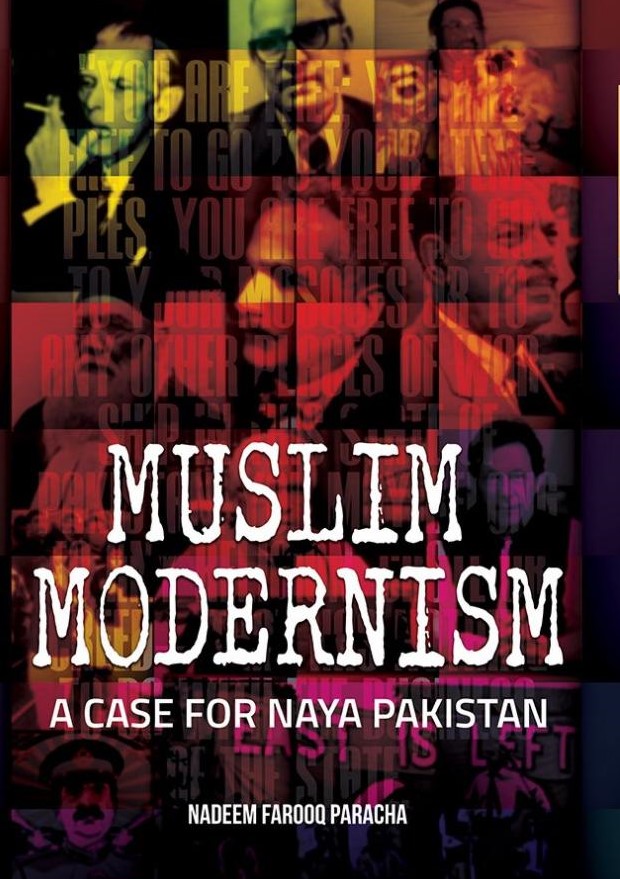
The international scholarly debates on the ideological politics of the subcontinent mainly emphasize the growth of Islamic ideology under the influences of different political parties and social movements. The leading intellectual circles of different states have produced many different levels of analysis on the role of ideology generally and Islam specifically in mainstream politics of the subcontinent. While passing through various groups of ruling elites, the inseparable imprint of ideological politics brought massive changes in the geopolitical landscape of the subcontinent. This dimension of religious ideologies and their political orientations have been studied by different Pakistani authors as well. Akin to few analytically rational studies carried out by some authors, the book under review comprises the logically convincing and rationally impartial arguments of a Pakistani author who has tried to provide a fresh look at the ideological politics of his country. The book’s writer, Nadeem Farooq Paracha attempts to discuss the history of religious politics in the pre and post-partitioned subcontinent. Paracha, a renowned columnist of DAWN, is an internationally famous literary figure due to attachment to the International Forum for Democratic Studies in Washington DC. His study of Muslim Modernism is primarily a critical appreciation of the impacts of Islamic ideology on the politics of Pakistan.
It is a brief study consisting of six short chapters, it starts the debate from the pre-partition subcontinent and ends it on the emergence of Pakistan’s third-largest political party in the parliament (Pakistan Tehreek-i-Insaf, PTI). The idea of Muslim Modernism and its persistent growth under different leaderships always produced significant political upheavals in Pakistan, which is the gravitational point of all chapters of the book. With the British colonial retreat, the ideological demarcation of the subcontinent resulted in the creation of Pakistan (with the Muslim majority and Hindu minority regions) and made India a land of significant Muslim minorities in 1947 (p.4). After providing an initial knowledge on the genesis of political Islam in the subcontinent under British colonial rule, the book introduces the role of modernist thoughts in support of the Muslim Modernism project, which laid the foundation of an independence movement for the creation of Pakistan during the colonial era (p.15). The intellectual efforts of Sir Syed Ahmad Khan, a Muslim rationalist, were the prime forces behind echoing the notion of Muslim Modernism. It brought various pragmatic changes in the Muslim community parallel to enlightening their religious thoughts on logical grounds. In contrast to creating enlightened Islamic society in the subcontinent, a socially influential and politically active role of Ulema became an unavoidable force against the notion of modernizing the Muslim community. In this way, Paracha talks about the tug of war between two different segments of Islamic society, which reached into its zenith in an independent Pakistan.
Parallel to discussing domestic politics of Pakistan on the austere ideological fragmentation in the form of inter-religion and intra-religion societal clashes, the quest for using religion as an effective tool for achieving foreign policy objectives during the Bhutto and Zia regimes further explain the internationalization of the ideological politics in the book. Instead of facilitating Pakistan in the extra-regional affairs, the promotion of religion in the mainstream foreign policy framework multiplied the foreign policy challenges by placing Pakistan between two ideological groups such as Pan-Islamism and Arab Nationalism (p. 100). According to Paracha’s study, the Saur revolution in Afghanistan and the Islamic revolution of Iran further complicated the ideological politics in Pakistan. The subsequent developments in the post-Cold War and post-9/11 environments also increased various religious fanatic sentiments in Pakistani society. Moreover, the writings of Syed Ameer Ali, Chirag Ali, Altaf Husain Hali, Maulana Mumtaz Ali, and Hamza Alvi are used as the most authentic references in the book. In other words, the book contains a compressive review of literature providing different and convincing arguments on the major obstacles in understanding the role of religious forces beyond the political spheres of the country. The central theme of the book revolves around the historical growth of Muslim modernism, which is greatly affected by the ruling political elite and their use of religion as a most preferred tool for deepening their societal roots. In the book’s main arguments, the writer endeavours to investigate the evolution of Islamic ideology in the politics of Pakistan and its social, political, and cultural effects. He slightly touches on the economic impacts of political Islam in Pakistan under different governments. As an eminent historian and an independent cultural critic, the writer’s arguments generally approach selected segments of the society. Due to his exceptional way of examining an unclear amalgamation of politics and religion in Pakistan, his journalistic viewpoints under Smokers’ Corner always provide a different dimension of various socio-political developments of Pakistan. He becomes a permanent feature of Pakistan’s largest English language newspaper based on his academic and journalistic capabilities.
The book under review is a remarkable work due to its non-traditional nature. Moreover, the inclusion of diverse literary references enhances the legitimacy and validity of Paracha’s arguments. It could be treated as an appropriate study to understand the roots of Pakistan’s various socio-religious and socio-political problems.