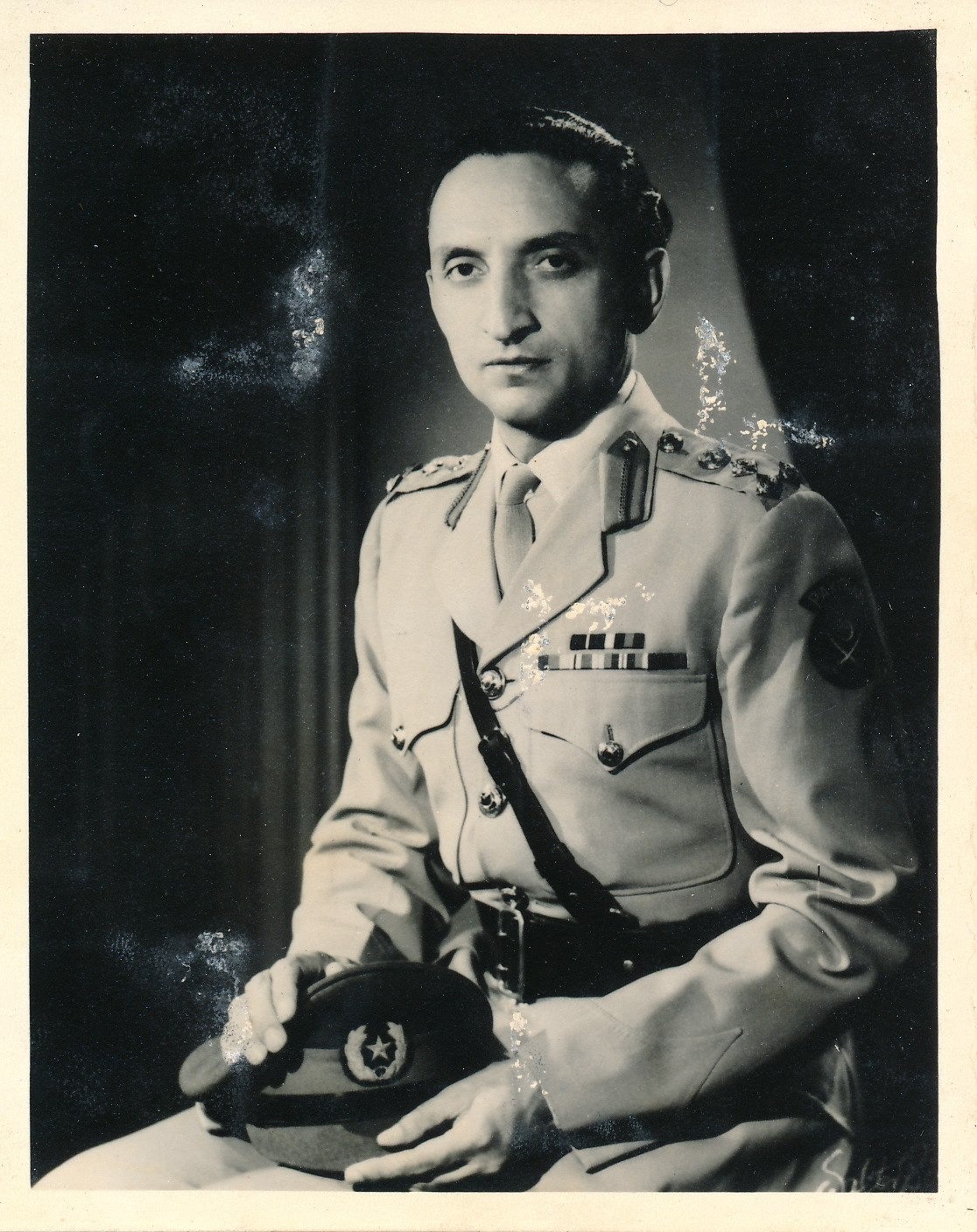
Sahabzada Muhammad Yaqub Khan is part of that generation of the subcontinent that witnessed some of the most exciting events of the last seventy years. He was not only a witness but active participant in many events of these challenging times. Some events of his life seem to be the material for a novel rather than real life experiences. This generation born at the zenith of British Raj in India received the best education that the Raj could offer and joined Indian army during the Second World War. Young lads from different religions and ethnicities were comrades in elite regiments fighting under the guidance of their British mentors. As Captains and Majors they saw the independence of their land and the departure of the British. Some had to leave their ancestral lands that happened to fall on the wrong side of the divide. Former comrades became foes when their newly independent countries got entangled into prolonged conflict over the disputed territory of Kashmir. Many fought against each other as Captains and Majors in the 1947-48 war in Kashmir, in 1965 war as Brigadiers and Major Generals and in the 1971 war as senior commanders of their respective armies. In the case of Pakistan, they saw the secession of the eastern wing in 1971. Yaqub is a poster child of this generation of officers.
Yaqub was born in the aristocratic household in the princely state of Rampur. He studied at Prince of Wales Royal Military College at Dehra Dun and joined Royal Indian Military Academy at Dehra Dun and commissioned in Indian army. He joined the elite 18th King Edward VII Own Cavalry of Indian army. During the Second World War, 18th Cavalry left India in January 1941 for the Middle East theatre and landed in Egypt. The Regiment was then commanded by Lieutenant Colonel Howard Fowler (he had just taken over command from Lieutenant Colonel H. M. Tulloch) and the senior most Indian Viceroy Commissioned Officer (VCO) was Risaldar Major Kapur Singh. Lieutenant Yaqub was with A Squadron (Hindu Jat), commanded by Captain J. M. Barlow.
18th Cavalry was part of 3rd Indian Motor Brigade commanded by Brigadier E. W. D. Vaughan (later Brigadier Filose) and grouped with two other elite cavalry regiments – 2nd Royal Lancers (Gardner’s Horse) and 11th Prince Albert Victors’ Own (PAVO) Cavalry. They were supported by 2nd Field Regiment of Indian Artillery. Volunteers from all three cavalry regiments of 3rd Indian Motor Brigade formed Indian Long Range Scouts (ILRS). It was a squadron strength organization commanded by Major Samuel Vallis McCoy and consisting of J (Jat), R (Rajput), M (Muslim) and S (Sikh) patrols. In May 1942, Italian forces overran 3rd Indian Motor Brigade and a large number of Indian officers and men became Prisoners of War (POW). Yaqub’s comrade in 18th Cavalry was Second Lieutenant Abhey Singh. Yaqub and Abhey came from similar backgrounds. Yaqub was from the princely house of Najibabad and his father Sir Abdul Samad Khan was Prime Minister of the princely state of Rampur. Abhey was from the princely state of Kota where his father Major General Sir Onkar Singh was Prime Minister of the state. Two other officers of the regiments fighting alongside Yaqub’s 18th Cavalry were also from aristocratic families. Major Rajendrasinhji Jadeja (he has the distinction of being the first Indian officer to win DSO and later rose to become Chief of Staff of Indian Army 1953-55) commanding B Squadron of 2nd Lancers was from the princely state of Nawanagar and Lieutenant Sardar Hissamuddin Mahmud el- Effendi of 11th PAVO Cavalry was a scion of the Afghan royal family. Yaqub and Hissam were later polo buddies (along with Colonel ‘Huskey’ Baig and Colonel Sikku Baig they played at Lahore Polo Club).
Yaqub and Abhey along with the senior most Indian officer Major P. P. Kumaramangalam (2nd Field Regiment) were together in Italian POW camps of Avers and Avezzano. In the confusing times of 1943 when Italian forces capitulated, these three officers escaped. Yaqub had learnt Italian during captivity therefore he was leading the pack interacting with Italian peasants to try to reach the allied lines. They were captured again, this time by the Germans and they spent the next few years in a German POW camp of Braunschweig. Yaqub learned German during his stay with the Germans. He was repatriated after the end of the war in 1945. In 1947 Yaqub opted for the Pakistan Army while his comrade Abhey Singh stayed with the Indian Army. Abhey transferred to 17th Poona Horse and led a tank squadron in ‘Operation Polo’ when Indian army moved into the state of Hyderabad in 1948. In 1965 war, Yaqub’s parent battalion 18th Cavalry managed to reach the Burki Police Station on Lahore front and their commandant Lieutenant Colonel Hari Singh Deora (later Brigadier) had his picture taken in front of Burki police station. Yaqub commanded 11th PAVO Cavalry in 1952-3; the regiment that was in the same formation when he served with 18th Cavalry during Second World War. In 1947, Hindu and Sikh soldiers of regiments allotted to Pakistan went to India and Muslim soldiers of regiments allotted to India came to Pakistan. Muslim elements of 2nd Lancers (along with some elements of 8th Cavalry and 9th Deccan Horse) joined 11th PAVO Cavalry while Sikh squadron of 11th PAVO Cavalry went to 18th Cavalry and thus the circle was completed.
In 1947, Yaqub was Second in Command of Viceroy’s Bodyguards then commanded by Lt. Colonel Peter Hussey. Indian army regiments were divided between India and Pakistan including Viceroy’s Bodyguards. This unit consisted of Punjabi Muslims and Sikhs. Like all other regiments, personnel and equipment of bodyguards was also divided. Major Yaqub representing Pakistan and Major Gobind Singh (Jaipur Guards) representing India went to the stables of Viceroy’s Lodge to divide the property of the regiment. Mountbatten’s ADC Lieutenant Commander Peter Howes arbitrated and at one time a coin toss decided about which country would get the gold carriage of Viceroy. Yaqub came to Pakistan with the Muslim component and their share of the property of one of the oldest regiment of Indian army and became the first commandant of Governor General’s Bodyguards. Yaqub’s elder brother Sahabzada Muhammad Yunus Khan was commissioned in the Indian army from Officers Training School (OTS) at Bangalore and served with Garhwal Rifles. In the Second World War both brothers fought under the Union Jack and both earned Indian General Service Medal (IGSM). In 1947, Yunus opted for the Indian army. Immediately after independence, India and Pakistan went to war in Kashmir. Yaqub was sent by Pakistan army while Yunus was sent to the same theatre by Indian army. Yunus was with Garhwal Rifles (most likely 3/18 Garhwal Rifles commanded by a fine officer Lt. Colonel Kaman Singh and a superb senior most JCO Subedar Major Sher Singh Rawat as this unit saw lot of action and 1/18 Garhwal Rifles came to the theatre quite late in July 1948). Yunus served as Deputy Military Secretary to President of India and retired at the rank of Colonel.
A number of Indian and British officers were captured by Italians in Middle East theatre in May 1942. All three commanding officers of the regiments of 3rd Indian Motor Brigade, Lt. Colonel Fowler CO of 18th Cavalry, Lt. Colonel De Salis CO of 2nd Lancers and Lt. Colonel P. R. Tathem CO of 11th PAVO Cavalry were bagged by the Italians. In the Aversa POW camp in Italy, a very strange chapter of Indian military history was recorded. The Italian commander of the POW camp, Colonel Errera appointed several Indian officers for management of prisoners. These officers of different faiths and ethnicities were fighting under the flag of the British Indian army and were now prisoners. Major Kumaramangalam (2nd Field Regiment) being the senior most officer was appointed commanding officer of the camp. Captain Yahya Khan (4/10 Baluch Regiment, now 11 Baloch of Pakistan army) was camp Adjutant and his assistant was Lieutenant Shamsher Singh. Captain Tikka Khan (2nd Field Regiment) was Quarter Master. Other inmates of the camp were Yaqub Khan (18th Cavalry), Major Ajit Singh (Royal Indian Army Service Corps), Captain Kalyan Singh (2nd Field Regiment), Captain A. S. Naravane (2nd Field Regiment), Lieutenant Abhey Singh (18th Cavalry) and Lieutenant Sardar Hissamuddin Mahmud el-Effendi (11th PAVO Cavalry). Many officers of this POW camp later played important part in the history of India and Pakistan. The Italian Colonel of the POW camp could not have imagined that he was holding a whole crop of future high power society. This camp has the world record of holding so many future senior officers under its roof. Kumaramangalam escaped from Italy but was captured by the Germans and was their guest for a few years. He later became Chief of Army Staff of India (1966-69). Yahya Khan rose to become Pakistan army chief and then President (1966-71). In 1971, Tikka Khan was Commander of Eastern Command and later became Pakistan army chief (1972-76). 2nd Field Regiment of artillery can be proud to have two army chiefs of rival India and Pakistan. Yaqub Khan became Lieutenant General and served as commander of Eastern Command during the fateful days of 1971. After retirement he served as ambassador at several important posts and Foreign Minister of Pakistan. Hissam rose to the rank of Brigadier in Pakistan army. Ajit Singh rose in the ranks to become Lieutenant General, Kalyan Singh and Naravane became Major Generals and Shamsher Singh Brigadier in Indian army.
Yaqub left his mark on the Pakistan army. He has many admirers as well as his critics. Yaqub is a pioneer of starting the intellectual life in Pakistan army. He served as Director Armored Corps as Brigadier, 6th Armored Division commander, Commandant of Staff College and Chief of General Staff (CGS) as Major General and Corps Commander of East Pakistan at the rank of Lieutenant General. As Commandant of Staff College at Quetta, he introduced Pakistani officers to the higher direction of war. He was also instrumental in establishment of National Defence College (now National Defence University) with its two tiered course. There were not too many thinking generals in Pakistan army at that time.
In view of his aristocratic background and intellectual bent, Yaqub was different in outlook. He was from the old school of strict adherence to protocol and traditions. One of his junior officers who served with Yaqub when later was commanding 11th PAVO Cavalry recalls an incident in the mess. In one of the early days of his command, Yaqub stormed out of the dinning room because his cold meat was not properly dressed and potatoes were not of uniform size. The officer swears that he saw tears in Yaqub’s eyes. I can easily visualize that during the Second World War, when ready to surrender, Yaqub donning his best cavalry uniform and asking his orderly to polish the boots with extra shine and then put on his cavalry sword and wait for the Italian officer to show up and Yaqub surrendering with full protocol.
Yaqub’s critics point to three incidents pertaining to three different times of his life. First is when he was in Kashmir war in 1947-48. Yaqub was ordered to rescue a small picket surrounded by Indians. He was a thinking officer and kept calculating his own likely action and enemy’s possible reaction. In the meantime, the Indians overran the picket. Second was when he refused to carry out military action against Bengalis when he was commander of Eastern Command. Yaqub was sacked from the army for his refusal. At that time, almost all officers regardless of their rank and social background denounced Yaqub. Later, with hindsight, some changed their mind and thought Yaqub did the right thing. The third criticism relates to his post retirement career. He served at important ambassadorial positions under Prime Minister Zulfiqar Ali Bhutto and later served as Foreign Minister of Bhutto’s executioner General Muhammad Zia ul Haq without any qualms.
In one life, Yaqub has enjoyed every aspect of an adventurous journey. A long and fulfilling military career was followed by an equally rewarding career of a well respected diplomat. In addition to these full time occupations, he continued his passion of reading (his grandfather Abdus Salam Khan was an avid reader and kept a large library) with some philosophical bent and played polo. He is probably the oldest living officer in Pakistan and at the ripe age of 91 he has a treasure chest of memories that can bring a smile as well as a tear or two in the eyes.
End Notes:
1- Major General Partap Narain. Subedar to Field Marshal (New Delhi: Manas Publications, 1999)
2- Major General ® A. S. Naravane. A Soldier’s Life in War and Peace (New Delhi: A. P. H. Publishing Corporation, 2004)
3- Larry Collins and Dominique Lapierre. Freedom at Midnight (New York: Simon & Schuster, 1975)
4- Charles Chenevix Trench. The Indian Army and the King’s Enemies 1900-1947 (New York: Thames & Hudson, 1988)
5- The Tiger Kills (London: Her Majesty’s Stationary Office,1944)
6- M. Y. Effendi. Punjab Cavalry: Evolution, Role, Organisation, and Tactical Doctrine 11 Cavalry (Frontier Force) 1849-1971 (Karachi: Oxford University Press, 2007)
7- Colonel Abdul Qayyum. Pakistan Army’s Mosaic of Ideas – I. Defence Journal, July 2000
8- Hamid Hussain. Stranger than Fiction – Story of Identity, Loyalty, Sacrifice and Betrayal. Defence Journal, December 2007
9- Hamid Hussain. Lest We Forget. Defence Journal, March 2010