

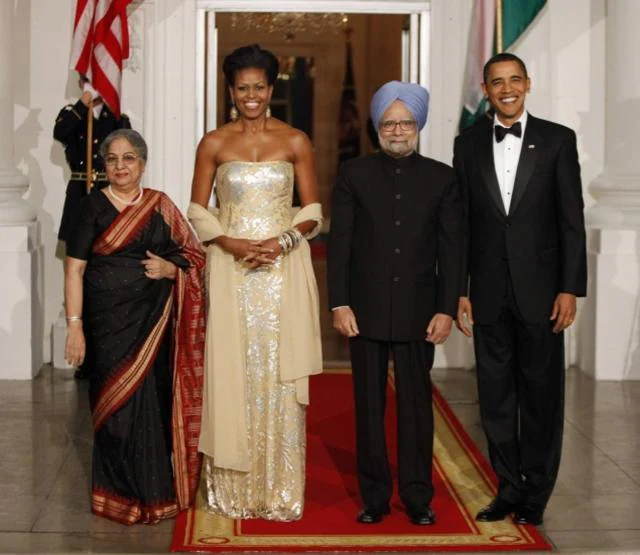
“The two leaders have a shared vision for peace, stability and prosperity in Asia, the Indian Ocean region and the Pacific region and committed to work together, and with others in the region, for the evolution of an open, balanced and inclusive architecture in the region. In this context, the leaders reaffirmed their support for the East Asia Summit and committed to regular consultations in this regard. The United States welcomes, in particular, India’s leadership in expanding prosperity and security across the region. The two leaders agreed to deepen existing regular strategic consultations on developments in East Asia, and decided to expand and intensify their strategic consultations to cover regional and global issues of mutual interest, including Central and West Asia.” (Joint Statement by President Obama and Prime Minister Singh of India issued by the White House on November 8, 2010)
Having followed President Obama’s visit to India and read the newspapers watched our television and heard our expert commentators, views on the matter, I have doubled up laughing at the so-called Pakistani predicament as we specialize in twisting facts and ourselves into knots. Once more, we have succeeded in proving to the World that we are in fact a Nation that does not know what to think or even have a firm hold on our beliefs or actions. We are very similar in our reactions, to when you try and visualize a virgin teenage grandmother and then insist that it is a truth. A natural impossibility but we cannot see it that way, because we can’t be pretty or sexy in our chattering circles, if we did. And I say this as a very patriotic Pakistani.
I am deeply hurt by Pakistan’s reaction to President Obama’s visit to India because at age 63 Pakistan still doesn’t know what to think and has even less control of what it says. Pakistan is a deeply troubled nation of undisciplined bosses and a country of very smart people who prefer to think with their hearts and not with their heads. We are a pendulum swinging from one end to another in either ecstasy or despair and are totally incapable of reaching a middle ground or have a serious dialogue with themselves because introspection means coming to face with a reality. In such matters Pakistan akin to Dorian Gray afraid to see a picture of ourselves. We refuse to look at ourselves to see what we have become. We cannot stand ourselves and blame the world for doing the same. We have forgotten who we are and firmly believe the Quaid e Azam was joking when he laid down the principle of Unity Faith and Discipline. We profess and pay lip service to any or all three principles that the Quaid e Azam held supreme.
For once, we ought to shut up and think very clearly and properly and have the courage to walk on a very bumpy road. Should we fail to do that, we will be condemned to being a nation that lost itself and probably become a footnote in the pages of history. We have forgotten to look at the big picture and insist on fighting about the shade of one insignificant piece of the colour it ought to be. Invariably, we come up with the lament that we didn’t know or nobody told us. This is our pet excuse for being incompetents who insist that losing is a better way of life because it is hard to go on winning. This state of affairs leaves no time for us to act like what we have to look ay ourselves and have become, a very bad, pathetic joke.
So my brothers and sisters, here comes a review of history with a dash of geography. I am doing this because I care for my country because without it, I am nothing. With it I am a Pakistani who I still proud enough to say so and believe that winning is a frame of mind that you develop when you stop believing in all the rumours that float around or whatever a newspaper headline has to say. Read the contents of the article and view it in the context of historical events. And most of all have the courage to believe in yourselves, your ability to think clearly and your ability to win.
India from the very word go, believed that it was a world power and somehow the world powers that were or be, were a bunch of bananas for not believing them. All that President Obama has said is ‘You are no longer an emerging power, you have emerged.” With that statement, one of India’s most cherished desire and dreams were fulfilled and reality looked rosy instantaneously. That India is a somebody and it is a big boy at long last. What president Obama also said was the USA will back India claim for a seat as a permanent member of the United Nations Security Council once the reworking process starts. The same promise was made to Japan in 1990 and after 20 years Japan is still waiting to take its place in that August assembly. How much longer will it have to wait? That depends on many things and permutations that are beyond the USA’s control. We have to keep this in mind. So there is no need for us to run around like a headless chicken just because India is ecstatic over President Obama’s speech at the Lok Sabha.. We have to depend on ourselves. We as Pakistanis and Muslims should leave behind our penchant for fighting for the cause of the Islamic world before we fight for ourselves for a change.
I’m going to shoot sacred cows now, so bear with me or stop reading.. The Masjid Al Aqsa that is in Jerusalem or the Bait ul Muqaddas, fell to the Israelis decades ago. The OIC came about to galvanize the Islamic World to free it. The Palestinian problem has been constantly aggravated by Israel, and with the backing of the West, has thrived at the Palestinian Arab’s expense as they continue Palestinian land grabbing. The OIC is well over thirty and close to forty years old. What have the Arabs done? They have not done a thing except accepting the Carter Doctrine as a fait accompli and kowtowing to the West. The Arabs are incapable of defending themselves or retaking the Masjid al Aqsa. The Arab and the Muslim world stood by silently as spectators when the USA attacked Iraq in 2003 on a fraudulent premise as was demonstrated later. Was the American misadventure in Iraq undertaken to safeguard Saudi Arabia’s security and with their approval or backing? You will most certainly get that impression after reading Bob Woodward’s book “Plan of Attack”. The USA was delighted to jump on the already depleted Iraqi forces in 2003 and destroy whatever they had achieved in terms of progress under the Baathist regime of Saddam Hussein and reduced Iraq to a shambling hulk and it will take Iraq decades to reach its former state of development. In the process of doing that, the USA swallowed poison and is shown the world over as a has been force. Could the USA have done that had Saddam Hussein developed a nuclear or a working WMD arsenal? Think about it and you will see that the Pakistani mindset is based on excuses of why it can’t be done rather than why it can and what and should be done. That if you can’t have it no one else should have it should end and to top it all off, we will not make the effort to get whatever we want on our own. We have reached a state of pettiness or even the pinnacle of pettiness where the head of the Pakistani squad to the Commonwealth game snatched the flag away from the man who was supposed to be carrying it. He had the power and he wanted the five minutes of glory most probably, in an otherwise uneventful life. This is how low we have sunk. We put our mind to it and developed a nuclear capability. Can you deny it? But after that we have decided to put our brains in a cold storage. Let us get back to India now.
What we Pakistanis never built into our calculations, was India has claimed that it’s major threat is China despite the fact that India concentrated its troops on our borders we have never tired of saying the latter part of the statement because of our penchant for self flagellation, that took over. Everyone knows that and that we have gone to war four times with India. I wonder how India could have massed its troops against China and where would that be? After the beating India took at the hands of the Chinese in1962, the famous slogan Hindi-Chini Bhai Bahi became Hindi-Chini Bye Bye. India waited till after Pandit Jawaharlal Nehru’s demise to start working on its nuclear arsenal. This Patriarch of Indian politics insisted that India did not need the Atom Bomb but needed steel mills, heavy industry and socialism. India had to wait till 1964 before it started work on its Atom Bomb.
Till today, India shrinks back from being equated with Pakistan who they consider to be mindless hooligans and insists China is its biggest threat despite the fact there is no way that they can fight a land war against China. All that President Obama has done is accepted India’s oft repeated claim that China is India’s greatest threat as a reality and propped up India as a counterweight to China in Asia to serve the USA’s purpose. Read the Joint statement issued by the White House on the 8th of November 2010 which appears in-toto as Annexure I
Today China is the world’s second largest economy in the world and this scares the USA because China is also the USA’s largest creditor. After the initial Euphoria in India, the reality will sink in and they will start to think of a way out of accepting this dubious privilege. Just look at President Obama’s itinerary. It consisted of India, Indonesia, country and then the G-20 meeting in Seoul where the USA hopes that an unscheduled meet the Chinese Prime Minister on the sidelines will take place.
It is now time to look at the map of the Bay of Bengal and the Indian Ocean. You will see that Myanmar and China are beginning to pose a threat to the Indian hold of the northern segment of the Bay of Bengal. If the Chinese and Myanmar can consolidate their hold in the Bay of Bengal, they will pose a threat to the US access to the Pacific Ocean through the Straits of Malacca. Both India and Indonesia are major nations that straddle the access to these Straits in the Indian Ocean. It would pay to remember that the US COMPAC or the USA’s Command Pacific consists of the area that starts with India and encompasses Eastern Asia. The Eastern Indian seaboard the Andaman and especially Nicobar islands are ideal refueling stops and a stone throw away from Bandar Aceh that is the Northern most segment of Indonesia island nation. So the two states that were the first and second stops of this American presidential tour, were accorded the privilege of President Obama’s presence and undertaken by the USA to re-enforce the USA’s access to the Straits of Malacca. It could be quite incidental at this time, that President Obama spent a portion of his life in Indonesia. Today America is worried about China who has refused to revalue it currency to oblige the USA, and has generally been acting up and has stalled America’s desire to address the balance of Trade situation that is heavily in China’s favour and exerting great pressure on the American Dollar. What America will not do is stop buying so much from China or change the way America works.
Geography shows that it would be an impossibly long haul with stops at Hawaii and the Midway Islands for America to access the Far East. This is the closest, the shortest and the most defendable route to the Far East for the US Navy. The USA desperately needs footholds to protect its interests in Asia and this is it. Until very recently, the US Navy was the sole power operating in the area. Today China is in the process of building its navy and laying claims to islands that are under Japan or Vietnam or Philippines control but China says it is their territory.
China has started flexing its biceps in the Far East where the USA is at its weakest and short of going to war with nuclear weapons, it cannot protect Japan, South Korea and Taiwan if the Chinese decide to do something. The USA is dependant on China to bring North Korea to the table to discuss its “ever so dangerous and clandestine nuclear program” that incidentally may be the World’s smallest nuclear arsenal. America’s problem is the lack of manpower in its armed forces also known as boots on the ground. This has bred an excessive reliance on technological superiority to compensate for this shortfall. Today the American army is no longer an army of conscription but is an army of volunteers and this will show why the USA’s army cannot commit and could not commit adequate manpower to hold on to either Iraq or Afghanistan. Can America hold on to what it has conquered without boots on the ground? The answer would be an unqualified Yes if you are Donald Rumsfeld, Dick Cheney, Paul Wolfowitz, Condoleeza Rice or others of their ilk. The answer would be a resounding No if you looked at what happened in Iraq and Afghanistan as a consequence of the USA’s Shock and Awe tactics that were employed by the USA. Shambles, pure and simple shambles od such magnitude, that it could make any Pakistani worth his salt extremely jealous.
We tend to forget that we have been a frontline state for 30 years and counting. This state of affairs has wrought havoc with the people, the way they think and an extreme sense of futility and pessimism. A disturbed Western border has really disrupted our economy also and reduced our mindset to that of becoming beggars holding out our kashkol asking for foreign aid whether it is for running the country, brushing our teeth or even sneezing. We do this while we have a Government and an economy based on exceptions. Anyone who is a somebody can be accommodated by an exception. This is very different from the way India does things. India puts its money down as payment for whatever they want. Pakistanis want aid for whatever we want. In the world’s eyes, we are a bunch of bananas, and are corrupt and we are beggars and we should be treated as such. We cannot blame the Rest of the World for our problems. The words I would care to emphasize here is “our problems”. I am quit6e sure India Israel and the USA have more to do than play with the Pakistani mind. Just treat our problems for what they are and get rid of them without excuses or trying to do it tomorrow.
What we seem to forget is hegemons have atom bombs so for my brothers and sisters who insist that India has become the USA’s hegemon after President Obamam’s visit to India. I say think again. If Pakistan did not have a nuclear arsenal that presently and incidentally is larger than India’s nuclear arsenal, then India could have become our hegemon. Our nuclear program has set us free from the threat that our Eastern borders faced if not entirely then to a great extent because otherwise whatever L. K. Advani and other Indian right wingers said during the two weeks that separated India’s nuclear tests and Pakistan’s nuclear tests would have become a reality.
Remember we in Pakistan fall under USCENTCOM, Or the US Central Command and have been de-hyphenated from India a long time ago by the USA only we do not realize it. This means that any Indian involvement in Afghanistan, per force, will have to be much smaller than our involvement in Afghanistan. It is us, the Pakistanis and our 1857 mindset that insists on being equated with India and making it a major problem for ourselves. Gain a perspective. Our destiny as a country does not lie to the East. It lies to the West. We have to emphasize the agreement to transit Afghanistan into Central Asia and act as the place from where Central Asia can ship their goods to the rest of the world. There is a big world out there. Think about it if you possibly can. We have to by-pass a segment of our history if we are to ever gain a perspective about ourselves and what and where our destiny is or should be. To gain a better perspective, think of what India looked like before the Second Afghan War. How much territory did the British Empire in India gain as the result of the Afghan defeat and from the Durand Line. History starts with our school books but it certainly does not end there. Where is your faith? Where is your trust in your capabilities? Why are you so dependent on others for your existence as a free and independent State? This is because we have lost our perspective of what the truth and the situation on the ground is and are unable to handle that.
Annexure I
Joint Statement by President Obama and Prime Minister Singh of India
Reaffirming their nations’ shared values and increasing convergence of interests, Prime Minister Manmohan Singh and President Barack Obama resolved today in New Delhi to expand and strengthen the India-U.S. global strategic partnership.
The two leaders welcomed the deepening relationship between the world’s two largest democracies. They commended the growing cooperation between their governments, citizens, businesses, universities and scientific institutions, which have thrived on a shared culture of pluralism, education, enterprise, and innovation, and have benefited the people of both countries.
Building on the transformation in India-U.S. relations over the past decade, the two leaders resolved to intensify cooperation between their nations to promote a secure and stable world; advance technology and innovation; expand mutual prosperity and global economic growth; support sustainable development; and exercise global leadership in support of economic development, open government, and democratic values.
The two leaders reaffirmed that India-U.S. strategic partnership is indispensable not only for their two countries but also for global stability and prosperity in the 21st century. To that end, President Obama welcomed India’s emergence as a major regional and global power and affirmed his country’s interest in India’s rise, its economic prosperity, and its security.
A Global Strategic Partnership for the 21st Century
Prime Minister Singh and President Obama called for an efficient, effective, credible and legitimate United Nations to ensure a just and sustainable international order. Prime Minister Singh welcomed President Obama’s affirmation that, in the years ahead, the United States looks forward to a reformed UN Security Council that includes India as a permanent member. The two leaders reaffirmed that all nations, especially those that seek to lead in the 21st century, bear responsibility to ensure that the United Nations fulfills its founding ideals of preserving peace and security, promoting global cooperation, and advancing human rights.
Prime Minister Singh and President Obama reiterated that India and the United States, as global leaders, will partner for global security, especially as India serves on the Security Council over the next two years. The leaders agreed that their delegations in New York will intensify their engagement and work together to ensure that the Council continues to effectively play the role envisioned for it in the United Nations Charter. Both leaders underscored that all states have an obligation to comply with and implement UN Security Council Resolutions, including UN sanctions regimes. They also agreed to hold regular consultations on UN matters, including on the long-term sustainability of UN peacekeeping operations. As the two largest democracies, both countries also reaffirmed their strong commitment to the UN Democracy Fund.
The two leaders have a shared vision for peace, stability and prosperity in Asia, the Indian Ocean region and the Pacific region and committed to work together, and with others in the region, for the evolution of an open, balanced and inclusive architecture in the region. In this context, the leaders reaffirmed their support for the East Asia Summit and committed to regular consultations in this regard. The United States welcomes, in particular, India’s leadership in expanding prosperity and security across the region. The two leaders agreed to deepen existing regular strategic consultations on developments in East Asia, and decided to expand and intensify their strategic consultations to cover regional and global issues of mutual interest, including Central and West Asia.
The two sides committed to intensify consultation, cooperation and coordination to promote a stable, democratic, prosperous, and independent Afghanistan. President Obama appreciated India’s enormous contribution to Afghanistan’s development and welcomed enhanced Indian assistance that will help Afghanistan achieve self-sufficiency. In addition to their own independent assistance programs in Afghanistan, the two sides resolved to pursue joint development projects with the Afghan Government in capacity building, agriculture and women’s empowerment.
They reiterated that success in Afghanistan and regional and global security require elimination of safe havens and infrastructure for terrorism and violent extremism in Afghanistan and Pakistan. Condemning terrorism in all its forms, the two sides agreed that all terrorist networks, including Lashkar e-Taiba, must be defeated and called for Pakistan to bring to justice the perpetrators of the November 2008 Mumbai attacks. Building upon the Counter Terrorism Initiative signed in July 2010, the two leaders announced a new Homeland Security Dialogue between the Ministry of Home Affairs and the Department of Homeland Security and agreed to further deepen operational cooperation, counter-terrorism technology transfers and capacity building. The two leaders also emphasized the importance of close cooperation in combating terrorist financing and in protecting the international financial system.
In an increasingly inter-dependent world, the stability of, and access to, the air, sea, space, and cyberspace domains is vital for the security and economic prosperity of nations. Acknowledging their commitment to openness and responsible international conduct, and on the basis of their shared values, India and the United States have launched a dialogue to explore ways to work together, as well as with other countries, to develop a shared vision for these critical domains to promote peace, security and development. The leaders reaffirmed the importance of maritime security, unimpeded commerce, and freedom of navigation, in accordance with relevant universally agreed principles of international law, including the United Nations Convention on the Law of the Sea, and peaceful settlement of maritime disputes.
The transformation in India-U.S. defense cooperation in recent years has strengthened mutual understanding on regional peace and stability, enhanced both countries’ respective capacities to meet humanitarian and other challenges such as terrorism and piracy, and contributed to the development of the strategic partnership between India and the United States. The two Governments resolved to further strengthen defense cooperation, including through security dialogue, exercises, and promoting trade and collaboration in defense equipment and technology. President Obama welcomed India’s decision to purchase U.S. high-technology defense items, which reflects our strengthening bilateral defense relations and will contribute to creating jobs in the United States.
The two leaders affirmed that their countries’ common ideals, complementary strengths and a shared commitment to a world without nuclear weapons give them a responsibility to forge a strong partnership to lead global efforts for non-proliferation and universal and non-discriminatory global nuclear disarmament in the 21st century. They affirmed the need for a meaningful dialogue among all states possessing nuclear weapons to build trust and confidence and for reducing the salience of nuclear weapons in international affairs and security doctrines. They support strengthening the six decade-old international norm of non-use of nuclear weapons.
They expressed a commitment to strengthen international cooperative activities that will reduce the risk of terrorists acquiring nuclear weapons or material without reducing the rights of nations that play by the rules to harness the power of nuclear energy to advance their energy security. The leaders reaffirmed their shared dedication to work together to realize the commitments outlined at the April 2010 Nuclear Security Summit to achieve the goal of securing vulnerable nuclear materials in the next four years. Both sides expressed deep concern regarding illicit nuclear trafficking and smuggling and resolved to strengthen international cooperative efforts to address these threats through the IAEA, Interpol and in the context of the Nuclear Security Summit Communiqué and Action Plan. The two sides welcomed the Memorandum of Understanding for cooperation in the Global Centre for Nuclear Energy Partnership being established by India.
Both sides expressed deep concern about the threat of biological terrorism and pledged to promote international efforts to ensure the safety and security of biological agents and toxins. They stressed the need to achieve full implementation of the Biological and Toxin Weapons Convention and expressed the hope for a successful BWC Review Conference in 2011. The United States welcomed India’s destruction of its chemical weapons stockpile in accordance with the provisions of the Chemical Weapons Convention. Both countries affirmed their shared commitment to promoting the full and effective implementation of the CWC.
The two leaders expressed regret at the delay in starting negotiations in the Conference on Disarmament for a multilateral, non-discriminatory and internationally and effectively verifiable treaty banning the future production of fissile material for nuclear weapons or other nuclear explosive devices.
India reaffirmed its unilateral and voluntary moratorium on nuclear explosive testing. The United States reaffirmed its testing moratorium and its commitment to ratify the Comprehensive Test Ban Treaty and bring it into force at an early date.
The leaders reaffirmed their commitment to diplomacy to resolve the Iranian nuclear issue, and discussed the need for Iran to take constructive and immediate steps to meet its obligations to the IAEA and the UN Security Council.
Technology, innovation, and energy
Recognizing that India and the United States should play a leadership role in promoting global nonproliferation objectives and their desire to expand high technology cooperation and trade, Prime Minister Singh and President Obama committed to work together to strengthen the global export control framework and further transform bilateral export control regulations and policies to realize the full potential of the strategic partnership between the two countries.
Accordingly, the two leaders decided to take mutual steps to expand U.S. – India cooperation in civil space, defense, and other high-technology sectors. Commensurate with India’s nonproliferation record and commitment to abide by multilateral export control standards, these steps include the United States removing Indian entities from the U.S. Department of Commerce’s “Entity List” and realignment of India in U.S. export control regulations.
In addition, the United States intends to support India’s full membership in the four multilateral export control regimes (Nuclear Suppliers Group, Missile Technology Control Regime, Australia Group, and Wassenaar Arrangement) in a phased manner, and to consult with regime members to encourage the evolution of regime membership criteria, consistent with maintaining the core principles of these regimes, as the Government of India takes steps towards the full adoption of the regimes’ export control requirements to reflect its prospective membership, with both processes moving forward together. In the view of the United States, India should qualify for membership in the Australia Group and the Wassenaar Arrangement according to existing requirements once it imposes export controls over all items on these regimes’ control lists.
Both leaders reaffirmed the assurances provided in the letters exchanged in September 2004 and the End-Use Visit Arrangement, and determined that the two governments had reached an understanding to implement these initiatives consistent with their respective national export control laws and policies. The Prime Minister and President committed to a strengthened and expanded dialogue on export control issues, through fora such as the U.S. – India High Technology Cooperation Group, on aspects of capacity building, sharing of best practices, and outreach with industry.
The possibility of cooperation between the two nations in space, to advance scientific knowledge and human welfare, are without boundaries and limits. They commended their space scientists for launching new initiatives in climate and weather forecasting for agriculture, navigation, resource mapping, research and development, and capacity building. They agreed to continuing discussions on and seek ways to collaborate on future lunar missions, international space station, human space flight and data sharing, and to reconvene the Civil Space Joint Working Group in early 2011. They highlighted the just concluded Implementing Arrangement for enhanced monsoon forecasting that will begin to transmit detailed forecasts to farmers beginning with the 2011 monsoon rainy season as an important example of bilateral scientific cooperation advancing economic development, agriculture and food security.
The two leaders welcomed the completion of steps by the two governments for implementation of the India – U.S. civil nuclear agreement. They reiterated their commitment to build strong India – U.S. civil nuclear energy cooperation through the participation of the U.S. nuclear energy firms in India on the basis of mutually acceptable technical and commercial terms and conditions that enable a viable tariff regime for electricity generated. They noted that both countries had enacted domestic legislations and were also signatories to the Convention on Supplementary Compensation. They further noted that India intends to ratify the Convention on Supplementary Compensation within the coming year and is committed to ensuring a level playing field for U.S. companies seeking to enter the Indian nuclear energy sector, consistent with India’s national and international legal obligations.
India will continue to work with the companies. In this context, they welcomed the commencement of negotiations and dialogue between the Indian operator and U.S. nuclear energy companies, and expressed hope for early commencement of commercial cooperation in the civil nuclear energy sector in India, which will stimulate economic growth and sustainable development and generate employment in both countries.
Just as they have helped develop the knowledge economy, India and the United States resolved to strengthen their partnership in creating the green economy of the future. To this end, both countries have undertaken joint research and deployment of clean energy resources, such as solar, advanced biofuels, shale gas, and smart grids. The two leaders also welcomed the promotion of clean and energy efficient technologies through the bilateral Partnership to Advance Clean Energy (PACE) and expanded cooperation with the private sector. They welcomed the conclusion of a new MOU on assessment and exploration of shale gas and an agreement to establish a Joint Clean Energy Research Center in India as important milestones in their rapidly growing clean energy cooperation.
The leaders discussed the importance of working bilaterally, through the Major Economies Forum (MEF), and in the context of the international climate change negotiations within the framework of the UNFCCC to meet the challenge of climate change. Prime Minister Singh and President Obama reiterated the importance of a positive result for the current climate change negotiations at the forthcoming conference of the United Nations Framework Convention on Climate Change (UNFCCC) in Mexico and affirmed their support for the Copenhagen Accord, which should contribute positively to a successful outcome in Cancun. To that end, the leaders welcomed enhanced cooperation in the area of climate adaptation and sustainable land use, and welcomed the new partnership between the United States and India on forestry programs and in weather forecasting.
Inclusive Growth, Mutual Prosperity, and Economic Cooperation
The two leaders stressed that India and the United States, anchored in democracy and diversity, blessed with enormous enterprise and skill, and endowed with synergies drawn from India’s rapid growth and U.S. global economic leadership, have a natural partnership for enhancing mutual prosperity and stimulating global economic recovery and growth. They emphasize innovation not only as a tool for economic growth and global competitiveness, but also for social transformation and empowerment of people.
Prime Minister Singh and President Obama celebrated the recent growth in bilateral trade and investment, characterized by balanced and rapidly growing trade in goods and services. They noted positively that the United States is India’s largest trading partner in goods and services, and India is now among the fastest growing sources of foreign direct investment entering the United States. The two leaders agreed on steps to reduce trade barriers and protectionist measures and encourage research and innovation to create jobs and improve livelihoods in their countries.
They also welcomed expanding investment flow in both directions. They noted growing ties between U.S. and Indian firms and called for enhanced investment flows, including in India’s infrastructure sector, clean energy, energy efficiency, aviation and transportation, healthcare, food processing sector and education. They welcomed the work of the U.S. – India CEO Forum to expand cooperation between the two countries, including in the areas of clean energy and infrastructure development. They also encouraged enhanced engagement by Indian and American small and medium-sized enterprises as a critical driver of our economic relationship. They looked forward to building on these developments to realize fully the enormous potential for trade and investment between the two countries.
Recognizing the people-to-people dynamic behind trade and investment growth, they called for intensified consultations on social security issues at an appropriate time. The two leaders agreed to facilitate greater movement of professionals, investors and business travelers, students, and exchange visitors between their countries to enhance their economic and technological partnership.
To enhance growth globally, the Prime Minster and President highlighted both nations’ interests in an ambitious and balanced conclusion to the WTO’s Doha Development Agenda negotiations, and in having their negotiators accelerate and expand the scope of their substantive negotiations bilaterally and with other WTO members to accomplish this as soon as possible. They agreed to work together in the G-20 to make progress on the broad range of issues on its agenda, including by encouraging actions consistent with achieving strong, balanced, and sustainable growth, strengthening financial system regulation, reforming the international financial institutions, enhancing energy security, resisting protectionism in all its forms, reducing barriers to trade and investment, and implementing the development action plans.
Building on the historic legacy of cooperation between the India and the United States during the Green Revolution, the leaders also decided to work together to develop, test, and replicate transformative technologies to extend food security as part of an Evergreen Revolution. Efforts will focus on providing farmers the means to improve agricultural productivity. Collaboration also will enhance agricultural value chain and strengthen market institutions to reduce post-harvest crop losses.
Affirming the importance of India-U.S. health cooperation, Prime Minister and the President celebrated the signing of an MOU creating a new Global Disease Detection Regional Center in New Delhi, which will facilitate preparedness against threats to health such as pandemic influenza and other dangerous diseases.
Embracing the principles of democracy and opportunity, the leaders recognized that the full future potential of the partnership lies in the hands of the next generation in both countries. To help ensure that all members of that generation enjoy the benefits of higher education, the Prime Minister and the President agreed to convene an India – U.S. Higher Education Summit, chaired by senior officials from both countries in 2011, as part of a continued effort to strengthen educational opportunities. They welcomed the progress made in implementing the Singh-Obama 21st Century Knowledge Initiative that is expanding links between faculties and institutions of the two countries and the expansion in the Nehru-Fulbright Programme for Scholars.
Noting that the ties of kinship and culture are an increasingly important dimension of India-U.S. relations, President Obama welcomed India’s decision to hold a Festival of India in Washington DC in 2011. Recognizing the importance of preserving cultural heritage, both governments resolved to initiate discussions on how India and the United States could partner to prevent the illicit trafficking of both countries’ rich and unique cultural heritage.
A Shared International Partnership for Democracy and Development
Consistent with their commitments to open and responsive government, and harnessing the expertise and experience that the two countries have developed, the leaders launched a U.S.-India Open Government Dialogue that will, through public-private partnerships and use of new technologies and innovations, promote their shared goal of democratizing access to information and energizing civic engagement, support global initiatives in this area and share their expertise with other interested countries. This will build on India’s impressive achievements in this area in recent years and the commitments that the President made to advance an open government agenda at the United Nations General Assembly. The President and Prime Minister also pledged to explore cooperation in support of efforts to strengthen elections organization and management in other interested countries, including through sharing their expertise in this area.
Taking advantage of the global nature of their relationship, and recognizing India’s vast development experience and historical research strengths, the two leaders pledged to work together, in addition to their independent programs, to adapt shared innovations and technologies and use their expertise in capacity building to extend food security to interested countries, including in Africa, in consultation with host governments.
Prime Minister Singh and President Obama concluded that their meeting is a historic milestone as they seek to elevate the India-U.S. strategic partnership to a new level for the benefit of their nations and the entire mankind. President Obama thanked President Patil, Prime Minister Singh, and the people of India for their extraordinary warmth and hospitality during his visit. The two leaders looked forward to the next session of the U.S.-India Strategic Dialogue in 2011.