





Davos, Switzerland, January 22, 2026
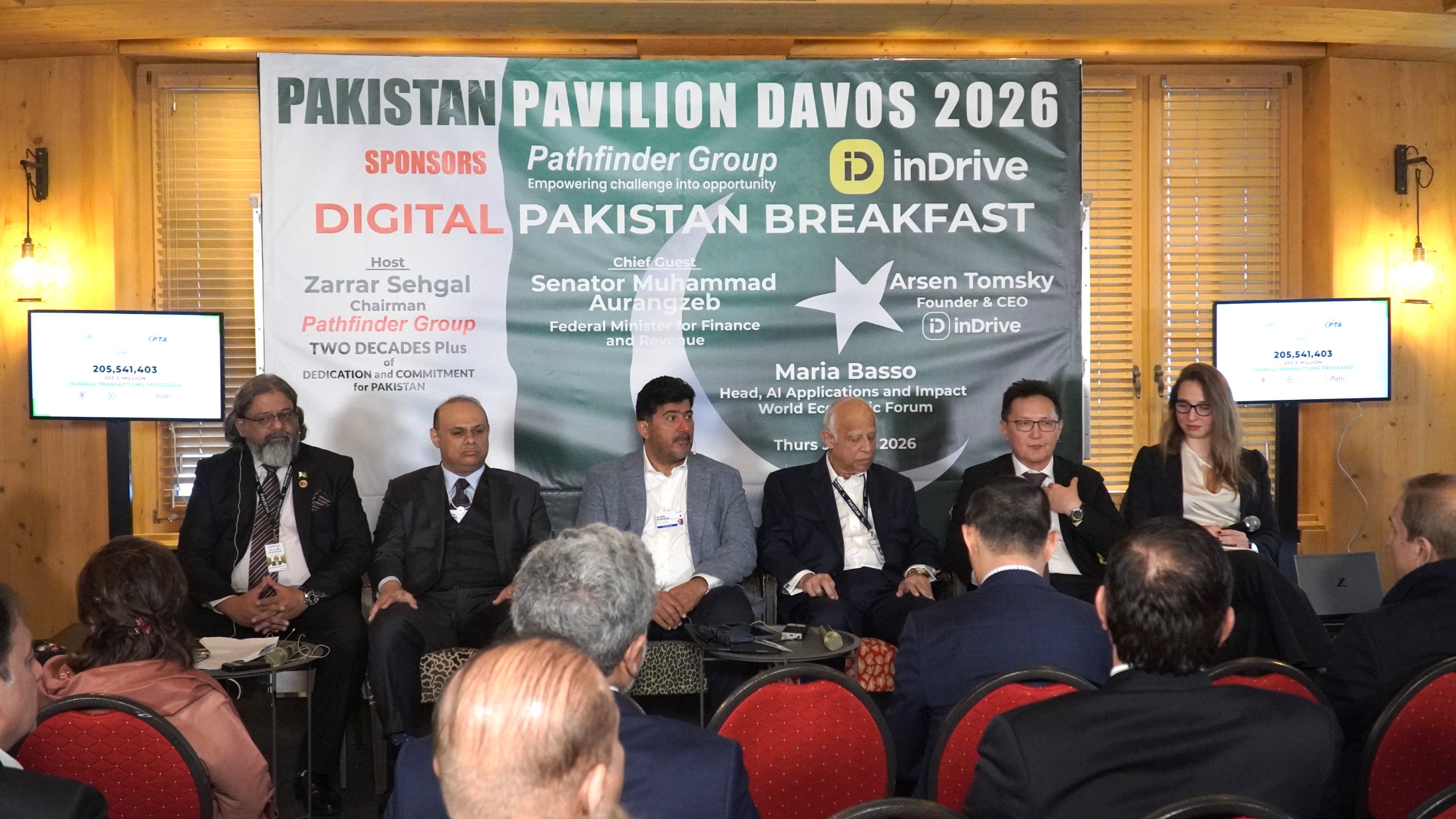
The Pathfinder Group hosted the “Digital Pakistan Breakfast” at the Pakistan Pavilion during the World Economic Forum (WEF) Annual Meeting in Davos 2026 on Thursday, January 22, 2026, from 7:30 a.m. to 9:30 a.m., at the Morosani Posthotel. The event brought together leaders from government, technology, finance, and global digital platforms to discuss Pakistan’s digital transformation and technology-driven growth agenda.
Zarrar Sehgal – Chairman Pathfinder Group (Host):
Welcome to the Digital Pakistan Breakfast on behalf of the Pathfinder Group and VRG. I’d like to welcome everybody. Our chief guest couldn’t be here, or it might be delayed because the Prime Minister had to cancel an event and he had to take his place. These things happen at Davos all the time. That’s been happening all day yesterday, today as well, but that’s just the nature of the forum.
Anyway, on behalf of the Pathfinder group, I welcome everybody, and particularly I’d like to welcome Maria Basso. We’re delighted to have you. She’s the head of AI applications and impact at the World Economic Forum, a relatively new group, but one that has become critical to the future of both the forum of AI and the future of where the forum is going as well. I know, Maria, there are a lot of demands on your time as well, so without much of an introduction, I’ll turn it over to you.
Maria Basso – Head of AI Applications & Impact WEF:
Thank you for having me here, and I hope you have had a pleasant Davos experience so far. I have to say that, at the Forum, we are deeply proud of our relationship with the Pathfinder Group. So, thank you very much, Ikram Sehgal and Zarrar Sehgal, for the legacy we share and for this deep friendship that has developed over time.
Thank you as well for hosting the Pakistan Breakfast at Davos and the Digital Pakistan Breakfast. It is truly appreciated, and I think it is incredible the work you have been doing and the way you collaborate across the entire ecosystem. From the Asaan Mobile Account (AMA), where you coordinated with so many stakeholders to truly uplift vulnerable people, including a large number of women, to your broader initiatives, the impact is very visible. I also had the pleasure of spending some time with some of the startups from your startup ecosystem, and it is really incredible to see the energy, momentum, and technology you are bringing into the country. It speaks strongly to the spirit of the Forum, which is about bringing all stakeholders in society together to drive innovation forward.
At the Forum, we have this mission of bringing everyone together from different sides of society to advance and make progress. We started 56 years ago as a community, continuously gathering people, always asking ourselves each year how we can make more impact and how we can make more progress. Over these 56 years, we have evolved. We expanded into research and reports, and more recently into driving impact through our centers. As you mentioned earlier, our Center for AI Excellence kicked off in April. We focus on three main pillars. The first is about the scaling of AI adoption and innovation, which is something everyone here is thinking about.
In this area, we work with many industries and many startups on how to scale, how to adopt AI in a purposeful way, how to move fast, and how to rethink workflows and processes within organizations. We also learn a great deal from innovators and from young people, who I would say are among the best at adopting AI and thinking about new ways to use it.
The second pillar is around competitiveness, specifically how AI is leveraged for competitiveness across countries. There is a lot of discussion these days about AI sovereignty, but we truly believe we need to rethink this concept. In today’s world, no one can really have true AI sovereignty. AI value chains are global. The question then becomes how we can foster collaboration across countries and regions, considering different national contexts and strategic objectives, so that countries can truly make the most out of AI.
The third pillar focuses on governance, safety, and trust, especially looking at how we can continue to evolve alongside rapidly evolving technologies and how we can keep monitoring those technologies. Right now, we are working on areas such as agents and AI, world models, AI and quantum, and we collaborate with leading experts in these fields to ensure that we are thinking carefully about safety guardrails and guidelines that we should all consider.
This is an ecosystem with many different stakeholders, and many of their priorities align very closely with your vision and mission. We would love to continue strengthening our collaboration, not only through events but throughout the year, working closely with you and your incredible ecosystem. Hopefully, next year we will be here again, talking about even more that we have done together. Thank you once again for the invitation, and I hope you have a wonderful rest of the week at Davos.
Zarrar Sehgal (Host):
Thank you very much. I truly appreciate you being here, and I appreciate your kind words. We look forward to collaborating with you in the future. I will now turn to Salman, our CEO of VRG, who will introduce our other speakers as well and then take you through what VRG stands for. We hear a lot about the numbers, and you have heard them throughout the sessions: the number of accounts we have, 13.8 million accounts, the number of female users, and so forth. But to simplify what VRG and the Asaan Mobile Account (AMA) really stand for, it is access to digital finance.
What VRG has tried to do is to democratize access to digital finance, and that is at the core of our mission. Simply and neutrally, we work with banks and telecom companies to give the unbanked access to digital financial services. That has truly been the key mission of VRG. With that, Salman, I will hand it over to you.
Muhammad Salman Ali – CEO, VRG Financial Inclusion – Pathfinder Group:
You keep hearing about the numbers and the AMA scheme, but let’s talk about the impact and what we are actually delivering, including the new products coming onto the same platform. On top of that, there are many companies in Pakistan that are doing similar things, but not in the way we are working and not in the way we are addressing people who genuinely want the right solutions, not just fancy apps or AI.
Sorry to all those who are simply shifting toward AI, but first, you need adoption. You need to enable people, generate data, and only then work on AI solutions based on that data. I will start by saying that I do have a presentation for you, but for now, let’s move on to another speaker. Arsen Tomsky, Founder and CEO of inDrive, is someone I recently got in touch with. In just 12 or 13 years, he has built a company that has expanded to 50 countries and is operating in 183 cities. It is the fastest-growing ride-hailing service provider across those 50 countries. Beyond that, he is leading nearly 3,000 people, and he is also an excellent runner and athlete. So yes, it is still a tough game.
Arsen Tomsky Founder & CEO inDrive:
Thank you very much. Good morning, dear friends, dear Ikram Sehgal. Thank you so much for allowing me to join the distinguished Pakistan delegation. It is my first time here. I came to see whether this is a good place to promote the ideas of capitalism, and I am highly impressed by the professionalism of your team. Let’s give a round of applause to the Pathfinder team.
We are currently operating in 48 countries and 1,065 cities. We are the second most downloaded ride-hailing application in the world and probably the second largest ride-hailing company by network. But it was not simple to achieve this. We started in a very remote town, at the edge of the world, and for a long time, we had no access to external support, no funding, no tech talent pool, and so on. Yet we found a way to compete with very large and very aggressive competitors, and we found their weakness. What is the weakness of companies like Uber, for example, in the bidding business model? I believe it is greed. They are extremely greedy. They enter a new market, keep fares artificially low for a long time, gain a monopoly, and then start squeezing the ecosystem. They begin charging very high commissions, raising fares, and sometimes charging up to 15 percent. You can see this pattern across food delivery, bookings, and many other services. And this, in fact, has been very good for us.
I call our company underdogs. We found our mission here, our purpose. And it is very powerful to have a deep purpose in your work. I try to find purpose in everything I do, and I try to turn my weaknesses into purpose. For example, as you can hear, I stutter.
I have stuttered all my life. It is very difficult to build a global company if you are not the best communicator. On top of that, I am an IT guy and an introvert. But I use this as a purpose because I want to show people who stutter an inspiring example of how we can achieve great success in life. In the future, I want to use my resources to create a scientific research center to help solve this challenge. If you do not have access to resources, try to find a deep purpose in your work. We offer people fair play in business. We charge only about a 10 percent take rate, and we do not set fares. People do. They negotiate. I believe some of you use inDrive. We actively encourage people to come to us, and many of them switch. Not all, of course, but some do, and then they actively invite their social circles to use our platform. We did not need extensive resources to launch, because we benefited from this word-of-mouth effect. This is how we did it, and I highly recommend this approach. Find a deep purpose and try to turn your weaknesses into strengths. Recently, we conducted research with the support of Oxford Economics, and they confirmed that this bidding model with a low take-rate commission is much more beneficial for people on both sides. You can find this research online.
I believe Pakistan has three main strategic assets: a young population, an entrepreneurial culture and strong resilience. This creates a foundation for leapfrogging into a bright future. I am humbled and inspired to be part of this journey toward the country’s bright future.
Muhammad Salman Ali – Moderator:
I used to travel a lot to attend many meetings, especially technology-focused meetings and, in particular, World Economic Forum gatherings. Whenever I went, many people would ask about a certain person who was speaking in a session. Who is that person? They wanted to know who had changed the dynamics of digital financial services and telecom services, especially in the MENA region.
That person has served on many boards, including with Pakistani institutions such as U Bank, PTCL, and several other banks. He has also held leadership roles across multiple verticals within a company called e& life. Ladies and gentlemen, please welcome Khalifa AlShamsi, CEO of e& life.
Khalifa Al-Shamsi CEO e& life:
So, I will start with a brief introduction about myself and the company, and then we will talk about Digital Pakistan, which is what really matters here. My name is Khalifa Al-Shamsi. I have been with our company, e& life, which is a technology and telecom company based in the UAE. Today, we operate in 20 markets. Our home markets are the UAE and Pakistan, of course, along with 18 other markets across Asia, Africa, and Europe. Europe was added last year through acquisitions in four markets in Central and Eastern Europe. I have been with the company for almost 33 years. In fact, before that, the company awarded me a scholarship which adds another four and a half years. So, I have essentially seen technology and telecom evolve throughout my entire career. I started as an engineer, building mobile networks, then moved into commercial marketing, digital services, and strategy roles. In 2022, with e&life, I had the opportunity to step back and truly reflect on what is happening in the industry overall.
When I joined telecom in the early 1990s, it was a booming sector, with high double-digit growth. But in recent years, and this is very evident here in Europe, the sector has not only stagnated in terms of subscribers and revenue, but it has also actually declined. This is due to a lack of investment, very high regulation, and a limited appetite for investment in new bets and new technologies.
At e&life, we reflected on what was happening not only in our industry, but across other industries as well, and asked ourselves how we could make a bigger difference going forward. How could we sustain the interest of investors in the company itself? That is when we launched a new and bolder strategy to transform ourselves from a regional telecom player into an international technology company with a strong telecom foundation.
With this strategy, we began accelerating our growth in the telecom domain and expanding into new geographies. The four European markets I mentioned earlier are an example of that. At the same time, we started placing bets in new technology domains. That is why it is great to be here among the tech community in Pakistan and to continue the discussion we already started during breakfast.
We strongly believe that a telecom operator doing the same things it has done for years will not be sustainable in the long term. The relationship with the customer has changed. Before, it was exciting just to have a SIM card or access to data. Today, customers expect much more. They want additional services, whether those are FinTech-type services, which telecom operators have a strong right and ability to play in and win. We have customer insight, data, lower acquisition costs, and the infrastructure needed to build and scale new products and services. Out of our 20 markets, we are already active in FinTech in 16 markets, including Pakistan. This is a domain where we have doubled down. Sometimes we build these capabilities ourselves from scratch, as we did with us in house FinTech platform, using our own capabilities and insights. In other areas, we have learned to be humble. In the past, and perhaps even today, some telecom companies believe they can do everything themselves. But the reality is that we cannot.
We look to entrepreneurs and startups that are truly making a difference in specific industries. In this journey, we partnered with two entrepreneurs whose startups are creating significant impact, and both of them happen to be Pakistani. One is Kareem Technologies, not the Careem ride-hailing service, but the Kareem everything app platform, which today operates in three countries: the UAE, Saudi Arabia, and Jordan. It spans multiple services, including food delivery, grocery delivery, FinTech services, and many more to come, such as home services.
The other is STARZPLAY, which operates across 22 markets throughout North Africa and the Middle East, from Morocco all the way to Pakistan. With these entrepreneurs, we give them the freedom to drive the technology and the business, while we support them from an investment perspective and provide access to our assets and customer base. From a governance standpoint, we give them full control to grow because they understand their businesses better than we do.
On the FinTech side, our belief is simple. Just as telecom helped solve connectivity inclusion by putting a mobile phone and smartphone into every hand, we now aim to do the same in financial inclusion. Every user, in every market we operate in, should have access to full financial services. Not just payments, not just local or international transfers, and not just cards, but complete financial services.
We are also moving toward investments so that people can participate in wealth creation. I may not be able to buy a mansion on the Palm in Dubai, but I can buy a fraction of it and benefit from its appreciation. I may not buy one kilogram of gold, but I can buy a few grams of gold or silver and participate in value creation. This is the mission we have: to ensure these opportunities reach all our markets. That was a brief overview of myself and the company.
Now, turning to Digital Pakistan. As an investor in Pakistan and as a shareholder of PTCL, we take responsibility to work with all stakeholders. This is what excited me about the invitation to be here and engage with the community. We already kick-started this discussion during the Pakistan Breakfast.
Harrison is here with us today. He leads our group strategy and corporate venture capital activities. We do many investments across the region, but so far, not in Pakistan. That is something we want to change. He has already visited some universities, but we would now like to engage more deeply with startup hubs in Pakistan. This could be through taking small equity stakes or even through partnerships. We offer more than just capital. Through us, these companies can access not only the Pakistani market, but also much larger markets across the Middle East. This is a commitment we are making as part of this engagement.
As an investor and shareholder in PTCL, we will continue working closely with the PTCL leadership team to accelerate the investments Pakistan needs. Pakistan deserves to be at a much higher level of digital maturity than where it stands today. Inshallah, with the government announcing the upcoming 5G spectrum, and with fiber already in place but needing much higher penetration, we believe that by aligning all stakeholders and encouraging local innovation, we can accelerate Digital Pakistan and improve global rankings year after year.
Beyond our direct investments through PTCL, Ufone, and now Telenor, I am proud to say that e&life is one of the largest, if not the largest, companies outsourcing software development and technology services to Pakistani firms. Systems Limited is one example. If you ask their CEO who their largest global client is, he will tell you it is the e&life Group.
Over the past ten years, and especially in recent years, we have invested around $600 million into Pakistani software development through outsourcing, leveraging the incredible tech talent available here. Inshallah, this will continue to grow as we expand services across telecom, consumer technology, and e& enterprise domains, including cybersecurity, IoT, and cloud services. So please count on us as your business partner. We consider ourselves part of the Pakistani digital and business community. We are always accessible to brainstorm ideas, collaborate, and accelerate progress, whether within Pakistan or across the broader region. Thank you once again for inviting me.
Ikram Sehgal – Co-Chairman, Pathfinder Group:
I’m going to ask Farhan, who is the project coordinator of CITADEL, to tell us exactly what we are doing, and we’re already working with PTCL. Please just say a few words about what we’re doing. I just want to step in, change the pattern, just for you. I’m so encouraged by what you said.
Air Cdre (Retd) Farhan Ahmed Project Director CITADEL:
What we are doing now is establishing a Center of Excellence for Innovation in the region, and we have partnered with OIC COMSTECH as well. Practically, we are extending our reach to the entire region. Just to bring you into the loop, since you are present here from the region, this time we brought startups from Pakistan, including AI startups, FinTech startups, health tech, and education tech, all of them AI-based.
We are now extending this initiative to the entire OIC region through collaboration and coordination with OIC COMSTECH. In the spring session this April, we will be bringing in not only startups from Pakistan, but from across the entire OIC region. This is a step we are taking to bring the whole region along with us. We work across three verticals. The first vertical is career jumpstart. What we do here is bridge the gap between what academia teaches and what industry actually needs. We collaborate with the largest software house association in Pakistan, P@ SHA, and we refine our curriculum in line with their input so that it reflects real industry requirements. We also work with many universities, including most of the leading universities across Pakistan. We take their graduates, bridge their skill gaps and help place them in relevant roles. That is our first vertical.
The second vertical is what you have already seen here today, the startups. You have seen eight startups represented here, young teams working on integrating AI into everything they do. Whether it is FinTech, health tech, education, or other fields, all of these startups are part of our ecosystem. The third vertical is where you come in, and in fact, you are relevant across all three verticals. In this vertical, we focus on driving AI and digital transformation across the entire industrial environment in Pakistan and the wider region. We not only train leaders to meet the needs of the 21st century, but also work to transform their organizations to meet modern digital requirements.
This is what we do, and across all three verticals, we look forward to collaborating with you. Not only to support, jumpstart, and accelerate our startup ecosystem, but also to help transform the digital infrastructure and digital environment of our country and the region.
Khalifa AlShamsi CEO e& life:
Apart from Pakistan being one of the 19 markets under my responsibility, I will also be joining the PTCL board this month. This means I will be coming to Pakistan physically much more often. We will use this opportunity not only to look at operations, but also to understand the wider market and explore more areas for collaboration.
As I mentioned earlier, there are opportunities in the excellent work you are doing that are not limited to Pakistan alone. These models can be applied to other markets as well. In the UAE, we have already seen the strength of Pakistani talent in the technology industry, whether in software development or even in design. In the past, we used to pay for most of our app design by engaging high-end global players. Later, we started experimenting with Pakistani specialists in UI and UX development and design, and we found exceptional talent. This is where you can also guide us by pointing out hubs of capability in specific domains. We can then experiment and test together. If the capability is there and the delivery is reliable, Pakistan will naturally take precedence, as it already does today, and this will lead to even more collaboration across our markets.
Imran Jattala – Vice President, CITADEL:
CITADEL is an upskilling, innovation, and entrepreneurship platform. PTCL is the largest telecom operator in Pakistan, with a collective reach of over 70 million users. Upskilling presents a significant opportunity for both Pakistan and the Middle Eastern markets. We have a large youth bulge, and by training and upskilling this talent, we can prepare them to fit into PTCL as well as into markets across the Middle East, including the UAE, Saudi Arabia, and other regional markets.
Innovation and entrepreneurship are where we can truly create the growth engine. As you know, founders like Mudassir Sheikha, CEO of Careem, are a great example of what is possible. Through Pathfinder CITADEL, we believe we can discover and develop many more Mudassir Sheikhas from Pakistan. We would love to collaborate with PTCL at a strategic level.
Muhammad Salman Ali – Moderator:
Alina Timofeeva is a very dynamic individual. It has only been a few days since I got to know her. Before coming to Pakistan, she was a state guest. She is an advisor on AI and works with different governments on strategic alliances, helping them develop strategies and governance platforms. She also advises them on how to build these solutions, along with the necessary governance frameworks and policies. With that, over to you, Alina.
Alina Timofeeva – Senior Advisor in Technology, AI, Cybercrime:
Assalaamu Alaikum, everyone. Good morning. I’m Alina Timofeeva, and it is a great pleasure to be with you today once again. As mentioned, I had the opportunity to visit Pakistan last year and meet the P@SHA team. I also met the Prime Minister, the Deputy Prime Minister, and the Minister of Technology. More importantly, I witnessed firsthand the key objectives around growth, investment in digital technologies, and the youthful population. I was invited as part of the DFDI initiative by His Excellency Jamal Abdullah Yahya, in line with the cooperation between the Middle East and Pakistan. From my perspective, I am a senior advisor in data and AI, running my own company, and I am currently based in Saudi Arabia. I work across the Middle East and historically, I have also worked extensively in the UK and Europe.
Over the past 12 months, I have had the opportunity to travel to many countries, including Pakistan, China, Hawaii, Qatar, and Bahrain, engaging both with senior officials at the ministerial level and with people on the ground. What I have observed is that everyone wants to see the tangible impact of AI, not just in terms of investment numbers, but in how it improves people’s daily lives.
There is optimism that AI can make processes more efficient and simpler, and everyone genuinely wants it to succeed. My background is in mathematics. I trained as a scientist at Moscow State University, one of the top universities in Russia, focusing on intelligent automation and intelligent systems. At the time it was very theoretical. Today, however, I see AI as an opportunity to align national agendas and visions to create meaningful impact for humanity.
Yesterday, His Excellency, the Finance Minister, spoke about several AI initiatives underway in Pakistan, including upskilling programs and the application of AI to create real-world impact. When we compare Davos this year to last year, there has been a shift. Last year, the conversation was mostly around AI being revolutionary, but now it is about implementation: how to make AI work and scale. Early adopters have invested heavily, but many have yet to see the return on investment, and scaling remains a challenge.
I have worked with technologies even before AI became a global hype, including cloud computing and cybersecurity. What I have observed consistently is that transformation takes time. It is unrealistic to expect that simply releasing a new AI model will transform an enterprise within three months. Most organizations, whether large or small, are not yet using AI to transform their entire operations or processes. What has worked so far is using AI for specific tasks, such as research, financial forecasting, or copiloting routine work. Full end-to-end transformation has not yet been realized. Specifically, in Pakistan, there is a significant growth agenda and there is an opportunity to learn from other countries and companies that have tried AI adoption.
One key lesson is that technology itself is only about 10 percent of transformation. Data is critical, but we must also consider that most AI models, especially those from the U.S. are trained on U.S.-centric data and may not culturally represent regions like the Middle East or Pakistan. The third, and perhaps most important aspect is change management, culture, and people. Transformation is not just about technology; it is about designing processes to be AI-first, whether in large organizations or smaller businesses. There are three critical questions: Are we realizing value from AI? Are we redesigning processes to make them truly more efficient, or are we simply layering AI on top of existing processes? And third, are we ensuring responsible and ethical AI? Misuse of AI, whether for cybercrime, deep-fakes, or other harmful purposes, has raised important ethical concerns.
On a positive note, my journey to Pakistan has been truly inspiring. I see a tremendous amount of ambition and potential in using technology, attracting investment, and driving digital transformation. However, investment and progress rely on trust, and trust comes from demonstrating real change. Transformation is not just about technology and data; it is about managing change effectively. Finally, AI is not just a technology; it is a tool for humanity. It should be used to create a meaningful, positive impact, and I believe Pakistan has an enormous opportunity to do just that. Thank you.
Ikram Sehgal – Co-Chairman, Pathfinder Group:
As Khalifa AlShamsi has to leave, I want to express my gratitude to him for being here. It was invaluable to get a real, cross-sectional overview, which I am sure requires education and understanding on both sides to truly grasp where we are, because it is not always easy to understand a country’s dynamics.
I am genuinely happy to note the breadth of initiatives you are undertaking. I believe that not only can we in Pakistan support these efforts, but we can also act as a bridge to others within the country. For example, from the 200 startups initially considered by the venture, the number was narrowed to 60, then 20, and now the eight startups we see here today. This kind of process and vision is truly inspiring, and I am very encouraged by what you shared. Thank you, Mr Khalifa AlShamsi for being here. I sincerely appreciate it.
Arsen Tomsky Founder & CEO inDrive:
I have an announcement to make. First, we can support the Pakistani tech ecosystem. We have sponsored important research, which we will soon receive and publish on the company’s social media channels. You will be able to use this report to showcase the Pakistani ecosystem to foreign investors. Second, we are creating a special fund to support female tech entrepreneurs. If you are a female tech entrepreneur, please apply.
Third, I would like to remind you that we are running an internal venture capital fund of $100 million. Last year, we made our first investment in a Pakistani startup. If you are interested, you can also apply. Thank you very much.
Muhammad Salman Ali – Moderator:
So, about Virtual Remittance Gateway. We are a unique company in Pakistan, holding two licenses. One is for a payment service operator, and the second is for a third-party service provider, acting as an aggregator for our telecom services, especially on the USSD system. We work very closely with the State Bank, the Ministry of Finance, and particularly with the Pakistan Telecommunication Authority (PTA) and the World Bank. Financial inclusion in Pakistan is now progressing at a remarkable pace. We played a significant role by introducing a new platform two years ago called the Asaan Mobile Account (AMA). Everyone has heard about it. In every speech, people are talking about AMA.
It works on both feature phones and smartphones. In Pakistan, out of 200 million telecom subscribers, 43% are still using feature phones. That’s about 85 million users, the real masses who truly want to be included in the financial ecosystem. We introduced this platform for them, and in just the last 38 months, we have acquired 13.6 million accounts. This is a live ticker, a live counter, right here in front of you. We have processed nearly 208 billion rupees through our platform. The remarkable part is that, according to the State Bank of Pakistan, not a single fraud has occurred on this platform. The second achievement I am very proud of is our focus on women’s empowerment, especially in our family as well. Currently, 38% of accounts belong to women, whereas previously it was only 18%. This is a remarkable achievement, though there is still a gap, and we are actively working to reduce it. I will show you what we are doing to close this gap.
Let me share some quick statistics, especially on province-based segregation. We have the data. We are the only company in Pakistan with telecom and banking data available on a single platform. We are on the high radars of both the State Bank and the PTA, with a high level of data security. This data is currently being used by the PTA and the State Bank to draft policies, particularly for the National Financial Inclusion Strategy 2024. The State Bank has used this data to design sector-specific policies.
For example, I want to highlight that only 4.15% of a certain segment has been included so far. I can give you a concrete example of a woman in FATA using our platform. Through this platform, she can perform transactions of various types and values. This demonstrates the strength of our system. By leveraging this data and technology, we can reach the masses and draft appropriate policies and products tailored for them. This is extremely exciting.
Moving on to what we have done for farmers: they contribute nearly 20% of Pakistan’s GDP. Last year, at the same World Economic Forum event during the Pakistan Breakfast, we launched our Green Inclusion initiative. At that time, we had onboarded roughly 375,000 farmers on our platform. Today, more than 500,000 farmers are using it. This platform serves farmers through USSD for feature phone users.
The process for payments and transfers is simple. They can apply for a loan, which is either approved or rejected within four hours, with funds directly transferred to their accounts. We are working with Zarai Taraqiati Bank Limited (ZTBL), the largest agricultural bank of Pakistan. My team is on the ground, and technical integration is ongoing.
We are now developing technology-based advisory services for crops, market rates, soil monitoring, and more. All this information is accessible through USSD technology, not via any mobile app or fancy application. This is the real empowerment we are bringing to the farming sector. The next area is SMEs. Recently, there has been a major drive in Pakistan to enable SMEs to accept digital payments. For example, a low-income person visiting a retailer or a Kiryana store should be able to make a digital payment.
The State Bank has placed QR codes everywhere, which is excellent. But what about the 43%, the 85 million people who do not have smartphones? How can they pay digitally using QR codes? The only option is our USSD platform. We created a platform that is live with SBL. Anyone can dial *2262#, go to a small Kiryana store, buy eggs or bread, enter the merchant’s code, an 8-digit PIN below the QR code, and send the money directly.
Data production happens in real time. There are 55 million retailers and SMEs operating in Pakistan, which represents an enormous opportunity. This is what the State Bank and I are working toward. Using USSD technology, even with the advent of 5G, I have a different perspective. While 5G is great, only 2% of people in Pakistan currently have 5G phones. The business case is limited because mobile sites for 5G are very expensive. Most people will continue using 4G and USSD. USSD will remain essential in Pakistan for at least the next five years.
Another major initiative we are working on is expanding touchpoints. Currently, Pakistan has around 18,000 bank branches which is insufficient. Many people cannot access a branch, but agents are present everywhere. Unfortunately, these agents work in silos, serving only their own bank’s customers. Three years ago, we proposed to the State Bank the creation of a universal agent network. Today, Pakistan has 700,000 agents operating across remote and urban areas. By making them universal agents, a customer of bank A can go to an agent of bank B for cash-in and cash-out transactions. This effectively creates 700,000 new branches available from 5 PM to 1 AM, drastically improving cash handling, cash movement, and promoting cashless transactions.
We launched an agent interoperability platform in August 2024, mandated by the State Bank. The pilot was successful and it is now live in Pakistan. Currently, 127,386 EasyPaisa agents accept payments for HBL Connect customers. For instance, 22,000 Foodpanda riders with accounts at HBL no longer need to submit cash at specific times. They can deposit money anytime at any agent directly into the base pool account. Since its launch on 26th November 2025, overall transactions have already reached nearly 1 billion rupees and are growing rapidly. Another exciting development: Pakistan was selected for the World Economic Forum’s 1 Billion Lives initiative under the Edison Alliance.
Pakistan is ranked third globally for this stream. Originally scheduled for 2026–2027, the initiative was completed in mid-2025. A new community, Global Regulatory Innovation Platform (GRIP) was launched with Pathfinder Group and VRG as founders. The goal is to implement solutions that work collaboratively between the government and private entities, benefiting low-income populations. The AMA platform is now a role model for both the State Bank and the World Economic Forum. We submitted a case study on agent interoperability, requested by the World Economic Forum. Out of around 50 companies, our submission was approved and is now live as of 5th January 2026. This is another feather in the cap for Pathfinder and VRG.
We are also exploring how to replicate these models in other developing countries. As Khalifa AlShamsi said, collaboration is key. We are the enablers with reach to the masses. Let’s build products on this platform, including AI-based products. I am providing the platform, and you provide the last-mile reach. Greater collaboration strengthens all organizations involved. I want to emphasize the importance of data. The data we have is critical, and it must be protected. Low-income people are vulnerable and can be easily exploited, so our products must safeguard them.
Finally, Pakistan has immense potential in payments, financial services, and especially AI. We are still learning AI, but it is now a call to action. We have the data. Why not use it? Local language models are not yet available in Pakistan, while in the UAE, there are four Arabic LMs. There is a tremendous opportunity here. If anyone has ideas to serve low-income populations, please come to us. Join us. Let’s work together. Thank you.
Ikram Sehgal – Co-Chairman, Pathfinder Group:
Thank you, Salman. Thank you to the entire panel. I think we had a very interesting discussion, even though, unfortunately, the finance minister couldn’t come. But I think what this discussion showed was the amount of potential waiting to be exploited in Pakistan, and to be positively exploited in a manner that is beneficial both to the individual and to the country. Thank you, everybody