


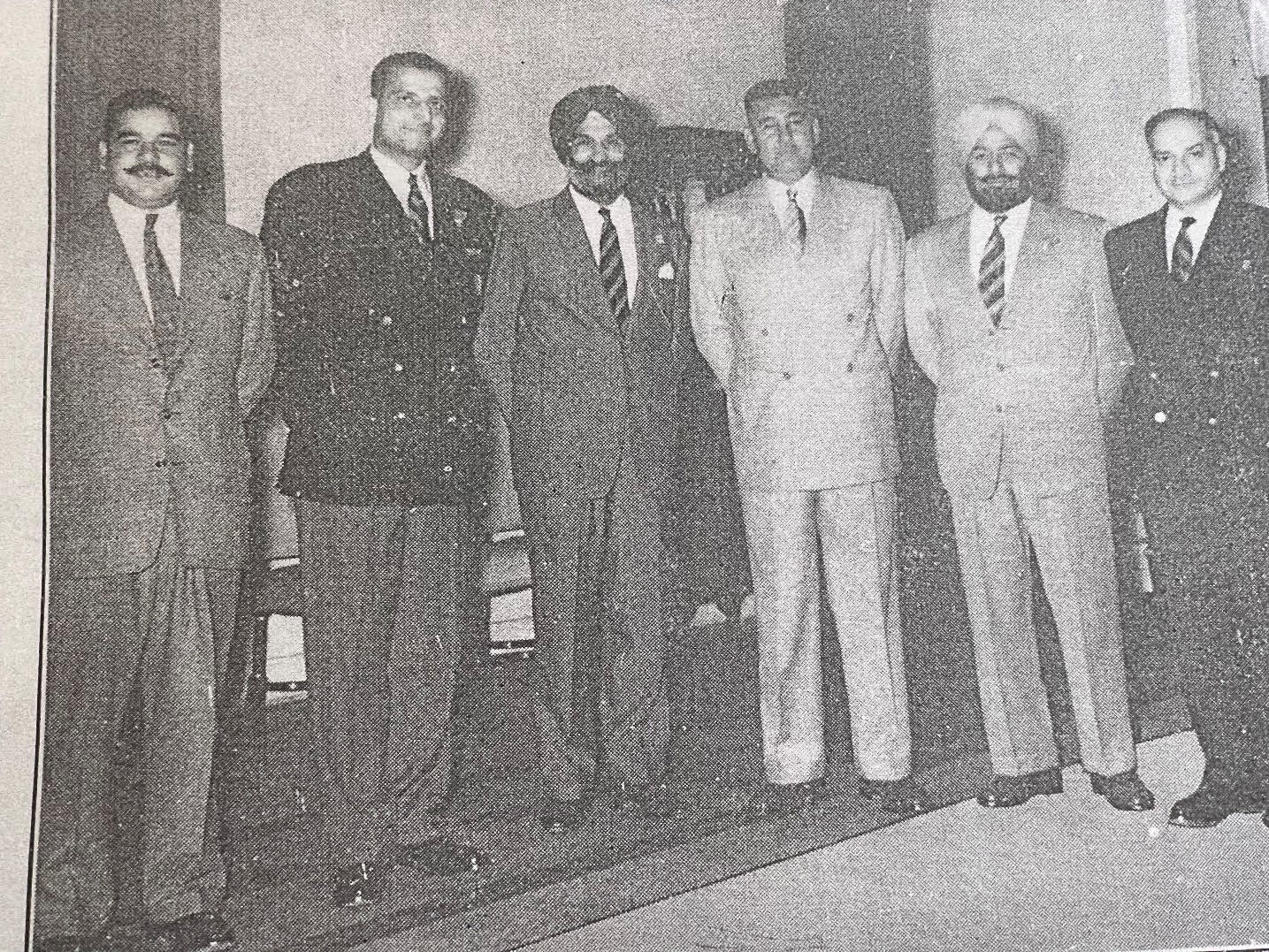
In 1960, General Muhammad Musa visited India on the invitation of the Indian army chief General K. S. ‘Timmy’ Thimayya. This group photograph was taken when former comrades of 6th Royal Battalion of 13th Frontier Force Rifles (6/13 FFR) got together in Delhi. The battalion had many titles over time. After the British conquest of Sindh, it was raised in Karachi in 1843, as Scinde Camel Corps, in 1851 retitled as the Scinde Rifle Corps, Punjab Irregular Force, in 1865 became 6th Punjab Infantry Regiment, in 1903 became 59th Scinde Rifles (Frontier Force), 1921 became 59th Royal Scinde Rifles (Frontier Force) and in 1922 became 6th Royal Battalion 13th Frontier Force Rifles.
In 1947, the battalion was allotted to the Pakistan army and in 1956 reorganization became 1st Battalion Frontier Force Regiment (1 FFR). There was a painting at Indian army headquarters depicting a battle scene of Second World War where Sepoy Ali Haidar of 6/13 FFR won his Victoria Cross. Thimayya presented this painting to Musa for officer’s mess of 6/13 FFR. Musa belonged to the Hazara tribe of Afghanistan, his father Sardar Yazdan Baksh had migrated to British India in 1890s during genocidal campaign of Afghan Amir Abdur Rahman Khan against the Hazara of central Afghanistan. Yazdan was a Jaghori Hazara from Ghazni province of Afghanistan and many Afghan Hazara were recruited in the Indian army. He joined 126th Baluchistan Infantry and transferred to 106th Hazara Pioneers when it was raised by transferring Hazaras of 124th and 126th Baluchistan Infantry to the newly raised Pioneers.
He retired at the rank of Subedar. Yadzan’s many family members remained in Afghanistan including his brother whose daughter was later married to Musa. He was imprisoned in 1960s, and he died in Ghazni prison. His son and Musa’s brother-in-law was imprisoned in Kabul jail and after his release he fled to Pakistan. On the advice of his two British officers, Yazdan enlisted Musa in 106th Hazara Pioneers in November 1926. Musa served for four years in the ranks and was promoted to the rank of Naik. In 1930, he attended the Army School of Education at Belgaum that prepared Indian non-commissioned officers for Indian Military Academy (IMA) to be commissioned as officers. Musa joined the first batch in October 1932 and commissioned in February 1935. They were called ‘pioneers’. Indian officers commissioned from Royal Military College Sandhurst and later IMA were posted to designated units marked for Indianization.
In 1923, eight Indian army units were marked for Indianization. The list included 7th and 16th Cavalry, 2/1 Madras Pioneers and 2/1 Punjab, 5/5 Mahratta Light Infantry, 1/7 Rajput, 1/14 Punjab and 4/19 Hyderabad infantry regiments. In 1933, eight additional Indian army units were marked for Indianization including 3rd Cavalry, 5/2 Punjab Regiment, 5/6 Rajputana Rifles, 5/8 Punjab Regiment, 5/10 Baluch Regiment, 5/11 Sikh Regiment, 4/12 Frontier Force Regiment and 6/13 Frontier Force Rifles (in 1933, 2/1 Madras Pioneers was disbanded).
Newly commissioned Indian officers spent one year with a British regiment before joining their parent battalion. Musa spent one year with 1st Battalion, the Royal Norfolk Regiment before joining the newly Indianized 6/13 FFR. Commanding Officer of 6/13 FFR, Lieutenant Colonel Noel Luis St. Pierre Bunbury had served with 106th Hazara Pioneers where Musa’s father had served under him. It was Bunbury who told Yazdan to have his son opt for 6/13 FFR and pulled strings at Military Secretary (MS) office in Delhi to have Musa posted to his battalion.
Musa’s colleagues in the battalion were Mohindar Singh Chopra, Nazir Ahmad, Mohammad Sher Khan, Bikram Singh, Akbar Khan, Pran Nath Narang, Kanhaya Lal Atal, Bakhtiar Rana, Yusuf Khan, Anant Singh Pathania, Kashmir Singh Katoch, and Sadiqullah Khan. They got their baptism of fire in Waziristan where battalion was stationed from 1936 to 1939. All these officers later rose to senior ranks of Indian and Pakistan armies. The British comrade with these Indian officers was Captain S.J.H. Green whose great-uncle Lieutenant George Green (along with Lieutenant Robert Fitzgerald) had raised the battalion in 1843. The class composition of the battalion was one company each of Sikh, Punjabi Muslim, Dogra, and Pathan (Khattak and Bangash).
In the Second World War, 6/13 FFR served in North Africa, Italian East Africa, Persia, Iraq, Palestine, Syria, and Italy. Musa spent only a brief period with the battalion during the war and did not see any major action. This was in sharp contrast to his colleagues who were in the thick of the battle and several of them won Military Cross (MC) including Anant Singh Pathania, Bharat Singh, ‘Jangu’ Satarwala, Kashmir Singh Katoch, Bakhtiar Rana, and Sadiqullah Khan. He completed staff college course in December 1941 and served as GSO-II at Officers Training School at Mhow for six months. His career took a curious turn, and he served for three years with Intelligence Bureau (IB) at Quetta. This is highly unusual as army officers were not seconded to the IB that was run by the Indian Police Service. In October 1946, he was appointed Assistant Secretary of the Armed Forces Nationalization Committee. In May 1947, he was appointed Assistant Adjutant & Quarter Master General (AA & QMG) Bihar and Orissa Area. During this time, orders were issued posting him to 1st Sikh Light Infantry (SLI). This was a wartime raised battalion that recruited low caste Mazhabi and Ramdasia Sikhs (high caste Jat Sikhs would not like to mingle with low caste co-religionists therefore they were not mixed with Sikhs serving in Sikh, Punjab, and Frontier Force Regiments). However, he did not respond to letters from the battalion and never joined the 1st SLI as the chaos of partition intervened. In August 1947, he was appointed GSO-I of Lahore Area Headquarters followed by command of 103 Infantry Brigade in Sialkot and 52 Brigade in Quetta. He was appointed Director General of Pakistan National Guard (PNG) including its women wing. Musa was very unhappy as this was a third-tier post. He tried to wiggle out by telling C-in-C General Douglas Gracey that how could he encourage Pakistani women to join PNG when he would not allow female members of his own family to join it.
However, Gracey refused to change his decision. He served as Director Infantry for a short while before assigned to Agent to Governor General Baluchistan wearing civilian clothes. This was most likely an intelligence related assignment. In 1951, he was promoted Major General and appointed GOC of 14th Division in East Pakistan. Later, he served as Deputy Chief of Staff, Chief of Joint Services Secretariat at Ministry of Defence and then Chief of Staff (COS). After the 1958 coup, General Muhammad Ayub Khan appointed him C-in-C. Earlier, when Musa (PA-28) was promoted lieutenant general, two of his seniors Major Generals Sher Ali Khan Pataudi (PA-24) and Latif Khan (PA-26); both Sandhurst graduates asked for early retirement. There is consensus among officer corps that Musa was selected for his loyalty rather than professional competence.
There was a certain amount of class consciousness among Indian officers where Sandhurst graduates called King Commissioned Indian Officers (KCIOs) were considered the corps d’elite and IMA graduates called Indian Commissioned Officers (ICOs) were considered inferior while Emergency Commissioned Officers (ECOs) were at the bottom of the social ladder. Ayub Khan graduated from Sandhurst, and this class bug may be at the back of his mind when he selected Musa.
Ayub sidelined and eased out several Sandhurst graduates senior to Musa. Musa was from the Hazara community that was a tiny Persian speaking Afghan refugee community in Quetta. He had no ethnic or tribal constituency in the army nor in the country that could pose a threat to Ayub. In 1962, Ayub gave Musa another four years extension. He retired in 1966 and in 1967 Ayub appointed him governor of West Pakistan.
During Yahya Khan’s military rule (1969-71), he was persona non grata due to his close association with Ayub Khan. In 1970, Musa wanted to meet Yahya Khan and COS Abdul Hamid as his brother was in trouble, but both refused to meet him. During General Muhammad Zia ul Haq’s military rule, he was appointed governor of Baluchistan province. He died in 1991 and was buried in Mashad in Iran.
Brigadier (later Major General) ‘George’ Bharat Sewak Singh (IC-333) was commissioned in April 1940. He won his MC in Italy. In 1947, when his parent battalion was allotted to Pakistan, he transferred to 5th Gurkha Rifles. He commanded a Garhwal Rifles battalion and later was appointed Colonel Commandant of the Garhwal Rifles. He also served as chief instructor at Staff College and in the 1965 Indo-Pakistan war, commanded 3rd Infantry Division.
Brigadier (later Lieutenant General) Jehangir Tehmurasp ‘Jangu’ Satarvala (IC-272) was commissioned in July 1939. After spending one year with 1st Battalion Devonshire Regiment, he joined his parent 6/13 FFR. He served as adjutant of the Battalion, won MC in Italy and later awarded MBE. He was a member of the Indian army contingent that participated in the victory parade in London. In 1947, when his parent battalion was allotted to Pakistan, he transferred to 5th Gurkha Rifles.
In the 1947-48 Kashmir war, he was Colonel Staff at headquarters of Jammu & Kashmir Force. In the 1962 Indo-China war, he was Director Staff Duties (DSD) at GHQ. Later, at major general rank, he commanded 20 Mountain Division and served as commandant of IMA. At lieutenant general rank, he commanded I Corps. Major General Bikram Singh was commissioned in 1933. He spent a year with Royal Berkshire Regiment before joining his parent 6/13 FFR. In April 1947, he was promoted Lieutenant Colonel and was appointed Commanding Officer (CO) of 4/7 Rajput Regiment. During the 1947 riots after partition, his battalion was assigned internal security duties in Calcutta and Ranchi. In the 1947-48 Kashmir war, he commanded 268 brigade in Kashmir.
In December 1949, he took over 181 Independent Brigade Group in Assam followed by staff appointment of Brigadier Administration of Eastern Command. At major general rank, he commanded an Infantry Division in Kashmir, followed by General Officer Commanding (GOC) Assam Area and then GOC Delhi & Rajasthan Area. In 1961 he was promoted to lieutenant general and given command of Srinagar based XV Corps. On 22 November 1963, an army helicopter carrying Bikram Singh, GOC-in-C of Western Command lieutenant general Daulet Singh, AOCin-C Western Command Air Vice Marshal Eric Pinto, GOC 25 Division Major General N. K. D. Nanavati and commander 93 Brigade Brigadier S. R. Oberoi crashed killing all officers and the pilot Flight Lieutenant S. S. Sondhi. This was on the same day when American President John F. Kennedy was fatally shot in Dallas, and this news overshadowed the Indian army loss.
Lieutenant General Kashmir Singh Katoch (IC-83) was son of Major General Janak Singh Katoch, Prime Minister of Kashmir state. He attended the Royal Indian Military College (RIMC) at Dehra Dun followed by training at IMA and was commissioned in July 1936. He joined 6/13 FFR and served as Battalion Adjutant and later was second in command. He won MC in Italy. In September 1947, at the request of Maharaja of Kashmir, he was appointed military advisor to the state replacing Major General H. L. Scott. He served as director of military operations and commanded an infantry brigade and infantry division. He also served as Inspector General Assam Rifles (1954-55) and in the 1965 Indo-Pakistan war commanded XV Corps. Later, he served as Director General Military Training (DGMT), Adjutant General (AG) and Vice Chief of Army Staff (VCOAS).
Mohindar Singh Chopra was commissioned from Royal Military Academy, Sandhurst in 1928. He was commissioned in 1st Battalion of 7th Rajput Regiment and later transferred to 6/13 FFR when later battalion was Indianized. He was the senior-most Indian officer of the battalion and the newly commissioned Indian officers posted to the battalion looked towards him for guidance. A good athlete he commanded the Physical Training School at Kasauli. He was given command of the 1st Assam Regiment (then Lieutenant Colonel later Field Marshal Muhammad Ayub Khan was sacked from the command of 1st Assam Regiment by Division Commander Major General ‘Pete’ Reese).
In 1947, during partition, he oversaw the referendum in Sylhet. After Independence, when his parent unit was allotted to Pakistan, he became affiliated with 5th Gurkha Rifles the only PIFFER unit assigned to the Indian army. He became the first Indian Colonel of the 5th Gurkha Rifles and commanded 123 Brigade at Amritsar and later was GOC of 20 Division.
In 1911, the 1st Manchester Regiment was grouped together with 47th Sikhs and 59th Scinde Rifles to form the 8th Brigade, based in Jullundur which was part of the 3rd (Lahore) Division. The Battalions competed at football and hockey grounds and engaged in social activities such as drama clubs and concerts. In the First World War, the Jullundur Brigade fought in different battles on the western front including battles of Ypres, Neuve Chapelle, Festubert, and Loos. After spending seven months on the killing fields of the western front, the Jullundur Brigade was moved to Mesopotamia.
An interesting encounter took place on October 28, 1914, when 47th Sikhs attacked a German position defended by German 16th Bavarian Infantry Regiment among whose ranks was one Corporal Adolf Hitler. The 16th Bavarian lost several dead and wounded but the Corporal survived to lead the Third Reich. However, the drums of Hitler’s parent regiment are now in the officers’ mess of the 47th successor 5th Sikh Regiment. If a Sikh soldier had bayoneted the young corporal, the history of the world may have taken a different trajectory.
The seven-year association of the brigade in war and peace created a special bond between these three battalions. To commemorate this association, three identical centerpieces were ordered from the Goldsmiths and Silversmiths Company. The centerpiece consisted of a triangular column rising from a triangular base, surmounted by a winged figure of Victory. At each corner of the base was a silver model of a soldier of each battalion – an Englishman, a Sikh, and a Muslim.
This memory is preserved in the three center pieces still cherished by the successor battalions of the three countries. 1st Manchester is now 2nd Battalion, the Duke of Lancasters Regiment of the British Army, 47th Sikhs is now 5th Battalion of the Sikh Regiment of the Indian Army, and 59th Scinde Rifles is now the 1st Battalion Frontier Force Regiment of the Pakistan Army.
In February 1988, PIFFER week was celebrated at regimental center at Abbottabad and as the senior most pre-partition Frontier Force officer of the Indian sub-continent, Major General Mohindar Singh Chopra was invited. He described the visit as ‘going home again’. He also visited Khyber Rifles mess at Landikotal.
He also visited his old paltan then stationed at Bahawalpur. At the formal dinner, paltan’s Jullundur Brigade trophy, a reminder of the past togetherness, was displayed. This inspired Mohindar’s son Pushpindar Singh who was also present to find two other trophies. This journey ultimately resulted in re-establishment of old association during war and peace. All three governments and HM the Queen approved and Jullundur Brigade Association was formed.
In 1989, seventy-five years after the brigade went into action in France, a historic reunion took place in Manchester. Several serving and retired officers of three countries attended the re-union and made a special visit to Neuve Chapelle in France.
From Pakistan, Deputy Chief of Staff Pakistan Army and Colonel of the Frontier Force Regiment, Lieutenant General Ahmad Kamal (10 FFR) and Commandant of the Frontier Force Regimental Centre, Brigadier Fazle Qadir (9 FFR) attended. The 1st Battalion Frontier Force Regiment was represented by Commanding Officer, Lieutenant Colonel Sadaqat Ali Shah, Adjutant, Captain Nadir Khan and Subedar Major Mohammad Bashir. They shared memories of close association of the past. A century later, the trophies are proudly displayed by the three battalions, now part of three different armies in Britain, India and Pakistan.
During the Raj, men belonging to different religions and ethnicities joined the army. They shared memories of happiness and sports competition during peace time and sweat and blood during wars. This created a unique bond of comradeship. They rose to higher ranks in independent India and Pakistan. Subsequent wars between two countries and rise of religion laced nationalism took the center stage and past memory of comradeship faded away with the passing of the pioneer generation of Indian and Pakistan armies.
Acknowledgments
Author thanks Sushil Talwar, an eminent military historian for details of careers of Indian officers, Major General (R) Syed Ali Hamid a well-respected military historian for details about service of officers of 6/13 FFR in Waziristan and the Second World War, Colonel Iqbal Khattak for valuable inputs and pictures of Khyber Rifles mess and several PIFFER officers. All errors and omissions are author’s sole responsibility.
Notes
• Brigadier W.E.H. Condon. The Frontier Force Regiment. Gale & Polden: Aldershot, 1962)
• Captain D. M. Lindsay. Regimental History of the Royal 6th Battalion of 13th Frontier Force Rifles (Scinde) 1843-1923. (London: Gale and Polden), 1926
• Hamid Hussain. Forgotten Pioneers – Hazara Pioneers, Hazaras & General Muhammad Musa Khan. Defence Journal, Vol. 15, Issue: 12. August-September 2011: 99-103
• General Muhammad Musa. Jawan to General: Reflections of a Pakistan Soldier (Karachi: Royal Book Company), 1984. Reprinted 2008
• Pushpindar Singh Chopra. The Tribune. September 2, 2014
• Nishaan, November 2015, https:// seekingwisdomblog.wordpress.com/ wp-content/uploads/2016/05/ nishaan_sikhs_wars_-ii-2015.pdf