


Gaza Plan and the Middle East Security Alignments
Context
U.S. President Donald Trump’s proposed 20-point Gaza peace plan represents an ambitious attempt to reshape the strategic landscape of the Middle East by reframing the terms of the Israeli-Palestinian conflict and subsuming regional security structures into a U.S.-led framework. Unlike previous mediation efforts, which sought to balance mutual concessions between Israel and Palestinian factions, the plan adopts a distinctly anti-Hamas posture. Rather than defining peace as a process of mutual accommodation, it positions Hamas as the sole obstacle to stability and tasks regional actors with enforcing compliance.
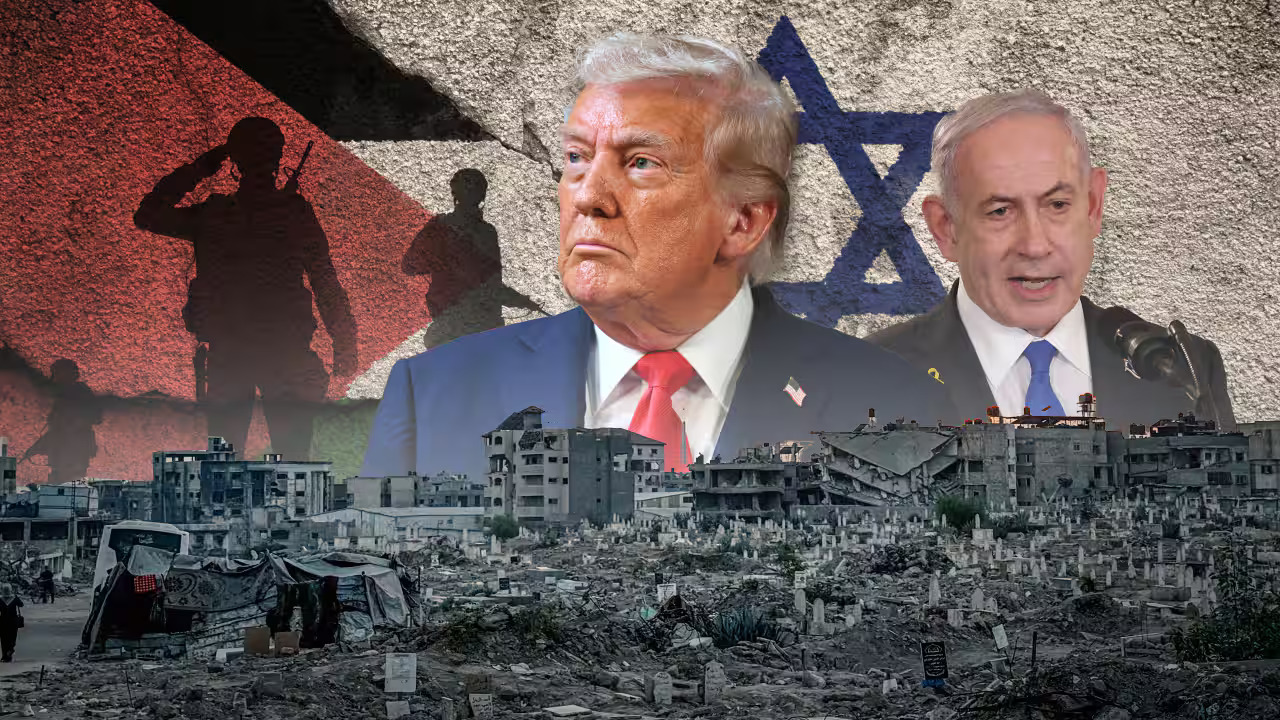
In a joint press conference at the White House, U.S. President Donald Trump, flanked by Israeli Prime Minister Benjamin Netanyahu, unveiled a comprehensive plan for Gaza aimed at achieving a ceasefire, facilitating a hostage exchange, advancing demilitarization, and establishing a transitional governance structure. President Trump said the framework is designed to pave the way for “eternal peace” in the Middle East by creating lasting conditions for Israeli security and promoting peaceful coexistence between Israel and its neighbors. He also highlighted the plan’s potential to expand the Abraham Accords, encouraging more countries to normalize relations with Israel, and directed his diplomatic team to intensify outreach, asserting that “now these countries have no excuse” for delaying participation.
At the core of the proposal is an implicit strategic ultimatum: Hamas must either comply with externally imposed terms or face continued isolation and military pressure. The release of Israeli hostages—long understood as a potential gateway to negotiations—is framed not as a basis for de-escalation but as only a preliminary expectation. Even if carried out in full, it would not insulate Hamas from Israeli military operations. Disarmament remains a permanent condition for any normalization, yet it is widely understood across the region that such a demand is incompatible with Hamas’s identity, internal legitimacy, and long-standing political narrative as a resistance movement. Its domestic authority in Gaza, its ideological foundations within political Islam, and its external alliances—particularly with Iran, Hezbollah, and elements of the Muslim Brotherhood—are rooted in its claim to armed defiance. Voluntary disarmament, therefore, remains a political impossibility.
This inherent contradiction has not deterred efforts by the United States, Israel, and several Arab capitals to structure incentives and pressures around acceptance. Reports indicate that Arab governments, including Qatar, Egypt, and Saudi Arabia, have engaged directly with Hamas leadership to encourage cooperation. Israeli Prime Minister Benjamin Netanyahu has publicly welcomed these developments, declaring them an unprecedented diplomatic success. In a video posted online, he asserted that “the entire world, including the Arab and Muslim nations, is pressuring Hamas to accept the terms we formulated alongside Trump… Who would have believed it?” His framing underscores the broader narrative shift: whereas previous peace discussions positioned Israel as the negotiating party under scrutiny, Trump’s plan seeks to consolidate international legitimacy behind Israeli strategic priorities.
International Stabilization Force and Regional Security Alliances
One of the most significant structural elements of the plan is the proposal for an International Stabilization Force (ISF) to be deployed in Gaza. Unlike previous multinational monitoring missions, which were largely symbolic, the ISF is envisioned as an active security mechanism composed predominantly of Arab and Muslim countries. Its mandate includes cooperation with the Israel Defense Forces (IDF) and Egyptian security services, as well as coordination with newly trained Palestinian police units. This arrangement implicitly acknowledges that Hamas cannot be relied upon to maintain internal order, while also preventing the emergence of an independent Palestinian security structure.
More importantly, the ISF concept redirects regional strategic initiatives. Following Israeli strikes in Doha targeting Hamas-linked operatives, the Arab-Islamic Summit convened in Qatar to explore the idea of an independent collective defense framework among Muslim-majority states. The proposal included discussions of joint air defense systems, intelligence-sharing platforms, and rapid deployment capabilities. However, Trump’s stabilization force effectively co-opts this momentum by integrating Arab defense participation into a U.S.-led security umbrella. Rather than building a parallel structure that could act independently—or adversarially—to Israeli interests, Arab and Muslim states would be positioned as auxiliary guarantors of a settlement defined primarily in Washington and Jerusalem.
This structural absorption aligns with broader developments within the Gulf Cooperation Council (GCC), particularly following the announcement of the Saudi-Pakistan Mutual Defense Agreement. The pact formalized long-standing defense ties between Riyadh and Islamabad, granting Saudi Arabia access to Pakistani military expertise while extending Pakistan’s strategic reach into the Arab world. Shortly after the Doha strikes, the GCC Defense Council issued a collective statement declaring that an attack on Qatar would be treated as an attack on all member states. This declaration marked a rare moment of collective deterrent posture among Gulf States—one that implicitly treated Israeli military actions as a potential trigger for regional escalation.
However, rather than pushing the GCC toward strategic autonomy, the episode drove member states further into reliance on external guarantees. The United States subsequently responded by issuing an executive order pledging to treat any armed assault on Qatar’s territory or infrastructure as a threat to U.S. security. This move, while lacking the formal status of a treaty, functioned as a de facto security guarantee. Trump had emphasized earlier that Gulf States remain dependent on U.S. protection, remarking that “without us, they probably would not exist right now.”
Saudi Arabia has reportedly requested similar written assurances ahead of Crown Prince Mohammed bin Salman’s expected visit to Washington later this year. If granted, this would mark the first formalized U.S. security guarantee to Riyadh beyond implicit defense expectations. Modeled on the Qatar precedent, such an understanding would bind Saudi Arabia more tightly to U.S.-led regional doctrine and potentially pave the way for normalization with Israel under strategic protection rather than reconciliation.
Pakistan’s position in this emerging structure is complex. Foreign Minister Ishaq Dar confirmed that Pakistan is considering participation in the proposed ISF. Indonesia has reportedly already offered 20,000 troops. Pakistani troops have historically served in defensive roles in Saudi Arabia and other Gulf states, but direct deployment into Gaza would represent a significant escalation. Dar suggested the deployment would constitute “a special force dedicated solely to Gaza,” indicating an attempt to frame the mission as humanitarian stabilization rather than combat support.
Yet Pakistan’s alignment with the plan has been met with internal resistance. Opposition parties have accused the government of subordinating national interests to U.S. and Gulf pressure, while public sentiment remains strongly supportive of Palestinian armed resistance. Facing criticism, Dar attempted to clarify that “this is not our document” and that the White House draft “does not include all of our proposals.” The language suggests that while Pakistan endorses the broader framework, it seeks to distance itself from specific provisions perceived as overly favorable to Israel.
Qatar has adopted a similar approach. Prime Minister Mohammed bin Abdulrahman Al Thani has described the Trump plan as “an initial document,” stressing that it requires substantial clarification, particularly regarding the timeline of Israeli withdrawal from Gaza. This language reflects a deliberate strategy of conditional alignment—supporting U.S. diplomatic efforts while preserving negotiation leverage and domestic credibility.
The Evolving Security Architecture
The evolving security architecture raises broader questions about the future of Arab strategic autonomy. With the ISF and bilateral U.S. guarantees acting as the central pillars of post-conflict stabilization, regional defense initiatives are increasingly being absorbed. While some analysts view this integration as pragmatic, others warn that it cements long-term dependency. Iran, Hezbollah, and non-state actors aligned with the so-called “Axis of Resistance” are likely to interpret these developments as evidence that Sunni Arab regimes have effectively aligned with Israel under U.S. supervision. This could intensify proxy dynamics across Lebanon, Syria, and Iraq, rather than neutralizing them.
Ultimately, Trump’s 20-point plan seeks to impose a security-first solution rather than a political settlement. It presumes that once Hamas is neutralized or structurally constrained, governance and reconstruction can be engineered from the outside. Yet the durability of such a framework depends on more than enforcement capacity. It requires sustained political legitimacy—not only among governments, but among populations whose perceptions of justice and sovereignty remain deeply shaped by decades of conflict.
The plan’s success will likely hinge not on immediate compliance but on long-term containment. If Saudi Arabia formalizes its security partnership with the United States and subsequently normalizes relations with Israel under strategic guarantees, it may signal the consolidation of a new regional order. But the exclusion of grassroots Palestinian representation and the marginalization of ideological resistance movements may simply displace rather than resolve the underlying conflict. As past decades have demonstrated, security architectures in the Middle East are only as stable as the political narratives that sustain them.