


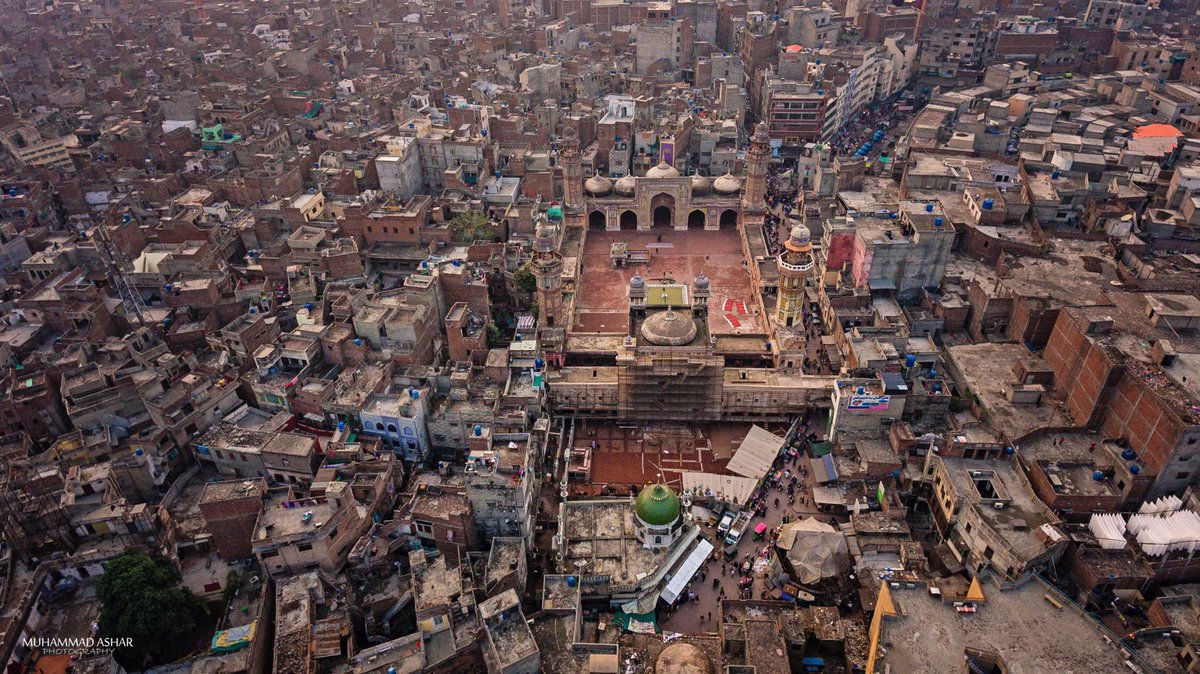
The military history of Lahore has long been overlooked, often eclipsed by the city’s more vibrant cultural and literary reputation. Even in the present day, old Lahore is remembered more as a cultural, archaeological, and architectural amusement than as a former engine of war and defence. Few South Asian cities embody as long and layered a martial past as Lahore. Standing on the Ravi River, at the hinge between Central Asia and the Gangetic plains, Lahore has for centuries been both a garrison and a frontier city. From its ancient citadel mound and river crossings to its Mughal arsenal, Sikh capital, British cantonment, and modern military station, Lahore’s defences and armies have repeatedly shaped the city’s identity, and also those of kingdoms.¹
Origins and Early Fortifications
The earliest mention of Lahore by name appears in the 10th-century Persian geography Hudud al-Alam (982 CE), which describes it as a town with temples and markets. Yet archaeology at the Lahore Fort mound has revealed much older cultural layers, with terracotta, early ceramics, and even Bronze-Age pottery suggesting habitation going back several millennia. This mound by the Ravi’s ancient course served as the natural redoubt for rulers who followed.²
Watch Posts and Early Citadels
In early centuries, defense relied on watch posts at gates and ferries. The main crossing at Shahdara, linking Lahore to the northern road, was guarded for centuries and by the colonial period even had a year-round bridge of boats of 31 vessels. Gate names preserve this military function: the Khizri Gate (later Shairanwala) signaled the river-crossing cult of Hazrat Khizr, while Mochi Gate derived from morchi (trench gunner). The citadel mound itself became the nucleus of successive forts, evolving from earth-and-mud enclosures to Akbar’s massive brick and stone structure of 1566.³
Why Lahore Mattered Militarily
Lahore mattered militarily for multiple reasons. Its geography on the Ravi corridor gave it a natural moat and flood shield, while its crossroads location placed it between Central Asia, Kashmir, Multan, and Delhi. Trade and invasion routes converged here via the Grand Trunk Road, ferries, and later railways, making it a hub for both commerce and war. The Walled City and Fort functioned as one defensive organism until the British period, when deliberate segregation created Civil Lines for administrators and Mian Mir Cantonment for soldiers.⁴
First Battles and Early Sieges
The earliest confirmed battle at Lahore was the capture by Mahmud of Ghazni in 1021–22, after which he placed Malik Ayaz as governor. In 1043–44 a confederation of Hindu princes attempted to besiege Ghaznavid-held Lahore, unsuccessfully. Later in 1186, Muhammad of Ghor seized Lahore, ending Ghaznavid rule. The Mongols sacked Lahore in 1241, and Timur raided it in 1398–99. In 1524 Babur burned Lahore and secured it on his way to Panipat. Humayun retook it in 1555 before recovering Delhi. Later centuries saw the city stormed by Nader Shah in 1739 and Ahmad Shah Durrani in 1752, with Sikhs gradually taking over from 1761 until Ranjit Singh’s triumph in 1799.⁵
Garrison Life inside the Walls
Within the walled city, everyday security revolved around gates, chokes, militia, and couriers. The kotwal oversaw the gates, supervised night patrols, and regulated the markets, with each gate doubling as a chowki or police post. The faujdar could summon cavalry and town levies when needed, while specialized daroghas managed the armoury (topkhana), the powder stores (baroodkhana), and the city’s workshops. Messages and directives moved swiftly thanks to couriers (dakias) who relied on relays and sarais along the Grand Trunk Road, feeding into local chowkis within the city. Inside the Fort, soldiers manned the bastions, guarded portals, and kept the powder magazines secure, while chowkidars and militia enforced curfews, carried out fire patrols, and ensured public order. In this way, Lahore’s walled heart was both protected and carefully policed, with military and civil security tightly intertwined.⁶
Lahore’s Smaller Forts and Defensive Compounds
Beyond the main Fort, a network of smaller strongholds added layers of security to the city. To the east stood Qila Gujar Singh, an eighteenth-century mud fort that acted as an outwork during the Sikh era. The imposing Haveli Barood Khana, meanwhile, functioned as a large arms depot and reminded passersby of Lahore’s role as an arsenal city. Across the river at Shahdara, the Akbari Sarai provided the dual function of caravanserai and secure walled compound, guarding a key crossing point. Within the city, the gatehouses of Roshnai and Akbari stood like miniature forts with their guard chambers, monitoring every entry and exit. Even the grand havelis of Lahore such as those of Nau Nihal Singh, Rang Mahal, and Dina Nath, could be turned into defensible residences in times of crisis, their high walls and courtyards doubling as bastions of protection when danger pressed close.⁷
Weaponry across the Ages
In the pre-gunpowder age, Lahore’s defenders relied on bows, spears, swords such as the Talwar and khanda, maces, shields (dhal), helmets, and even boiling pitch to hurl down from ramparts. With the arrival of early gunpowder, small hand-guns, bombards, and stone-throwers began to supplement traditional arms. By the Mughal peak, Lahore bristled with matchlocks (toradar), grand artillery parks, zamburak swivel guns, and the armouries of the Sheesh Mahal and topkhana stocked with mail and helmets. For urban policing, more modest tools were preferred: spears, lathis, daggers, short swords, ropes, and lanterns to patrol the narrow lanes. In the Sikh era, the Khalsa fielded musketeers and flintlocks, deployed heavy artillery, and rode cavalry armed with lances and swords, while the Akali Nihangs added the distinctive chakram to their arsenal. Under the colonial regime, new firearms appeared: Enfield, Martini-Henry, Lee-Metford, and Lee-Enfield rifles; alongside breech-loading artillery and machine guns, while the police carried lathis, sabers, and revolvers. In the early Pakistan era, the city’s armouries held .303 rifles, sub-machine guns, machine guns, recoilless rifles, and artillery for air defence, while the police modernized with shotguns, pistols, riot shields, and eventually tear gas and now contemporary equipment.⁸
Lahore as the Mughal Capital and Arsenal
Under the Mughals, Lahore was not only a capital city (1584–1598) but also a critical military and arsenal hub. Akbar’s rebuilding of the Fort in 1566 in brick and red sandstone gave it formidable defences and solidified its role as a strategic bastion. Jahangir reinforced the city’s authority by completing administrative courts, while Shah Jahan’s embellishments, the Sheesh Mahal (1631–32), Naulakha Pavilion (1633), Moti Masjid (1630s), and Shah Burj, were not merely decorative but also symbolic assertions of power, overlooking parade grounds where troops assembled. Aurangzeb’s addition of the Alamgiri Gate (1673–74) created a monumental, defensible entrance that projected strength to both friend and foe. The Ravi’s proximity ensured supplies, arms, and reinforcements could move by boat, sustaining campaigns and sieges. Even the Mughal gardens functioned as drill and parade spaces, while the Grand Trunk Road enabled rapid movement of troops and couriers, ensuring Lahore’s place as one of the empire’s foremost centres of military power.⁹
The Sikh Capital and Khalsa Army (1799–1849)
When Ranjit Singh captured Lahore in 1799, it became capital of the Sikh Empire. The Khalsa Army was reorganized into the Fauj-i-Ain (regular army) and Fauj-i-Khas (elite corps), with European officers drilling infantry and artillery in French style while foundries and magazines in Lahore cast cannon. At the heart of the city, the Hazuri Bagh, built in 1818, stood as Ranjit Singh’s marble pavilion opposite the Alamgiri Gate and became the ceremonial review ground for his troops. The Fort itself served as treasury and arsenal, while the Haveli Barood Khana and other magazines stored powder and munitions. Daily life in Lahore reflected this militarized atmosphere: garrison drills and parades filled the streets, Akali Nihangs in their striking blue attire with tall turbans and steel quoits mingled with European-trained infantry in uniforms, and the city bristled with martial spectacle. After Ranjit Singh’s death, however, the army swelled to 80,000 and grew politically powerful and unruly, leading eventually to the Anglo-Sikh Wars and the annexation of Lahore in 1849.¹⁰
British Annexation and the Cantonment City (1849–1947)
After the Battle of Gujrat in 1849, the Union Jack was raised at Lahore Fort, the Khalsa disbanded, and the Fort turned into an armoury. Soon after, the British established the Mian Mir Cantonment on high ground east of the city, designed on a grid with a vast parade ground, barracks, bungalows, bazaars, churches, and hospitals. During the uprising of 1857, Lahore remained neutral largely due to the dramatic pre-emptive disarming of Bengal Native Infantry regiments on the Mian Mir parade ground under the watch of British artillery. By the later nineteenth century, Lahore had also become headquarters of the North Western Railway, with the Mughalpura workshops keeping troop trains and supplies flowing to the frontier. The city’s administration reflected colonial segregation: Civil Lines developed apart from the military cantonment, and the cantonment itself housed regimental depots, churches, cemeteries, and the British Military Hospital that would later evolve into CMH Lahore.¹¹
Lahore in the World Wars
During World War I, Punjab was Britain’s main recruiting ground, and Lahore became a vital recruitment, training, and administrative hub. In World War II, the city’s role expanded even further. The Walton Aerodrome served as the Initial Training Wing for the Indian Air Force and also hosted Chinese Nationalist cadets who trained there. At the same time, the establishment of CMH Lahore in 1943 merged British and Indian Military Hospitals into a single institution under the Indian Army Medical Corps, reflecting the city’s growing medical importance. The Mughalpura railway workshops kept supplies and troop trains moving across India and the Northwest Frontier, underscoring Lahore’s place as a logistical heart of the war effort. On the home front, civil defence units organized blackouts, air raid precautions, rationing, and price controls across the Punjab capital. Beyond the battlefield, Lahore was also the stage for a political milestone: the adoption of the Lahore Resolution of 1940, which charted the path that would eventually lead to Pakistan.¹²
Partition 1947
Lahore became a violent flashpoint as Partition descended into riots and chaos. The cantonment and Fort were crucial in maintaining a semblance of order during the bloodshed, their garrisons trying to hold the line while the city burned. On the outskirts, Walton Camp swelled into South Asia’s largest refugee reception center, through which millions of uprooted men, women, and children passed in search of safety. With the departure of British regiments, the Pakistani Army assumed control of Lahore Cantonment, transforming it into one of the new nation’s most vital bases.¹³
Pakistan Era and the Modern Front
After 1947, Lahore saw the expansion of its cantonment and the creation of modern housing as a residential–military complex, reflecting the new nation’s efforts to blend defence and urban growth. In the 1965 War, the city became a main front: the BRB Canal served as a determined anti-tank obstacle, while fierce battles at Barki (8–11 September) and Dograi (20–22 September) pushed perilously close to the city’s outskirts. During the 1971 conflict, Lahore was again heavily fortified, though the fiercest fighting took place in East Pakistan. In the decades since, Lahore Cantonment has matured into a central hub of Pakistan’s defence infrastructure, housing major headquarters, training institutions, CMH, and the Rangers, symbolizing both its historic and ongoing role as a garrison city.¹⁴
From ancient citadel mound to imperial arsenal, from Sikh parade ground to British cantonment, and from Partition refugee hub to modern border city, Lahore’s military history is inseparable from its urban identity. Its geography on the Ravi and at the crossroads of empires made it a perennial garrison, while successive regimes reshaped its walls, gates, cantonments, and ceremonial spaces. Even today, the city’s Fort, cantonment, and border defenses remind us that Lahore’s story has always been written in both stone and steel.
References
1. Wink, Andre. Al-Hind: The Making of the Indo-Islamic World. Vol. 2. Leiden: Brill, 1997.
2. Latif, Muhammad. Lahore: Its History, Architectural Remains and Antiquities. Lahore: New Imperial Press, 1892.
3. Asher, Catherine. Architecture of Mughal India. Cambridge: Cambridge University Press, 1992.
4. Talbot, Ian. Punjab and the Raj, 1849–1947. Oxford: Oxford University Press, 1988.
5. Chandra, Satish. Medieval India: From Sultanat to the Mughals. New Delhi: Har-Anand, 2005.
6. Latif, Muhammad. Lahore: Its History, Architectural Remains and Antiquities. Lahore: New Imperial Press, 1892.
7. Latif, Muhammad. Lahore: Its History, Architectural Remains and Antiquities. Lahore: New Imperial Press, 1892, 211–215.
8. Gommans, Jos. Mughal Warfare: Indian Frontiers and High Roads to Empire, 1500–1700. London: Routledge, 2002.
9. Asher, Catherine. Architecture of Mughal India. Cambridge: Cambridge University Press, 1992.
10. Lafont, Jean-Marie. Maharaja Ranjit Singh: Lord of the Five Rivers. Delhi: Oxford University Press, 2002.
11. Talbot, Ian. Punjab and the Raj, 1849–1947. Oxford: Oxford University Press, 1988.
12. Khan, Yasmin. The Raj at War: A People’s History of India’s Second World War. London: Vintage, 2015.
13. Talbot, Ian, and Gurharpal Singh. The Partition of India. Cambridge: Cambridge University Press, 2009.
14. Nawaz, Shuja. Crossed Swords: Pakistan, Its Army, and the Wars Within. Karachi: Oxford University Press, 2008.