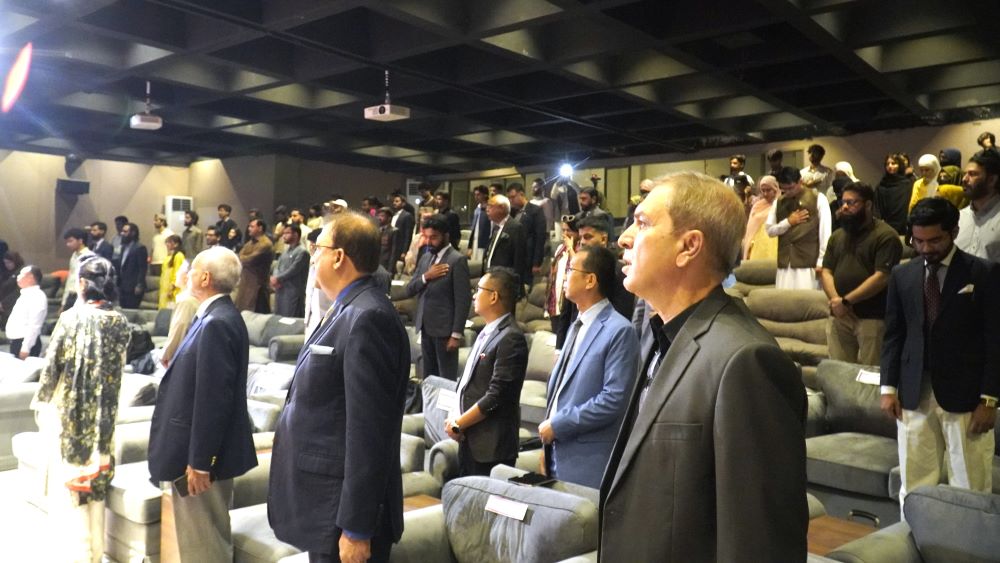






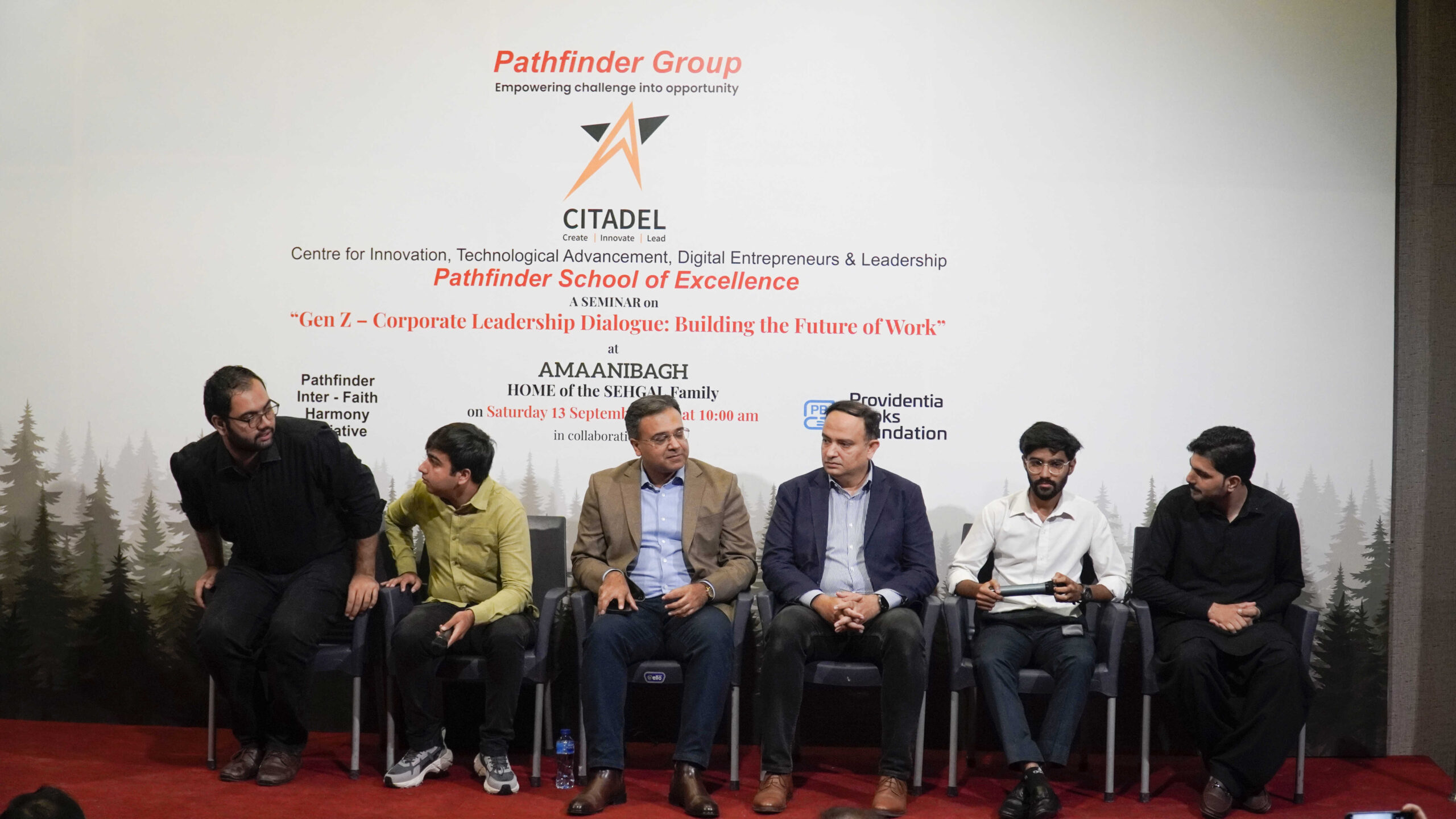
The Pathfinder Group’s School of Excellence, Centre for Innovation, Technological Advancement, Digital Entrepreneurs & Leadership (CITADEL), in collaboration with Providentia Books Foundation, hosted a seminar titled “Gen Z – Corporate Leadership Dialogue: Building the Future of Work” at AmaaniBagh, Angoori, Islamabad, on 13th September 2025. The event brought together industry leaders, academics, and students from leading institutions, including NUST, The Millennium Universal College (TMUC), Lawrence College Murree, and Quaid-i-Azam University. Opening with remarks by Air Cdre Khalid Banuri and AVM Asad Ikram, the seminar featured two sessions: Tech-Powered Work in the IT Sector, where speakers highlighted the transformative role of AI in IT operations and its broader impact on the industry, and Corporate Culture in the Telco Industry, where experts emphasized AI’s potential for national progress, the evolution of Pakistan’s telecom sector from 2G to 5G, and the importance of soft skills for professional success.
Providentia Books Foundation is a non-profit organisation committed to promoting a passion for reading and learning amongst underprivileged children. It connects book donors with individuals and institutions seeking educational materials, streamlining the donation and distribution process. Collaborating with publishers and other non-profit organisations, the Providentia Books Foundation distributes books to schools in underserved communities, aiming to bridge the literacy gap and empower children through education. In a brief period, the foundation has already collected more than 70,000 books and distributed over 61,823 of them across five major cities and several smaller towns in Pakistan. The Pathfinder Group has recently undertaken a groundbreaking initiative with the curtain-raiser on CITADEL, the Centre for Innovation, Technological Advancement, Digital Entrepreneurs, and Leadership. CITADEL is a state-of-the-art innovation hub purpose-built to bridge the skills gap, empower digital entrepreneurs, and cultivate transformative leadership. Situated at the intersection of technology, education, and enterprise, CITADEL aspires to become Pakistan’s premier launchpad for private sector innovation and impact. Another significant initiative is the Pathfinder Interfaith Harmony Initiative (PIHI), which aims to promote respectful dialogue among faith communities, create safe spaces for collaborative action, and celebrate the shared moral values that unite our nation. PIHI seeks to promote a sense of urgency in countering extremism through education, empathy, and engagement. These noble objectives will be achieved through workshops, educational outreach, collaborative forums, and community projects. Through such synergy, PIHI strives to transform faith into a force for unity rather than division.
Today, our discussions extend beyond leadership, technology, and the future workplace. We are also critically examining how Gen Z is actively influencing the world around us. A recent example is of the Prime Minister of Nepal stepping down amid widespread protests, primarily led by Gen Z, against restrictions on social media and messaging apps. This singular event serves as a potent reminder that our youth are not passively awaiting the future; they are demanding it, building it, and reshaping it in real time. This profound shift is a major reason that brings us together for today’s discourse.
Without further ado, I would like to invite Air Vice Marshal (Retd) Asad Ikram, President of CITADEL. He is a visionary leader whose career has been defined by building the very foundations of innovation. AVM Asad Ikram is not merely a leader within the aerospace and aviation community; he is an institution builder, instrumental in establishing pivotal organisations that drive our nation’s technological advancement. AVM Ikram has been instrumental in establishing key organisations, including the Navigation Systems Department at the Advanced Engineering Research Organisation, the Telecom and Marketing Department at LT Engineering Limited, and the Aviation Research, Innovation and Development Organisation (ARIDO) at the Pakistan Aeronautical Complex. He has also served as the Director General of Corporate of the National Aerospace Science and Technology Park (NASTP) and currently advises the National Radio Telecommunication Corporation. For his meritorious services over the years, he is a recipient of both the Sitara-e-Imtiaz and Tamgha-e-Imtiaz. Please join me in extending a warm welcome to a true architect of progress, Air Vice Marshal Asad Ikram.
AVM (Retd) Asad Ikram
Distinguished guests, ladies and gentlemen, Assalamu Alaikum. It is my privilege and honour to welcome you to this esteemed occasion. I am truly thrilled, as coming out on a Saturday morning is never easy. Your presence here demonstrates your commitment to the progress of our country. It is particularly inspiring to see so many young people in attendance, both at the front and in the rear. As mentioned earlier, our core mission at CITADEL is to foster societal transformation for the betterment of Pakistan.
We all understand the deep interconnection between society and technology. Society not only defines the needs for technological advancement but also funds its development. In turn, technology provides new ways of engaging with ourselves and the world. This symbiotic relationship means society drives technology change, and technology drives change in society. We all accept that change is the only constant. Society is in a continuous state of flux, as is technology. What has fundamentally changed over time is the speed of technological change, which accelerates societal transformation. Although generations are more of a continuum—since human births are ongoing, not segmented—the rapid acceleration of technological change over the past few decades has led to significant social shifts. This has led us to classify different generations based on their birth periods. However, it’s not solely about their birth year; it is more accurately related to the technologies they encountered at birth and had to adapt to afterwards. For those unfamiliar with these definitions, we identify them as Baby Boomers, Gen X, Gen Y (Millennials), Gen Z, Gen Alpha, and Gen Beta. A notable observation is the decreasing duration of each successive generation. For example, the Baby Boomer generation lasted from 1946 to 1964, a substantial span. In contrast, Gen Alpha covers barely 11 years, and Gen Beta is expected to be even shorter. This rapid evolution directly impacts the skill sets needed within society and for national development. Consequently, organisational culture is also undergoing notable change.
The main goal of today’s discussions is to facilitate interaction between seasoned industry professionals, who can share insights into their fields, and the younger audience, who can listen, learn, and offer their perspectives. This collaborative approach is vital for shaping our society’s future.
Turning to the Pakistani context, we face a considerable challenge: creating 2.5 million new jobs annually. Currently, our graduate unemployment rate is around 31%. This critical window for action is limited to the next 15 years, after which our young population will age. If we do not invest in them now, they risk becoming a national liability. However, problems always present opportunities for solutions. We must focus on upskilling our workforce to boost employability. Simultaneously, there is an urgent need to create more jobs, which requires a strong focus on entrepreneurship. To excel both locally and globally, we need leadership excellence at all levels. Against this backdrop, the Pathfinder Group, one of Pakistan’s leading business groups, has developed a transformative vision. This vision, led by Mr Ikram Sehgal, who is present here today and can be seen smiling to my right, resulted in the establishment of the institute we are discussing—the Centre for Innovation, Technological Advancement, Digital Entrepreneurs, and Leadership (CITADEL).
To address the three core problems identified earlier, CITADEL operates through three main verticals: the Career Jump Institute, the Escape Velocity Accelerator, and Strategic Innovation Consulting. Each vertical is designed to address one of these challenges. I would like to elaborate on the Escape Velocity Accelerator, which aims specifically at creating more jobs within the country.
I am proud to announce that this initiative is an industry-first from the private sector: showcasing Pakistan’s top five start-ups at Davos next year. We have named this the Pathfinder CITADEL Davos Start-up Challenge. This challenge directly aligns with CITADEL’s mission to empower Pakistan’s innovation ecosystem and turn talent into jobs, and ideas into scalable ventures. The goal is to give Pakistan’s top five start-ups a global platform to pitch their innovations during the Pakistan Breakfast at the Pakistan Pavilion, held alongside the World Economic Forum (WEF) annual meeting at Davos in January next year. The selection process for this prestigious opportunity will involve a major national competition with three stages. The call for applications will open this Monday, Insha Allah. The first round, identifying the top five start-ups, will take place on October 11th through a hybrid virtual and physical process. The final round will be held on October 25th. Following this, we will conduct a training boot camp in November and December to prepare the Pakistani teams thoroughly for their pitches to venture capitalists from around the world at Davos in January 2026.
Our focus areas for these startups include Artificial Intelligence (AI) and Machine Learning (ML), FinTech, Health Tech, Climate and Green Tech, and Deep Tech. The winners will gain exceptional benefits: global visibility before leading investors and decision-makers, international media coverage across major outlets, access to acceleration and mentorship from global industry leaders, and a critical connection to international markets. This initiative underscores our commitment, fully aligned with government policies supporting Vision 2030 and Digital Pakistan through entrepreneurship, thereby addressing national priorities. Naturally, we look forward to collaboration with both government and private sector partners. I will conclude with an African proverb that resonates deeply with our vision: “If you want to go fast, go alone. If you want to go far, go together.” Thank you.
The announcement regarding the Start-up Challenge was truly exciting. With that, ladies and gentlemen, it is my great honour to introduce our next speaker, Air Cdre (Retd) Khalid Banuri. His career exemplifies diversity, dedication, and the use of innovative approaches. With his calm demeanour, he effectively fosters the ability to cultivate new ideas through collaboration and build high-performing teams. Throughout his distinguished career, which spans several decades, Mr Banuri has made his mark as both a practitioner and a scholar across a wide range of fields. His expertise encompasses fast-flying jets, nuclear politics, international law, strategic training, research, and education, all while providing significant inspiration to others. He has substantial senior-level experience in management policy analysis, diplomacy, lecturing, and writing. In recognition of his outstanding contributions, the Government of Pakistan has honoured him with two prestigious awards: the Sitara-e-Imtiaz Civil Award for excellence in policy analysis and the Sitara-e-Imtiaz (Military) for his dedicated services to the Pakistan Air Force. Please join me in welcoming Air Cdre (Retd) Khalid Banuri.
Air Cdre (Retd) Khalid Banuri
Some years ago, at an international seminar, I was asked to speak about disease surveillance. Just like this year, Pakistan had gone through significant floods those days. I also had a childhood recollection of the infamous Cyclone Bhola that devastated parts of Bangladesh. While thinking about the mitigation strategies, I felt that three aspects were important: the institutions, the process and then the implementation.
One can note that any new ideas invariably involve these three things: institutions, processes and the implementation methodologies.Let me contextualise with what we intend to do today. First, on institutions. CITADEL is one such institution in the private sector, which has shortlisted the processes of innovation, technological advancement in less traversed or new fields, encouraging entrepreneurship and providing inspirational leadership. Second, the fact that process matters. After having started the conversations in five earlier generational dialogues, we are today poised for our sixth initiative on building the future of work. The pace is set, the process is evolving, through a threetier programme.
Third comes the implementation strategies- easier said than done. The notional outreach suggests that, with some variations, Gen Z is used symbolically. Suffice to say a loose definition would tend to include some millennials and some Gen Alpha, too. The challenge is that the implementation aspects differ with each Generational change.
How do we convince each generation to work with the other? Can they? Will they?
There is a theory called the theory of innovation diffusion. Simply stated, it suggests that with any new idea or technology, one should never assume that 100% of the target audience can be totally committed. It suggests that for something new, there are always about 2.5% that are eager beavers, and about 16% that are naysayers. But you look for the next 13.5 % that will ask the right questions, understand the new idea, and then become those early adopters. The rest – two sets of 34% each will come around when that idea takes shape and the dividends start appearing. So, we are looking for those 16% early adapters and innovators together who can take a new idea and make it successful. Ideas like CITADEL are of a similar kind.
Today’s programme focuses on two industries in the corporate world – the IT which provides, in various ways, the backbone and the telecom industry, which then uses that backbone to ensure connectivity. Together, these two industries at large are two dominant areas in the corporate world. Both these industries, as indeed others, need the right kind of people who can make these works, innovate, enhance and ensure the global journey to a different kind of world, mostly for the betterment of humankind.
For this, our focus is the next generation that has the time, and hopefully the capacity, to transform the world. In that we think of Gen Z in general. I must add that during all Gen Z-related work that we did earlier, one factor was dominant, making teams from different backgrounds and Universities, to work together, collaborate and develop one outlook.
Creating happy teams is never easy. But some of the earlier ones were able to do just that. We also run a clock so that students develop the habit of managing their time, for the future world would not give extensive time to anyone. The slower ones will easily fade away.
So here is what we do then. The first segment is “Tech-Powered work in the IT sector” We have two BS-level university student teams for this segment. They have been given the objectives and asked to explore answers to some relevant questions – to kick start the debate.
For this, we have the following:
Mubashir Kalhoro and Shahid Ali Khan – from QAU as Team Red. They will talk about exploring the transformative impact of technology on the modern world. And then we shall have NUST, from where we have Shawaiz Zafar, Abdullah Mustafa, and Aarish Sajjad. They will talk about “The Global Industry: Past, Present and Future” This is Team Blue.
Then we have the surgeons, so to speak. Two eminent experts from the IT industry will give us their outlook. Mr Muneeb Rabbani, the Head of IT and Technology at a leading backbone company, the Tansworld, and thereafter, Mr Ather Imran Nawaz, the CEO and Director of Sybrid and Ice Animations- both private limited companies of the Lackson Group. For a total of 30 minutes, they will provide their reflections. We shall break for a swift cup of tea before the rest of us in the audience can ask questions. We shall have a special address from Mr Abu Bakar, the CEO of Pakistan Software Export Board (PSEB), whose focus has been to promote and nurture the industry.
The 2nd Panel is about “Corporate Culture in the Telco Industry”. The pattern will be similar, with students’ presentations first and experts’ reflections later. Team Yellow and Team Green represent The Millennium Universal College (TMUC) and Lawrence College, Ghora Gali, respectively.
Alongside the wrap of this interesting event, we have a short introduction to the Pathfinder Inter-Faith Harmony Initiative. In that, Brig (Retd) Mujahid Alam shall introduce the newly established Advisory Council. This will lead to the wrapup of this interesting half day, with the closing remarks by Mr Ikram Sehgal.
I have two more things to point out to you regarding the future:
The younger generations- some millennials, all Gen Z and very soon Gen Athere are a lot of writings about their outlook on life, work ethics and behaviours. The point that is often missed is that in Pakistan, the Gen Z, for example, is not as per the classically defined global understanding. For example, the rural and urban divide suggests there will be significant differences in their work behaviours. Also, those graduating from Universities largely have the theoretical knowledge. When they get into the industry, they often want to settle into the required work environment. This gap between academia and the industry needs to be filled in. CITADEL is one such initiative that aims for it.
In the context of providing opportunities, allow me to refer you to the notion of Shark Tanks. In simple words, Shark Tanks focus on the facilitation of new ideas of young minds. They bring out their ideas and some proven ability of their products, which is reviewed and questioned by experts – the sharks- who will seek your blood if your idea is not good enough, but protect you with opportunities and support, if you can demonstrate that your product is workable, carries value and can fetch the market interest.
To the young people in today’s audience, and indeed elsewhere in the country, this is the Pathfinder challenge. Show that you can, and CITADEL will help you connect with the world of opportunities, so you can draw the interest of venture capitalists around the globe. Ideas, they say, are the new black. They can lead to miracles. But to achieve those miracles, one has to work terribly hard. Those who are up to the challenge will rise; others may perish. That’s how the world works.
Sehrish Mustufa (Host):
Thank you, sir. It’s always a pleasure to hear your valuable insights. I invite both teams to come on stage: Team Blue from NUST and Team Red from Quaid-e-Azam University, representing our Gen Z leaders. Also, I would like to welcome our esteemed IT sector experts, Mr Muneeb Rabbani and Mr Athar Imran Nawaz—please join us on stage. To kick things off, let’s hear the presentation from Quaid-eAzam University, Team Red.
Mubashir Farooq (QAU):
Assalam-o-Alaikum, everyone and good morning. I am Mubashir Farooq from Team QAU, and I’m delighted to delve into the topic of tech-powered work in the IT sector. This is, without a doubt, a multi-million dollar industry in today’s world; IT is embedded in everything we do. From agriculture to education and every business currently operating, anything digitally available requires IT. It has become our economic backbone. The digital economy’s growth profoundly impacts IT. To illustrate, IT contributes to 22% of the world’s GDP.
Furthermore, the global transformation post-COVID has led to 60-66% of people, across all generations, preferring remote or hybrid work models. Concurrently, the proliferation of AI is undeniable; it has been integrated into nearly every facet of our lives, whether strictly necessary or not. This has driven 56% of our work growth through AI. Essentially, anyone with a phone is a key stakeholder in the IT industry. If you are not a user, then there is no sense in providing a solution.
Let’s examine the needs of the various stakeholders:
• Students and Educators: As the starting point for future professionals, they require updated curricula, robust programming skills, and a strong foundation in emerging areas like AI, cloud computing, and cybersecurity.
• Employers: They seek skilled graduates. As Mr Banuri mentioned, university curricula often focus heavily on theoretical knowledge. There’s a critical need for more practical, lab-based work to bridge this gap. We will discuss this in greater depth shortly.
• Government and Policymakers: From my perspective, policies are well-articulated on paper, but regulation often lags. For example, while NUST and QAU might offer similar curricula, the same standard might not be met in universities in more remote areas. Consistent regulation is crucial.
• Global Platforms: Entities like Google and Meta are the global institutions that have shaped and continue to drive the IT infrastructure.
Core Technical Skills
In the IT sector, core technical skills include programming and cloud computing. However, in today’s era, the tech industry stands on two primary pillars:
1. AI: Encompassing machine learning, deep learning, and agentic generated AI.
2. Cybersecurity: With the immense volume of data processed by AI, the concept of data breaches has significantly increased, leading to substantial demand for cybersecurity professionals.
Beyond these, various tools and platforms are essential for maintenance, version control, deployment, and other operational aspects. I believe soft skills are even more critical than technical skills. For instance, how one presents oneself is paramount. Statistics show that 71% of employers prioritise soft skills in their employees, even if technical skills are initially somewhat lacking. These include communication, teamwork, adaptability, and critical thinking. Individuals need to be presentable and adept at proving their point. This includes knowing how to effectively pitch a project, grasp new ideas, and understand novel concepts. This ability is, in fact, the biggest advantage humans hold over AI. While some argue that AI will take our jobs, there are areas where we unequivocally outperform AI, and soft skills are a prime example. Next, let’s consider the generational gap through a simple example: my father began using a phone in his late 40s. The subsequent generation, Gen X, likely started using phones in their early to mid-30s. I, personally, began using a phone when I was 12 years old. Strikingly, my two-year-old nephew can now use a phone almost as proficiently as I can. This clearly illustrates the significant generational gap and how rapidly technology has evolved, integrating everyone into its ecosystem.
Different generations also exhibit distinct characteristics in the workplace:
• Baby Boomers typically prioritise discipline, hierarchy, and loyalty.
• Millennials are tech-savvy but also highly purpose-driven. They seek flexibility and innovation, representing a blend of Boomer and Gen Z characteristics.
• Gen Z are true digital natives. I would argue that Gen Z, Generation Alpha, and Beta are the first truly “native” generations in this digital era.
Gen Z, Alpha, and Beta are characterised by their need for immediacy; they struggle to focus on any single item for more than 10-15 seconds. Internet speed and efficiency are paramount for them. To illustrate the rapid pace, if I am unemployed for six months, I am effectively outdated in this industry.
This leads to a constantly changing culture:
• Remote/Hybrid Work: As mentioned, 60% of people now prefer remote or hybrid work models.
• Increased AI Assistance: AI tools like ChatGPT and Claude are ubiquitous, not only in academia but also in professional settings.
• Cloud Collaboration: Cloud technology is pervasive. Anything on the internet is essentially on the cloud, enabling widespread collaboration through online project management tools and other digital platforms. The post-COVID era further accelerated this shift, as everything transitioned online due to stay-at-home mandates.
Future Trends: Adaptability is Key
As far as my understanding of future trends is concerned, IT is synonymous with adaptability. Unless you adapt, you simply cannot compete in this race. For example, some of our PhDs, while excellent in their specific areas, can become outdated by the time they complete their degrees. While there’s a growing awareness to stay current, earlier generations often faced this challenge. The core point is that we must continuously adapt and evolve with constant change.
This leads us to the imperative of lifelong learning. We must continuously work on our digital tools and infrastructure. It’s important to remember that if certain aspects are challenging, it doesn’t mean the entire landscape is bleak. In Pakistan, we rank fourth globally in software exports. To illustrate with figures: December 2024 statistics show IT to reach $10 billion by 2029. Gen Z has distinct expectations regarding work culture. As I mentioned earlier, we crave immediacy; we dislike delays and want tasks completed swiftly. The traditional 9-to-5 work culture is often a turn-off for this generation. We prefer hybrid models or freelancing.
Furthermore, 89% of Gen Z members seek a clear purpose in their work. Even in a job, they want to learn something interesting and progress rapidly, rather than waiting five years for a promotion. We desire fast career growth but also prefer not to be restricted by company policies. A global trend, adopted by companies like Google and Netflix, is to allocate 20% of employees’ work time for personal development and projects, irrespective of immediate company benefit. Gen Z deeply values this autonomy.
Intergenerational Challenges and Mutual Learning
Challenges arise from the differences between generations. Gen Z evolves quickly, whereas Baby Boomers and Millennials often value hierarchy and maintain clear distinctions between formal and informal interactions. For example, a Gen Z individual might prefer text communication, while a Millennial or Boomer might insist on a face-to-face meeting, leading to misunderstandings. This isn’t unique to Pakistan; it’s a global phenomenon. We must understand that both Millennials and Gen Z need to “learn to unlearn.” If certain practices existed in the past, they can, at the very least, be improved if not entirely changed. In this process of learning to unlearn, a willingness to learn from each other is crucial. There should be no barriers based on respect or hierarchy. For instance, if I am teaching my boss something new, it doesn’t mean I am pretending to be his boss or entertaining illusions that I can run the company better. It’s simply about mutual growth and progress. Let’s discuss Pakistan’s framework within the IT sector. We possess distinct strengths: we are technically skilled, have good English language proficiency, and our culture is highly adaptable—we readily adjust wherever we go. However, as Mr Banuri pointed out, there’s a significant lack of hands-on experience integrated into our academic curriculum. For instance, if I aim to pursue a Cisco certification like CCNA, the university course I’m studying often doesn’t align with its requirements.
This forces me to pay thousands of dollars for separate training before I can even apply for the certification. This highlights a critical need for collaboration between industry and academia. Imagine if industry partners offered certification facilities, perhaps by saying, “Give us a list of your top students, and we will provide them with world-recognised certifications.” To advance, Pakistan must first improve its training facilities by introducing globally recognised certifications such as AWS, Cisco, and others. While initiatives like DG Skills, PITP, and P@SHA (Pakistan Software Houses Association) are already active, we need to ensure their reach and impact extend across the entire country. Secondly, we must actively bridge the existing gaps, particularly in terms of facilities and practical exposure, as previously mentioned.
In conclusion, I reiterate: until we adapt, we will be left behind. Many fears that AI will “eat our jobs.” However, AI will not eliminate jobs in their entirety. This fear is reminiscent of the late 1980s and 1990s, when people panicked about computers taking over, performing the work of ten people at once. Those who failed to adapt to the computer revolution were indeed left behind. These technological advancements, like AI, ultimately create new jobs; we should not panic but rather embrace them. Thank you.
Sehrish Mustufa (Host):
Thank you so much, and I believe our experts and millennials in the audience were diligently taking notes on Gen Z’s expectations! we shall now move directly to the Team Blue from NUST.
Shawaiz Zafar (NUST)
Assalam-o-Alaikum. My presentation today will cover the IT industry’s past, present, and future. We will explore its evolution and endeavour to explain the challenges faced at a global level. The IT industry undeniably drives global progress, but the critical questions remain: Is it always for the better, and are we truly ready for the future? We will examine three main aspects of the IT industry: understanding its fundamentals, tracing its global evolution, and envisioning the necessary future developments. The IT industry was born in the 1940s. You’re familiar with ATM cards; computing began with a similar concept—the punch card, where information was encoded through simple holes. Moving into the 1970s and 80s, personal computers came into existence.
As was mentioned earlier, while personal computers were gaining popularity, many people reacted with panic. However, amidst that panic, several giants emerged—Apple, Google, Amazon, and Microsoft—who were relentlessly innovating. The 1990s heralded the advent of the World Wide Web and the Internet. The birth of the internet, much like the rise of AI today, created exponentially high opportunities and threats simultaneously. The era around the internet’s inception was strikingly similar to our current technological landscape.
In the 2000s and 2010s, with Apple leading the charge in the smartphone industry, followed by Samsung, Nokia, and Motorola, we entered the era of smartphone devices, effectively placing the entire world into the palms of our hands. In the 2010s and extending into the present, the major debate undeniably revolves around Artificial Intelligence, particularly conversational AI like ChatGPT.
I believe it gained prominence around 2022, and I was genuinely shocked by its capabilities—you simply provide a prompt, and it converses like a human, offering suggestions and is now capable of far more, including generating presentations like this one. As a member of Gen Z, I actually made this presentation using AI, demonstrating the direct application of this technology here today. Regarding the IT industry in Pakistan, any discussion would be incomplete without mentioning Arfa Karim. She was a child prodigy who sparked a revolution in Pakistan’s IT sector, becoming the youngest Microsoft Certified Professional, or MVP, if I recall correctly. This legacy was followed by Ayaan Qureshi, who achieved Microsoft certification at just five years old. These examples highlight Gen Z’s exceptional aptitude for learning, their quick adaptability, and their eagerness to explore new things.
Pakistan’s it Industry: Stakeholders and economic Impact
Everyone is a stakeholder in Pakistan’s IT industry—anyone with a smartphone, anyone who engages with digital technology. This includes developers, start-ups, and indeed, every one of you in this audience. Economically, Pakistan ranks among the top five freelancing countries globally, with combined exports reaching approximately $3.8 billion. It’s worth noting that these figures can vary due to the IT industry in Pakistan not being as comprehensively documented as it could be. Today’s industry is further supported by numerous incubation centres across Pakistan. I’m sure many of you are familiar with them; NSTP (National Science & Technology Park) at NUST is a prominent name, alongside other NSTPs and Technopolis centres in Islamabad, and various incubators in other cities, all playing a crucial role. Gen Z is directly involved in these initiatives, and these centres are actively targeting Gen Z because the future rests on our shoulders, and we are poised to lead it.
As emphasised earlier, no industry has a sustainable future unless it actively contributes to both the local and global economy. Within this framework, we are witnessing a freelancing boom, significant job creation, and increasing exports, all directly linked to economic growth. Next, let’s turn to the global impact of IT. Information Technology has profoundly influenced three major sectors of our lives:
• Culture: IT has redefined how we communicate, speak, and even think. You must have heard of Gen Z lingo—terms like “gang” or “riz.” This is an entirely new language that emerged because communication improved, and Gen Z, perhaps bored with old linguistic norms, created a new vocabulary that rapidly gained global popularity. Everyone now understands these terms, primarily because IT solved a major problem: communication. Gen Z has leveraged this, demonstrating a new angle for problem-solving. You can create new things and effectively convey them through enhanced, cross-border communication.
• Education: Online learning and smart tools, particularly AI, have been popularised by Gen Z in highly creative ways, transforming educational methodologies.
• Economy: The IT sector drives e-commerce, remote work, and the burgeoning gig economy, fundamentally reshaping how we earn and exchange goods and services.
Before discussing challenges, let me address future implications.
Quantum Computing: This is currently one of the hottest topics globally. We all understand encryption, the use of prime numbers for security. Quantum computing possesses the power to decode the strongest encryption in seconds. How? Quantum computers can store two bits simultaneously and operate at incredibly high speeds, representing an entirely new paradigm of computing. Extensive research is underway in this field; Google, for instance, has a quantum computer at its headquarters and is actively working on its development.
• Metaverse and Virtual Worlds: These are the “new thing” that Gen Z desires. Meta (formerly Facebook) is heavily investing in this domain, and Gen Z is embracing it, but we must also consider its broader implications. In science, for example,
there are initiatives like the H.R. Hive lab, where we can visualise and interact with chemical reactions and the 3D interactions of molecules and atoms in virtual space. Initially, VR was primarily used for simulations, but Gen Z students have discovered innovative ways to apply it to education and learning.
• Sustainability through Green Initiatives: This involves a critical focus on environmental protection and climate change. Given recent events, such as the devastating floods, it is clear we must actively work on sustainable solutions.
With that, I will now hand over the stage to Abdullah Mustafa to discuss the challenges and opportunities.
Abdullah Mustafa (NUST): Before proceeding with my presentation, I wish to strongly second the opinion of the previous speaker: Gen Z lingo and trends in Pakistan differ significantly depending on the region. I hail from a small town, and for most of my life, I used words as they were conventionally understood—terms like “charismatic” or “greatest of all time.” Then I arrived at NUST and was immediately confronted by new terminology. I genuinely didn’t understand what “riz” meant. I asked for clarification, and they made me feel like an alien! Then there was “GOAT” (Greatest of All Time), which I eventually understood. But then, it evolved again; they shortened “good” to simply “go.” I’d walk into a room and say “hello,” and they’d say, “You, go.” This illustrates the stark difference in Gen Z culture globally and, crucially, between the rural and urban areas of Pakistan.
Before I delve into the challenges within the IT industry, I would like to expand a little more on the global impact of IT. What exactly is the global impact of IT? Let me illustrate with examples. For Baby Boomers, a meeting was often considered crucial. For Gen Z, however, a common sentiment is, “This could have been an email,” signalling wasted time. This evolution is a direct result of IT development. In earlier times, emails weren’t popular, necessitating meetings for almost everything. Today, we achieve so much via email, and platforms like Skype, Zoom, and Teams have globalised communication. In the 1980s, no one would have imagined video calling someone in England; today, they are just one click away. Consider the revolution in education. Pakistan has the Virtual University, enabling students to study from home. NUST, for its part, hosts the first supercomputer in an educational institution, located within my own department, which facilitates advanced research. This progress is solely attributable to IT.
Challenges in the IT Industry
First, we face a significant skill gap and talent retention issue. Pakistan possesses immense talent. I know countless individuals who are incredibly productive, constantly learning, and developing projects that are beyond my imagination—projects I didn’t even know existed. However, we consistently encounter a resource problem, specifically a gap between academia and industry. Students are developing innovative projects and apps and conducting impressive research, but they often lack the funding and industrial guidance necessary to scale their ideas. Pakistan ranks fourth globally in freelancing, but why are we not leading in the core IT economy, like India? The answer lies partly in the scarcity of domestic IT jobs, which leads many talented individuals to prefer freelancing. These are highly skilled people who, if given the right opportunities, could create astonishing things.
I earnestly invite you all to NUST’s career fair or our final year project (FYP) juries. You will witness phenomenal FYPs. Yet, these brilliant projects are often not converted into startups due to a lack of funding, industrial guidance, and mentorship. This represents a significant challenge for Pakistan’s IT industry.
Furthermore, we contend with infrastructure issues. We lack the state-of-the-art buildings and advanced machinery prevalent in Western countries. We must make do with what we have, a situation that could be greatly ameliorated through government funding and enhanced industry-academia collaboration.
Then there are cybersecurity threats. This is rapidly becoming one of the biggest challenges. With the ubiquity of cloud computing, we store everything online—our photos, documents, and more— often using services like Google backup without fully considering the implications. While IT simplifies our lives, it also makes us more vulnerable. Our data is constantly on the web, exposed to potential cyberattacks that can steal information or jam websites. How do we defend against this? This is where cybersecurity comes in.
As a student, I’ve observed many software development firms in Pakistan, but far fewer dedicated cybersecurity companies. This is a sector where both industry and the nation must invest. Finally, we face rapid technological changes. I recall ChatGPT’s emergence around 2020. Initially perceived as a generative writing tool, it was destined for much more. Today, just five years later, we can create entire documentaries using AI tools. We must constantly keep pace with these swift technological shifts.
Despite the challenges, the opportunities in the IT industry are immense and right before us.
• AI: There are vast opportunities in AI. I urge everyone not to be overly scared or overly awestruck by AI. It is a tool. AI cannot take your jobs, nor is it inherently better than you. It is a tool to be used by humans, and it will do precisely what we instruct it to do. Pakistan, in particular, has significant potential in the AI sector.
• Cloud and Edge Computing: We can leverage cloud computing, especially when coupled with robust cybersecurity measures to mitigate threats.
• Gaming and Digital Industry: These sectors offer immense growth potential.
• Remote Work and Global Freelancing: These trends continue to open doors for Pakistani talent on a global scale.
I would like to conclude my presentation by emphasising that Pakistan is brimming with opportunities and talent, but a noticeable gap persists between industry and academia. What we truly need is for Gen Z to step forward, and for all generations— Baby Boomers, Millennials, Gen Z, and older generations—to unite. We must set aside our differences and work together, recognising that everyone possesses unique strengths. No one is perfect. For example, as a Gen Z individual, I dislike attending university at 9 AM. How can I be expected to show up at an office at 8:30 AM? I would rather work productively through the night, as I am a night owl, and rest in bed during the day. Yet, if my boss, a Baby Boomer or Millennial, adheres strictly to office hours, I might be fired. We need to find ways to collaborate, understand, and accommodate each other’s working styles, and critically, provide genuine opportunities for our youth. Thank you again for this opportunity. I will take your leave now.
Sehrish Mustufa (Host):
Now, we will turn to our esteemed experts who can offer valuable insights into navigating this dynamic field. Mr Muneeb Rabbani, the Head of Information and Technology at Transworld, will share his views. Mr. Rabbani is a highly accomplished IT professional with extensive experience in the strategic planning and management of IT systems and resources. He excels in designing and delivering complex products and solutions. His expertise encompasses IT solutions and systems management for Tier 1 operators across Asia, the Middle East, and Africa. He specialises in digital transformation, business process re-engineering, product management, product development, and the architectural design of product and service portfolios. His strategic planning and execution skills have consistently enabled seamless digital transformation, fostering innovation and significant growth. The stage is all yours, Mr. Rabbani.
Mr Muneeb Rabbani Head of IT, Transworld
Good morning, everyone. In our generation and work environment, there’s a rather humorous anecdote: On the Day of Judgment, facing our Creator, we’ll likely request a few minutes to open our laptops and prepare a PowerPoint presentation to present ourselves before His judgment. I’ll keep my remarks informal, as Team Red and Blue have already covered a great deal in their excellent presentations, leading to some unavoidable repetitions. Therefore, I’ll focus on points I believe are particularly relevant for our continued discussion. Yes, we have already witnessed this dynamism.
The younger generation, Mashallah, has truly captured the essence of the moment. We are hitting over $3 billion in revenues from IT exports—an achievement we should all be proud of. We currently have around 21,000 IT and IT-enabled services companies registered in Pakistan. Furthermore, the sector provides approximately 300,000 direct jobs in IT. We also boast almost 500,000 freelancers, who are contributing very effectively to our economy, placing us fourth globally in freelancing. Overall, things are looking quite good, with around 1 million direct and indirect jobs in the IT sector. I’ve cited my sources, but if there’s any discrepancy, I would advise you to defer to the figures provided by Gen Z—I’m confident their research will be superior to mine! Having said that, as I mentioned, things are currently moving in the right direction for Pakistan. However, there are quite a lot of challenges ahead. When we look to the future, we all have a general awareness of the technical and soft skills that will be crucial. However, one area I wish to emphasise strongly, and whose growth will be paramount, is this: currently, the majority of our IT industry’s focus is on providing services. For example, if I receive an order from America, I will develop software for them. If I establish a BPO here, I might run a call centre primarily focused on serving overseas customers. We provide numerous service-related activities and support. But we must acknowledge a substantial gap when it comes to developing and selling an actual product. The majority of our companies, which I highlighted previously, are indeed generating good revenue. However, their potential to bring in even greater revenue is currently untapped because of this product deficit.
While preparing for this workshop, I discussed with Air Commodore Farhan, who made a profoundly insightful point: “We missed the first industrial age, but we absolutely cannot afford to miss this new industrial revolution that is upon us.” This realisation is driven not solely by economic and commercial reasons, but also by significant security concerns. When we discuss technical skills in fields such as Artificial Intelligence (AI) and Machine Learning (ML), we must recognise and acknowledge these as extremely serious needs. In my opinion, the age of AI is not merely approaching; it is already upon us. There are many critical developments that we must undertake inhouse within Pakistan. The concept of sovereign AI is necessary for this country. If our dependency on AI infrastructure continues to reside entirely in the outside world, we will face deep trouble. That is my firm conviction.
In this entire AI ecosystem, it should ultimately help us create products that are sellable internationally. I will keep my conversation and presentation more economy-oriented, as I represent a private organisation whose core mandate is to generate revenue. Therefore, it’s crucial to understand that while you can write excellent code or craft amazing presentations, you must always sell them. The younger generation consistently brings forth incredible ideas and develops innovative concepts. As one of the teams mentioned, we see great projects at our job fairs. However, it’s vital to remember that a project must be sellable. Only then will a board or a venture capitalist invest money. Yesterday, in our company’s board meeting, we spent half an hour just to justify our investment in Fibre to the Home (FTTH) services. Everything is rigorously scrutinised by the board. They demand to know the return on investment (ROI). Net Present Value (NPV) and Internal Rate of Return (IRR) are concepts that are forty years old, yet even today, every financial analyst uses them to evaluate and approve investments. This is an area we critically need to develop.
Moving forward, let’s address the challenges. Yes, there is a clear skill gap, and we often observe a disconnection between academia and industry. Eleven years ago, I had the opportunity to experience a 360-degree view of the Bay Area. We met venture capitalists, interacted with students, and attended classes at UC Berkeley and a lecture at Stanford. Even then, in 2014-2015, they had an ecosystem where an undergraduate student was designing a product and simultaneously engaging with a lawmaker, discussing necessary regulatory amendments for future exports. This illustrates the kind of intellectual and economic growth that occurs when academia, industry, and regulators collaborate. Brain drain is a known phenomenon, and I won’t delve into its details.
We also face policy uncertainty. Regarding infrastructure issues, I’ve already touched upon them, but setting aside political considerations, we genuinely experience significant challenges in connectivity. I work for an internet company, and I can tell you: submarine cables are not eaten by sharks. It’s impossible. However, it is a reality that we are currently suffering a major breakdown in the Arabian Sea, where a large seafaring ship has damaged a cable. This is a tangible reality. What we need to do is build robust redundancies to counter such eventualities in the future. In this regard, the Special Economic Organisation (SEO) has already taken an initiative to establish a landline cable, which we hope will help us address similar issues in the future.
Beyond connectivity, we must actively invest in our existing infrastructure. We currently spend millions of dollars hosting our code on Amazon, Microsoft, and Google. Why are we not doing the same in Pakistan? Local providers like Garage are offering excellent services. PTCL has a 1,800-rack data centre readily available. A new organisation, Sky 47, is set to launch with 1,000 racks. We need to consider utilising these existing and upcoming in-country facilities. Similarly, regarding GPUs, let me share a concerning observation. A couple of months back, at a cybersecurity conference, the Director of PTM Cyber Security mentioned that people have started using AI as an email writing tool in both the government and private sectors. We upload information to GPT and ask it to draft a fancy email. It’s fantastic; you get a well-written email with excellent syntax and grammar. Allow me a brief digression: I often used to tell Mr Taimoor that his emails were always so well-written and intellectual, they gave me an inferiority complex. But now, thanks to AI tools, I can match his expertise!
However, the issue surrounding this practice is critical: if I use AI to write an email that involves uploading data to the cloud, I am potentially sharing major, sensitive information that might not be secure. Therefore, it is vitally important that we bring GPUs into the country. Again, if you bring a good product to market and present it properly, it will gain traction. Presentation matters. You need to look professional and presentable when showcasing something. When you do that, you will be compensated. We know that in Pakistan, Alhamdulillah, even the private sector, with Fatima Fertiliser as one example, actively contributes to new start-ups. I’ve already highlighted the issue of services over products and the academic-industry gap.
Now, let’s address workplace culture. This is indeed a significant issue, and my comments are drawn from my experience across the Middle East, Africa, and APAC. In these regions, you are expected to work long hours to meet deadlines. If a deadline exists, you must meet it; there are no exceptions. Very few countries will tell you to go home after eight hours if your timeline is at risk of being delayed indefinitely. This should not be the norm. However, in the last five to six years, we have seen things beginning to change, thanks to you all.
When you, the younger generation, come and ask questions, if we don’t have a valid answer, rest assured, we will think at least six times before creating a similar requirement again. Now, what should the government do? Firstly, the government must create stable policies and frameworks that do not constantly change, particularly regarding taxation and regulation.
We have extensively discussed the existing gap between industry and academia in terms of what we can do and what we should avoid. We need strong curriculum alignment, a product mindset, and a dedicated focus on Research & Development and innovation. Finally, I want to address what Gen Z should do—or, more accurately, what they should avoid doing. Firstly, embrace the concept of T-shaped skills. What does “T-shape” mean? The horizontal bar of the ‘T’ represents your breadth of skills.
In IT, you shouldn’t just be a data scientist; you should also possess expertise in cybersecurity, know infrastructure, and know how to code. This is your breadth. The vertical bar of the ‘T’ represents your depth. In your chosen area of excellence, you must go so deep that you become a master. For example, if coding is your perpendicular length, your breadth should ensure you understand the cybersecurity implications of your code, where to host it, and how to create a stable environment. This T-shape is extremely important. One thing I’d add to the list of “avoids” is: do not floor your audiences with fluff. If you create an amazing CV using AI, but when we assess a candidate, we can usually ascertain within the first three to four minutes how much “fluff” they are employing. We can determine if they have genuinely executed the projects they describe, or if their role was merely that of a silent participant. Therefore, please build a genuine portfolio. Develop your GitHub repositories. Document your contributions on open-source networks by publishing them. This genuinely adds to your portfolio and demonstrates your true strength.
I appreciate that perspective shared by the CEO of Microsoft—recognising that our industry values innovation over tradition is crucial for moving forward. It’s a reminder to stay focused on new ideas rather than getting stuck in the past. Collaboration is key, and by combining innovative thoughts with practical strategies, we can turn those ideas into sustainable ventures. Reflecting on my own journey, I’ve spent my whole career in Pakistan, holding a Pakistani passport. My travel history includes visits to South Africa, Thailand, Malaysia, Dubai, Yemen, and Afghanistan, but despite all that, I’ve always worked and lived in Pakistan. It’s interesting to note how I often receive special treatment at airports, but I’ve done all this whilst pursuing my career here. We face significant challenges, including brain drain, but it’s essential to remember the vast potential this country has to offer. Countless opportunities are waiting to be harnessed. Thank you all for being here and engaging in this important conversation. Together, we can create meaningful change.
Sehrish Mustufa (Host):
I would like to invite Mr Athar Imran Nawaz. He is the CEO and Director of Cyber Private Limited and Ice Animations Pvt. Ltd., both companies are part
of the Prestigious Lexon Group of Companies, Pakistan. He has served on the Boards of Education and Philanthropic Organizations over the last decade. He was also the founding chairman and later president of the Board for OPEN Islamabad. OPEN is the largest global network of Pakistani and Pakistani-origin professionals and entrepreneurs.
Athar Imran Nawaz CEO and Director of Sybrid and Ice Animations
I would like to shed some light on Pakistan’s IT industry, what it is today, and where it is headed. Fundamentally, our IT industry is a services-driven sector. This means that we are mostly working for others, fulfilling outsourcing projects, and providing manpower for global requirements. The reality is that the majority of revenues in this industry come from exports, not from our own domestic market. Why? Because Pakistan’s local market is very small. It has potential, but not enough life or volume to sustain a big IT industry on its own.
More than 95% of our companies are service providers. Now, developing a product is a very different challenge altogether. It requires a different mindset, a different skillset, and most importantly, an ecosystem, which unfortunately, we currently lack. This ecosystem is not optional; it is essential. Especially in today’s world, where with the rise of artificial intelligence, services will be the first to be commoditized. So, if we remain only service-driven, we risk becoming irrelevant.
Therefore, we must broaden our lens. Technology is not just about the technical or the commercial side. My personal opinion is that we need to look at it from a social and economic perspective as well. Where does IT fit into our social and economic landscape? Let’s take the example of demographics. In Pakistan, more than 60% of the population is under the age of 30–35. This is both a blessing and a challenge. Youth can be the driver of innovation, growth, and prosperity, but youth unemployment is also a ticking time bomb. If we cannot provide meaningful work opportunities to this massive young population, the risks of poverty, frustration, and polarization will grow
This is where IT comes in. IT is one of the few sectors that can provide sustainable employment for the youth, while also fuelling economic growth. This is why youth skill development is such a major focus in Pakistan. We may not always be executing it perfectly, but at least the direction is right. Because if the youth are employed, they can transform energy into progress. If they are unemployed, however, that energy turns destructive.
Look at smaller European countries; despite having small populations, they built large service industries. When you have fewer people, you make the most of efficiency. In contrast, Pakistan has a massive youth base. For us, the challenge is not just to create a services industry, but to shift toward product development, innovation, and intellectual property creation. This is also why the BPO (Business Process Outsourcing) sector is big. It employs a large number of people. India provides a good parallel; its massive service industries created large-scale employment for millions. Pakistan does not have too many other sectors capable of absorbing our youth at this scale. So, IT becomes not just an economic sector, but also a social stabilizer. The growth of IT must become part of Pakistan’s national strategy. We may not be doing everything perfectly, but the focus is correct. If you compare IT to traditional sectors like agriculture or manufacturing, those will remain important, but they will never yield the kind of exponential growth that IT can. IT today is like textiles once were for Pakistan, a foundational, central industry. But IT goes beyond; it is also an enabler for other sectors, from health to education to governance.
Now, let’s move to the employment and generational dimension. This is something I personally experience every day. I run a company with around 2,300 employees. I am in my late 40s and probably the oldest person in the organization. Most of my colleagues are in their 20s and 30s. The average age of the company is just 24–25. This generational gap brings unique challenges. I have been in the tech industry for 26 years. Except for my two years abroad for my master’s, I have worked entirely in Pakistan. But the people who report to me are usually in their early 30s, and the people reporting to them are in their 20s. Naturally, their worldview, their approach to work, and their consumption of knowledge are all very different from mine. This is where understanding generational change becomes crucial. Every generation is different, our parents, our grandparents, and now Gen Z and Gen Alpha. Most of these changes are for the better. But the real issue today is the pace of change.
Earlier, technological revolutions took 50 or 60 years, giving societies enough time to adjust, regulate, and build new business models. Now, the cycle has shrunk to months and weeks. Business models are disrupted overnight. The rate of change has become overwhelming. In this context, I want to refer to a classic book written around 60 years ago: I’m OK, You’re OK. It explains that inside every human being, there are three personas: the child, the parent, and the adult.
The child carries emotions, fears, and instincts developed in early years. The parent enforces values and judgments of right and wrong, often based on what we were told as children. The adult evaluates logically, making rational decisions independent of conditioning. Most of our lives are driven by what we learned in our first five years. Real growth happens when we engage as “adults” when logic replaces stereotypes. Similarly, real conversations between generations can only happen when both sides engage at the adult level.
For those of us above 40, it is very important to understand how Gen Z and Gen Alpha operate. Their way of thinking is fundamentally different. For example, when I graduated from GIKI in 1999, I got my first email in my final semester. I got my first mobile phone only after graduation. Knowledge was hierarchical; we relied on newspapers, the 9 pm bulletin, or our elders for information.
Today’s youth, however, consumes information completely differently. If they want to know something, they go online instantly. For them, Twitter now X trends are the pulse of real-time events. They trust what is happening “live” rather than what is presented through traditional channels. Their consumption is horizontal, fast, and external, while ours was vertical, slow, and top-down. Unless we understand this difference, there will always be a communication gap. And remember, communication is not what the speaker says, it is what the listener understands.
This challenge plays out at four key levels: home, where parents and children often struggle to understand each other. If there is no alignment here, it carries into society. An organization where leaders in their 40s or 50s must learn how to connect with 20-year-old employees. Otherwise, innovation and growth suffer. The community also faces generational divides, which affect social harmony. Lastly, the national level is where policies must be shaped with these dynamics in mind, or else they will always clash with realities on the ground.
Now, about skill development. I personally feel it is an outdated term. It is not just about teaching tools or coding languages. AI and foundational technologies are already known to most. What matters is adaptability, creativity, and the ability to evolve with change. Freelancing, for example, has its value, but it cannot be the ultimate goal for someone with a bachelor’s or master’s degree. Freelancing is fine for certain segments, but if the majority of our graduates limit themselves to earning $500–1000 from freelancing, it may help individuals, but not transform the country. True growth lies in structured innovation, product development, and organizational building.
In conclusion, unless we step back and truly understand the psychological, social, and generational dynamics, we will always struggle. The real key is for the “adults” in every generation to talk to each other with logic and openness. Only then can policies, strategies, and industries align. Otherwise, we will keep having debates and making policies, but clashes will persist. The IT sector, with its potential to employ our youth and enable other industries, must remain at the heart of our national strategy. And if we combine innovation, social understanding, and generational harmony, Pakistan’s IT can indeed become a global force.
Sehrish Mustufa (Host):
I would like to invite Mr Imran Jattala. He’s a founder of the National Incubation Centre for Aerospace Technologies, NICAT. He’s an eminent figure in the global innovation landscape, recognized for his pioneering work in establishing the South Asian Middle East’s first aerospace and deep technology incubation centre. He’s a passionate advocate of innovation. Imran has been instrumental in leading large-scale innovation programs across Pakistan and the MENA region.
Imran Jattala Advisor, CITADEL
I myself belong to the millennial generation. When we were growing up, life was very filtered and structured. There used to be just one TV channel, limited sources of information, and we had to be very careful, very calculated about what we could say and what we could not say. In other words, we grew up with filters. But you, the digital natives, are different. You were born into a flood of information. You did not inherit those filters. You are more open, blunter, and more straightforward, and honestly, that is refreshing.
For example, I noticed a student from Quaid-e-Azam University speaking in a very normal, direct tone, just instructing openly about what bosses should do and how they should act. He was not shy, he was not reserved, and he simply said it as it is. So there is a fundamental shift between my generation and yours, between millennials and Gen Z, between the culture we inherited, and the digital workplace culture you are shaping. That is the gap we are trying to bridge. And hopefully, we will meet somewhere in the middle. You also need to remember that millennials and Gen X are still here, and will remain part of the workforce for another decade or so. Globally, Gen Z already makes up about 25% of the workforce, and in the next five years, you will become the majority chunk of it. This is a massive shift.
The good thing is that Pathfinder CITADEL is giving you a platform for exactly this reason. We are bringing the corporate world and the younger generation together, creating a dialogue. And we very carefully chose the word “dialogue.” Because we are not here to only lecture you or give instructions. We are here to listen to you, to adapt ourselves, and at the same time, we hope you will also give us some margin and adapt to us. That way, both generations can co-exist and grow together. Let me also say this with full honesty: we are proud of you. You are amazing. You are better than us, hands down. Your creativity, your openness, and your confidence are inspiring. I thank you sincerely for the excellent presentations we heard today from both Quaid-e-Azam University and NUST.
Now, earlier, Athar mentioned a very interesting concept, that every human being has three personas. I would like to reframe that in my own way: I believe these can also be understood as mental models. Every human being, as they grow up, develops their own mental models. These are the frameworks through which we view the world. And once these mental models form, they eventually become our belief systems. Anything that does not fit into those mental models irritates us or makes us uncomfortable. This is why the mental models of millennials, Gen X, and boomers are very different from the mental models of Gen Z. You, the digital natives, are absolutely unique. They are the first generation born into a completely digital world. Even their understanding of relationships is different.
In your world, you can “friend” or “unfriend” someone with just one click. For us, friendship meant something very different. It was a deeper, slower, more deliberate process. Relationships were defined more permanently. But we are still learning from you, and in many ways, your approach reflects the realities of the time you live in. This generation also lives in a world of instant gratification. You people are lucky to be born in a time where, with one click of a button, you can order food, buy clothes, or get almost anything delivered instantly. Companies are competing to make this process faster and faster. For us, it was completely different. I still remember that we used to plan our Eid shopping weeks or even months in advance. Families, especially the women in the house, would start preparations long before Eid, and even then, sometimes things would not be ready on time. That was our world, slower, more planned, and structured. Yours is faster, digital, and instant. So yes, we come from different worlds. But through this platform, we are trying to create a bridge. A bridge where your energy, creativity, and boldness meet our experience, patience, and structure. That is the spirit of this dialogue, and let me once again thank our two experts, Athar Imran and Muneeb Rabbani, for sharing valuable insights from the corporate perspective. Because no matter what, each one of you, students, Gen Z, will eventually become part of some corporate world, some organization, or some industry. And we want you to be prepared for that journey. Through this platform, our aim is to equip you, enable you, and empower you to play your part more effectively. We want you to be confident when you enter the workforce, but also aware of the cultural and generational dynamics you will face. So, with that, I would like to quickly open the floor to questions. And here, I encourage the young lot, Gen Z, to ask questions, while the senior side responds. Because that is exactly the purpose of this dialogue: to create an exchange, not just a one-sided lecture.
Question & Answer Session
Question:
Aslam-o-Alaikum. This is Syed Amar Maqdoom. I just want to make a few corrections and add some clarifications to the discussion. There was a point raised about statistics, particularly regarding our children, the IT sector, and freelancing. The colleagues from Quaid-e-Azam University mentioned that Pakistan is the fourth-largest software development country in the world. I think what they meant and what we need to state correctly is that Pakistan is actually the fourth-largest country in terms of freelancers, not software development overall. That’s an important distinction. Now, if we look at freelancing in Pakistan, the economy of freelancing is worth about 76 million dollars, with around 1 million freelancers currently active. But when you do the math, the yield per freelancer comes to only about Rs. 2 lakh per year, which, unfortunately, is among the lowest in the world. Then, if we turn to IT exports, Pakistan’s exports are around 3.8 billion dollars. That may sound like a big number, but let’s place it in context. The total software services business globally, just last year, was worth 3.3 trillion dollars. Out of that, India alone accounted for 10% roughly 330 billion dollars. Now compare: Pakistan’s contribution is 3.8 billion dollars, which is not even 0.001% of the global share.
To add another layer of perspective: last year, Bangladesh reported IT exports of 5.6 billion dollars. They even claim to be the 45th largest software developing country. So, while we are doing reasonably well at 3.8 billion, we are still lagging behind countries like Bangladesh and remain far behind India. Having said that, it is also true that we are doing some phenomenal things. For example, in just the last few years, around 75,000 students have graduated from IT universities across Pakistan. This is a massive number. But here lies the challenge: out of those 75,000 graduates, only about 5,000 can be directly employed in the industry. That is hardly 10%, maybe a little more. The remaining 90% need to be trained, up-skilled, and prepared before they can effectively join the workforce.
Imran Jattala:
This is where Mr Rabbani made a very important point, and I want to emphasize it again. Someone asked: What should the government do for the IT industry in Pakistan? Mr Rabbani shared an example from India.
A couple of years ago, someone posed the same question to a leading Indian IT entrepreneur. At that time, India’s IT industry was worth around 330 billion dollars. Do you know what that entrepreneur said? He said, “The government should do only one thing, just stay out.”
That, in my view, is perhaps the best suggestion for Pakistan as well. The less government interference we have in the IT sector, the better. If the government had simply stayed out of the way since 1995, and not tried to build such institutions.
Question: My name is Minahil Shahid, and I am from the Department of Defense and Strategic Studies, Quaid-e-Azam University. Now, I want to begin by clarifying something: since I come from a social sciences background and not IT, I don’t have much direct connection with the technical side of the IT sector. One thing that stands out to us is the way PM Youth Initiatives in IT are presented. There are always big announcements, impressive presentations, and very glossy pictures shown at the end. The impression created is that Pakistan’s IT sector is booming, that everything is changing overnight, and that all these initiatives are a great success. But from the ground perspective, at least from where we see it, there are questions. We wonder: Is this really beneficial? Or is it more of a challenge in terms of
actual implementation? Because what is projected looks very ambitious and glamorous, but when it comes to the actual impact, the execution, and whether these programs really reach the youth in a meaningful way, that part remains unclear.Sometimes, it feels like there is more promotion than practical change. We see pictures, reports, and success stories, but at the end of the day, the reality doesn’t always match the narrative, and that leaves students like us wondering: if we already know that many of these things don’t really work in practice, then why are they being presented as such significant achievements?
Mr Athar Nawaz: There are really two aspects to any program: one is its design, and the other is its execution. Now, design is something you can always debate, whether it should have been done this way or that way. Execution is also always up for discussion, because no program ever goes exactly as planned. But fundamentally, when we talk about these kinds of initiatives, I would say that most of them do carry some inherent value. To be very honest, I don’t know the detailed workings of this specific program. But speaking generally, from my experience of observing such initiatives, I can say that almost all of them, in one way or another, provide some value. The real question is not whether they provide value at all; the key question is the cost-tovalue ratio, and by cost, I don’t just mean financial cost. Cost includes your time, focus, effort, and mental energy. Against all that, what is the actual value you’re getting in return? That is the most critical way to evaluate any program. I cannot say exactly where this particular initiative stands in that equation, but this is the first lens through which it should be analyzed.
The second aspect is more structural. In my opinion, IT is fundamentally a federal subject. It is something that must exist at the national policy level, with a consolidated, long-term drive behind it. Why? Because IT cuts across everything from your economy, to digitization to national security, to export growth. It is linked with every single sector of national development. Unfortunately, in Pakistan, we often had a fragmented approach. Programs are designed in silos. One ministry runs its own program, another authority starts a separate one, provinces attempt their own, and everyone works in isolation. The result is duplication, inefficiency, and scattered outcomes. Unless we develop a consolidated, collective approach, bringing all stakeholders to the same table, we will not be able to achieve meaningful, scalable results. The third point, and I want to be very transparent about this, is that many programs also carry a political aspect. Often, initiatives are rolled out with the intention of gaining political mileage, especially because youth are the largest voting bloc. Now, one could argue that if a political program is genuinely delivering value to the youth, then perhaps it’s acceptable, because at least the youth benefit. But again, it all circles back to the same question: what is the cost-to-value ratio? Are we spending more effort on the publicity and politics of the program than on its actual delivery?
There is a saying that I often use to describe this in the Pakistani context: “If you want to work with one hand, you also need to beat the drum with your other hand.” Meaning, you have to balance the work itself with some degree of promotion. The problem arises when both your hands are busy beating the drum, and no one is actually doing the work.
So, to sum up, the way to evaluate these youth IT programs is through three lenses:
1. What is the cost-to-value ratio? Are the benefits worth the resources?
2. Is there a consolidated, national-level approach, or just fragmented, siloed efforts?
3. How much of the program is about actual delivery, and how much is about political mileage?
Only by addressing these questions honestly can we know whether such initiatives are truly beneficial or whether they are just cosmetic exercises.
Question: Sir, first of all, I want to say that I feel proud to be a Gallian and to represent Lawrence College here today. I have some objections as well. These objections are about the idea that Artificial Intelligence and Information Technology will not replace jobs. Because in my view, they actually do. Let me share one of my personal experiences. Last month, I fell ill. Normally, I would have gone to see a doctor. But this time, I didn’t. Instead, I went straight to technology. I searched online, interacted with different medical platforms, got a diagnosis, found the medicine, and even managed the treatment, all without ever visiting a doctor. Now, if technology can do all this, then doesn’t it mean that the role of the doctor, in that case, was replaced? So, with respect, I disagree with the idea that AI and IT do not affect jobs. They do, and in many cases, they are already replacing human roles. That was my first point. My second point is about the progress of technology in general. Yes, IT and technology are advancing rapidly, and yes, they are creating economic opportunities and making people wealthy. From a purely economic perspective, this is excellent. Our economy can grow, our exports can rise, and there are huge benefits.
But my concern is about the social side of this progress. Technology may be driving our economy forward, but inside our homes, it is also creating challenges. Depression is becoming more common. Anxiety is rising. Relationships within families are being affected. For example, the interaction and communication that used to happen naturally between father and son, or between brother and sister, is no longer the same. Everyone is busy with their devices, their screens, their virtual worlds. That human connection is weakening. So, yes, from the economic point of view, technology is doing very well. But from the human and social point of view, there is a cost. And I think this costs us mental health issues, lack of communication, and weakening of family bonds, which needs to be part of the discussion as well.
So my question is: how do we balance both sides? How do we grow economically with IT and AI, while also protecting our human connections and mental well-being?
Muneeb Rabbani: An excellent and very thought-provoking question. I must say, this is exactly the kind of dialogue we need. When the initial session on AI was being held, the issue of jobs being replaced by technology also came up. And I will be very frank with you: yes, jobs will be impacted. There is no doubt about it. In fact, we are already seeing this trend. For example, in the United States, many entry-level jobs that were once easily available are now starting to disappear. So, the concern you raised is real. However, this does not mean that you and I, or people like us, will suddenly become unemployed. It simply means that the nature of jobs will change.
You gave an example of using technology to self-diagnose and treat your illness without going to a doctor. That’s a very powerful case. But let me share another example with you. Recently, at Harvard, there was a relatively new case about a company called Nvidia. They developed a system to make dental treatments more effective with the help of AI. This wasn’t just technology working on its own. IT specialists and doctors worked together to create this. They started the project in 2021, and by 2023, they had FDA approval. This shows that while certain jobs might be disrupted, new opportunities and collaborations will emerge at the same time.
Tools like AI will replace some traditional functions, but they will also open new avenues where people will not only build these technologies but also operate, manage, and expand them. Even today, for every AI system we talk about, there are IT professionals required to run, train, and maintain it. And as AI expands, new skillsets will be in demand. For instance, it is estimated that by 2027, AI systems in the US alone will require around 10% of the country’s gigawatt capacity just to manage the energy load. That means more infrastructure, more technical jobs, and more opportunities.
Now, coming to your second point, the social impact of technology. I agree with you, technology has created distance inside our homes. Depression, anxiety, and lack of communication between family members are real issues. And unfortunately, this is one of the by-products of the digital age. But here, I believe the responsibility lies with us, not with the technology itself. We cannot simply remove technology from our lives; it is too deeply embedded. But what we can do is set boundaries and create balance. I recall one of our senior speakers said something very meaningful: When you sit at the dinner table, put your mobile phone upside down. Talk to your father. Ask your siblings how their day was. Initiate conversation yourself rather than waiting for someone else. These small practices can help bridge the gap that technology sometimes widens. So, in conclusion, it is true that AI and IT will have an impact on jobs, but they will also create entirely new opportunities. And yes, technology has social side effects, but the solution is not to remove it from our lives; it is to consciously make space for human connection alongside it.
Question:
My name is Ayesha, and I run a social media management start-up. My question is very basic, but at the same time very important. When we go through the process of education, when we study and even complete big degrees, it often feels that once we step into the real world and start something of our own, suddenly that degree doesn’t carry as much weight in practice. It almost feels like you have to start from scratch again.
For example, I have a degree in marketing, and my business in social media management is a relevant field. Yet, when I launched my start-up, I realized that even though I had all the theoretical knowledge, the practical side was missing. There were so many aspects of implementation that I had never been exposed to. So my first question to the experts is: how do we bridge this gap between academics and practice? Because when you are starting as a solo entrepreneur, you have to manage everything yourself, finances, marketing, operations, and execution, it becomes very hard to navigate all these challenges without guidance. I also want to add a small personal experience. I recently completed my Master’s degree in London.
During that time, I observed something interesting. I felt that, in terms of confidence, Pakistanis are actually far ahead of Indians. Even in my own class, I could see that. Despite this, my Indian classmates were able to land jobs in places like Amazon and Google, while we Pakistanis ended up taking smaller opportunities, often working in restaurants or doing part-time jobs. The opportunities for them seemed easier to access, while for us, it felt more limited. So my second question is: why does this gap exist? When we also have confidence, skills, and even innovative start-up ideas, why are we still lagging in global opportunities? I’d like to share my experience. My final year project at university received funding and is still ongoing at NSTP, but I was never involved or informed about it. This highlights a lack of mentorship and follow-up. In conclusion, we struggle to tackle real-world entrepreneurial challenges without proper guidance as we transition from university to industry. Even the most capable graduates feel like they’re starting from scratch. So, how can we bridge the gap between education and real-world entrepreneurship, and how can students get the mentorship we need to succeed?
Imran Jattala: Your education truly starts the day you graduate. A degree is important, yes, but its primary purpose is not to give you one fixed set of skills. Rather, every single degree, no matter which discipline it belongs to, serves the purpose of sharpening your cognitive abilities. It trains your mind to think critically, to analyze, to question, and to solve problems. That is the real essence of education. But the real learning begins the moment you step out of the university gates. From that day onward, it became a lifelong journey of learning. It’s often repeated because it is a universal truth: education is a lifelong process. Our own religion teaches us the same principle, “To seek knowledge from the cradle to the grave.” Life, in its own way, will continue to teach you. It will test you, and many times it will even humiliate you. Every challenge, every failure, every difficult situation becomes a teacher. Trust me, more than anyone senior to you, life itself will humble you and remind you that growth never ends.
As you grow older, you will come to a profound realization: the more you learn, the more you discover how little you actually know. That realization is not a weakness; it is the beginning of true wisdom. So, remember this: education is not confined to your degree. That is only the starting point. Real education is a continuous, lifelong journey of learning, unlearning, and relearning through experiences, challenges, and the wisdom you gain along the way. I would now like to invite Mr Abu Bakar, the Chief Executive Officer of the Pakistan Software Export Board (PSEB). This is a very important organization working under the Ministry of IT, dedicated to the uplift and growth of Pakistan’s IT industry and the freelancing sector.
Mr Abu Bakar brings with him a wealth of global experience, having spent a considerable part of his career in the United States. After gaining valuable exposure and insights from international markets, he has now chosen to return to Pakistan with the vision of contributing to the development of our IT ecosystem. Under his leadership, PSEB continues to play a crucial role in promoting Pakistan’s IT exports, empowering freelancers, and ensuring that our country secures its rightful place in the global digital economy.
Abu Bakar CEO PSEB
I was born and raised in Karachi, where I spent the first 19 years of my life. After that, I moved to the United States, where I lived for the next 33 years. I completed my studies there and then worked in the IT industry for 25 years. Over the course of my career, I have had the privilege of working with several billion-dollar organizations, serving in board seats and senior executive positions.
In 2023, I was fortunate to work with a company where I was part of the board and executive leadership. Together, we grew that company from $300 million to $3 billion, and eventually, it was sold for $9 billion. After that milestone, I felt I had experienced enough of corporate life in America. I wanted to do something different, something more meaningful.
During those 25 years, I had the chance to work with IT firms across the globe: in India, Poland, South America, the Philippines, and many other countries that provide outsourcing services. I also took a break to explore new ventures, including private equity and partnerships in venture capital. Alongside, I remained connected with Pakistan, and through OPEN Global, an organization with 16 chapters worldwide, I served as its President. It is one of the most dynamic networks of Pakistani professionals and entrepreneurs across the globe. I always had this desire: to give back to Pakistan. Eventually, someone reached out and suggested that I take on a role in the Pakistan
Software Export Board (PSEB), applying the 25 years of international experience I had gained. So, about a year ago, I decided to move back to Pakistan, leaving behind family, comfort, and the life I had built abroad, because I believed it was time to contribute directly to the uplift of our IT industry.
Now, let me share with you what PSEB is and what we do. Our mandate is very simple: To work with the IT industry to increase the software and IT exports of Pakistan. That is our core mission, no rocket science in that. But how we achieve this is where the real effort lies. I usually describe it in four main pillars: Demand Generation, our first job is to ensure there is continuous demand for Pakistani IT services globally. This is an endless task. We work on B2B and G2G opportunities, open doors in international markets, and create avenues where Pakistani companies can showcase their capabilities. Without demand, the industry cannot grow.
Quality Supply, demand means nothing if we don’t have the quality supply to deliver. This is a real challenge. We have the numbers, but we must improve the skills, training, and professionalism of our talent so that Pakistani companies not only win contracts but also deliver world-class results. Quality supply ensures repeat business and credibility. Operational Facilitation, the third pillar, addresses the operational issues faced by IT companies. These include tax policies, payment gateways, company registration, and banking hurdles. Every day, we are fighting on behalf of the industry with institutions like the FBR, State Bank, and other government agencies. We act as the voice of the industry, ensuring their concerns are heard and resolved.
Brand Pakistan, perhaps the most critical pillar, is building the global brand of Pakistan. Our perception internationally is often a challenge. Branding is not built overnight; it requires consistent effort. Whether it’s London, Silicon Valley, Riyadh, or Dubai, we make sure Pakistan’s IT industry is represented with strength and professionalism. Now, while these are the organizational pillars, let me shift to some broader reflections.
I have met with 400+ companies in the past year and interacted with thousands of professionals. One thing is clear: our technical talent is excellent. On a purely technical level, Pakistanis are as good as anyone in the world. The challenge, however, lies in exposure, confidence, and presentation skills. Let me give you an example. We took about 15–17 Pakistani gaming companies to the Game Developers Conference in Silicon Valley. It’s a premier event in that sector.
We arranged networking sessions with local entrepreneurs and investors, giving each company two minutes to pitch. What became immediately obvious was that while the technology was strong, the pitches lacked clarity, confidence, and structure. We arranged coaching sessions with professional mentors, people who had coached Fortune 500 companies. Out of the 15+ companies, only five showed up for the coaching. This is something we need to change. There are no shortcuts. Indians are not smarter than us; they are not even technically stronger, but they are extremely hardworking and disciplined. That is the difference.
If you want to compete globally, you must be willing to put in the effort. Never go in thinking “I already know everything.” If you knew everything, you wouldn’t be here. Learning and growth are continuous. Now, let me also address a common mindset: that the government should do everything. This is not true. Look at Silicon Valley; it was built with zero government funding. No government incubation centres, no training programs, no direct investments. It was entirely private-sector driven. The government has a role, yes, but success depends on the industry, entrepreneurs, and individuals themselves. I also want to share something important about perspective. Many of us become obsessed with everything wrong in Pakistan. But trust me, problems exist everywhere. Look at the United States, the world’s biggest economy. Its current President is not someone most Americans even believe should be in office, but you don’t hear professionals complaining daily. They get up, go to work, and keep building. In Pakistan, yes, we have challenges. But we also have incredible success stories, innovations, start-ups, and professionals making a global impact. Our diaspora is among the most successful communities worldwide. Many of them studied in the same schools and colleges as you. The difference is mindset, consistency, and perseverance.
So, my message to you is simple: Stay positive, focus on what you can do, work harder than the competition, and stop being overly obsessed with the negatives. If you use your talent wisely, work with discipline, and carry forward the spirit of resilience, there is no reason why Pakistan cannot become one of the leading IT nations of the world. Thank You.