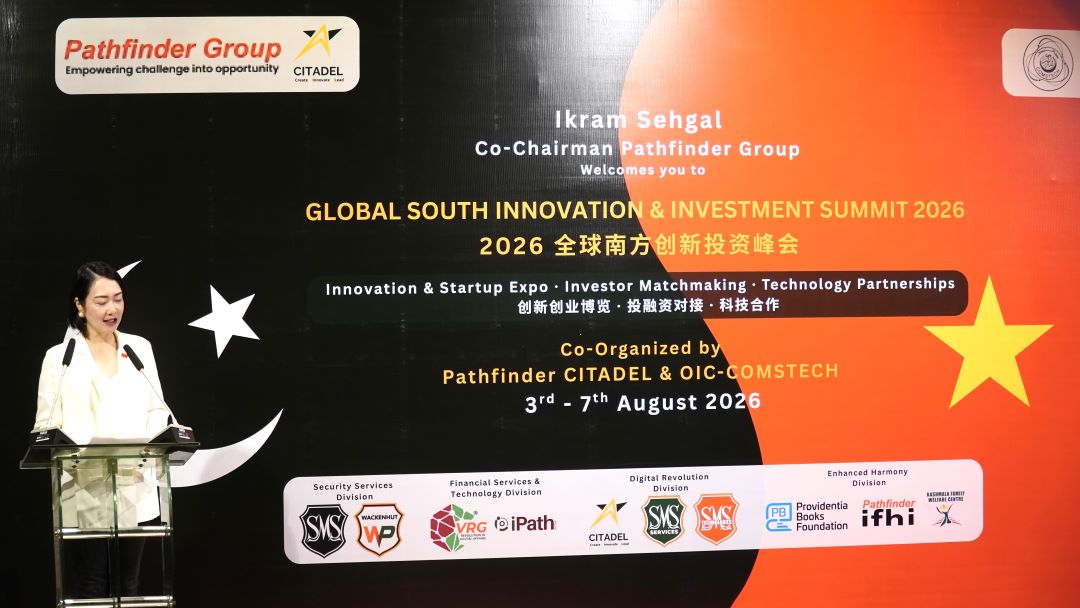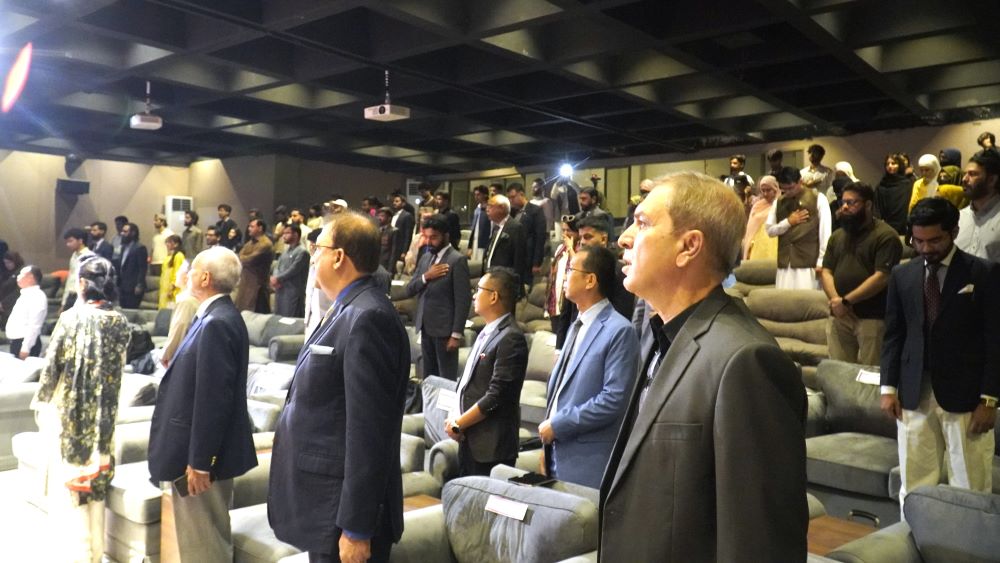






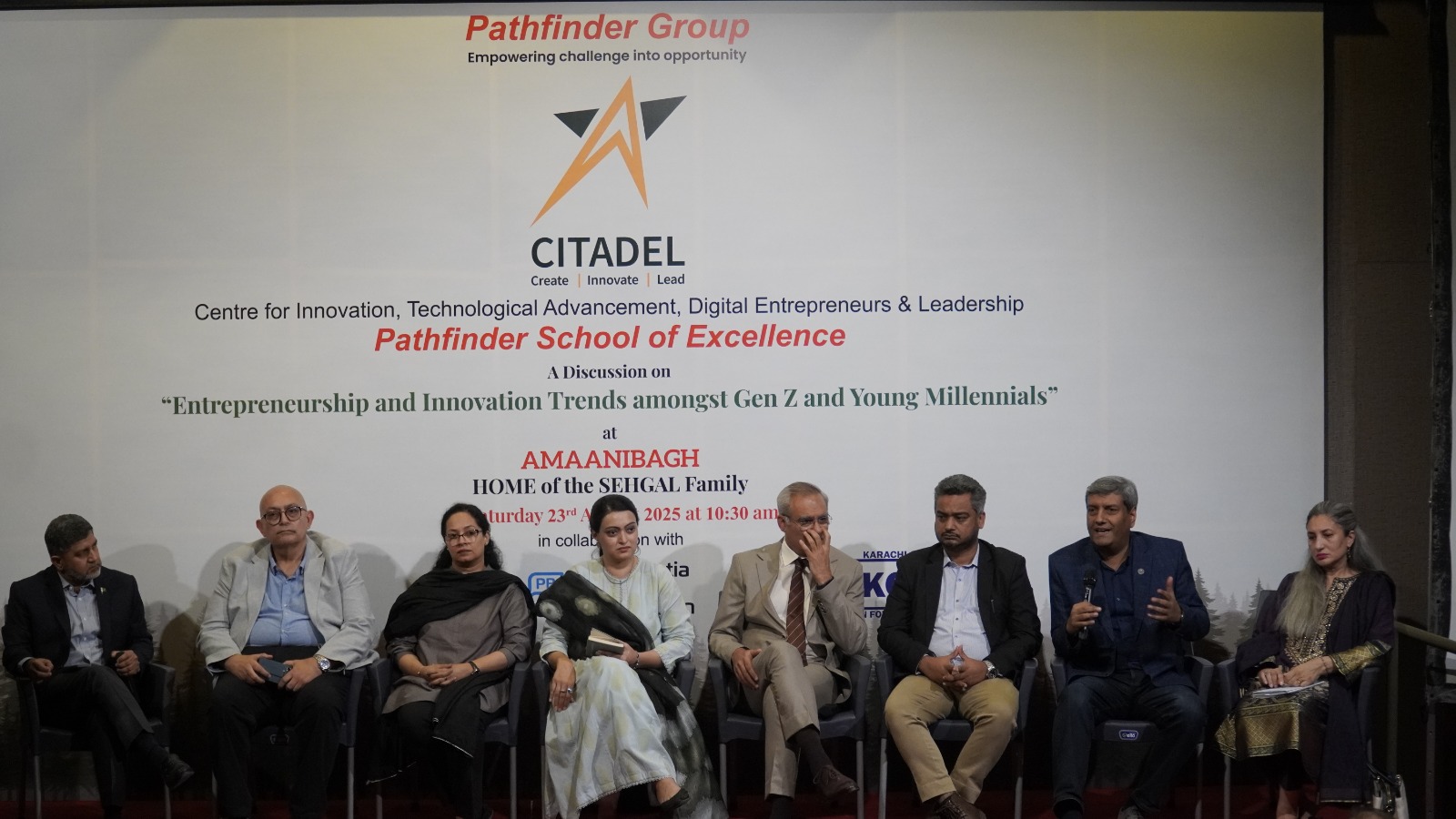
Pathfinder Group’s flagship initiative, “Centre for Innovation, Technological Advancement, Digital Entrepreneurs & Leadership (CITADEL)” organized an engaging discussion titled “Entrepreneurship and Innovation: Trends amongst Gen Z and Young Millennials” on August 23, 2025, from 10:00 a.m. to 3:00 p.m. at Amaanibagh Angoori, Islamabad. Supported by the Providentia Books Foundation (PBF) and the Karachi Council on Foreign Relations (KCFR), it brought together policymakers, academics, entrepreneurs, and students from leading institutions, including NUST, COMSATS University, Air University, Future World College (Roots), SZABIST, Quaid-i-Azam University, and Pakistan Global Institute (PGI). Many students participated in the panels as speakers, contributing their perspectives on the challenges and opportunities of entrepreneurship in Pakistan.
Sehrish Mustafa:
Pathfinder Group stands as Pakistan’s largest provider of integrated security services, employing approximately 12,000 individuals across over 75 cities and towns nationwide. The group’s security services division comprises the country’s two largest private security companies, Security & Management Services (SMS) and Wackenhut Pakistan Pvt Limited. Expanding beyond security, Pathfinder’s financial services division includes Virtual Remittance Gateway (VRG) and iPath, with additional related companies currently under incorporation.
The two significant initiatives that the Pathfinder Group has launched over the last month are CITADEL and the “Pathfinder Interfaith Harmony Initiative (PIHI).” CITADEL is a cutting-edge innovation center, and its purpose is built to bridge the skill gap, empower digital entrepreneurs, and cultivate transformative leadership positioned at the intersection of technology, education, and enterprise. CITADEL aims to become Pakistan’s premier Launchpad for innovation and impact.
Providentia Books Foundation is a nonprofit organization committed to promoting a passion for reading and learning among underprivileged children. The Foundation connects book donors with individuals seeking educational materials, facilitating the donation and distribution process, collaborating with publishers and other nonprofit organizations. Distributing books to schools in underserved communities, Providentia Books Foundation is aiming to bridge the literacy gap and empower children through education. In a brief period, 70,000 books have already been distributed across different cities and towns in Pakistan.
I would like to invite Air Commodore (Retd) Khalid Banuri for the opening remarks. A practitioner and scholar with diverse interests and experience, spread over 47 years in public service in six broad realms, including aviation, nuclear politics and arms controls, training, education, international law, and outreach, he has substantial experience in senior-level management, policy analysis, diplomacy, research, lecturing, and writing. In recognition of his outstanding contributions, the Government of Pakistan has honored him with two prestigious awards. The Sitara-e-Imtiaz (Star of Excellence) Civil, for “Excellence in Policy Analysis”, and the Sitara-e-Imtiaz (Star of Excellence) Military, for his dedicated services in the Pakistan Air Force.
Air Cdre (Retd) Khalid Banuri:
Bismillahir Rahmanir Raheem. Thank you, Pathfinder Group, for making all this happen, making CITADEL happen, and making this event happen. This is the fifth event in a row at Amaanibaagh, about young people. CITADEL, the Center for Innovation, Technological Advancement, Digital Entrepreneurs and Leadership, is the way or the path to the future is which we think this can lead to. This initiative, to my knowledge, is the first in Pakistan, entirely sponsored by the private sector. It is totally done out of the thought process of service to the nation.
This session today is about innovation and entrepreneurship. Those who know me have a sense that I usually come with structured remarks, but innovation demands that I should also go unstructured. And so I will give you some random thoughts on it before the people who are more knowledgeable on these subjects. In this very room or just outside it, some weeks ago, I met a young team of a brother and a sister. The young woman, a Gen Z, was very energetic about doing something for the future of her generation. She was passionate about interfaith harmony. Right next to her was her younger brother, quiet, very typically, the way Gen Alpha is, and standing there listening patiently and quietly. And I asked, “Can we do a dialogue between Gen Z and Gen Alpha?” And this woman, who was very objective about all of those things, kind of glanced at her brother and said, “Oh, him.” That is the problem with generations. We, the boomers, look at Gen Z or the millennials and say, ‘You guys need some fixing.’ We are here to find out that do they need fixing or are they really the agents of change as we perceive them? And that is the thought process with which we want to go about. The ideas, as they say, are the new black. You come up with a good idea, and can you translate it into something like this? I am now cautious that several of the university students represented in this audience today are primarily focusing on international relations and strategic studies. Very few pursue hardcore technical subjects. However, our primary audience is focused on technology and entrepreneurship. How does this gel? What gels in here is the notion of ideas. Can I come up with an idea that will work, and should I follow the existing norms, or can I approach it in an unstructured way?
This is something that we want to build on. If I’m a young person and I want to start a startup and become an entrepreneur. What should I focus on? Should I look at big companies and consider their successful models as the ones I need to follow? How can I differentiate myself? Am I willing to think outside the box and challenge conventional ideas, knowing that there’s a possibility of failure? Will I be prepared to improvise if things don’t go as planned? So, these are some of the questions that we need to consider randomly.
Let’s think of Tesla. They thought of manufacturing a fancy, beautiful car that would be different and innovative from other cars, and they said we would go to the best market and sell it to whoever we wanted to sell it to. The idea was to build a one-of-a-kind car, use that money to make a more usable and relatively cheaper model later on. And then came Elon Musk, who said, “Okay, let’s just sell some cars.” And they went out to California. They looked at people who had money. They also indicated that they are going to build an environmentally friendly car. This caught the attention of the masses, and people who heard them were convinced that they wanted a car of this kind in their porches, and that led to the selling of about 100 cars for $100,000 each by Tesla. And guess what? Without actually having a single car ready. But the promise that they could carry this out led them to that. And that hard cash of $10 million or so. They started this process, went on to do what they were claiming that they could do. Is this the model that we have? These are ideas about innovation. There are ideas about entrepreneurship.
Coming to today’s event plan, we will have two sessions. We will be asking some young people how they feel about innovation and entrepreneurship. This is our first time conducting this endeavor, and we aim to gather clear opinions from both Gen Z and Millennials. Let’s listen to their thoughts and continue our discussions. The conversation we started today should carry on. And let me end by saying something which Vladimir Lenin said many years ago. “There are decades when nothing happens, and there are weeks when decades happen.” Can we make that happen? Thank you very much.
Sehrish Mustafa:
The interaction between Gen Z and Gen Alpha will be interesting because Cambridge University just added 6,000 words, and they have included different slang words used by Gen Alpha, like ‘Delulu,’ ‘Skibidi,’ ‘Tradwife,’ ‘Sigma,’ ‘Lewk,’ and even ‘Mouse Jiggler.’ So, Gen Alpha has already started inventing things. They are innovative. They are innovating a language. So what should Gen Z and young Millennials do? They should innovate ideas, and they should innovate ways to materialize these ideas.
With that, I would like to invite Mr. Mustafa Mumtaz. He’s a co-founder and CEO of Doyam, a deep tech startup based in Germany, developing hardware and AI-powered solutions for advanced battery diagnostics and energy storage optimization. His focus is on real-time health insights for first-time and second-life battery applications to enhance battery performance and sustainability across the energy and electric vehicle sectors.
Mustafa Mumtaz:
Thank you, Sehrish, and thank you, everyone. I really love it when Mr Banuri calls himself a “boomer.” I think that’s wonderful because it sets such an open and friendly tone for a dialogue.
I was actually having a conversation with Khalid Banuri, and we were talking about the culture of innovation, especially in Pakistan. I was born here, I grew up here, and for the past nine years I’ve been living in Germany. But my heart still lies in Pakistan, and no matter where I go, I call myself a Pakistani.
Every time I come back, I ask myself: how are we doing as a country? I see so many young people with so much potential. But what I feel is missing is a true culture of innovation. Now, I’m not claiming to be an expert, but I’d like to share my thoughts and observations. I’ll highlight a few differences I’ve noticed between Germany, Europe, and Pakistan.
Of course, entrepreneurship is such a wide and complex topic that I can only point to certain ideas – hopefully in a way that sparks thought about where we can go. One question really stood out to me: Why are countries like Germany so innovative? It’s the third-largest economy in the world, and it has a deep culture of innovation. The level of technological advancement they’ve achieved is outstanding. So why are we lagging? Why, after 78 years, do we still not have a single unicorn company? That’s a question we need to ask ourselves. I don’t like to simply blame the system. Yes, it has challenges, but I think the younger generation, especially Gen Z, needs to think about the problems they can solve.
From my own experience in senior corporate roles, one of the biggest lessons I’ve learned is that successful nations and companies always look at the bigger picture. They plan not just for the next five years, but for the next 20, 30, even 50 years. And that’s something we lack in Pakistan.
I’ve noticed that Europe and North America excel at spotting emerging global trends, such as artificial intelligence, the energy transition, and the rapidly changing landscape of skills for the future of work. What we’re studying today might not even be relevant five or ten years from now. That’s why it’s so important for young people to think ahead: by the time they graduate, what skills will still matter? And with global dynamics shifting – geopolitics, defense, and technology – these areas are also driving innovation. My own startup is working in some of these spaces.
Now, Pakistan does face problems, but we also have strengths. More than half of our population is under 30. That’s a huge opportunity. We just need to understand how the world is changing and where we can fit in. Take China as an example: because of the one-child policy, their demographics are shifting, wages are going up, and Western countries are now looking to reduce their dependence on China. That opens doors for Pakistan. With our young workforce, our skills, and our strategic location, we can position ourselves to serve Asian, Middle Eastern, and African markets, the very regions that represent the future.
The key question is: how do we keep up? And that’s where entrepreneurship and innovation come in. Startups can’t survive without constant innovation. The world today is moving at such a fast pace. A few years ago, a new software model could give you a competitive edge for several years. Now, that edge might last only a few weeks, because with AI and rapid development, competitors can catch up almost instantly. That’s why I always tell young people: when you start a new venture, ask yourself, will this idea still be defensible as a business six months from now? One year? Five years? You have to keep innovating. Another thing I’ve learned on my own entrepreneurial journey is this: having a technical solution is not enough. The bigger question is, can you sell it? You might have a great, innovative idea, but if no one is willing to pay for it, you can’t succeed as a business. And that’s why I’d really emphasize: don’t limit yourself to Pakistan as your only market.
The world has become so small, and global markets are wide open. Technology and communication make it easier than ever to sell anywhere. In our own startup, for example, we focused on energy and defense technology. We worked on developing batteries, knowing that electric vehicles and renewable energy will eventually replace internal combustion engines.
Within that space, we saw opportunities in drones, both for civil and defense use. But the competition is tough. Even in Europe, we’re up against India and China. And honestly, we constantly struggle to keep pace with the speed of innovation.
That’s why, as a country, we need to create and promote a culture of innovation. And we need to support young people who are trying to build something new. Initiatives like this seminar are an important step; they give us a chance to reflect, to think collectively, and to push forward. That’s all from my side. Thank you.
Sehrish Mustafa:
We have 25 crore people, and out of them, 65% of our population is under 30. And we have hundreds of incubators and co-working spaces. It’s like we are sitting on a gold mine. But unless we invest in skills, technology, entrepreneurship, and creative industries, this youth bulge could turn from an opportunity into a burden.
That’s where CITADEL comes in. CITADEL aims to transform you into job creators, not job seekers. With that, I would like to introduce you to my cohost, Mariam Khan. She is a workplace behavior and organizational development strategist, executive coach, and founder of NeuroNurture, Pakistan’s first mindset and behavior change coaching and consultancy firm, with over 17 years of experience. She specializes in designing high-impact behavioral interventions to enhance workplace performance, engagement, and well-being. Mariam, the stage is all yours.
Mariam Khan:
Good morning and Assalamu Alaykum. Distinguished guests, respected speakers, panelists, and our promising young participants. A very warm welcome to all of you on behalf of Pathfinder’s CITADEL. It’s an absolute honor to have you all here today at this inspiring venue of AmaaniBaagh for a day filled with dialogue, innovation, and the spirit of entrepreneurship. Before I move on, I would like to quote Mr Mustafa Mumtaz on his words, “Why don’t we have a unicorn in Pakistan as yet? When I am managing people or handling the mindset and behavior change concerns of organizations, and when I’m speaking to their senior executives, one thing that I keep reminding them of is the fact that the most powerful way to shape our lives is to get ourselves to take action. One of the most challenging aspects of today’s generations, both Gen Z and Gen Alpha, is the fact that we are a lot in our own minds than outside of it. The more action-oriented we become, the better innovation can happen and will happen sooner. So, probably, that may be one of the ways or one of the reasons for not having a unicorn in Pakistan yet.
Our theme today, ‘Entrepreneurship and Innovation Trends Amongst Gen Z and Young Millennials’, reflects the pulse of the time. Of course, together we will explore ideas, share experiences, and most importantly, learn from the wisdom of our thought leaders and the creativity of our youth gathered here today. Before we begin with the panel discussions, we have a lot of good stuff planned for you. Let me get a quick show of hands. How many of you here see yourselves as future entrepreneurs? So many hands, Amazing. Okay. And how many are here to explore innovation in your own respective fields? I can see many raised hands, wonderful. We have a discussion planned on both. Do you know that about 170 million new jobs will be created by global macro trends this decade? That’s according to a new report from the World Economic Forum (WEF) that delves into the future of work over the next 5 years. Considering the radical technological development and advancement, the green transition, economic and demographic shifts, innovation too is being rewired.
Let’s explore this further, and also how to find and nurture innovative ideas in everyday life, in our first panel discussion on innovation and skills. This session will be moderated by Mr. Imran Jattala. He’s the Regional Director of OTS and an advisor to CITADEL. He’s the founder of the National Incubation Center for Aerospace Technology (NICAT) as well. He is an eminent figure in the global innovation landscape, recognized for his pioneering effort in establishing South Asia and the Middle East’s first aerospace and deep technology incubation center. He’s a passionate advocate for innovation and has been instrumental in leading large-scale innovation programs across Pakistan and in the MENA region.
I would like to invite our esteemed panelists now. First, we have Muazzam Arslan Bhatti. He is the Founder & CEO of Alfoze Technologies. Mr. Bhatti is a seasonal entrepreneur, an AI expert, a digital economy and Ed-tech expert as well. Additionally, he is the Founder and Chairman of Carbon Negative, a CSR initiative dedicated to promoting green initiatives and sustainability. Please, sir, I would like to invite you on stage.
We have Mr. Raza Ahmed Sukhera, Director at the Pakistan Software Export Board (PSEB). Mr Sukhera has been involved in numerous policy assignments at the Ministry of IT and Telecom, Government of Pakistan. With eight years of experience in policy initiatives and a total of 13 years of experience in both the public and private sectors, he has a strong understanding of the political and regulatory dynamics in Pakistan.
I would also like to invite the students from our great universities in Pakistan. We have Noman Mushtaq from Air University, Minahil Shahid from Quaid-i-Azam University. We have Azim from Shaheed Zulfikar Ali Bhutto Institute of Science and Technology (SZABIST), Omar Farooq from Future World College, and Muhammad Ayaan Zia from COMSATS University.
Imran Jattala Moderator, CITADEL
Assalamu Alaykum, everyone. So, what is innovation? What do you understand by innovation? What is your definition of innovation? Constant improvement. Innovation is creating value. Innovation is a meaningful arrangement of existing things. Innovation is different from invention. Invention is where you create something new, and innovation is where you create a new, meaningful arrangement and create value. So, the best example I can quote is about ‘Careem.’ So, the cars were there, the drivers were there, the riders were there. So they just created an app, and that app connected all three. So, they invented with zero resources, they created a new meaningful arrangement, and they created value.
Another very simple example can be that you buy fruits from the market and you extract juice from those fruits. You’ve created value. This is a very simple form of innovation. And the next step is entrepreneurship. So let’s say, in the market, there are 100 people selling juice with different brands, different names, and different shops. Can you create a brand? Can you create a Nestle out of juices? Can you continuously capture value? Creating value is one thing. Then you need to deliver value. And the third thing is capturing value. This is the complete value chain of innovation and entrepreneurship. You create value, you deliver value, and you capture value. So delivering and capturing are the most important parts of entrepreneurship. We’ll be covering that in the next panel. Creating value, innovation, and the skills you need to do that, we’ll probably be addressing in this session.
We are dealing with Gen Z and Gen Alpha. Those who know me know that I’m a millennial, so I always say I’m between the younger ones and the older ones. We are about to hold the torch and pass it on to the younger ones. And then we are in an excited position. We enjoy the lessons we learn from the older ones, and we’re helping the younger ones to take this country forward. At any age, the biggest asset of any nation is brain power. And Alhamdulillah, Pakistan is super blessed. 65% of the population is young. If we train them and give them the right skills, we can be a regional power or even a superpower. We have demonstrated that in May this year (War with India). We can showcase this in every dimension. We pick, we decide, and we put effort into that.
One of my panelists, Muazzam Arslan Bhatti, leads an Ed-Tech company. He powers a lot of universities in Pakistan; almost 40 to 50 universities across Pakistan are powered by the systems developed by him. He deals with youth. So, Muazzam, what’s your take on innovation?
Muazzam Arslan Bhatti CEO, Alfoze Technologies
Thank you, Imran Bhai. I’d like to add something to your first question, when you asked what exactly innovation is. I think you’ve already explained it very well, but let me share a simple perspective. Often, when we hear the word “innovation,” we think of complex systems – cybersecurity, artificial intelligence, and advanced technologies. And if you Google it, those are probably the images you’ll see. But innovation doesn’t always have to be that complex. As long as you’re adding value – whether by reducing time, lowering cost, improving quality, or creating a new channel – you’re innovating.
Let me give you the simplest example: sticky notes. All of us have used them at some point, during our studies or work. At the end of the day, it’s just a small piece of paper with a bit of glue. No transistors, no electronics, no power, just a piece of paper that sticks lightly. It’s not too sticky, so you can paste it on a wall and remove it easily. And that was the real beauty. Interestingly, 3M invented it by accident. They were actually trying to create a stronger glue, but couldn’t. Instead of discarding it, they realized it had a completely new use case, something as simple as taking notes and sticking them temporarily. That small idea became a global product that has been around for 40–50 years now. Why? Because it solved a simple problem.
Another classic example is ride-hailing services, or even the EasyPaisa system. The problems already existed, but innovators used an existing channel, the mobile phone, the smartphone, to solve them. That’s all innovation is: finding smarter ways to address everyday challenges. So, to all the youngsters here: when you think about innovation, don’t only think about AI or advanced technologies. Look around you. You’ll find hundreds, even thousands, of problems waiting for solutions. Take floods, for example.
In recent years, we’ve heard more and more about flash floods and cloudbursts, terms many of us didn’t even know before. Now, the question is: how can we create smart ways to warn people earlier? How can we spread awareness? How can we equip communities with survival skills? These are practical challenges that innovation can address.
And here’s the key point: we are living in a time that goes beyond simple automation. With the largest segment of our society being youth, we need to rethink our approach. Instead of just graduating with a degree, students must also leave universities equipped with relevant, practical skills, skills aligned with emerging trends, and skills that solve real problems. Because when you have those skills, you’re not just looking for jobs, you’re creating them. You become problem solvers, entrepreneurs, innovators. And honestly, this is a huge change I’ve observed over the past 10–15 years. Back then, when I spoke with graduates, most of them would simply say, “I want to join this company or that company.” But now, when I talk to young people, I hear something very different: “I can use this technology to solve this problem.” That’s a massive shift in mindset, and it’s extremely encouraging. What we need to do now, everyone who has the capacity or the position to help, is to channel this energy and creativity in the right direction. Our youth are not just the future; they are our hope. Thank you.
Imran Jattala:
I want to hear from the students in the panel, the Gen Z. We want to listen to you. What’s your take on innovation?
Muhammad Ayaan Zia, (COMSATS)
Thank you very much. Basically, innovation starts with curiosity. It’s a process where, first, you identify a problem, and then you figure out a way to solve it. That’s the very first step in creating something new. Innovation can give you a competitive edge, it can solve a problem in your daily life, or it can simply make a process easier. And it doesn’t always have to be something big or complex. Innovation can apply to the simplest of tasks, or it can address the most complicated challenges.
The key is curiosity. When you’re curious, you notice gaps, you notice loopholes, and you see opportunities where innovation is needed. If you look at the evolution of humankind, it was always curiosity that led to progress. People faced problems, came up with solutions, and those solutions pushed society forward. Each step of curiosity and innovation led to more advancement in technology and human development. If we are where we are today, it’s all because of innovation and our curious minds. As humans, we are made that way.
Noman Mushtaq, (Air University)
Thank you. Innovation is a very interesting phenomenon in our daily lives. As human beings, we’re given a limited period of time to live. Within this time, we have limited health, limited energy, and limited resources. Nothing lasts forever. So in this short span of life, with limited resources, we need to find solutions to our challenges in ways that help us save time, conserve effort, and do more with less.
Let me give you a simple example. There was a time when we all had to carry calculators, cameras, and many other devices separately. Each had its own space and its own use. But with the blessing of innovation, all those tools have now been brought together into one small device, our mobile phone. That is innovation.
Alhamdulillah, it is truly a blessing for humankind that we’ve been given a brain capable of innovation. With it, we can create solutions that make life easier and more productive, not just for ourselves but for all of humanity. Thank you.
Azim, (SZABIST)
My perspective on innovation is that human evolution and innovation go hand in hand, because innovation is really about experience. If we look at history, many giant businesses that failed to innovate eventually collapsed. A prime example is Nokia. It was once one of the biggest brands in the telecommunications industry. Their focus remained on hardware, but when Android came, they failed to adapt. They didn’t bring innovative ideas into an increasingly competitive market. They already had the market space, yet they fell behind simply because they lacked innovation.
On the other hand, their competitors who embraced innovation survived and thrived. This shows that experience and innovation must always go hand in hand. In Pakistan, there are many phases of innovation that still need work. But at least today, we are talking about innovation, and that itself is a start. As we move into the next phases, there is wide room for progress. Innovation can help us grow as a society and also provide better experiences for our businesses. Thank you.
Imran Jattala:
So, if I can just summarize what the three of you have said, first, curiosity is the beginning of innovation, and second, innovation is a continuous process. You may become a giant like Nokia, but if you stop innovating, you fade away. That’s why innovation is not a one-time event; it’s a continuous journey.
Now, since I’ve been told we’re short on time, let me quickly take up two important questions. The first one is about community problems. Just think for a moment, the problems you face in your community, in your street, in your school, or even in your social circle. The real question is: how can we solve those problems using social media?
Unfortunately, as a nation, we spend most of our energy discussing politics. Now, of course, there are dedicated people for that, but we, as members of civil society, have another responsibility. And that is to focus on solving social problems.
So, when you think about the issues you face daily, whether it’s in your street, your locality, your town, your school, or your college, the challenge is: how can we use social media as a tool to bring solutions to those problems?
Omar Farooq (Future World College)
Okay, so first of all, I’m going to address my Gen Z audience. Innovation is not just about building big things, it’s about adding value to the most ordinary things we already have. Even a small step in society can create a huge impact. That’s the essence of innovation, small steps that help society move forward.
Now, let me give you a simple example. Right here, in this hall where we’re sitting, we have projectors. A few years back, these projectors weren’t here. And now, look how much they are facilitating us, making things simpler, saving time. Imagine, instead, if someone were standing at the board with chalk, writing everything down. Would that save time? No. Would that save resources? No. In fact, we’d probably need an extra worker just for that.
So, what I mean is, innovation doesn’t always have to be something massive; it can come in many different ways. Take another example: in 2019, Pfizer used a new technology – mRNA. And that technology helped millions of people. A vaccine that normally would take 10 years to develop was created in less than one year. That is innovation, and that’s how it transforms our lives. Thank you.
Minahil Shahid (Quaid-i-Azam University)
This is Minahil Shahid. Instead of defining innovation in technical terms, I want to draw your attention to a very real issue we face as a generation: unemployment. Now, we’ve been thinking about this problem a lot, and I’d like to share two innovative solutions with you.
The first one is what we call a micro-internship marketplace. These will be short, paid projects, two to four weeks long. Because let’s be honest, when we graduate, what do employers want? They want two years of experience and two research articles published in HEC-recognized journals. But how can a fresh graduate do that? I can’t work on a twenty-thousand-rupee job after spending eight lakh rupees on my degree. That’s just not sustainable.
So how do we solve this? Through real projects. We can start an app, like a mini-LinkedIn, or even just Facebook groups at the beginning, where companies and organizations post small projects, coding tasks, policy briefs, services, and undergraduates from their 4th to 8th semester can apply. They pay a very minimal amount, complete these tasks, and in return, they gain real-life work experience. That experience counts because it’s practical, not theoretical. The second solution is creating campus-based Shark Tanks. Just imagine, students pitch their ideas, and small business owners, policymakers, and even investors come and buy those ideas for anywhere between fifty thousand to two lakh rupees. This way, students not only get exposure but also get funding to start something of their own.
Let me give you an example from my own life. I love to cook. I cook really good food, and my friends can vouch for that. Imagine I pitch an idea where I host a small gathering for 10 to 15 people on my house rooftop, beautifully decorated. It’s a cozy socializing environment. People register through social media, pay four to five thousand rupees each, and get a four- to five-course meal, along with live music.
For instance, one of my friends is a guitarist, my sister is a social media manager, and I would obviously need a team to run this smoothly. So not only am I earning, but I’m also creating jobs for others.Now, yes, there is a challenge about security. I cannot just invite strangers to my home without proper verification. But this is just one example. There can be countless more, like a strategy simulation app, a crisis management app, or other innovative platforms that we can work on within our departments. So at the end of the day, what I want to say is, innovation is not always about technology, it’s about finding creative solutions to real problems like unemployment. That’s the idea from our team at Quaid-i-Azam University. Thank you.
Imran Jattala: Now we’re moving to the last panelist, Mr Raza Ahmed Sukhera. He heads one of the largest training programs in Pakistan at the Pakistan Software Export Board. Sir, you just heard these young voices, talking about innovation, about skills, about opportunities, and challenges. You, on the other hand, have perhaps the best data on how our youth are being trained, and more importantly, you’re already building plans for the future workforce of Pakistan. So I’d like to hear from you, what’s your take on this? Where do you see the gaps, and how do you think we can bridge them?
Raza Ahmed Sukhera (Pakistan Software Export Board)
Sure, thank you. I’ll try to wrap this up and connect it to what my fellow panelists have said about innovation, workforce, and the ongoing projects that need alignment with our future needs as a country of 240 million people. Let me first highlight the bigger challenge we face. Every year, about 75,000 IT graduates enter the market, 45,000 from accredited programs and 30,000 from non-accredited ones. But if you broaden the view, another 700,000 to 800,000 non-IT graduates are also added annually. So the question is: how do we close this massive gap between the skills they bring and the jobs the economy actually needs? I was recently going through the World Economic Forum’s Future of Jobs Report 2024, and the numbers are fascinating. The report says that because of AI, around 180 million new jobs will be created globally. Yes, some 70 million jobs will disappear, and about 80–90 million will be redefined. But the point is, it’s not simply “AI will take away jobs.” It’s about which of these new or redesigned roles Pakistan’s 800,000 graduates each year will actually be ready to take on. That’s the real challenge. We’ve been engaging with different stakeholders, CPEC teams in China, GCC countries like Qatar and Kuwait, and, of course, the Higher Education Commission (HEC). Just last night, I was in a private sitting with the outgoing HEC Chairman, Dr. Mukhtar, where we discussed the importance of embedding real projects into degree programs, just like Minahil mentioned earlier. Because scalability and employability must go hand in hand.
Look at Sri Lanka: 97% of their computing graduates are employed on “day zero.” Compare that to Pakistan, where the industry tells us not more than 10% are immediately employable. The other 90% require an additional six to eight months of training to bridge the gap. So what needs to change? One key shift is in the cross-tech combinations students opt for. If I’m a student in Fintech, Agri-tech, or Health-tech, I need to make that choice in my first or second semester. And equally, if I’m pursuing a BS in agriculture or health
sciences, I also need to pair it with some technology track. That’s how we can build a truly innovative workforce, by making tech an essential layer, not a separate silo. Now, let me also touch on Pakistan’s unique growth story. Unlike many countries where big firms led IT exports, our growth has been organic through freelancing and SMEs. We’ve seen remarkable cases, a student in a third-tier city becoming the world’s top freelancer in API integration on Upwork, then building a small ecosystem around him. That’s inspiring, but it also shaped a short-term mindset, easy money, limited patience, and less focus on scaling products.
Here’s another concern:
57% of our IT exports go to the US, and 90–95% of that is services. Very few Pakistani companies are in the products. With AI disrupting everything, the challenge now is whether we can make the long-term shift from services to products. Because as long as we remain in the second, third, or fourth tier of service provision, we won’t build durable global competitiveness.
But here’s the opportunity: with AI, the playing field has been reset. Everyone, everywhere, is back to ground zero. Yes, we missed the wave of 1980s industrialization. We missed several emerging tech waves. But with this AI disruption, we stand at the same starting line as Sri Lanka, as India, as everyone else. A Pakistani graduate today has the same chance as any graduate globally, if we prepare them right.
So to conclude: our biggest challenge is mindset. We must build patience, adaptability, and the courage to invest in products, not just services. We are running one of the largest training programs in Pakistan, and we’re working hard to align funding, policy, and training models with the future of jobs. But the real test will be: can we turn this massive youth population into a flexible, innovative workforce ready for the AI era? That’s where the future lies.
Imran Jattala:
So, thank you very much, Mr Raza, for elaborating for us, and especially for the young people, what is needed in this innovation economy, or in the age of AI. There is nothing to be scared of. As Raza Bhai just said, 180 million new jobs are expected to be created. Many people fear they will end up losing jobs, but in reality, AI has reset everything.
All of us, all global economies, are now at the zero line. Whoever sprints ahead now and builds AI talent can win this race. There is equal opportunity for someone sitting in Bahawalnagar, someone in Quetta, or someone up north. With just a working mind and a functional laptop, you can tap into global markets. AI is truly an age of opportunity for you.
This era is meant to empower you, not to frighten you. With your skills, your spark, and your energy, we are really proud that Pakistan is heading toward a bright future.
Question & Answer Session
Air Cdre (Retd) Khalid Banuri:
My question to the panel is this: If you come up with a new idea, and perhaps that idea hasn’t yet been tested, do you want me to invest in it? I mean, I need to be convinced before I decide to invest. Is there a way to present a new idea and make it convincing enough?
Imran Jattala: I would say that trying new ideas, I am all for it. As an innovation consultant, I believe that is where the real magic of innovation lies. Since emerging economies lack resources, we should not focus on the path of pure inventions. That is where developed economies excel. For us, innovation that works within resource constraints is more suitable. There is still a lot of potential, much “magic,” to be unlocked in the innovation space. Let’s focus on that. By creating new arrangements, new ideas will naturally emerge, and we can test those as well.
Question from the Audience: If you have a functional laptop and live anywhere in Pakistan, you can, in theory, reach out to the global market and start earning through entrepreneurship. But I would respectfully disagree. I know people in Balochistan who have great ideas and want to make a living out of them, but they have absolutely no internet access. For example, I have a friend from the School of Politics and International Relations at QAU, Islamabad. He is from Rajanpur, and he once shared his idea with me. He wanted to design a machine for the Pakistan Cricket Board. The purpose of the machine was to measure the speed of the bat at the exact moment a batsman hits the ball. It was a brilliant idea, but he did not have the facilities in his hometown to turn that idea into practical work.
Raza Ahmed Sukhera:
I think we cannot truly achieve innovation unless we unleash everything to its full potential. And just to second your point, the thought process cannot be a regulatory one. It cannot be restrictive; it cannot lack the very essence of creativity that you mentioned. If we want real innovation, we need to understand that the problem lies in opportunity loss.
We once had a very meaningful discussion with Dr. Mukhtar, the former Chairman of HEC, who served multiple tenures. We asked him candidly to share his views, and the punch line was this: the real challenge is whether decision-makers can understand the kind of thought process you have in your question, or the kind of thought process your friend in Balochistan has.
If governance and decision-making are not aligned with such ideas, then everything else is in vain, all the resources, all the decisions, the long meetings, and even the weekend work. The answer lies in aligning the thought process with what you are saying.
Omar Farooq:
You talked about internet facilities, and you also mentioned freelancing. Let me share my story. I am currently 16 years old, and I am from Quetta. I was 13 when I first started using the internet. At that time, I wanted to do graphic design on Upwork and Fiverr, but it was expensive. So instead, I began making YouTube videos and creating my own content using the internet. Now, if we talk about internet facilities there, yes, they are limited, but it’s not true that there is no internet at all. When I was 14, I started getting clients simply by posting YouTube videos and sharing my work on Twitter.
Just last year, four companies from the US contacted me. What I want to say is that yes, there are limitations, but you have to work hard and push yourself out of your comfort zone to succeed.
Imran Jattala:
See, the challenges are there; nothing is perfect. We acknowledge that the challenges of remote areas exist, and we also acknowledge that we are not there yet; the situation is not ideal. But the good thing is that we are discussing it, and the good thing is that you are highlighting it. InshaAllah, we are moving in the right direction.
Mariam Khan: We are running short of time, so I would like to close this panel discussion with a key thought. There are many takeaways from today’s discussion, but one very important one is this: we are living in the age of digital nomads, in the age of AI. There are countless opportunities before us—we just need to have the right mindset to see them, perceive them, realize them, and make use of them. Of course, curiosity must be there, and we already have a thriving community of freelancers.
But one very important factor is employability. The skills we have today may not remain relevant over the next five years, or even sooner. That means we need to create employability faster, by acquiring new skills that are more relevant to the market, the job environment, and the future of work.
Thank you so much to our esteemed panelists and to the students for a wonderful, enriching, and exhilarating discussion on innovation. Thank you.
I would like to call upon the stage, Mr. Kim Kyoung Eun, Vice Chancellor of Pakistan Global Institute. It is the first South Korean institute in Pakistan. Please, sir, that stage is yours.
Kim Kyoung Eun (Vice Chancellor of Pakistan Global Institute) Good morning, everyone. I would like to thank Mr. Ikram Sehgal for giving me this opportunity to speak to all of you. Thank you, Sir. I will talk about South Korea in five minutes and then close this discussion. (Mr Kim spoke in Urdu; translation in English is as follows)
I have been in Pakistan for the last 17 years, so my Urdu is not very good, and I apologize for that. I hope you will understand me. Today, we are talking about innovation and entrepreneurship. Let me say this: you all have smartphones, right? Download ChatGPT and ask it, “What is innovation?” Three years ago, Dr Ahsan Iqbal, during a talk, said that Pakistan makes excellent plans but fails to implement them. The IMF gave similar plans to Egypt, and its government implemented them successfully. There is blessing in action.
I cannot say much about innovation in Pakistan, but let me tell you about the innovation the world has seen in the last 45 years. Back in 1980, there was not much difference between South Korea and Pakistan. In fact, Pakistan was ahead. Quaid-e-Azam said: Work, work, and work. People sometimes joke that he didn’t mention where to work. Our ancestors worked hard every morning after waking up, but unfortunately, we did not channel that effort properly.
Recently, our President, while addressing the nation, said that South Korea will become the world’s fifth-largest economy in the next eight years. In the field of AI, the U.S. is number one, China is number two, and South Korea is number three. I do not want to praise my own country, but let us see: in 1980, Bill Gates introduced Windows. I would say he gave the world a “window” to see through. In the 1990s came email, then the Internet revolution, and more recently, COVID-19, which brought the world even closer. Now, think about the smartphones in our hands and pockets today. How do they help us? They are the best professors; they carry the best information. People come to me and ask how to prepare a 4–5 day program for an event. I tell them not to spend so much time; instead, I say, ask AI. It’s your secretary; it will guide you in the shortest time. In South Korea, every company has already recognized the changes that AI has brought. Let me explain simply: when I first came here 17 years ago, I used to carry thousands of dollars with me. Today, I only need an ATM card and maybe 100 dollars. In fact, even the ATM card is no longer necessary; the smartphone does it all. It carries Starbucks coupons, Uber, and mobile payments. For example, at Dubai Airport on my way here, I used my phone to pay. That’s how simple life has become. In my country, within just six years, we built high-speed bullet trains from Seoul to Busan, a distance similar to Islamabad to Lahore. The journey takes only 2 hours. Imagine that! The world is changing at this speed. Take drone technology as another example.
Last May, I was in the U.S., and a Harvard professor said: AI is also transforming higher education. A professor can give his face and voice to AI software, and within 2–3 days, a complete lecture is generated for anyone to watch and learn from. I often talk to the Chairman of HEC about this. Today, AI can even produce entire books. Let me give another example from South Korea. In the 1980s, Samsung was not a famous company. In 1983, its founder gathered all his employees and said, “Except for your wife and children, change everything.” And that is exactly what they did, and they changed the world. If you compromise on quality, you cannot make an impactful change. But if you don’t compromise, you will surely succeed. When we were constructing our university campus, I told the cleaners, “Your competition is the cleanliness of the Marriott Hotel and the Serena Hotel. I will not compromise on cleanliness or discipline.” I even promised them a stay at the Marriott Hotel after one year for keeping the standards of cleaning. Today, there is no garbage anywhere on my campus. That is why I always remind people of what the founder of Samsung said: “Change everything, except your wife and children.” That is the true beginning of innovation.
In the 1970s, South Korea could not build a single ship domestically; we lacked both money and technology. Today, Hyundai is the world’s number one shipbuilding company. That is the kind of change I am talking about. Similarly, KIA Motors is now a leading automobile company after Hyundai. They sold 5000 units of the KIA Sportage Car in Pakistan alone last year. When I asked them how they did it, they said: “Through integrity and honesty, we succeeded.” That is why I say, in the era of AI, your humanity, integrity, and honesty must be strong. Without them, innovation can become destructive. Thank you very much
Second Session – Entrepreneurship
Mariam Khan:
Before we start this discussion on entrepreneurship, I would like to share a fact: In the second quarter of 2025, Pakistani startups raised an impressive $60.2 million in funding, surpassing the total investments of the entire 2024 fiscal year. Notably, fintech led the charge, drawing in $52 million, which accounts for 86.3% of the total funding that quarter. With this exciting fact, let’s begin our Entrepreneurship Panel Discussion. The idea behind this discussion is to focus on the foundational principles of turning an idea into a business. We all have ideas, but not all ideas are linked with business acumen, and that’s exactly what we aim to discuss today.
This session will be moderated by Air Commodore (Retd) Farhan Ahmed, Deputy Director General of Corporate and Commercial at the National Aerospace Science and Technology Park (NASTP). He has served for 32 years in the Pakistan Air Force and is currently the Managing Partner of Innovator Garage International. He has worked and trained abroad with officers of advanced air forces such as the USAF, PLAAF (China), Sweden, Japan, Malaysia, and the UAE. He brings with him extensive experience in the formulation of test protocols, evaluation of equipment, human resources, and the establishment of new directorates and squadrons. We also have an excellent lineup of panelists today, Chaudhary Waseem Fazal, Founder of AKSA-SDS, with over 23 years of experience in the technology industry. He is a visionary leader, innovator, and entrepreneur who has reshaped Pakistan’s tech landscape through digital transformation. Dr. Imran Akhtar, Professor at NUST, has led entrepreneurship and training at EME College, NUST, with 20+ years of experience in entrepreneurship. Ahad Nazir, Associate Research Fellow at the Sustainable Development Policy Institute (SDPI). With over 8 years of experience, he has led initiatives driving digital transformation and regulatory reforms to foster sustainable economic growth, with a focus on Pakistan’s business climate through tools like the Business Climate Investment Index. Alongside them, we are privileged to have promising youth voices joining us on this panel: Adil Azimi from Air University, Tehreem Fatima from Quaid-e-Azam University, Qirat from SZABIST, Mahrukh Nasir from Future World College, and Saira Tariq from COMSATS.
Air Cdre (Retd) Farhan (Moderator/ Project Director, CITADEL)
Aslam-o-Alaikum, ladies and gentlemen. I formally welcome all the panelists and the audience here on behalf of Pathfinder Group & CITADEL. When we talk about entrepreneurship, I sometimes wonder why it feels like such a daunting word in itself. At times, it creates fear, haunts, and even scares so many young people who genuinely wish to tread on this path. Perhaps it is because of the longer steps, lengthy definitions, or complex jargon often associated with entrepreneurship.
But as I understand it in a nutshell, entrepreneurship is the commercialization of an idea. How effective and how fast you do it, and how well it aligns with the market, is what defines entrepreneurship. As our discussion grows, and as we speak about Gen Z, Gen Alpha, and Millennials, one thing has become very clear to me. For years, we have heard the phrase, “Pakistan has potential.” But with this generation, there is an important addition: they not only have potential, but they also have determination. From my interactions with Gen Z in particular, I have realized that they are actually doers. They practically believe in doing and accomplishing something, which is why the culture of entrepreneurship is much more prevalent among them compared to previous generations.
Before delving further into the discussion, I would like to request one of our panelists to initially define entrepreneurship and provide a pathway for our young minds to step into this field. What are the impediments? What are the challenges they are likely to face if they choose this path? And, most importantly, how easy or how difficult is it to venture into this journey?
Ch Waseem Fazal (Co-Founder, AKSA-SDS)
Entrepreneurship is basically about bringing up or starting a new and innovative idea or a business model. The most important factor is market research, understanding where and how we are supposed to deploy that idea. In Pakistan, the main reason for business failures is that the ideas we try to implement often do not generate the required finances.
First, we need to evaluate whether the idea we are implementing has market demand or not. Along with that, we must also understand how to make the idea sustainable in the market and ensure that it generates revenue. Speaking from my own experience, I have spent 20–25 years starting many entrepreneurial ventures. But without proper market research, I faced several failures, and eventually, some of those products had to be closed down. In my point of view, market research is essential. Only then can what we are trying to create also generate funds and achieve sustainability.
Air Cdre (Retd) Farhan:
This is where the newly coined term “thought leadership” comes into play. It means researching the market, identifying what is required, making a statement regarding that requirement, and then starting to work on it. Now, I would like to move on to the younger side of my panel. I would like to hear your views about the impediments and challenges you face once you embark on the journey of entrepreneurship or when you start your own startups.
Saira Tariq (COMSATS University)
Aslam-o-Alaikum, everyone. Thank you for having me. The topic of today’s discussion is Entrepreneurship. In my point of view, entrepreneurship is not just about running a business or making money; it’s actually a mindset. If you want something, create it. Don’t wait for someone to offer you a job or for a company to hire you. If you truly want it, you can make it happen. And if you have a skill, you are already an entrepreneur yourself.
For an entrepreneur, it’s not compulsory to own a letterhead, a registered company, or even a physical store. If you have a skill, you can turn it into a gig. Today, we have many platforms to showcase our skills, such as LinkedIn, Upwork, Fiverr, and many others, where you can find clients and earn money. Entrepreneurship is indeed a very diverse topic, but I’ve highlighted a few key points that I wanted to share. People nowadays are building mind-boggling businesses, and most of them are Gen Z or young millennials.
We have potential in our country. We have diversity in our country. I have seen many young people with innovative ideas. Unfortunately, we lack certain things in our education system, such as mentorship, guidance, and practical work. We are more focused on numbers. For example, students are often more focused on scoring 1193 marks in their 10th grade. While that is also important, once you step into the real market, skills matter far more. Gen Z loves to use trendy words like “Skibidi” or “Delulu.” But don’t you think words like Entrepreneur, CEO, and Founder are much cooler? Imagine being at a gathering and introducing yourself by saying, “I am the CEO of this company.” Isn’t that far more powerful and lasting than using words that change every other month?
I also want to highlight the role of social media. It plays a very important part in entrepreneurship today. You don’t need huge capital or big funding to get started; you can begin with a small amount. For instance, if someone wants to open a restaurant, it’s not necessary to start with a fancy, large place. One can begin with a small food cart and, with the help of social media, build it into a brand.
Take the example of Crumble. They have physical outlets, but their massive reach and popularity come from their content on Instagram. To quote one of our AVMs, who once said about the Rafale, I would say the same about social media: it is an equally potent platform. If used wisely and with focus, it can make something good, impactful, and cool at the same time.
My message is simple: Be independent. Be confident enough that when you go out with your family to a gathering, you can take out your own card and pay the bill. That is one of the proudest moments of life. Finally, I want to mention one of my teachers who is present here today. She is one of those mentors who once told me, “You have the potential.” She advised me to walk in with the attitude: “Yes, I am the Data Scientist. Ma’am, I may not know much about the data science part yet, but I assure you, I will make you proud with something else.
Qirat (SZABIST University)
Entrepreneurship is basically about creating opportunities, not just for yourself, but for others as well. It’s about starting a small business while keeping in mind the risk factors that always prevail. One of the biggest risk factors is the fear of failure. If someone wants to be an entrepreneur, they must be resilient and willing to learn from their failures. If I talk about myself, since childhood, I have been an artist. I loved doing art activities. When I got my first phone, I started exploring TikTok and came across the ribbon flower bouquet trend. Inspired by that, I started my own small business. Of course, there were many challenges, and the fear of failure was always there. But somehow, I managed to get some investment from my father, and from that business, I actually earned money. The purpose of sharing this with you all is simple: we all have potential. It’s just about taking the first step.
Air Cdre (Retd) Farhan:
I request that the next one focus on the challenges that you face while doing your own startups.
Adil Azimi (Air University)
Aslam-o-Alikum, everyone. If we focus on the failures and challenges that Gen Z faces in society while trying to establish themselves as entrepreneurs and develop their business ideas, several points come to mind. The first challenge is the fear of failure. This fear dominates their mindset, questions like “What if I fail? How will I cope with it?” But the truth is, failure is a part of the entrepreneurial journey. The ability to adapt, learn, and move forward should be the focus, not the fear of failing.
The second challenge is the culture of demotivation. Even before the journey begins, doubts arise: “Will this idea work? Am I capable enough? What if I’m not?” And these doubts don’t just come from competitors; they often come from society itself. Constant discouragement can trap young people in selfdoubt, stopping them from even trying to become entrepreneurs.
The third major challenge is financial capital. Creating capital for a business idea is never easy. Today, it is still as challenging as it was in the past. We are often taught to believe that our ideas won’t work or won’t bring change, which leads to the perception that we can’t create financial capital. But in reality, if people see potential in an idea, something that can transform society and generate profit, then capital does get generated. Sadly, this process often leads to demotivation and pushes people away from becoming job creators and instead forces them into being job seekers. Finally, I would like to highlight another significant barrier: bureaucratic hurdles. These include issues like taxation, compliance, and regulatory challenges.
To establish a business, one has to go through so many hurdles that people often give up, because it feels like “you have to give money to make money.” Even larger think tanks and policymakers have recognized this challenge, which is why initiatives like SIFC have been created to reduce bureaucratic obstacles. Yet, these hurdles remain one of the biggest challenges for entrepreneurs today.
Air Cdre (Retd) Farhan:
Before we continue with the discussion on Gen Z and young entrepreneurs, I would like to direct a question to our policymakers, those who have worked closely with regulators, been involved in policy-making, and have immense experience in this regard. Adil has already highlighted a few of the regulatory impediments that entrepreneurs face. I would like to ask: What are the other likely impediments that they encounter? What is the government currently doing about these issues, and what more should it be doing?
When addressing this, it is essential to keep in mind the mindset of Gen Z. They are fast-paced, they don’t like to wait, and they are natural doers. Compare this with the Baby Boomers and Gen X, who are actually in the decision-making seats today. The key question is: How do you carve out policies that not only align with the realities of today’s environment but also suit the fast, dynamic mindset of Gen Z?
Ahad Nazir (Associate Research Fellow, SDPI)
I would like to first of all thank AVM Asad Ikram, Air Cdre (Retd) Farhan, and Imran Jattala for allowing me to speak today. With regard to the regulatory environment, I have been working on it for the last nine years. During this time, I have worked with all the regulators. Unfortunately, it often feels like one step forward and two steps back. Yes, there have been some positive developments. For example, SECP’s registration portal now allows you to register your company within two hours, which is definitely a step in the right direction. But at the same time, there are still many issues, especially in terms of the regulator’s own understanding.
I would like to frame my argument by focusing on both the supply side and the demand side. On the supply side, the government is responsible for providing infrastructure. As one of our colleagues pointed out, the lack of internet connectivity in certain areas is a major barrier. The responsibility for this lies with the government. In fact, we are already paying for it. A portion of our payments to telecom service providers goes into the Universal Service Fund, which was originally developed to provide internet connectivity in remote areas. Unfortunately, that fund has not been used for its intended purpose. Instead, it has been diverted twice to pay off circular debt. That, in itself, reflects the priorities of the government and shows us how regulators are actually thinking.
The second aspect is taxation, which my colleague also alluded to. The main problem here is that regulators still treat every aspect of business as if it were goods. But services are not goods. This mindset needs to change. Currently, there is a large awareness-raising and capacity-building program being run at the FBR, and hopefully, this will extend to the provinces as well. The provinces, in fact, are relatively better because they focus specifically on sales tax on services. They at least understand what type of services need to be taxed.
At the federal level, however, we continue to face major challenges in explaining that services are fundamentally different from goods. Most of the startups that our young entrepreneurs are working on will be service-based. As was also pointed out by our colleague from PSB, this distinction is critical. If we go back to Public Policy 101, we see two recurring problems: Inconsistent policies. One department may give you a benefit, while another may tax you for the very same thing. Lack of coordination leads to tax fragmentation and even double taxation.
For example, if I want to work across Pakistan, I must register in all the provinces separately. This not only increases the cost of doing business but also creates the risk of being taxed multiple times for the same service. Ultimately, this makes the business case unviable. Finally, because of the overall accountability and transparency structure we have in place, one startup may be affected more than another. This creates unfair competition, which could be based on geography, income level, or other demographics. And this, going forward, remains a serious challenge for startups.
Tehreem Fatima (Quaid-i-Azam University)
I have to talk about entrepreneurship in this fast-changing world of Gen Z, where trends shift overnight. I won’t repeat the facts that have already been shared. Instead, I’ll bring something new. I believe the biggest problem today is that the start feels nearer, but the end feels farther. And by “end,” I don’t mean the collapse of a business or startup. I mean reaching the point of success, growth, and excellence. The journey from start to end is full of hurdles, and I want to highlight some of them. The first hurdle is saturation and overcrowding in one domain. Many people simply follow the blueprint of those before them and enter fields that are already overcrowded. For example, one person talked about her interest in making buns, and another talked about entering the food business. These are great ideas, but this shows how often we gravitate toward the same saturated spaces. This brings me to the second hurdle: lack of mentorship. Many people are misdirected because they don’t have proper guidance. The best businesses don’t come from copying others; they come from within. And by “within,” I mean recognizing the problems you face yourself, or the problems you see others facing. If you understand those problems, if you have an interest in solving them, and if you have the skills to act on them, then you can build a truly impactful idea. When you bring an idea to the market, it should have a unique niche. It should not just be a copypaste of what already exists. Your product or service must stand out and be superior in value. Another mistake is waiting too long for the perfect product. Many of us hold back, trying to perfect things instead of getting immediate feedback. What we should do is target our potential customers, validate our idea with them, and improve as we go. Then, there is the issue of funding gaps for Gen Z. Young people are often not trusted by their parents or elders. My own father is sitting here, and I want to say respectfully: we don’t want the traditional 9-to-5 jobs anymore. We want to try new things. We want to build something different. And for us, entrepreneurship is not just about profit-making. We want to mix profit with solving real-world problems like sustainability and inclusivity. We want to collaborate with other institutions, and we don’t see our peers as competition. We see them as potential partners. I believe our nature as Gen Z is perfectly suited for today’s fast-changing world.
Mahrukh Nasir (Future World College)
Asslam-o-Alikum, everyone. In my point of view, an entrepreneur is not just a CEO or someone who does business. An entrepreneur is a person who takes the bold initiative to work for what they want without asking anyone for permission. However, in Pakistan, when we focus on the challenges, I would highlight two major issues that we face. First, we have created a stereotype that when you are young, you are “not supposed to be right about things.” The assumption is that young minds don’t work that way or don’t have the maturity to contribute. But when we think like this, what are we actually doing? We are alienating young people who have so many ideas and so much to contribute. Simply because of their age, we push them aside and neglect their potential.
Second, I want to talk about gender discrimination. We live in a very male-dominated society. The stereotype around women is that they must either choose to work or choose to focus on family, as if they cannot do both. This mindset has prevented many extremely capable women from contributing to the economy. Whether it’s cooking, sewing, or even small-scale hobbies, these skills can add value to our economy. They can contribute to our GDP and play a role in boosting our nation forward.
When we deny women the right to pursue their interests and use their skills, we are not just holding them back; we are collectively failing as a nation. Because we are not allowing every individual to contribute in the way they are capable of.
Air Cdre (Retd) Farhan:
So far, we have understood that these young minds, Gen Z, badly need their freedom. They are totally averse to the traditional 9-to-5 slavery. They are not followers; they are leaders. So let’s respect them for that. Now, I would like to request another panelist, someone who has immense experience in entrepreneurship, training, understanding Gen Z, and academics. He has listened to them, has heard their problems, and some of the challenges they face. My question to you is: How do they navigate through these challenges? How do they overcome the feelings of restriction and limitation that they currently have? And further, what can the Millennials, Gen X, and Baby Boomers do to give them the kind of initiative and freedom they so badly require? Because I truly believe they have ideas, and not just ideas, but brilliant ideas.
Dr Imran Akhtar (Professor NUST)
First of all, I would think of myself as the odd man out. My grandfather was in government service, my father was also in government service, and I myself have been in government service. And yet, here I am sitting and talking about entrepreneurship.
However, I would add to that, I had the opportunity of spending almost 10 years doing my PhD, starting somewhere in 2005. During that time, there was an institute that was created: ICTAS, the Institute for Critical Technologies and Applied Sciences. What I saw there, in front of my eyes, was how technology was transformed into spin-off startups, and how products started coming into the market. The kind of research we used to do in the lab actually ended up becoming excellent products. That was my training ground.
Somewhere around 2010–2011, I came back and joined NUST. I really felt that entrepreneurship is a function of space and time. I know I’m talking a little bit of science here, but it’s important: things that might be useful in the U.S. may not be useful here, and things that might be useful here may have no relevance in other parts of the world.
Let me give you an example. A friend’s nephew created a huge startup, and now he’s doing very well with solar power chargers in Africa. If you take that same solar charger idea and pitch it somewhere in Stanford, the response would be: “Thank you very much.” That’s the importance of space and time. When I came back and joined NUST, I really felt there was a missing link. Our youth and their success stories were disconnected. I would strongly recommend a book that I have read, “Startup Nation.” It’s about Israel. I would urge especially the youngsters: please read it, at least once. It’s 500–600 pages, but the lessons are extremely powerful. In fact, that book became the motivation for certain trainings which we started conducting at NUST.
Now, if I summarize, that book had two key components:
1. Military training. Their Unit 8200 was an elite intelligence unit that produced the maximum number of entrepreneurs and startup founders. Why? Because of the kind of training they received, it allowed them to take on any stress level. That’s why we designed a training called the Stress Capital Workshop. Stress is usually seen as negative, but you can actually capitalize on it. It was a 72-hour non-stop workshop, no sleep at all, with only three missions in mind:
• Intellect. We gave them an eight-hour written exam.
• Creativity. Students and participants made cartoons, wrote poetry, did calligraphy, different creative expressions.
• Endurance. We even saw a PSO officer crawling under a tank.
All of these blended to create an environment where your neurons fired the right way. That was the lesson: military-style training under stress produces resilience.
2. Immigration. Israel calls itself a nation of immigrants. Many of their entrepreneurs, or their parents, had migrated from other parts of the world. We often hear stories of someone landing at New York airport with only $100 in their pocket and, in ten years, becoming a huge success.
If I bring this to our own context, I’d say: look at the people who migrated and settled in Karachi. They have some of the best entrepreneurial stories to tell in Pakistan. Because again, this is about space and time, you risk your money, you risk your time. So, these were the two important lessons from that book which I would highlight: stress as capital, and the power of migration. I strongly recommend the book Startup Nation. Please go through it; it’s an excellent starting point for all of you.
Air Cdre (Retd) Farhan: Well, another aspect that the young Gen Z has highlighted is the fear of failure, whether in making a startup or taking that leap forward. To me, it’s not that big leaders don’t fail, or that they don’t face problems while carrying out a mission or a job. The difference between a good leader and a bad leader is simply this: a good leader knows how to navigate through problems and solve them.
So, on that point, the fear of failure, Sir, since you’ve been in entrepreneurship for quite some time, I would like to ask: what exactly is this fear of failure? How do you encounter it? And what safeguards can one take against it?
Ch Waseem Fazal
As I have explained before, when you pitch an idea or start a startup, there are some basic things you must do. First, you need to conduct complete market research in the area where you are going to deploy your idea. Second, your business plan should cover a minimum of three years. That means you should have at least three years of financial modeling to know when you will hit break-even and later move into profitability. You must also understand exactly how much financial injection will be required along the way. So, my point is this: do your complete market research, build a three-year financial model and business plan, and then, only then, take the leap.
Air Cdre (Retd) Farhan:
As a matter of fact, before jumping into this idea of doing business, you must draw it on the drawing board and then move forward step by step. A few of the highlights that Ahad mentioned relate to regulatory issues, and you have also elaborated in detail on the role of regulatory bodies. What I would request is this: could you define a clear pathway for startups and businesses to navigate regulatory problems today, a step-bystep roadmap to get through these hurdles and reach their goals most expeditiously?
Ahad Nazir
I would suggest being aware, although both the generations we are talking about today are much more aware than I was at their age. Still, I think they should also be aware of the regulatory environment they are operating. The Government of Pakistan has taken some steps in this regard. There are awareness portals where you can simply enter your line of business and get an idea about the regulatory requirements you will need to fulfil. Especially if your business is related to exports and imports, you can visit the Pakistan Information Portal, which is part of the Pakistan. So, the same principle applies here. If you are developing something similar, you have to go through the entire process. But the ecosystem in the U.S. is way different from the ecosystem here. That was the whole idea of talking about space and time. But, as you mentioned, NSTP is doing an excellent job. They are addressing the bureaucratic hurdles, and the administration there is taking care of those issues for industries and front-end companies. Realistically, I can visualize that a 22–25-year-old young mind cannot handle those challenges easily. That’s where some of the more senior people are stepping in.
Adil Azimi: I would like to respond to your point about the adaptation of U.S. medical technology and how it can be applied here. There’s an app called Sehat Kahani, which was created by two doctors from Karachi. It was specifically designed for the rural areas of Balochistan, and Sindh, because people there cannot easily access healthcare. If I’m not wrong, it was created during COVID. The idea emerged because there was an economic and sustainability gap, and they found a solution. Once the problem was identified, the solution came in the form of this app. Now, although our seniors mentioned that the regulators are doing a fine job, I would respectfully disagree. In my view, they are not doing enough. Sehat Kahani is one of the biggest healthcare apps I’ve ever seen for rural areas, but it has not been promoted as much as it should be. There should be collaboration between private apps and the government so that these solutions can be scaled and reach the people who need them. I’m quite sure that almost 90% of the population hasn’t even heard about Sehat Kahani. In fact, I hadn’t heard of it until I researched it. That shows how far behind we are in the process.
Mariam Khan: I know this is an extensive topic, and it requires a lot of discussion, but due to time limitations, I would like to thank our moderator and our panelists for sharing such rich insights about entrepreneurship. One of the most important takeaways is the emphasis on mindset, how many of our fears are simply inside our own minds, and how much market research can help answer and resolve those fears.
Mariam Khan: I would like to invite our moderator, AVM Asad Ikram (Retd.), to the stage. He is an experienced professional with over 35 years in the aviation and aerospace industry, as well as academia. He is skilled in research and development, product realisation and qualification, academic-industry collaboration, and contract negotiation. Mr Ikram also holds a Master of Science in Electrical and Computer Engineering from Purdue University, USA. Let’s give him a round of applause!
Next, I would like to introduce our first panellist, Eng. Dr Shahid Mahmud, Chairman and CEO of Interactive Group. Dr Mahmud has more than four decades of transformative leadership experience in technology infrastructure development. Sir, we would love to have you join us on stage. Now, I would like to invite Dr Huma Waqar from Air University, who serves as an Associate Assistant Professor of Creative Technology. We also have Miss Reema Shaukat from the Institute of Regional Studies. She is a communication strategist at the university. Next, we welcome Mr Shahid Raza, a strategic communication expert from the Special Technology Zones Authority (STZA). We have Air Vice Marshal Rizwan Riaz, Proctor for NUST Research, Innovation, and Commercialization, with us. Additionally, we are joined by Rear Admiral Faisal Shah, who has served in the Pakistan Navy for 37 years and is the first Special Forces Admiral in the Pakistan Navy. Last but not least, we have Dr. Salma Malik, an Associate Professor of Defence and Strategic Studies at Quaid-e-Azam University and also the Director of External Linkages. I would like to invite Mr Kamran Jahangir, Managing Director of the National Book Foundation, to deliver the keynote speech.
Kamran Jahangir Managing Director, National Book Foundation
In the name of Allah, the Most Gracious, the Most Merciful. Assalamu Alaikum, everyone. Thank you to the honourable Mr. Ikram Sehgal, whom I deeply admire not only as a multi-generational leader and entrepreneur but also as a mentor, a big brother, and a compassionate human being. We are all proud of you and your achievements. I would also like to acknowledge the worthy panellists: AVM Assad Ikram, Air Commodore Khalid Banuri, Air Commodore Farhan Ahmed, Mr. Imran Jattala, and Sehrish Mustafa, as well as everyone in this lovely auditorium.
I must congratulate CITADEL, a term that refers to a fortress on higher ground or in a mountainous area. This fortress is fortified by technology, innovation, and entrepreneurship. I wish you success and recognition, as you truly deserve it. When discussing digital entrepreneurship in Pakistan, I want to emphasise its hidden potential that we need to explore and develop. For this purpose, we require skill development and funding opportunities. Both the government and private sectors have significant roles to play in creating opportunities for networking, empowering women, and fostering collaborative initiatives. Pakistan’s large population presents immense potential as a resource.
Opportunities in agriculture, health, education, commerce, trade, industry, and the service sector are substantial, given our population size. The government and private sector must spearhead this revolution of economic prosperity by formulating effective policy frameworks, encouraging collaborations, providing access to funding, and creating a regulatory environment that fosters an ecosystem where individuals and organisations are supported and encouraged to contribute. I have personally been involved in establishing two universities in Islamabad, serving as pro-rector at one and vice-chancellor at the other.
My experience revealed that at least 55% of the student population was female, while 45% to 48% were male. This highlights significant potential. However, the unfortunate reality is that we, as parents and in-laws, often do not allow these girls to benefit from the skills and knowledge they have gained in universities. We face social and cultural taboos, and I would say, complexes, that hinder our growth and development as a society, unlike many of our neighbouring countries and others around the world. Pakistan has a bright and promising future, not in the minerals we believe will change our fortune, as the richest nations that built their economies on such resources are now turning their focus toward investing in human resources for future dividends. Allah (SWT) has blessed Pakistan with a great nation, where more than 60% of our population is under the age of 30. We have over 200 universities and degree-awarding institutions providing degrees and skilled programs. Additionally, programs like the National Vocational and Technical Training Commission (NAVTTC) and provincial Technical Education and Vocational Training Authorities (TEVTAs) are in operation. In this context, all we need is an entrepreneurial and supportive environment where individuals can thrive and contribute to our national goals of financial and economic stability. Once again, I congratulate the organisers of this wonderful program. I apologise for missing the first part, as I was committed to another government program. My support and personal expertise are always available for Ikram Sehgal and his initiatives, and my organisation is more than willing to contribute in any way possible. Thank you very much.
AVM (Retd) Asad Ikram Moderator/ President, CITADEL
Assalamu Alaikum, ladies and gentlemen. I have some important news to share with you before we begin, and that news is that this is our last session before lunch. So, please make sure to stay awake! It was truly heartening to listen to Generation Z in the last two panels. They have a clear understanding of what innovation and entrepreneurship are. With the right guidance, I believe they can drive our nation towards transformation. There was a question that came up about team building just before I addressed you all. But first, I’d like to know how many students we have in the audience. Can you please raise your hands? That’s around 120 students! I see students from SZABIST, Roots, NUST, Air University, Quaid-i-Azam, Pakistan Global Institute, and COMSATS. One observation I made is that when students from a specific university were called, only students of that particular university clapped. This behaviour reflects a lack of teamwork and nationalism. I kindly ask all of you to clap for one another, regardless of your university. Thank you!
We need to understand that if we want to grow and transform, we must celebrate the successes of others. In someone else’s success lies our collective success. Unfortunately, our society often tends to pull down those who are succeeding. We need to change this mindset. As the youth and agents of change, I urge all of you to embrace and celebrate success in every domain. Every Pakistani’s success, no matter where it occurs, deserves to be celebrated. Only when we start valuing ourselves as a nation can we truly progress.
Now, having taken this time, I want to thank the panel for being here. This panel is a bit different from the previous ones, where we had younger participants. As one of the youth pointed out, “We don’t really trust all of you.” So, in this concluding panel, we aim to be more accessible. We want you to feel free to ask us questions, as we are here to answer and mentor you. Before we open the floor to questions, we have a few points we’d like to discuss to gain a broader understanding of what innovation and entrepreneurship can do for us. To start, I would like to invite Dr Shahid to share his insights: What is the potential of innovation and entrepreneurship for Pakistan as a country? Where can these two elements take us if we truly work to our strengths?
Dr Shahid Mahmud:
Thank you. First of all, I would like to thank Ikram Sehgal. I don’t think in the last few years I have seen such an impressive gathering of illustrious people under one roof, especially those who connect the dots, including Brig Mujahid. I must commend the team for putting this together. What is the potential? I can sum it up briefly. The potential is that we will be the third-largest nation in the world in the next 76 years. We will surpass 500 million people. The world will have a population of 11.4 billion. Therefore, we will add another two billion people to the global population. Within those two billion people lies all your potential. How do you connect to these two billion? At the start of the 19th century, we were one billion; today we are 8.5 billion. We will reach 11.4 billion, and Pakistan will rank third. We will be second after India with 1.5 billion people, but with 800 million living in poverty. China will decline from 1.2 billion to about 528 million. As neighbours, and acting as a conduit through the GCC to Africa—where 40% of the world’s population will reside—this is vital. If you truly want to be entrepreneurs and innovators, start learning about their cultures and behaviours, as they constitute 40% of your market. The remaining 20% you know well: the subcontinent. So, Asia will account for 42%, Africa and the Middle East 40%. All European countries combined will be just 6%, while North and South America will make up 10%. Your focus must be clear: who are you innovating for, and what are you aiming to achieve? When considering “what are we innovating to achieve,” the potential in Pakistan remains largely untapped. We span 800 kilometers in width and 2,400 kilometers in length, yet what we have not fully explored is our undersea territory, called the Exclusive Economic Zone. I am glad that some here are quite knowledgeable about this. It covers 290,000 square kilometers of additional Pakistani territory that still needs exploration. We must explore it because within this geographical area, we need to sustain another 150 million people. The upcoming generations, from Gen Alpha through Gen Beta, which will arrive by 2040, will still need to live within these borders. All they need will be served by the third-largest market right in front of us. I could continue explaining how to connect these dots, but I will leave it to others to speak.
AVM (Retd) Asad Ikram:
There was a question regarding the concern that if we innovate, someone might steal our ideas. This is a very valid concern. I would like to ask Dr. Rizwan, who is a Proctor at NUST and is associated with their well-established Intellectual Property (IP) office, to explain how the protection of intellectual property works.
Dr Rizwan Riyaz:
Regarding intellectual property (IP) protection, I have both personal and organisational perspectives. From an organisational viewpoint, it is crucial to protect our ideas. We need to file patents and register IP as quickly as possible because, in today’s world, it’s not a matter of “if” someone will steal your idea but “when.” Having legal recourse in such situations is important. However, on a personal level, the fastpaced tech landscape often does not support the
lengthy process of filing for IP. If you do not take your product to market quickly, someone else will likely beat you to it. This creates a bit of a conflict. Ideally, you should file a patent first; the process usually takes a couple of weeks. After that, don’t wait for the patent to be granted, as that can take significantly longer—focus on getting to market instead. Interestingly, the true value lies not in the idea itself, but in how that idea is executed. It is far more essential to execute an idea well than for it to be completely original.
I encourage young people to concentrate on the concept of “innovation” and the term “disruptive technologies.” These represent boundless possibilities and unpredictable outcomes. Looking at the young panel here—four young women and two young men who have ventured into entrepreneurship—it’s clear there is no single type of entrepreneurship. Each person comes from a different background and has a unique way of expressing themselves. NUST recently held a competition called FICS, where the last winner was a young woman from Loralai. This proves that there are no limits, and every problem can be seen as a business opportunity.
You all are the brightest generation, so seize that opportunity and make a difference. Stop complaining about challenges—think about how Bill Gates and Steve Jobs didn’t feel limited by their circumstances. Every problem has a solution; you just have to find a way around it. With a population of 240 million people, there’s ample opportunity right here. Don’t overlook the importance of filing your IP. It’s essential because someone will likely steal your idea—this is not a matter of “if.” Make sure to file your IP; it takes very little time. NUST provides support for students and faculty to do this for free, and I’m sure many universities offer similar assistance. Feel free to reach out to us for help. Thank you.
AVM (Retd) Asad Ikram:
Thank you. When we talk about innovation and entrepreneurship, especially in today’s world, there’s often a default assumption that it involves creating an app. This might be because app development is perceived as more accessible. However, innovation is much broader than that. It can involve improving processes, enhancing the way we work both at home and in the office, or transforming how we manage our communities. To support innovation, particularly in the hardware and software sectors, the government has established Special Technology Zones (STZs) across the country. These zones provide companies with significant tax advantages and other benefits. We have with us Shahid Raza from the Special Technology Zones Authority (STZA). I would like him to elaborate and share with everyone in the room what is happening in this area.
Shahid Raza (STZA):
Hello, everybody. Thank you, Mr. Ikram Sehgal, for hosting this wonderful event today. I would like to break down the subject into two sections. First, I want to address our senior participants in the room—Lt. Gen Naeem Lodhi, Lt. Gen Haroon Aslam, and everyone else. For your consideration, I pose this question: What is your state doing? What is the problem at the national level? This is the key thought I want you to take home with you. Now, for the young people present, there is good news, which I will return to later.
I want the senior, cross-generational audience to think about this problem statement: Currently, Pakistan’s economy is built on three main sectors— manufacturing, agriculture, and services—each contributing around 19%. The remaining sectors amount to pocket change. How do we establish a fourth economic vertical in Pakistan? I personally believe that this fourth vertical will be the knowledge economy. So, how do we build this knowledge economy? We need to set a strategic goal for the future, let’s say by 2040, and then work our way backwards, step by step, to create opportunities for our young people so they can drive this economy. They are the ones who will make it happen; it will not be the older generation. The second problem statement, which ties into this discussion, is this: We need to reflect on why significant companies like Careem, Fiver, and Cloudways were established outside of Pakistan. These companies were founded by Pakistanis and have become unicorns, each worth a billion dollars, yet they were not created here. We need to come together to analyse why this is the case. If we could not build such companies in our country, why weren’t we able to retain their economic value? When a company becomes a unicorn or exceeds that, it becomes challenging to maintain its economic value within the country.
For that to happen, the economy must be scalable, and the regulatory environment must be conducive enough to support and retain that economic value, as it contributes to job creation and broader opportunities.
I want to address two key issues that I believe the senior generation in this room needs to tackle: First, how do we build a knowledge economy in this country? What are the regulatory hurdles we must overcome? What are the perceived obstacles that we need to address? Additionally, what infrastructure-related problems must we resolve? I’ll also touch on the Special Technology Zones and briefly explain how they support the innovation sector in Pakistan.
The second point of my presentation is directed towards the young people in the audience. I notice that the youth in Pakistan are the majority, and unfortunately, they find themselves in a situation where opportunities are limited. Whether they are men or women, from rural or urban areas, many young people feel disenfranchised—and rightly so—due to the lack of opportunities and information regarding the options that exist in this country. Although there are challenges, there are also significant opportunities.
To the young people here, I want to keep my message very straightforward: If you want to establish start-ups or tech companies, or pursue innovation, I encourage you to reach out to the Special Technology Zones Authority (STZA), it offers a license that allows your company, regardless of its size or equity, to operate within a Special Technology Zone, where regulations support scaling specialised and growth. Think of it as a greenhouse filled with plants. This environment regulates temperature, humidity, and all the essential factors for nurturing innovation and promoting growth. The STZA provides a framework where you can operate with no taxes for an entire decade, until 2035. You’ll have the ability to maintain a foreign currency account and face no customs duties. The benefits provided are comparable to what you might find in Free Zones in Dubai or even certain parts of the US. In fact, even the US has fewer incentives. Other countries like Iran offer more, but they are oilrich, whereas we are not, which affects what we can provide. One of these zones is located at NUST, within the National Science and Technology Park, which offers a thriving ecosystem.
There are over 40 Special Technology Zones across Pakistan, at various stages of development, in cities like Islamabad, Rawalpindi, Lahore, and Karachi. The remarkable aspect of this regulatory environment is that once you receive a license to operate—known as a Zone Enterprise License— you can run your business nationally under a single license. If your company is based in Islamabad, you can also operate in Karachi and scale wherever human resources are available to you.
The government supports this initiative with tax incentives for up to ten years, along with public-funded education and research. This opportunity is available to youth right now. This is a key message I want to deliver to aspiring entrepreneurs, particularly in technology and engineering. I encourage you to read the Special Technology Zones Act and explore how you can convert this into an opportunity. The horizon for this initiative remains open until 2035, so please make the most of it.
Finally, I want to circle back to the senior policymakers in the room. We need to engage in discussions about job creation, innovation, entrepreneurship, and how to create more opportunities for young people within a broader strategic plan for the country. Movement and mass participation in public policy go hand in hand. This is what I would like to leave you with as a thought.
Again, the STZA is available to all young people involved in technology, entrepreneurship, and innovation. The zones are present in major cities, and there is plenty of thought leadership, mentorship, and additional support available. I encourage you all to start a conversation—we’re here to help you. Thank you.
Question & Answer Session
Question:
Assalamu Alaikum. My name is Mohammed Ali, and I am a final-year student at COMSATS. I have a question regarding the generational gap between Gen Z, Gen Alpha, and Millennials, like you, who have been in business for a long time. One example of this gap is the trend towards social media marketing. I often visit the National Science & Technology Park (NSTP) and various software houses, and I notice that the way they interact with students is quite different from what I would expect. For instance, I posted something on LinkedIn nearly a week ago, and it garnered over two hundred thousand impressions. While I won’t point fingers, I can sense that we, as students, are serious about our potential and eager to build something meaningful. We want to contribute, but those in established positions need to engage with us in a way that recognises our capabilities. Thank you.
Dr Salma Malik:
I want to approach this question with kindness because it touches on a challenging tendency. Mr Asad humorously pointed out, we often think that the younger generation still has much to learn. However, your pace of learning and your ability to adapt to social changes are much faster than what we were accustomed to. We also need the opportunity to transform as you embrace these new ways of understanding. This is a transformative situation, and many of us are still trying to find our footing with the transition to Gen Z. The late millennials are also grappling with these changing realities. It’s important to note that while we take many of your insights seriously, there are aspects that concern us, such as the tendency for a short attention span. This can lead us to reflect critically on your style of engagement. However, we must also recognise that this is a part of how innovation and new dimensions of change emerge.
Another point, which may differ from what I initially intended to discuss, has come up several times throughout our conversation today. I see many accomplished and confident young people in this room, but I worry about your ability to handle failure. Our generation struggled to accept the success of others, but many of you seem to have an incomplete understanding of what failure means. Experiencing failure is crucial to developing compassion, learning from pain, and adjusting your path to become more innovative. For instance, one of my students, who is not present today, once experienced disappointment when his grades fell short of his expectations. He fell into a deep depression, and it took considerable effort to help him recover. Now, Mashallah, he is thriving and has found his niche, but he needed that initial shock to truly grasp the realities of life.
Please don’t misunderstand; we take you seriously. It’s also essential for us to find a comfortable coexistence in the same space. Sometimes, I feel overwhelmed by the number of students, and I wonder, “Do they really have a future in our system?” Our generation has often been more pessimistic, questioning what will happen to you as you enter a conventional job market. Not everyone will become an innovator or entrepreneur; many will still pursue competitive exams and aim to become civil servants, which reflects a more traditional mindset. Yet, the innovation you bring to civil service will likely differ significantly from the streamlined methods we used. So, I ask for your patience. We are making a concerted effort to create space for you, and I am hopeful that we can find a way to coexist harmoniously. Thank you.
Question:
Hello, you recently mentioned during the summit that as Pakistan looks to the future, there will be economic growth stemming from our contributions. For those of you with more experience in these matters, how can you ensure the protection of our ecosystems throughout this process? We understand that as we pursue economic growth, our ecosystems may become more limited for ourselves and future generations. Thank you.
Dr Shahid Mahmud:
The concept of future generations and the advancements in technology can provide answers to your questions. Let me emphasise that Allah made you the noblest of creations, and as such, you have been endowed with intellect. This intellect is now manifesting in the form of tools like AI, ChatGPT, and countless others. It is up to us to consider how to address the challenges we face today. Unfortunately, we are at a critical juncture with climate change; nine tipping points have been identified, and six have already been reached. Pakistan, in particular, is facing significant climate impacts, and this will continue unless we utilise the innovations and tools available to us.
Allow me to share a personal anecdote for context: back in 1988, I signed the first private sector mobile phone service, Paktel, in Pakistan when I was just 27 years old. At that time, we were not in an ideal situation, but I was backed by a substantial investment of $100 million, which in today’s terms amounts to about 29 billion rupees. I had no formal qualifications in telecommunications—only degrees in mechanical and civil engineering. However, I recognised the potential for growth and innovation. In 2015, after learning a great deal from our military, I discovered that we often underestimate this country’s capacity for technological evolution. There are many capable individuals here, and what we accomplished in 2007, 2008, and 2009 is now being acknowledged globally.As we apply AI, keep in mind that 150 million more people will be added to our population, and we need to find ways to sustain 500 million people using the same Earth’s resources. The key lies in utilising AI to create systems that can replenish the natural world. By focusing on this goal, you could become the most successful generation in history. Keep this thought in mind, and you will find your answers.
Mariam Khan:
Thank you so much. It was an amazing, wonderful, thought-provoking discussion with exceptional points and insights that we have just gathered about where Pakistan has come from and how much potential we have. One thought that I want to (reiterate) here is that yes, we will be two billion (people) in the future, so it’s an immense opportunity and responsibility for all of us. And one more factor is the adaptability quotient. You may have IQ, you may have EQ, (you) may have (various skills), but if there is no adaptability and no understanding of the other person’s adaptability quotient, then probably a lot of collaboration will still not see a successful future. Thank you so much to my esteemed panellists and our distinguished, honourable moderator. I would like to proceed with closing today’s session. Thank you so much, sir. Thank you. I want to thank all of you first for being an exceptional audience. Before we finally close it, it is my honour to invite Mr Ikram Sehgal, a distinguished Pakistani business leader, defence analyst, and philanthropist. Mr Sehgal is the Co-Chairman of Pathfinder Group Pakistan, which includes two of the country’s leading security service companies, as well as significant investments in technology. In addition to his professional accomplishments, Mr Sehgal is deeply committed to social impact. He has played a pivotal role in the establishment and support of the Karachi Council on Foreign Relations and has been an active patron of various humanitarian initiatives. Please join me in welcoming Mr Ikram Sehgal for the closing remarks.
Closing Remarks
Ikram Sehgal Co-Chairman, Pathfinder Group
In the name of Allah, the Most Gracious, the Most Merciful. I would like to take a moment to express my gratitude to several individuals, particularly General Naeem Lodhi, General Haroon Aslam, and General Shakeel. These are the individuals I grew up with and served in the army alongside. Many people here have engaged in some truly remarkable discussions that get to the heart of a critical question: Where do we go from here? I want to emphasise that innovation and entrepreneurship are not just about looking at the horizon; it’s about looking beyond the horizon and envisioning where we can go.
To illustrate this point, let me share a different analogy. I know many people from my school, Lawrence College, are present here. During my time at Lawrence College, we excelled in many areas, especially when we attended the military academy and received various honours. However, we did struggle with swimming because we lacked a swimming pool. Recently, after becoming a member of the Board of Governors and the Management Committee, I decided to donate a swimming pool to the college. It is situated at 5,000 feet above sea level, in a beautiful setting—probably the highest swimming pool in the country. Now, my vision for this pool extends beyond just teaching the boys from kindergarten to senior school how to swim. It’s a competitive swimming pool, 25 meters long. I’m also thinking about the world’s athletes, particularly long-distance runners from countries like Kenya and Ethiopia, who train at high altitudes for better lung capacity. I spoke with members of the management committee about whether we could bring the army swimming team to train at our facility yearround, as it would be a heated, covered pool. The initial question was, “What’s the catch?” I replied, “They will train Lawrence College boys aged 4 to 15.” In four years, if our boys do not win championships in Pakistan and beyond, please change my name, because training at 5,000 feet will give them a significant advantage to their lungs.
The point of this analogy is to encourage you to think beyond the horizon—do not limit yourself to just what is visible. Let me provide another example of thinking beyond the horizon. Currently, 70% of Pakistan’s adult population does not have bank accounts. The World Bank has introduced a scheme for financial inclusion and women’s empowerment due to the disparity in account ownership—only 18% of accounts are held by women, while 72% are held by men.
To address this, we identified that many areas lack internet connectivity. Thus, we sought to establish a way to create bank accounts via mobile phones, without the need for the internet. We spent ten years developing this solution, and I’m proud to say that 100% of the platform was created by Pakistanis— there was no foreign assistance involved. The World Economic Forum (WEF) recognises us for this significant innovation. Sixteen banks are now part of this initiative. Anyone can take their phone and dial *2262# to access a menu where they can choose from these banks. Once you select a bank, such as HBL or Alfalah, you simply need to enter your ID card number along with the date of issue, and your bank account will be opened right there. This is an example of how thinking beyond the horizon can lead to tangible solutions and innovations that benefit society. Let’s consider the achievements we’ve had in revitalising our banking system. In less than two minutes, you can open a bank account without internet. We’ve opened 13 million bank accounts. But that’s not all. In the next ten days, the State Bank will announce agent interoperability, which means that anyone can have an account at HBL but can access their money from UBL. They can also withdraw cash from Jazz or Easy Paisa. Now, individuals are not confined to a single branch or a physical location; they can access the digital accounts from anywhere. This has never been done anywhere else in the world— Pakistan is leading the way.
What I want to emphasise is not just what we’ve accomplished, but what you can achieve. There are no limits, no horizons you cannot surpass. If you believe there are no boundaries, that mindset is crucial for realising that innovation and entrepreneurship thrive on thinking beyond conventional limits. I’d like to quote Lord Wavell, who was one of the last Commanders-in-Chief of the British Indian Army. He remarked, “From time to time, you have people, or leaders, who possess the unerring tenth instinct like a kingfisher flashing across the surface of a pond.” The kingfisher can spot a fish with incredible precision, and that’s what you have within you.
Why did we emphasise leadership in CITADEL? Because we recognised that today’s leaders need to be equipped with the skills necessary to make decisions in our technological age. We were fortunate between May 7th and May 10th 2025, as we made the right decisions and emerged better for it. However, we must be clear about our aspirations and look beyond our current situation. Do not think merely in terms of our population; think in terms of possibilities.
I have often expressed my belief since 1971 about the connection between Pakistan and Bangladesh: “Two countries, one nation.” Is this idea gaining traction today? Recently, the High Commissioner of Bangladesh asked me, “What should we do?” I replied that the solution is simple—eliminate visas between the two countries. No visas, no tariffs, no duties. Furthermore, if we have the courage, we should declare that an attack on Bangladesh is an attack on Pakistan, and vice versa. There’s no need for formal agreements; we just need to acknowledge this reality. I am very grateful to you all, especially General Haroon Aslam and General Naeem Lodhi; they are remarkable individuals. I am proud that you are here today. I want you to consider what we can achieve together as a group. I encourage every one of you to see yourselves as part of CITADEL. Please contribute and help advance our mission to improve the lives of the less fortunate in this country. Now, I’m trying something a bit unconventional today. In honour of our army officers, we usually serve burgers for lunch, but today I decided to serve “Dal Roti”. I hope you enjoy it, as it’s something we cherished when we were younger officers. Thank you very much.