


In 1849 the British East India Company (EIC) acquired Punjab and Pushtun lands across the Indus after defeating the Sikh dynasty of late Maharaja Ranjit Singh. Pathan tribesmen straddling key passes agreed to safeguard their territory in return for fixed payment. Adam Khel Afridi tribesmen inhabiting hills between Peshawar and Kohat kept that pass open in return for Rupees 5700 per year that was shared among various clans. This arrangement kept the peace for over twenty-five years. In 1877, British administrators were discussing decreasing the payments to tribesmen that resulted in resentment among tribesmen. After several attacks on British Indian soldiers and subjects, the Indian army conducted Jowaki expedition against Jowaki sub clan of Adam Khel clan of Afridis. Two major Jowaki maliks were Babri Malik and Mushki Malik. Their village Ghariba was destroyed and followers of Babri Malik settled in Babri Banda and followers of Mushki Malik in Jungle Khel, Kohat.
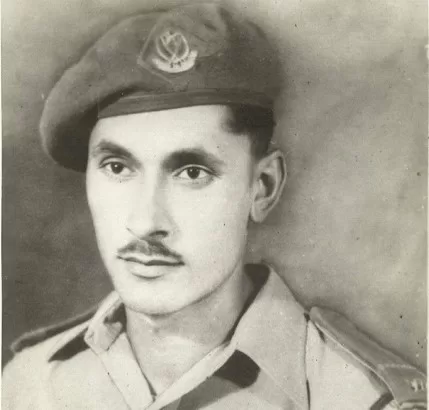
Khushdil Khan (KK) Afridi was born on 10 January 1929. His father Umer Khan Afridi was a government contractor in Kohat. There was family connection with the Raj on KK’s wife’s side. Her grandfather was Khawas Khan Shinwari of Indian Political Service (IPS) and served as Assistant Political Agent (APA) to Orakzaitribe. Her two brothers Colonel Zafar Khan Shinwari (14 Baloch Regiment) and Major Sikandar Azam Shinwari (8 Frontier Force Regiment) and a cousin Brigadier Qayum Sher (Baloch Regiment) proudly served the army.
Afridi studied at Islamia School Kohat and Islamia College Peshawar. He joined 4th Pakistan Military Academy (PMA) Long Course after pre-cadet course training at Quetta. At Kakul, his platoon commanders were Captain (later Lieutenant General and Governor of Punjab) Ghulam Jilani (8 FF) and Captain (later Brigadier) Syed Ali El-Edroos (10 & 14 FF). Platoon commanders are role models for cadets and this is the reason that they aspire to join the regiments of their role models. He held the Battalion Senior Under Officer appointment at Kakul and won the coveted sword of honor. He joined 5th Battalion of 13th Frontier Force Rifles (later designated 10 Frontier Force Regiment) on commission in 1951.
In 1955, Ava Gardner and Stewart Granger along with the MGM crew landed in Pakistan for filming of Bhowani Junction. The Pakistan army and police provided soldiers for the film. 5th Battalion of 13th Frontier Force Rifles then commanded by Lieutenant Colonel S. N. Shah Khan provided officers and soldiers for the film. It was a motorized infantry battalion and part of 3rd Armored Brigade along with 5th Probyn’s Horse. Afridi and Captains Agha Aman Shah and Shah Rafi Alam of 5th Probyn’s Horse were assigned to assist the film crew. Afridi handed the specially tailored Commanding Officer (CO) uniform to Stewart Granger. In the movie Granger played the role of Colonel Savage and one can see some grizzly PIFFER (nick name of units of Raj era guardians of the frontier passes) Junior Commissioned Officers and veterans of Second World War in the movie. In one scene, Victoria and Savage dance with PIFFER soldiers while the regimental band is playing the tunes.
In 1956, Afridi transferred to 8 Frontier Force Regiment and in 1957 he was posted GSO-3 of military liaison office in Pakistan High Commission in London where he spent three years. Once sitting in his office, a British gentleman knocked at his door and seeing blank expression on young captain’s face, told him in Pushto “udey na pejandam; Cunningham ya ma” (you did not recognize me. I am Cunningham”). He was the famous British frontier officer Sir George Cunningham (1888-1963). In 1947, the country’s founder Muhammad Ali Jinnah asked Cunningham to serve as governor of then North West Frontier Province (NWFP) for the third time. Afridi attended 1962 Staff College course and on completion of course was appointed instructor at School of Infantry & Tactics at Quetta.
In the spring of 1965, he was a company commander of 8 FF. The unit commanded by Lieutenant Colonel Ghulam Mustafa Khan Janjua was part of 51 Brigade commanded by Brigadier (later Lieutenant General) K. M. Azhar Khan operating in Run of Kutch area. The opposing Indian brigade was commanded by Brigadier Pahlajani and consisted of 2 Sikh Light Infantry (SLI) commanded by Lieutenant Colonel Henry Haus, 1 Mahar Regiment commanded by Lt. Colonel (later General and Indian army chief of staff) K. Sunderji and 11 Field Regiment Artillery commanded by Lieutenant Colonel ‘Henry’ Srinavasan.
Afridi took a team of thirteen men for reconnaissance of Indian forward positions. The team wandered into the minefield killing all except three. Severely wounded, Afridi lying in the minefield gave his weapon and watch to the Junior Commissioned Officer (JCO) and ordered him to go back. The JCO did not expect Afridi to survive, reported that he was killed and an absence prayer funeral was held for him. Afridi landed on his right side in the minefield with injuries to head, right hip, and loss of two fingers of the right hand. He was profusely bleeding and remained in and out of consciousness. Major R.K. Bali (2 SLI) extricated Afridi from the minefield, and he was evacuated by helicopter to Combined Military Hospital (CMH) Pune. The commanding officer of Pune CMH had served under Pakistan army Lieutenant General Wajid Ali Burki of army medical corps and was always kind to Afridi. A nurse from south India took extra care and once brought a banana from her hometown as a gift and a medical havildar risking his career volunteered to smuggle a letter out to his family. The letter reached the family who debated whether the letter was genuine or a ruse. Many believed that it was genuine because Afridi had used the nick names of his daughters. During transfer at the train station, one gentleman crossed the cordon of escort and asked Afridi if he was from Kohat.
A surprised Afridi answered yes but did not recognize the fellow who responded that I am Major Parshotam Lal Batra from Kohat. Afridi now recalled that Batra was in the same grade in school but studying at Hindu Sanatan Dharam Bharti High School of Kohat. In primary school, Hindus and Muslims studied together but they had separate high schools. Batra was a good hockey player, and Afridi had seen him at inter-school hockey games. During matric examination, both were sitting next to each other in the hall when Batra whispered to help Afridi in answering science and English questions and in return Afridi could help him in arts subject questions. A jubilant Batra asked if he could bring his wife to meet Afridi followed by his daughter and son. It was a strange meeting of old school boys in extraordinary circumstances. Afridi was treated very well, and he maintains that if he was evacuated to Pakistan, he may have not survived. After recovery, he was flown to Delhi and then repatriated on 14 August 1965. There are many stories about Afridi’s odyssey, but most are folklore. Captain Gandhi Mohan Bharati and Captain Joshi of 1 Mahar Regiment claim that it was a company commander of their unit who evacuated Afridi and unit’s medical officer Captain Rana initially treated Afridi before evacuation. It is also claimed that Afridi and Sunderji knew each other before partition – that is not correct. Major (later Lieutenant General) Venky Patel’s (1 Mahar Regiment) daughter claims that his father took Afridi to watch Raj Kapoor’s hit movie Sangam before handing him over for interrogation. This narrative is not correct as Afridi was severely wounded and semi-conscious and was evacuated by helicopter. Second Lieutenant Hariharan who was serving as intelligence officer of 11 Field Regiment was present during the initial interrogation of Afridi. He states that Afridi refused to give any details except his name, number, and rank.
After returning from captivity, he was recuperating from his injuries, his batman Sepoy Mukhtar was with him along with a servant from the village. In early September, the India – Pakistan war started, and one day the village servant taunted Sepoy Mukhtar. Mukhtar asked for return to the battalion and was killed during a night attack on Indian positions. He was awarded gallantry award Tumgha-e-Jurat (TJ).
Afridi was appointed GSO-II at Military Operations directorate. After commanding 18 FF (1967- 68), he was appointed instructor at Command & Staff College Quetta. In the spring of 1971, he was given the command of 12 FF to take the battalion to East Pakistan. He was promoted to Colonel rank and was appointed Colonel Staff of 9 Division commanded by Major General Shaukat Raza followed by Major General H.M. Ansari. After surrender of East Pakistan garrison, Afridi was taken as a prisoner at Ramgarh Prisoner of War (POW) camp. During his second captivity, he was not treated well and was given a tough time. The inmates of senior officers’ camp were also not having good relationship with each other due to the psychological trauma of captivity. Afridi had an interesting encounter with Major General Shah Beg Singh (Garhwal Rifles & Gurkha Rifles) then serving as General Officer Commanding (GOC) of Madhya Pradesh Area (Madhya Pradesh, Bihar, and Orissa). During his visit to the camp, officials complained to Shah Beg that Afridi was writing in letters that ‘Hindus are shameless’. Afridi told Shah Beg that ‘Sir, please note that I have not written the word Indian but Hindu’. Shah Beg was later dismissed from service. He joined Sikh rebel Jarnail Singh Bhindranwale and died during the India army’s Golden Temple operation in 1984.
Afridi was among the last batch of POWs to be repatriated in 1974. His wife was extremely ill and passed away only two weeks after his repatriation from India. Family members claimed that she was only waiting for the good Colonel to return before leaving this world. After his return from captivity, he was among the handful of Colonels promoted to Brigadier rank and commanded 102 Brigade in Peshawar. In 1976, he was promoted to Major General rank and commanded 14 Division (1976-78) and 19 Division (1978- 82). In 1982, he was promoted to Lieutenant General rank and appointed Corps Commander of Quetta based XII Corps. A Cessna plane carrying Baluchistan Governor Lieutenant General ® F. S. Lodhi crashed killing the pilot and the Governor’s ADC, but Lodi survived with injuries. Afridi was appointed acting governor of the province. The President and Chief of Army Staff General Muhammad Zia ul Haq held a conference on Islamization program that was attended by governors, senior government officials and leading clerics. Only Afridi and the Governor of then NWFP Lieutenant General Fazl-e-Haq disagreed with Zia’s program. The old soldier faded away after retirement into a quiet and long retired life and is still going on at the age of ninety-six. The military service continued in the second generation, and his son Lieutenant Colonel Saleem Afridi served with 10 FF and his nephew and son-in-law Captain Aizaz Rahman served with 18 FF before transferring to civil service.
In 1878, 5th Punjab Infantry destroyed the village of Ghariba in the Kohat pass and the residents moved out. Over the next one hundred years, it went through various re-organizations and was named 58th Vaughan’ Rifles, 5th Battalion of 13th Frontier Force Rifles and now 10 Frontier Force Regiment of Pakistan Army. One of the descendants of displaced villagers of Ghariba joined the old 5 Punjab Infantry and two generations served it proudly.