





“Education is out from books now – it’s time to work on personalized learning and smart tools” Sadaf Bhatt
In today’s fast-moving world, technology is changing the way we live, talk, and most importantly, how we learn.
One of the biggest change in education today is Artificial Intelligence (AI). It’s not just something for scientists anymore as it is becoming a part of daily life, and our schools need to keep up
Why AI matters in education?
AI helps make learning smarter, fa ster, and more fun.
Instead of just memorizing facts, students can now explore, ask questions, and create things. That’s what modern education is all about. But here’s something even more important: children need to start learning AI from an earlyage. Why? Because the earlier they get familiar with new technology, the better they can use it in the future. A for Apple? Yes. But A for Artificial Intelli-gence too. In many schools, we still teach kids “A for Apple, B for Ball.” That’s fine— but why stop there? What if we add “A for Artificial Intelligence” and “B for Bot”?
This way, children start building a modern mindset from the start. They don’t just learn words—they learn what those words can do in the real world.
“What children learn is what they search, and what they search becomes who they are.” – Sadaf Bhatti
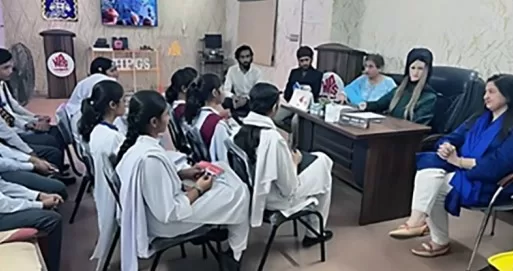
Now let’s talk about something truly amazing. At Happy Palace School (Isphani Campus) in Karachi, students are learning with two friendly robots—Miss Anny and Miss Saha. These arenot just machines. They are smart learning companions de- signed to teach, support, and inspire students.
Who is Miss Anny? Miss Anny is a cheerful and intelligent robot teacher. She helps students understand subjects like: Science, Mathematics, Geography, Social Studies and History. She explains things in simple words, speaks clearly, shows expressions, and interacts with students just like a real teacher. She turns boring lessons into fun sessions. Kids love her because she makes learning exciting.
Who is Miss Saha? Miss Saha is not a subject teacher—but she plays a very special role. She is a Mental Wellness Robot who helps students understand emotions, kindness, how to manage stress, and how to stay positive. In today’s busy and sometimes stressful world, students often don’t talk about how they feel. Miss Saha opens up this space. She talks to students about being kind, staying calm, and having a strong heart.
The Vision Behind the Robots
This creative project was led by Sadaf Bhatti—Vice Principal of Happy Palace School and Convener of the Education Reforms Committee at FPCCI (Federation of Pakistan Chambers of Commerce and Industry).
With a deep passion for innovation and learning, she turned this idea into reality with the help of two brilliant engineers, Hassan Siddiqui and Anees Siddiqui. Together, they brought technology and education into one powerful space.
“We don’t want our children to be just users of technology – we want them to become creators.” –Sadaf Bhatti
A Visit by the Providentia Books Foundation
Recently, the Providentia Books Foundation (PBF) Team visited the school and met both robots in action. They were impressed by how children interacted with Miss Anny and Miss Saha. The team praised the initiative and called it:
“A bold step towards inclusive, future-ready education in Pakistan.”
The Bigger Picture: AI for Every Child
Miss Anny and Miss Saha are not just for one school. This is the beginning of a larger dream, where every child in Pakistan, from every background can learn with the help of smart tools. Right now, many children don’t have access to digital learning or advanced subjects like AI. But if we act now—by updating our teaching methods, training teachers, and including AI in early lessons—we can give these children a real chance to succeed.
What needs to happen next?
To bring AI and innovation into all classrooms, we need to take a few clear steps:
1. Include AI in the school curriculum. Start with fun and easy activities at the primary level. Use stories, images, and games to teach what AI is.
2. Train teachers:
Teachers need to understand tools like ChatGPT, Canva, Scratch, and Google tools so they can use them in class.
3. Guide parents:
Many parents don’t know how AI works. Schools should organize awareness sessions so parents can support their children.
4. Create local content:
Make AI learning materials in Urdu and other local languages. Every child should understand, no matter where they’re from.
5. Give access to devices and internet:
Ensure schoolsespecially in rural areas have basic digital tools.
Not Just Robots – A Learning Revolution Miss Anny and Miss Saha represent something bigger than technology. They stand for a new mindset in education. They prove that smart learning is possible, even in a country like Pakistan where educational challenges still exist.
Books by Sadaf Bhatti To help teachers and students even more, Sadaf Bhatti has also written two eBooks which are very helpful:
“First AI Tools Dictionary”
– A guide to understanding popular AI tools in easy words. “Little Minds, Big Futures”
– A book to help young children explore creativity and technology. These books are made to support both schools and families as they move toward digital learning.
The Future
Is Now Everywhere in the world, students are using AI to build apps, design games, solve math problems, and even start small businesses. Pakistani students should have the same chance. But we must act now. We must move away from just paper exams and memorization. We must start focusing on skills, creativity, and emotional growth. Education is out from books now – it’s time to work on personalized learning and smart tools.” – Sadaf Bhatti
The future will belong to those who are prepared. If we want our children to compete, grow, and lead in the coming years, we must give them new learning tools, modern skills, and the courage to explore. Miss Anny and Miss Saha are not just teaching robots.
They are the beginning of a new story—one where Pakistani student become leaders, thinkers, inventors, and global citizens.