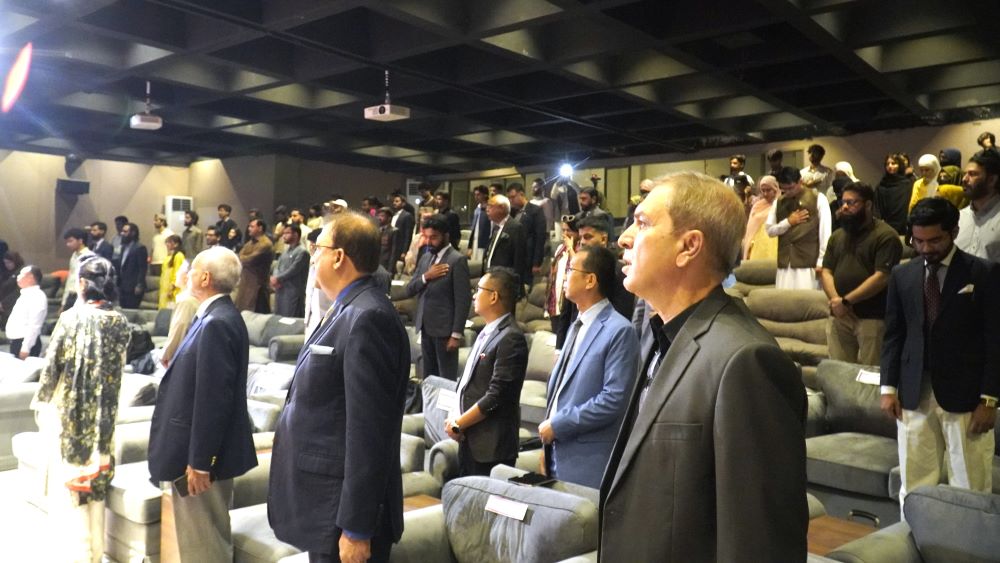





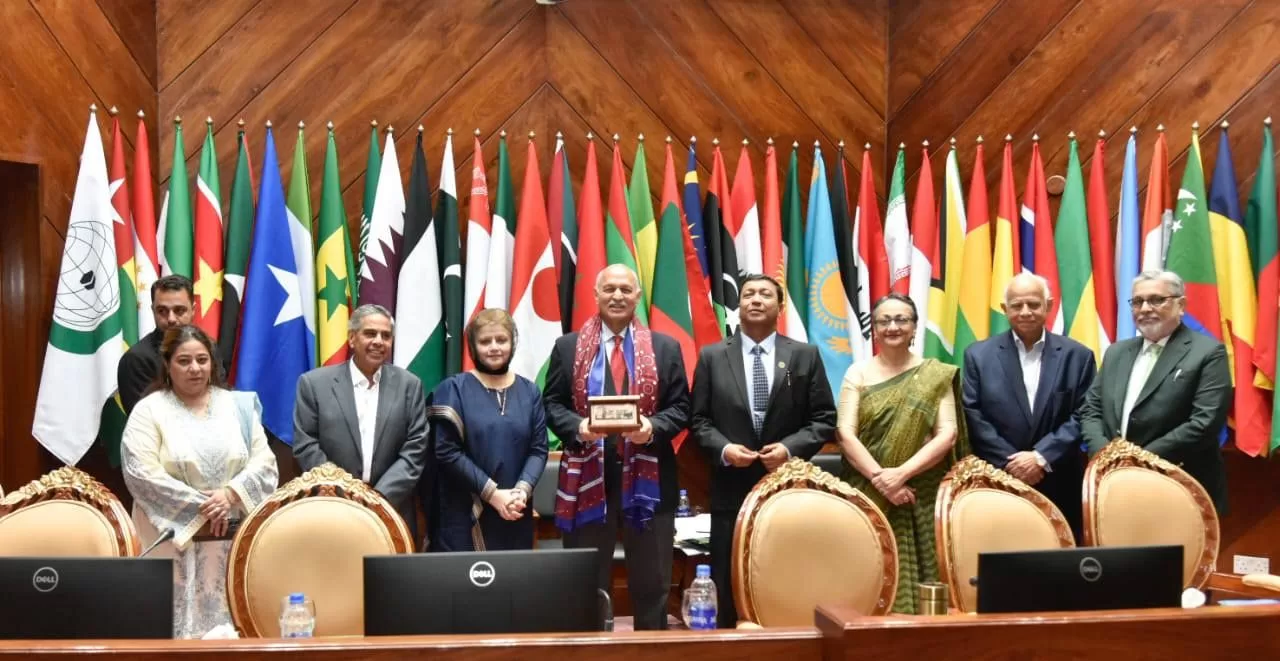
ISLAMABAD, June 4, 2025 – A high-level seminar titled “Water Crisis and the Indus Water Treaty” was held at the COMSTECH Secretariat, Islamabad, jointly organized by OIC-COMSTECH, Karachi Council on Foreign Relations (KCFR), the Hisaar Foundation and the Panjwani Hisaar Water Institute.
The seminar convened a distinguished gathering of diplomats, environmental experts, academics, and policy professionals to explore Pakistan’s escalating water challenges, particularly in light of India’s suspension of the Indus Waters Treaty (IWT) following the Pahalgam incident. The event served as a timely platform to discuss legal, strategic, and hydrological implications of the crisis and to explore resilient responses for national and regional water security. The seminar reiterated the need for a paradigm shift in how Pakistan addresses its water security by moving away from reactive politics toward a proactive strategy.
The event echoed with powerful voices of the following eminent speakers: Senator Mushahid Hussain, Chairman of Pak-China & Pak-Africa Institute of Development & Research, Ikram Sehgal, Co-Chairman of Pathfinder Group, Ms Nadira Panjwani, Chairperson of KCFR, and environmental experts such as Ms Simi Kamal, Chair of the Hisaar Foundation and the International Water Management Institute, Zohair Ashir, Member BOG, Hisaar Foundation, Ali Tauqeer Sheikh, Climate Change and Development Expert, and Rafay Alam, a renowned Environmental Lawyer.
A consensus emerged around a unified national water strategy based on lawfare, regional engagement, and environmental stewardship. As climate change and transboundary tensions grow, Pakistan must strengthen its hydropolitical defences with intelligence, legal preparation, and cooperation at home and abroad.
Nadira Panjwani sets the tone with an urgent call to action:
In her opening remarks, Ms Nadira Panjwani emphasized the collaborative effort of four partner organizations to bring critical attention to an existential threat facing Pakistan. She highlighted the long-standing relationship with COMSTECH and its Coordinator General, Dr Iqbal Choudhary, whose leadership has elevated the Panjwani Centre for Molecular Medicine to global excellence.
She elaborated on KCFR’s mission of projecting Pakistan’s interests through civil society dialogue and its proactive role in confronting India’s weaponization of water. Citing India’s construction of dams on Pakistan’s share of western rivers, she warned that the unilateral abeyance of the treaty marked a shift from diplomacy to hydro-warfare.
“The Indus Water Treaty is not a gift. It is a legal agreement backed by international guarantors. We will defend our rivers – not with charity, but with resolve,” she declared.
She concluded by underscoring the need for internal reforms, investment in hydrological resilience, and strategic diplomacy. “Water is life, and our right to life is non-negotiable,” Panjwani stated firmly
Zohair Ashir highlights institutional efforts and Public-Private leadership in water security
Mr Zohair Ashir, Member of the Board of Governors of the Hisaar Foundation and Executive Board of the Panjwani Hisaar Water Institute, followed with a comprehensive contextual briefing. He traced the evolution of the Hisaar Foundation under the leadership of Ms Simi Kamal from a grassroots initiative into a nationwide movement for water, food, and livelihood security. He explained the Foundation’s pivotal role in publishing the Citizen Water Policy in 2016, two years ahead of the government’s national policy, and emphasized its reach to over 2 million beneficiaries. Mr Ashir also introduced the Panjwani Hisaar Water Institute as a landmark public-private partnership with NED University, the Panjwani Foundation, and the Hisaar Foundation. The institute, launched amidst the COVID-19 crisis, represents a Rs. 1.6 billion investment in applied water research, with Rs. 1.2 billion already secured. “It is not just a research institute; it is a symbol of resilience and cooperation, aimed at science-driven water policy,” he said.
On setting the thematic focus of the seminar, he addressed the media-led distortion of facts in the current India-Pakistan conflict. He stressed the need for grounded discussions based on hydrological geography, treaty history, and legal structures, warning against emotional rhetoric and misinformation.
Ms Simi Kamal warns of weaponized hydropolitics, urges Pakistan to assert its water rights based on Geography and Science.
Ms Simi Kamal, renowned water expert and founder of the Hisaar Foundation, grounded the discussion in the hydrological and geopolitical realities of the Indus Basin. Drawing attention to the “Third Pole”, a term used to describe the ice-rich region of the Tibetan Plateau, she explained how this high-altitude zone plays a pivotal role in global atmospheric and hydrological systems. Ms Kamal emphasized that the Indus Basin is geologically active, with tectonic shifts continuing to raise the Himalayas, dramatically influencing the rivers that sustain life in Pakistan. “The Tibetan Plateau is not only a climate regulator but also Asia’s water tower,” she remarked, noting that rivers flowing from this region serve nine countries, including Pakistan, India, and China.
Turning to the geopolitics of water, Kamal explained how geography shapes regional power dynamics, citing the ongoing border disputes in Kashmir and the competing interests in transboundary rivers. She highlighted that while media narratives often stir alarm, decisions must be based on hydrological facts. “We must speak from a position of strength and science,” she urged.
Reflecting on the Indus Waters Treaty (1960), Ms Kamal provided a sobering analysis. Contrary to popular perception of the treaty as a success, she argued that Pakistan had effectively relinquished its claim to the three eastern rivers (Ravi, Sutlej, and Beas) without securing equitable transboundary rights. “This was not water sharing, it was water division, and it predated modern UN water conventions,” she clarified.
She also addressed critical gaps in the treaty, such as the exclusion of groundwater and the overlooked permission granted to India to discharge polluted water into Pakistan through designated drains. She lamented Pakistan’s failure to invoke international law to demand ecological flows and equitable distribution at the time the treaty was signed. Despite these shortcomings, she acknowledged Pakistan’s achievements made possible by the treaty’s infrastructure support, including the development of the world’s largest contiguous irrigation system, which catalyzed the Green Revolution. “We must treat our infrastructure as national assets and invest in their preservation,” she said, while cautioning against an overreliance on outdated canal systems.
Debunking alarmist claims that India could block Pakistan’s water, Ms Kamal reassured the audience that rivers are not taps that can be turned off. Citing scientific studies, she explained that India holds control over less than 10% of the Indus River’s upstream area.
Even if India attempted to build mega-dams in seismically active zones, the impact would be marginal due to the complexity of the river system fed by countless glaciers and tributaries. On groundwater, Kamal revealed that over 80% of Pakistan’s freshwater currently comes from underground aquifers, primarily in the Punjab, and that transboundary underground water migration often flows from India into Pakistan, not the other way around.
In closing, Ms Kamal called for a rethinking of water governance within Pakistan. She accentuated protecting the rights of lower riparian regions within the country, moving away from politically driven infrastructure projects, and adopting nature-based solutions and groundwater regulation. She asserted that, “This is not just a water crisis, it’s a governance crisis. Let us optimize what we already have before we build what we may not need.” Ms Kamal concluded with a message of strategic confidence: “Pakistan must advocate from a position of legal entitlement, geographic reality, and scientific integrity. India’s ability to cripple our water security is limited. The real battle lies in how wisely and justly we manage our water resources.”
Rafay Alam delivered a comprehensive legal-historical narrative
He urging Pakistan to replace alarmist rhetoric with rational, law-based discourse when addressing the country’s transboundary water challenges. “Water is not a war drum; it is a shared resource,” Alam asserted, calling for the demilitarization of language surrounding water politics.
He argued that discourse on water should not be driven by fear or political expediency, but grounded in legal reasoning, historical context, and scientific fact
Referring to the tectonic formations of the Himalayas, Karakoram, and Hindukush ranges, already covered by Simi Kamal, he emphasized that these natural forces shaped the region’s rivers long before man-made boundaries existed.
Alam traced the legal foundations of water governance in the subcontinent back to the colonial period.
When the British annexed Sindh in 1842 and Punjab in 1849, they introduced canal irrigation systems in response to famine and poor water management. Notably, the Upper Bari Doab Canal, constructed in 1879, now straddles the India-Pakistan border. Historical tensions over water allocations existed even before Partition. In 1918, the Ganga Canal project for the princely state of Bikaner from the Sutlej River triggered objections from the state of Bahawalpur, leading to India’s first water accord, a tripartite agreement based on the principle of equitable apportionment, which remains central to modern international water law.
Further historical insight was provided on the Rao Commission, established in 1942 to resolve a dispute between Punjab and Sindh over the proposed Bhakra Dam.
The Commission recommended compensatory measures, including the construction of the Guddu and Kotri barrages, validating Sindh’s lower riparian concerns. Alam argued that such decisions were early manifestations of transboundary water law principles that Pakistan can still leverage today.
The partition of 1947 transformed regional water politics into an international issue. Though the canal network was only minimally impacted, the new international border created a lower-upper riparian divide, especially affecting Punjab and Sindh. The April 1948 closure of water flows from India to Pakistan over the Upper Bari Doab Canal marked the first major flashpoint, eventually catalyzing the Indus Water Treaty (IWT).
Alam highlighted how the treaty, signed in 1960 and brokered with World Bank support, was not inevitable due to partition alone but was shaped by pre-existing infrastructural and political dynamics. He pointed out that while the treaty helped develop Pakistan’s extensive irrigation system, it also imposed legal obligations that India has often manipulated through unilateral dam construction.
The Kishanganga, Baglihar, and Salal dams were cited as contentious examples, particularly the issue of drawdown flushing, which Pakistan contested at the Court of Arbitration.
Importantly, Alam explained that while India has limited ability to weaponize water due to technical and geographical constraints, it continues to construct run-of-river projects on the western rivers, raising compliance questions under the treaty.
He noted that to store water in such dams, India would have to stop hydropower production, which would impact millions in northern India. Similarly, flooding Pakistan using stored water would require India to flood its territory first, making such scenarios practically implausible. On the eastern rivers, Beas, Sutlej, and Ravi, India’s irrigation infrastructure such as the Thein, Bhakra, Pong, and Pandoh dams, and the Indira Gandhi Canal, which irrigates much of Indian Punjab, Haryana, and Rajasthan. While these allow storage, their geographic distance from Pakistan limits their strategic threat.
He also provided a nuanced legal perspective on the IWT’s limitations. He argued that the treaty’s rigid framework is outdated and ill-suited to respond to emerging challenges such as climate change, transboundary groundwater flows, and ecological damage.
“The treaty focuses on dividing rivers, not sharing them. That approach no longer fits a world grappling with water stress and climate disruption.” Instead, he called for engaging with evolving international frameworks such as the UN Watercourses Convention, which emphasizes equitable and reasonable utilization, no significant harm, and prior notification, all principles that could strengthen Pakistan’s legal position.
Mr Alam concluded with a call for cooperative transboundary governance, stating that over two billion people depend on the Indus Basin and that “we must view it not solely through the lens of India-Pakistan rivalry, but as a shared responsibility among all riparian states.” He emphasized that law, diplomacy, and environmental justice must replace emotional narratives and build a future where water sustains peace, not conflict.
Senator Mushahid Hussain Syed delivered a compelling call to action against the weaponization of water
He urging a multi-pronged response that includes legal advocacy, regional diplomacy, and a robust national water strategy. His remarks, framed in the broader geopolitical context of India-Pakistan relations, highlighted the ideological motivations behind recent Indian threats to unilaterally suspend the Indus Waters Treaty.
Referring to his recent visits to China and Russia, Senator Mushahid emphasized the strategic importance of water in international politics. He cited Chinese scholar Victor Gao, who warned that using water as a weapon would be a crime against humanity. The Senator framed India’s approach not as a hydrological or technical issue but as a politically motivated strategy rooted in the ideology of the Rashtriya Swayamsevak Sangh (RSS)
“We must recognize this as an issue driven by bigotry and animosity. It’s not just about river flows, it’s about power, domination, and coercion,” he said.
In response to India’s threats following the terrorist incident in Pahalgam, Mushahid stressed that Pakistan must shift the debate to lawfare. “We need to fight this battle legally and strategically,” he stated, proposing that legal experts like Rafay Alam be engaged directly by the Foreign Office, GHQ, and other national institutions.
He emphasized the urgency of drafting a homegrown national water strategy and proposed the formation of a Citizens’ Task Force, composed of experts such as Simi Kamal, Nadira Panjwani, and Rafay Alam.
He also highlighted the importance of adopting a regional approach, looking beyond bilateral India-Pakistan tensions. He referenced water governance models from Central Asia, particularly those discussed during the China–Central Asia Summit in Xi’an in 2023. Stressing Pakistan’s growing strategic ties with Bangladesh, Central Asia, and China, he said: “Water must be seen through a regional and cooperative lens, not merely as a bilateral flashpoint.” On the legal front, Mushahid reminded the audience that the Indus Waters Treaty is an international obligation. Citing World Bank President Ajay Banga, he reaffirmed that India cannot unilaterally abrogate it. “We have geography, law, and international opinion on our side. What we now need is vision, preparation, and unity.”
Ikram Sehgal warns of strategic water weaponization, calls for a unified National Water Policy.
Mr Sehgal spoke with his characteristic directness, contextualizing water threats in both historical and security dimensions. He linked India’s IWT abeyance to a broader pattern of regional aggression. Reflecting on his military background and geopolitical experience, Sehgal emphasized that water is becoming the most powerful strategic resource in South Asia, with India’s rhetoric aiming to build a new regional reality based on resource control.
“The threat to make Pakistan ‘thirsty’ is not just political theater, it’s a reflection of India’s broader strategic ambitions,” Sehgal said.
Drawing historical parallels to Karbala, where water was denied to the Prophet’s family, Sehgal underscored ho psychological warfare around water scarcity can devastate communities even in the absence of actual deprivation.
Highlighting Pakistan’s underutilization of legal and diplomatic mechanisms, he criticized the state’s failure to invoke its full rights under international water law. “We have given up rights, perhaps in the hope of regional peace or fair trade, but we must now consolidate our legal claims, data systems, and infrastructure into a unified national policy,” he urged.
Sehgal warned that the Indus Basin’s integrity is under pressure not only from physical obstructions like dams but also from strategic messaging and psychological operations. “When people see rivers drying, even due to climate or mismanagement, the perception itself becomes a weapon.”
Mr. Sehgal cited the Neelum Jhelum Dam incident as a potential casus belli and argued that symbolic or retaliatory messaging could have served as a deterrent. He emphasized that India’s aggressive actions, from the Farakka Barrage against East Pakistan to more recent dam constructions, reflect a pattern of coercive water politics.
He suggested that India is attempting to replicate the Israeli model of regional dominance through resource control. However, he said that their strategy began to unravel with the collapse of the Hasina regime in Bangladesh last year, asserting that Pakistan’s geopolitical position is on the rise again.
Ali Tauqeer Sheikh laid out a detailed and thought-provoking framework for Pakistan’s response A man drinks water from a well in Achhro Thar, Khipro, Sindh to rising tensions over transboundary water sharing
Emphasizing that the current water discourse must move away from reactive rhetoric, Sheikh called for strategic, low-profile, and technically-driven diplomacy, warning that over-reliance on legal measures could delay or derail meaningful progress.
Opening his address, Sheikh underscored three guiding themes: political prudence, technical engagement, and long-term strategy. “The concept of alliance,” he asserted, “is political, not legal or technical. A purely legal response may not only be inadequate but dangerous.” He warned against placing undue trust in litigation processes that take years to unfold and yield uncertain outcomes. “A sovereign country like India cannot be compelled to comply with international rulings,” cautioning that excessive legalism risks governmental complacency and strategic passivity. He covered the following issues immaculately:
Political Challenge, Not Legal Crisis
Mr Sheikh pointed out that India’s aggressive posture should be viewed through a political lens rather than as a water dispute alone. He noted India’s messaging has increasingly included references to democracy, terrorism, and climate change, though the term ‘water terrorism’ has not officially been used. “Instead of reacting defensively,” he urged, “Pakistan should turn this into an opportunity to modernize the Treaty through climate adaptation and institutional enrichment.”
He criticized India’s failure to utilize Article 7 of the Treaty, which allows for modifications, annexures, and new protocols. India missed an opportunity to reform the Treaty using climate change as a basis. This would have made the agreement more resilient for the next 50 years. He acknowledged that India’s actions may benefit its domestic political narrative in the short term, but warned of long-term international and regional costs.
Pakistan’s Strategic Missteps
Turning to Pakistan’s shortcomings, he said, “Our response has been overly legal, reactive, and emotionally charged – marked by threats rather than strategic engagement.” He pointed out several institutional weaknesses, including the underutilization of the World Bank’s mediatory role, the dismissal of experienced water officials, and a lack of leadership driven by data in policy-making.
One official was labelled unpatriotic, while another provides services on an ad hoc basis through a consultancy. He described both instances as signs of neglect in a matter of national importance. Despite there being no immediate threat, he stressed the urgency of preparing for longterm risks, especially in the context of climate change, glacial melt, and erratic monsoon patterns.
Three Strategic Options for Pakistan
Mr Sheikh outlined three strategic pathways:
1. Maintain Status Quo
While the current situation poses no direct threat, remaining passive prolongs uncertainty and raises the risk of escalation during future flashpoints, especially under shifting climate conditions.
2. Renegotiate the Treaty
This high-risk option could take decades and demands political capital, financial backing, and goodwill – elements currently in short supply. He warned that reopening the Treaty may favor India’s stronger political and economic positioning.
3. Treaty Rehabilitation through Technical Engagement (Preferred Option)
“This is the most pragmatic path,” he said, recommending the formation of technical working groups focused on climate resilience, data sharing, and infrastructure management. He proposed quiet diplomacy, such as secretarial-level meetings or academic collaborations hosted in neutral venues or online. “Effective engagement starts small, outside of headlines, and builds trust over time.”
Learning from Other Models:
He drew parallels with international examples, such as the Turkey-Armenia model, where, despite a lack of formal diplomatic ties, both countries cooperated in scientific data collection through a third party (the Soviet Union). This depoliticized approach helped avoid conflict, suggesting that Pakistan and India could emulate such models for water data exchange. He also highlighted how the Punjab in India suffers disproportionately despite Modi’s nationalist rhetoric. Water-intensive cropping, subsidies, and poor management have led to groundwater depletion and internal migration, with Punjab farmers often blaming the Treaty for local scarcity. “This creates a political flashpoint within India itself,” he said, suggesting that regional scientific dialogue could help de-escalate tensions and improve mutual understanding.
Call to Action: Build Scientific and Institutional Capacity
He emphasized that Pakistan currently lacks credible water data, academic support, and technical assessments required for informed diplomacy. He proposed:
• University partnerships for joint doctoral research
• Professorial supervision to foster data-driven studies
• Protocols for data exchange, both within and beyond Treaty frameworks
He said, “We can’t win the water war without information, it’s not just about treaties or national rights – it’s about how well we’re prepared technically.” He called for integrating urban water management, drinking water quality, and climate adaptation into the national discourse. “We often think only of India and Pakistan, but the issue is broader. It’s about cities, livelihoods, and sustainable futures.” Mr Sheikh concluded with a powerful message:
“Let’s avoid panic. Governments must not react like households. The water right is universal, an ethical issue, not just a political one. Water is not a bilateral possession; it is a shared heritage of mankind.”
He urged Pakistan to invest in technical diplomacy, use Article 7 of the Indus Waters Treaty to propose meaningful updates, and prioritize cooperation over confrontation.
“If we don’t act now, we not only endanger ourselves but the very global legal architecture that has kept water wars at bay for decades.”
Question & Answer Session:
During the comment and Q&A session, several valuable insights were shared by participants, notably Dr Shaukat, who offered a detailed internal critique of Pakistan’s water management. He began by clarifying that the water crisis in Pakistan exists independently of any disputes surrounding the Indus Waters Treaty and is largely rooted in internal mismanagement. He shared that at the time of the Treaty’s signing, cropping intensity was projected to be around 75%, but by 2016, this had surged to 160%, effectively doubling the country’s water requirements. In contrast to India and China, Pakistan’s agricultural productivity is alarmingly low, about half that of India and just onefifth that of China, highlighting deep inefficiencies in usage. He pointed out that the country has virtually no water reuse or recycling systems in place. In major cities like Karachi and Lahore, nearly 600 billion gallons of wastewater are generated daily, yet only around 10% is recycled. In comparison, Amsterdam and Istanbul recycle over 90% and 60% of their water, respectively.
He further emphasized that groundwater aquifers are depleting rapidly, exacerbated by poor water management and incentives across the border in India that promote over-extraction.
He raised alarm over high contamination levels in irrigation water, where arsenic concentrations have reached over 200 micrograms per litre, far exceeding the WHO limit of 10 micrograms. Dr Shaukat also criticized the practice of exporting water-intensive crops such as rice, effectively equating them to exporting water.
He observed that various irrigation projects, such as the Kachhi Canal, have diverted valuable water to barren areas with questionable agricultural return, while many of Pakistan’s ageing dams have exceeded their intended lifespan and are burdened by sedimentation.
With only 20 to 25 days of water storage capacity remaining, Pakistan ranks among the lowest in the world. Reflecting on the past, he lamented how rivers like the Chenab and Ravi, which once flowed fully, now run dry, symbolizing the cumulative effects of decades of neglect.
In response to a question posed by Dr Saqib Nasir from the Pakistan Science Foundation regarding how to promote collaboration among government departments working in silos, Ms Simi Kamal emphasized the need for a unified national water vision. She called for strategic thinking informed by facts rather than reactionary media narratives, and underscored the importance of Parliament in empowering water-related institutions and expert voices. She reiterated that much of the research, strategies, and recommendations already exist; what’s lacking is political will and institutional synergy.
Another question was on the potential implications if India were to withdraw from the Indus Waters Treaty, especially in light of China’s role as an upstream riparian state. Rafay Alam responded by referencing China’s construction of dams on the Yarlung Tsangpo (Brahmaputra) and the resulting impacts on downstream countries. He stressed the importance of cooperative transboundary water agreements and cited the Danube River in Europe as a model of shared, peaceful, and mutually beneficial water governance.
Dr Bilal, a water professional working on international river systems such as the Nile, inquired about how Pakistan could attract international experts who not only understand global water practices but are also attuned to Pakistan’s unique challenges. He also commented on the strategic implications of India’s construction of 40 projects on the Chenab River, eight of which are under development and collectively capable of storing 3.6 million cubic feet of water. According to him, this could cost Pakistan approximately $92 million per season and grant India maneuverability to manipulate water flows at a time of its choosing. Rafay Alam responded that constructing dams like Baglihar is very expensive, often costing $5–7 billion, with limited impact on downstream flows lasting only a few days. He noted India’s prior breach of the Treaty during Baglihar’s filling, although they later apologized. Alam pointed out that the short-term threat is limited due to technological and environmental factors, such as glacier melt.
However, this was countered by Dr Bilal, warning that the purpose of building multiple dams is to divert water to India’s southern regions, potentially worsening drought in Pakistan. He criticized this view as misleading and emphasized the strategic implications. Ali Tauqeer Sheikh also contributed to the discussion by highlighting that the core issue is not water availability but productivity. Quoting a World Bank study, he argued that Pakistan has more per capita water than India, China, and even Germany. The real crisis lies in inefficient usage, poor pricing structures, and subsidization of elite agricultural interests. He proposed that if Pakistan could save just 1% of its water annually until 2047, it could achieve a 28% cumulative saving, and with 2% savings annually, up to 68%. He underscored that water productivity, rather than infrastructure expansion alone, must be the new metric for national water security.
The event was concluded with the closing remarks of Prof. Dr. M. Iqbal Choudhary, Coordinator General of OIC-COMSTECH who expressed deep gratitude to participants and emphasized the broader significance of the event, not only for Pakistan but for the entire Muslim world. He particularly thanked Ms Nadira Panjwani for choosing COMSTECH as the venue and co-host for this impactful gathering.
He said that this is not just another event – it is a strategic platform, all that was shared today would be translated in 50 languages through the Union of National Agencies (UNA) of the Organization of Islamic Cooperation (OIC), giving our message a truly global reach.”
He highlighted the instrumental contributions of all participants, particularly commending Ms Simi Kamal for leading a powerful discussion on Pakistan’s water challenges.
As a founding member of the OIC Water Vision, COMSTECH plays a central role in driving research and development to address water scarcity, a challenge confronting many of the OIC’s member countries.
Dr Choudhary took a personal moment to recognize Mr Ikram Sehgal and Mr. Ali Tauqeer Sheikh, a longtime mentor and climate expert. Recalling their early interaction in 1995, he said, “Tauqeer Sheikh taught me to apply threat forecasting, analyzing the worst-case scenario even when we act with the best of intentions. This, he stressed, is crucial for developing a resilient national water strategy that goes beyond politics to include ecological sustainability and technological advancement.
Dr Choudhary underlined the need for a bipartisan approach to water governance. “Water must not be politicized,” he said. Referring to the Indus Waters Treaty negotiations of 1960, he shared that the geopolitical context has changed, and Pakistan must now revisit its strategy, armed with modern legal tools, strategic foresight, and regional alliances.