

We cannot ignore the networks where there is an ideological battle going on – Miguel Diaz-Canel
In the last decade, networks have repeatedly surprised hierarchies of nation states. Groups designated as terrorists by the international community have shown resiliency against powerful states. Hamas in Gaza, Hezbollah in Lebanon and Houthis in Yemen engaged with the powerful Israeli army for over a year in kinetic operations. In two dramatic cases, Taliban in Afghanistan in 2021 and Hayat Tahrir al Sham (HTS) in Syria in 2024 took control of the states. These events have created a kind of cognitive dissonance.
After the overthrow of Bashar al Asad, U.S. Undersecretary of State for Near East met with HTS leader Ahmad al Sharra aka Muhammad al Jolani who at that time was on Federal Bureau of Investigations (FBI) most wanted list with $10 million reward.
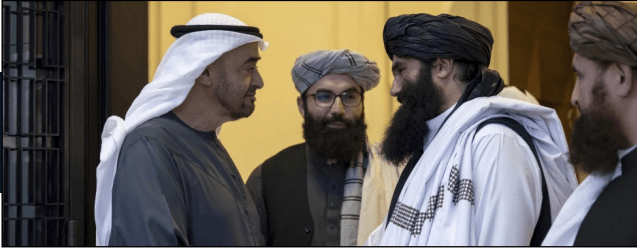
In February 2025, Sharra went to Saudi Arabia and met de facto ruler Crown Prince Muhammad Bin Salman (MBS), a close American ally and then Turkish President Recep Tayyip Erdogan, a North Atlantic Treaty Organization (NATO) member. In the summer of 2024, Taliban Interior Minister Sirajuddin Haqqani with $5 million head money and under United Nations travel sanctions met head of United Arab Emirates (UAE) Prince Muhammad bin Zaid (MBZ), a close American ally.
In January 2025, Haqqani met MBZ again and this time the Taliban intelligence chief was accompanying him who is a former Guantanamo Bay detainee. Such optics give an impression of ascendancy of networks against the “ “ NETWORKS VS HIERARCHIES Dr. Hamid Hussain EXCLUSIVE FOR DEFENCE JOURNAL nation states. Aspiring leaders of networks are learning the crucial lesson that if you are patient and resilient and survive the initial push back then you can reap enormous rewards.
The concept of networks versus nation states in modern conflict is a complex topic. Despite the altered landscape of global conflict and success of networks in modern conflict, there is little research on this phenomenon. Traditional nation-states, which are defined by territorial boundaries and centralized governments, are increasingly challenged by decentralized networks that operate across borders taking advantage of internal, regional, and international fault lines.
The nation state is a hierarchy defined here as a linear organization with topdown structure and a defined chain of command. Advantages of such an organization are the efficient decision-making process, specialization, and accountability but disadvantages are lack of flexibility and adaptability, communication barriers and resistance to change. On the other hand, network is non-linear consisting of inter-connecting nodes linking across boundaries. The advantages of networks are agility, flexibility, adaptability, and resiliency due to diffusion of authority. The disadvantages are lack of clear authority that can negatively impact decision making process and accountability.
The modus operandi of both models is shaped by the mindset. A hierarchy mindset is focused on inherent strengths of the nation state, and relies on military, economic, and diplomatic levers of power. Conflict is evaluated by war dialectics, military balance, and attrition. The Network mindset is based on acknowledgement of inherent weakness against powerful hierarchy. It must find solutions to enormous odds by removing constraints through distraction, sidestepping, blinding, removing adversary’s nodes of strength and suspending war dialectics through strategic surprise. It must move through the fault lines of the nation states and leverage commonly available cheap technology to coordinate activities, recruit members, generate financial resources and spread influence. These networks can be highly adaptive and resilient, and this strategy is essential to survive against more powerful conventional military strategies. A Hierarchy is trained to focus on quantifiable measures while network is focused on dominance in the unquantifiable, especially in the perception domain. Victory and defeat are in the eye of the beholder. At the conceptual level, networks have learned two crucial lessons dealing with both internal and external rivals. Networks challenging domestic status quo have gained confidence as feeling is that “WE CAN BRING DOWN OUR OWN PHAROAH” when they look at the fall of Hosni Mubarak of Egypt, Ali Abdullah Saleh of Yemen, Muammar Qaddafi of Libya, and Bashar al Asad of Syria.
Groups engaged in fighting foreign occupation forces have learned lessons from the retreat of American forces from Iraq and Afghanistan with the concept that “we can make the cost of occupation prohibitive forcing retreat of the adversary”.
Perceptions can be more powerful than reality and millions who saw images of highly orchestrated Israeli hostages handing over ceremonies by Hamas viewed it as a Hamas victory against the most powerful military of the Middle East.
Leaders of militant organizations designated as terrorists with head money of millions of dollars publicly rubbing shoulders with world leaders gives the impression of equality. The United States deployed two aircraft carrier groups in the Red Sea area against the Houthi militia that owns not a single ship or aircraft.
These optics project weakness of military power rather than strength and elevates the profile of the network. Unwashed militants with scraggy beards, wearing baggy natives dress and plastic sandals crashing into wood paneled board rooms and ornate palaces are usually scenes from B rated movies and not of the real world. These perceptions are crucial in recruiting future foot soldiers and leaders for the network organizations. Small scale violent attacks on military and civilian targets all over the globe are becoming the norm due to wide accessibility to news via social media platforms. More important is paying close attention to the trends, as this provides a window to the changing nature of the conflict.
This information is crucial for political and military leadership to take pro-active political, diplomatic and military steps to alter the future trajectory. In the case of the Israeli-Palestinian conflict, the trend to watch is primarily in the West Bank. We are seeing the process of Gazafication of West Bank where the popularity of Hamas and Palestinian Islamic Jihad (PIJ) has grown.
Palestinian Authority (PA) is viewed as a fossilized, corrupt entity run by aged men and at worst collaborators with Israeli occupation forces. Collapse of PA will dramatically change Israeli security dynamics where Israeli forces will be forced to take security of Area A (currently, PA has both administrative and security control of this area).
There are early signs of the trend where children of PA officials are joining rival groups. This is in direct response to the escalation of kinetic operations of Israeli Defense Forces (IDF). If this trend escalates then rival groups will have inside information about PA operations and popular uprising against PA to force dramatic change or even collapse of PA authority becomes a possibility. The number of Palestinian prisoners in Israeli jails doubled since October 2023 to around ten thousand. This rapid rise of prison population, severe restrictions placed on prisoners along with abuse due to raw emotions of Israelis risks prison riots and uprising.
Regarding the outside factors, the place to watch is Jordan. The Hashemite monarchy of King Abdullah II is facing several challenges including a rift in the royal family due to change of line of succession, economic decline, and unrest among Jordanian tribes especially in the north and south that have traditionally been the bedrock of support of the monarchy. Half of the country’s population is of Palestinian descent and public anger over the Gaza war is straining the country’s weak structures.
Such environment is conducive for both Islamist conservative forces who want constitutional reforms of public participation in the decision making process as well as radical elements like the Islamic State (IS) to overthrow the monarchy.
If IS cells from neighboring Syria and Iraq, make inroads into Jordan exploiting the fault lines then the security of the country will deteriorate that will have direct impact on Israeli security as the Jordanian- Israeli border is three hundred miles long compared to thirty-six miles of Israeli border with the Gaza strip. In the case of Syria, trends in the northeast bordering Turkey and southwest bordering Israel will have impact on the future trajectory. In the northeast, Turkish backed Syrian militias are in direct conflict with Syrian Democratic Forces (SDF) of Kurds that run autonomous cantons, control areas containing large oil and gas deposits and police the camps where 10’000 IS fighters and about 40’000 of their family members are imprisoned.
If the current delicate negotiation process breaks down and largescale violence erupts then the northeast will become destabilized with clear and present danger of IS fighters trying to break out from their camps and destabilize the whole neighborhood.
In the southwest that borders Israel, IDF has occupied no-man land as well as the peak and Syrian slope of Mount Hermon. They have come in conflict with local villagers as several roads are closed, and Israeli soldiers are searching homes for weapons.
“Power is changing hands, from dying hierarchies to living networks”
Marilyn Ferguson
This local grievance is at an early stage but if it escalates, we may see the emergence of a Sunni version of Hezbollah on the border. If Druze decide to make a link with their co-religionists in Israel for self-preservation, then that area will become militarized.
IS infiltration of the area to ignite border with Israel is another risk factor. These volatile ingredients of the southwest can start a fire very easily. The modern conflict landscape has been redefined where nation states are in direct conflict with networked organizations and the latter is scoring more victories. It is changing the international military, political and diplomatic order.
Understanding this dynamic is crucial for developing effective strategies to address the new challenges posed by the networks. Networks survive by maneuvering through global fault lines and taking advantage of rivalries of nation states. On the other hand, nation states use networks to advance their own interests, and Iran has perfected this art. This complex interaction is shaping modern conflicts.
Unfortunately, nation states are relying more on networks to achieve short term goals at the expense of long-term security. This is due to the mindset of the intelligence community offering a cheap option to policy makers and policy makers in turn taking a short cut to mitigate a perceived security challenge. However, the record shows that in almost all cases, rather than mitigating the risk, it increases the risk exponentially. The current trajectory suggests that we will see expansion of networks globally.
Decreasing friction among nation states is the first step towards pushing back against the momentum of networks that are disrupting the existing order.