




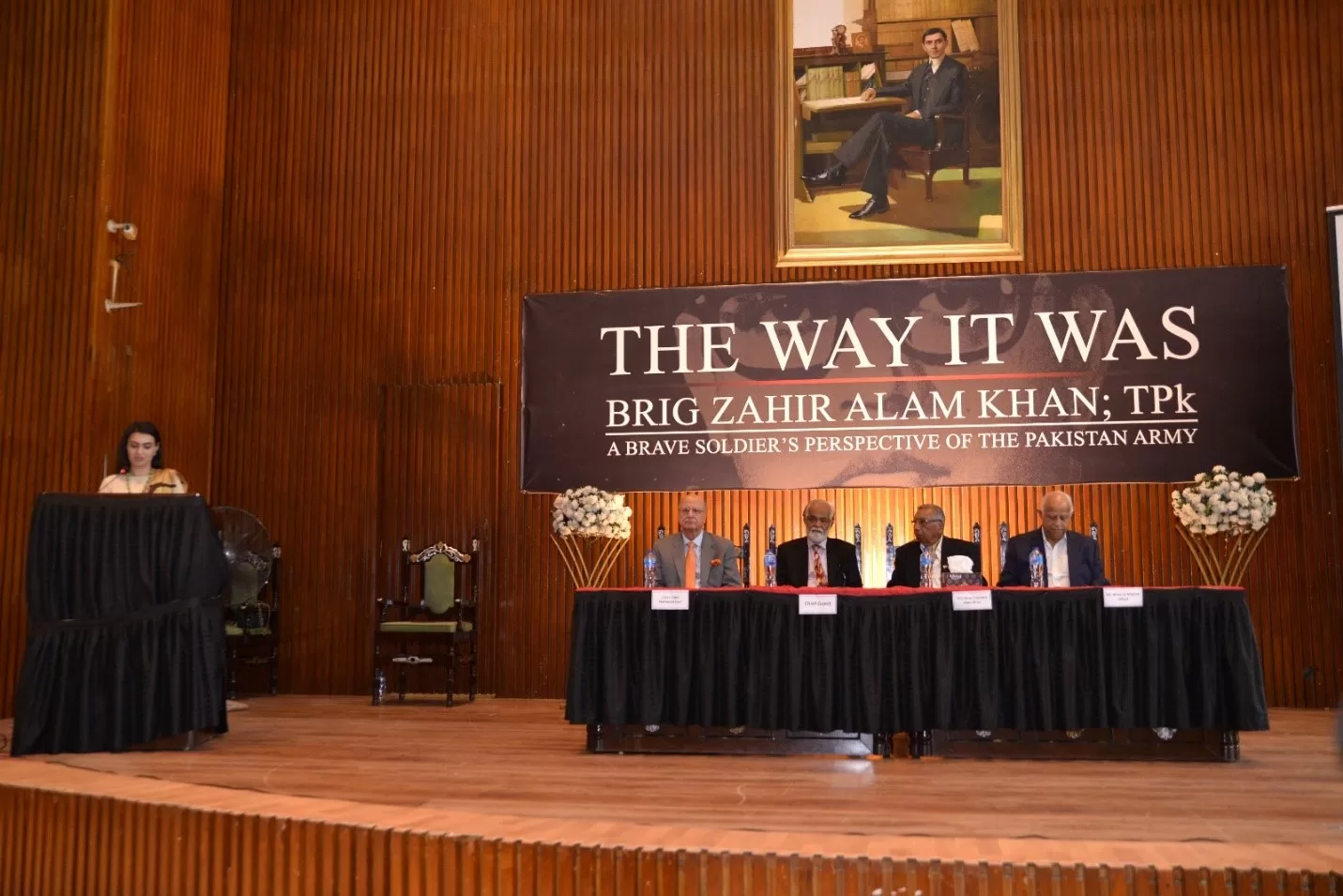
The relaunch ceremony of the book ‘The Way It Was’ was organized to commemorate the distinguished Alam Brothers, a group of remarkable individuals. All nine of them had served in the armed forces, boasting illustrious careers as soldiers. The keynote speaker for the event was the book’s editor, Lt Gen (Retd) Tahir Mehmood Qazi. Special guests included Ikram Sehgal, Vice Adm (Retd) Shamoon Alam Khan, and the Chief Guest, Gen (Retd) Muhammad Yusaf Khan (former Vice Chief of Army Staff). The book was first published in 1998 by Dynavis (Pvt) Ltd., a sister company of Pathfinder Group. Co-chairman of Pathfinder Group helped in editing the first draft of the book. The event was impeccably organized and attended by family, friends, and officers of the Armed Forces. Following the recitation of the Holy Quran, and playing the national anthem of Pakistan, the book’s editor extended a warm welcome to the audience, introducing
‘The Way It Was,’ a book authored by the late Brig Zahir Alam Khan.”


Lt Gen (Retd) Tahir Mehmood Qazi
Ladies and gentlemen, I would like to start by expressing my gratitude to General Yusuf, former Vice Chief of Army Staff, members of the great Alam family, distinguished guests, ladies, and gentlemen, Assalamu Alaikum and a very good afternoon. It is my privilege and unique honour to stand here and speak on the book, “The Way It Was,” about Brig Z. A Khan. Ladies and gentlemen, William Shakespeare in his drama, ‘Twelfth Night’ wrote, and I quote, “Be not afraid of greatness, some are born great, some achieve greatness and others have greatness thrust upon them.” This is exactly what happened to Brig Z. A. Khan and in the same order. Born in a renowned family,– Alam Brothers as they are now known – then trained from PMA, the world’s premium military academy, and then the SSG, the elite force of Pakistan, and finally the greatness thrust upon him during the turmoil in East Pakistan in 1971 and subsequently the war in the Western theatre.
The book was first published by Mr. Ikram Sehgal in 1998 and later it was selected by the Services Book Club and issued to all the member offices. The book was very well received. When General Javed Alam asked me to redo the book in 2022, I accepted it with a passion, for two reasons. One is that the book had a lot of strength in it, very candid and very truthfully explained. And the second reason was that Major Mahboob Alam, their father, was a colleague of my father and they were serving together in Survey of India and subsequently in Survey of Pakistan. So here was an opportunity for me to pay homage to both of them. I am grateful to General Javed Alam and remain indebted for this honour bestowed upon me. Our deep gratitude to Mr. Sehgal for granting the permission to republish the book.

Ladies and gentlemen, biographies are like a mirror in which the generations and the nations see their images. The quality of the image in this case is directly proportional to the truth and objectivity which goes in the book, that way, the image in this book is very real and very clear. When I was going through the book, I came across a passing sentence where Brig Z. A. Khan described the situation in the Battle of Longewala. In the absence of air cover by PAF, IAF was having a field day. In utter frustration, he wrote, that now the aircraft were being engaged by the main gun of the tank. Being from Air Defence, I challenged it. Never heard of it before. How come the tank gun can meet the gunnery parameters of the engagement of an aircraft? And if it is so, then we should pack up and go home. So, my research started, and ladies and gentlemen, it did happen, and the firer was nobody other than Brig then Major Talat Saeed serving in 22 Cavalry. My research further took me to the victim Wing Commander Kuki Suresh. He was flying Hawker Hunter and he said that when I dived, I saw the gun being elevated. At the moment I fired, there was a flash from the gun and instead of listening to a sound, I heard a “thub” and was lucky to land back. We have included this as a footnote in the book and we have included the pictures and the story in the photo gallery which is where you get some latitude to play around. This is the only example in the world since the aircraft and the tanks came to the battlefield.
As I said, the book is very candid, just one example. Brig Z. A. describes his meeting with General A.K. Niazi. He writes, and I quote, “When I met General Niazi in the Eastern Command Headquarters, I failed to impress him. As I was a far cry from the idea of a commando, I wore glasses, had two teeth missing, did not have an athletic build-up, and was given to disagreeing and objecting.” One verse of Allama Iqbal I think sums up the book and that is “Aayin-e-Juwaam-Mardaan Haq Goi Wa Be Baaki, Allah Ke Sheiro Ko Aati Nahi Rubai”. And for those, the new generation not very familiar with the Urdu verses. In Persian, Fox is called “Ruba” and since “Rubai” means cleverness.” So, the verse is “Allah Ke Shero Ko Aati Nahi Rubai (cleverness).”

The special edition is an improved version as footnotes have been added, chapters are named and sub-paragraphs heading are given. Toward the end, a new chapter has been added giving a brief introduction of the Alam family. It took me almost a year. It was, and it has been, a labour of love.
My special thanks to Col. Iftikhar Haider for joining me in this noble cause, without whom it would not have been possible to produce the special edition in a befitting manner. I acknowledge and thank Lt Col Zahid Mumtaz Armored Corps, for his support in tracing out the officers of bygone years. He has a tremendous passion for keeping the record of Armored Corps officers. I must appreciate Subedar Karam Hussain, my PA during the military service, for typing, re-typing and again typing the script with passion and patience. My deep gratitude and appreciation to Mr Haris Alam Khan for designing the jacket in a black-and-white colour scheme. This also depicts the life philosophy of Brig Z. A. Khan. He believed in “either-or” with no shades of grey. And so is the theme of the book.

Before I leave the rostrum, ladies and gentlemen, there is a message in the book for all of us which I would like to share. In the epilogue, Brig Z. A. Khan describes how most of them joined the army. For some, it was a job like any other profession and for others, it was a trust given by the country to defend it. Some did the job and some fulfilled the trust. Ladies and gentlemen, all of you, irrespective of gender, when next you see yourself in the mirror, ask a question to yourself and be a judge. Where do you fall in this spectrum? You all must read the book. By doing so, one of Allama Iqbal’s prayers will be accepted, “Khudaya Arzu Meri Yahi Hai, Mera Noor-e-Basirat Aam Krde.” Let everybody be like Brig Z.A. Khan. Thank you.

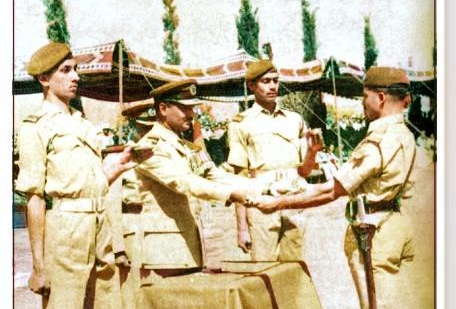
A Still Image of Z. A. Khan from a documentary on the lives of 9 brothers
A documentary prepared by Squadron Leader (Retd) Shuaib Alam Khan (Brother of Z. A. Khan) and narrated by his wife was then shown. The documentary shed light on the lives of 9 Alam Brothers and their life achievements while serving in the Pakistan Army.

Ladies and Gentlemen, it is my singular honour to represent my sister-in-law, Nuzhat Alam and nieces Naila Alam and Muneeza Alam, to celebrate this early afternoon, and I term it as Happy Hour. The Navy has been roped in, under the orders of Lt Gen Javed Alam, the youngest brother of the Alam clan to pay tribute to our eldest brother, Brig Zahir Alam Khan, who is better known as Z. A. To do this, I will be disappointing some of you by saying that I have not come here to praise Z. A. On my part, there will be no glorifications and no pretences. To do away with some long faces in the audience, I will tell you that the Alam family will reassure you that Z. A. did not like praise, he did not like buttering and he did not like apple polishers. Therefore, I have no option but to disclose to you some dark home truths about the Alam family.
To describe the life, we led in the Alam home in Murree Hills, I will draw on a Farsi saying, “It is better to be a dog than to be a younger brother.” A younger brother is treated like scum. He has to do all the dirty work and is bullied. By good fortune, I brought up the middle order of the Alam clan and therefore I was saved half of this agony. Imagine what Aftab and Javed had to go through since they brought up the tail end. One of the blessings of being a younger brother is that one does not have to worry about his wardrobe. The clothes came automatically down the line. They were well used, with holes and patches at the rear end of the trousers and the knees. Therefore, the modern fashionable trend of wearing patched clothing came early and easily to us. Of course, with the clothing, if they were too loose, we were told, wait, you will grow into them. One positive which came with the clothing was the experience that made us so much the wiser. When I look back at my brothers before me, Z. A., Feroz, Shoaib and Shameem, I am today a beneficiary of these outstanding men in uniform. Aftab and Javed were of course the tail-enders and the end beneficiaries.

Z. A’s close friends considered him, and indeed the Alam family, to suffer from a disease which they fondly termed the “Alam Kink.” I will explain this rare disease in five short episodes. I will start with my deeply religious mother. A newspaper reporter asked her, do your sons say their ‘Namaz’ (Prayers), do they keep ‘Rozas’ (fasting) and have they performed ‘Hajj’ (pilgrimage)? Her reply was, that her sons are not Hajjis, they are Pajis, which meant they are very naughty.
The second is when Z. A. Khan, as a green second lieutenant in an exercise, loses a confidential map. To make good the loss, he went to our father to obtain a replacement copy. My father told him that since he lost the map, which was an accountable item, he should therefore face the music. The third relates to then, Lieutenant Javed Alam being ordered by his Battery Commander to cut down some trees to build bunkers for the troop’s accommodation. The matter was duly reported and an inquiry was instituted. The CO bluntly denied giving any such orders and the blame came down to Javed. Javed went to Big Brother, who was then the Colonel Staff. Big Brother’s ruling was that since he had cut down the trees, he should face the music. The fourth occurrence was when Z. A’s GOC proudly presented his 1971 war plan and made the mistake of asking for comments. Z. A., then a Lieutenant Colonel, was quick off the mark and he found a lot of faults in the plan. The GOC asked him how he rectified these faults. Z. A’s kinky reply was, that it was not his problem, but it was the GOC’s job to do so. One would be surprised that after such a kinky reply, Z. A., even made it to the rank of Brig.

The last episode involves me. Z. A., on 25th March 1971, while commanding two commando battalions, arrested Sheikh Mujibur Rahman. Soon after that, he moved to Kaptai Dam with orders to attack and retake Rang Amati from enemy control. At this time, I had accompanied General Akbar, DG ISI, to Chittagong, and at the same time, intelligence information was received that the enemy had withdrawn from Rang Amati. I volunteered to carry this intelligence information to Z. A. and to tell him to exercise caution while attacking. On arrival at Kaptai, I found Z. A., and his commandos, ready to launch a waterborne assault across the lake from Kaptai to Rang Amati, which was the first and last assault of its kind in our military history. On reading the message, he asked me if the intelligence was authentic and had the enemy had withdrawn. I replied that I was only the messenger and it was not my problem, but his job to decide and then face the music. I soon realized that he didn’t have the foggiest idea as to how to sail his commandeered boats and navigate those tricky waters. I therefore asked him if I could help by accompanying him. To my most generous offer, he remarked, OK, it is your funeral. We landed at sunset and took Rang Amati without any loss. By this time, my stomach was growling with hunger. I then asked Big Brother, what do we do for dinner. After all the help that I had rendered, his reply certainly sounded kinky. He said that amongst us Commandos we have a rule that each one fends food for himself. And that brings me to the end of my kinky tribute to Brig Z. A Khan. May his soul rest in peace.


Ikram Sehgal, Co-Chairman of Pathfinder Group and the first Publisher of the Book
In his speech at the relaunch ceremony of “The Way It Was,” Ikram Sehgal, who fondly reminisces about his childhood with the Alam Brothers, provides a glimpse into the unspoken and remarkable stories of East Pakistan during a tumultuous time. He shares an intriguing anecdote involving Brig Z.A. Khan and their mission to rescue Mizo Chief Laldenga’s wounded relation (most probably daughter) from a perilous situation, this ultimately forged a significant alliance. Because of this act the Mizo Brigade fought alongwith the Pakistan Army in the Chittagong Hill Tracts throughout the war. Laldenga begged his Pakistani counterparts not to surrender. The speaker acknowledges the influence of individuals like Col Nusratullah and reflects on the invaluable lessons in character, patience, and integrity learned during those memorable years spent in their company. These individuals, including Brig. Z.A. Khan were known for their humility and aversion to self-praise, qualities that left a lasting impression on the speaker.

Chief Guest Gen (Retd) Muhammad Yusaf Khan, Former Vice Chief of Army Staff
Highly esteemed and most respected begum Z. A. Khan, venerate members of the Alam family, Mr. Ikram Sehgal, Vice-Admiral Shamoon Alam Khan, Wing Commander Aftab Alam Khan, Lt Gen Tahir Mahmood Qazi, Ladies and Gentlemen, Assalam o Alaikum. Almost a month ago, I had rung up Javed Alam for something. He had a request and he wanted to invite me to the launch of the new edition of Brig Z. A.’s book, The Way It Was. I thanked him and told him that I would certainly attend as it was one of the best books that I had ever read. After some time, he rang me up again with the opening sentence that he had a request.
I thought he had forgotten that he had invited me to the book launch. I did not know that besides his other qualities, he was also an exponent of the indirect strategy. His request now was that I be the chief guest at this function. I pleaded with Javed Alam that considering the brilliance of the book and the professional distinction of its author, I did not consider myself worthy of the honor. I requested him to find someone else more eminently suited for this honour. He did not relent despite my pleas.

I read this book in July 2000 when it was issued by the Army Book Club. The book was so interesting and riveting that I read it through in I think about three days. This is one of the best books I have read, if not the best. Like most, I love reading autobiographies. This is an autobiography of Brig Z. A Khan, mostly related to soldiering in peace and war. I hope I am not being unjustly judgmental when I say that a lot of books written by Pakistan military authors unfortunately are subjective. They are either attempting self-glorification, self-justification or by exaggerating the facts or by whitewashing their shortcomings. Such books are rarely read, mostly scanned, and often find their final abode gathering dust in the Almira’s and the bookshelves. The way it was, was based on truth and reality, and goes into the nitty-gritty of soldiering, starting from the junior levels and going right up to the top, with brutal frankness, candour and total objectivity. This makes the book unique. I related more to this book and found it more alluring as most of it was associated with armor. I, my father, and my forefathers were from the cavalry.

‘The way it was,’ from start to end, is interspersed with a subtle sense of humour characteristic of the Alam brothers. Brig Z. A. describes the life of an Armored Corps officer at all stages, as a young officer in 13 lancers, as a squadron commander in 23 Cavalry and as commanding officer of 22 and 38 Cavalry, highlighting the training, man-management and command aspects of both in peace and war. He covers joining the SSG at a nascent stage, raising, training and commanding a commando company. I have known three brothers of the Alam Khan Family intimately. Capt Ejaz Alam Shaheed was my coursemate and a very dear friend. I served as BM and commanding officer with General Shamim Alam Khan when he commanded the 10th Independent Armoured Brigade Group. Lt Gen Javed Alam served with me as a Brigade Commander when I was commanding the 1 Armored Division and later as Commander of 1 Core when I was the Vice Chief of the Army Staff.
Tragically, the only time I was directly involved with Brig Z. A. was when he had died. I recall when I was COS, I received a letter from his daughter. The letter stated the circumstances leading to Brig Z. A’s death in PNS Shifa, wherein no specialist attended to him for over two hours while he was undergoing a massive heart attack, despite the whole family running from pillar to post to get some specialist to see him. I recall she had mentioned that her father considered and termed all civilian doctors as quacks and had trust only in the army doctors. She also remarked that nothing could bring her father back and she was only writing so that this kind of a thing does not recur. I endorse this letter with very strong remarks to have the whole happening investigated and those responsible for the lapse punished. The inquiry put up to me was a complete cover-up, stating that no one could be held responsible. I did not agree at all and after obtaining facts from the family through General Shameem Alam had those responsible punished. I later learned that the Commandant PNS Shifa, who was likely to be promoted to Maj Gen, was superseded.

I had never served close to Brig Z. A. or under him. I had only seen him as a Lieutenant Colonel from a distance. I only met Brig Z. A. socially two or three times after he had retired and always in Karachi. Having read the way it was, I feel I know him as well as the three brothers, if not more, by just reading his book.
I will say a few words on the insight into Brig Z. A.’s personality and the impressions that I formed only by reading the book. Those of you who knew him could comment on whether I am correct or not. Brig Z. A. was a great leader of men, both in peace and war. He exhibited exceptional leadership qualities, particularly under adverse environments. In my opinion, he was also a model armour officer, a blend of technical and tactical competence, extremely decisive, always making decisions in complex and unfamiliar environments, in the absence of orders, and at times in defiance of orders, if the situation or the mission or the cause so dictated it. He was very bold and innovative in his approach and often came up with out-of-box solutions. He was always mission-oriented in his approach and conduct. Anything which detracted from it, he always opposed wherever it came from, even when it came from the seniors. When you don’t agree with the seniors, you are required to state your views and objections firmly while staying within the norms of discipline. Having done that, however, you can’t expect your senior to always agree with you. There were commanders who, blessed with the equity of practical judgment, could dispassionately and even-handedly figure out that if they followed orders, it might be detrimental to the cause. They risked their careers disobeying such orders. Brig Z. A belonged to this dying breed of officers who were officers of character with the courage of conviction, who were considered difficult subordinates for anyone trying to command them through the weight of their ranks. They were more disciplined when seen in the context of mission accomplishment. This dying breed, which became extinct in the early 80s, exemplified the theme, that the king can sever my head after the battle if he wishes but during the battle, he may kindly allow me to make use of it. Brig Z. A. stood out, unlike most career-oriented officers, for his scrupulous attention to detail in administration, man-management and logistics, both in peace as well as war. We have suffered because these aspects were neglected, particularly in wars. Service with SSG had honed his practical bias. He was not a slave to conventions, SOPs and procedures. He followed them whenever they were worthwhile, but disregarded them if they did not make sense. He always followed the dictates of common sense. We all in the Army know, as well as in the Civil, that subordinates are given tasks. How these are to be performed is left to the subordinates. However, since the 60s, senior commanders started violating this concept and micro-managing the tasks delegated to the subordinates, this tendency got worse as time passed.

Brig Z. A. never allowed his seniors to do this. A few words on the 1965 war. The raison d’etre (the reason for the existence) of a soldier as well as the commander is war. Commanders at all levels are required to prepare themselves, the equipment and their outfits for war. Although Brig Z. A. was on a course in the United States during the 1965 war and rejoined after the ceasefire, you can discern his professionalism in that he delved into various aspects of the 1965 war and the book included a very authentic account of the 1965 war, covering all sectors with excellent analytical comments. He commanded two commando battalions in the trying circumstances of East Pakistan, mainly in Chittagong, Rang Amati and in the capture of Sheikh Mujib ur Rehman in Dhan Mandi in Dhaka. He was then posted out due to friction with some senior commanders and posted to command the 38 cavalry of Reti Rahim Yar Khan. 38 Cavalry was raised just before the war with a mix of discards and some average soldiers from other units were equipped with Sherman II tanks which frankly were not fully battle-worthy. He should have been given command of the 22 Cavalry which he had commanded earlier instead of the 38 Cavalry. His conduct in East Pakistan before the war and with the 38 Cavalry personified the saying, when the going gets tough, the tough get going. Brig Z.A., while mentioning the attack by 13 lancers in Barrapind, Zafarwal sector in which Captain Ijaz Alam Shaheed was martyred, wrote that 13 lancers were trained to charge an objective. They used their tracks, not their guns. When I read that, my thoughts went back to the late 70s or early 71s.
13 Lancers had come to Kharian and the officers of 13 Lancers were dining in the Guide Cavalry Officer’s mess. I vividly recall one Sunday morning, Ijaz Alam and I were having breakfast together alone in the mess, and he remarked that in a tank-to-tank battle or a tank-versus-anti-tank battle, it was a firefight in which the side which had better gunnery and shooting would win the contest. He further said that movement is only used to get to an advantageous position for this firefight. He remarked that they were being trained as were we in the 6 Armored Division that the manoeuvre should be an extension of the firebase, and the attacking force should be close to the firebase, which frankly made it a frontal attack. On asking my views, I told him that I fully agreed with him as I feel that in such an attack the defender can bring down aimed fire on the attacker while the attacker cannot and if the defender does not lose his nerves and stands his ground and there is not enough suppressive fire, the defender would be able to cause a lot of casualties on the attacker. Ironically, Ijaz Alam was martyred in a similar attack, as was Major Ziauddin Ahmed Abbasi, Brig Z. A sportsman and a great friend, and Lieutenant Hussain Shah of my unit in the 1965 war in a similar attack on Gil and Libby.
I read this book as a Lt Gen and benefited greatly. I wish I had read it as a junior officer, which was chronologically not possible. Having been presented with a copy of the new edition, I must commend the editor Lt-Gen Tahir Mahmood Qazi for the exceptional quality of work. I have read two other books which were republished by Lt-Gen Qazi, The Stolen Victory by Brig Sultan Ahmed Hussain Bar and Witness to Carnage by Brig-Ali Agha. We must applaud his efforts for discovering these gems now it is the way it was and republishing them as most of these books are out of print, out of stock and even vanished from some of the libraries. They will Inshallah now become available to those young officers who are keen to read them.

The cover design by Haris Alam is excellent. The colour of the cover is black and white, which Gen Qazi mentioned, and I feel they symbolize the book. The way it was is black and white, with no ambiguity. I thank the Alam Brothers for inviting me as a chief guest.
I also thank them greatly for republishing the way it was, not as a money-making venture, but as a labour of love in remembrance of Brig Z. A Khan. I learned that this is being donated to the military and civil libraries as well as to some units and formations.
I would also like to thank you all, the Army of admirers of Brig Z. A Khan and the admirers the way it was for taking the trouble to grace this occasion.

Finally, let me have the honour of paying my tribute to Major Mehboob Alam Khan and Begum Mehboob Alam Khan, without whom the legend that we recounted would not be complete. One can only wonder and marvel at the extent of their love, dedication, inspiration, struggle and sacrifice which enabled this large “Band of Nine Brothers” to excel in their professional lives in combat as well as character.
It was Major Mehboob Alam Khan who set the trail blazing when in Burma during the Second World War he beat back a Japanese attack on his survey team for which he was mentioned in the dispatches. Allah Subhanahu Wa Ta’ala says in the Holy Quran that “when you come before me nothing else will matter except do you come with a pure and sound heart,” Qalb-e-Saleem. I believe Brig Z. A Khan will be looking down on all of us from the heavens with his mischievous smile with great fondness and favour.

May Allah bless all members of the Alam Khan family who have departed in a high maqam in Janatul Firdos. May he protect the ones who are living. Bless them with happiness, good health and a very long life. Ameen.