

Editor’s Note

Lt Gen Tahir Mahmud Qazi, HI(M), (Retd)
William Shakespeare in his play, “Twelfth Night” wrote;
“Be not afraid of greatness, some are born great, some achieve greatness and others have greatness thrust upon them…..”
And this is exactly what happened to Brig Z.A. Khan; all three came in the same order. Born in a renowned family (Alam Brothers, as they came to be known) then trained from PMA, the world’s premium military academy, and SSG, the elite force of Pakistan, and finally the greatness thrusted upon him, during the turmoil in erstwhile East Pakistan in 1971 and subsequently the War in the Western Theatre.
The book was first published by Mr Ikram ul Majeed Sehgal,’ DYNAVIS (Pvt) Ltd, Pathfinder Fountain Clifton Karachi in 1998 and later it was selected by The Services Book Club’ and issued to all the member officers. The book was very well received. When Lt Gen Javed Alam Khan asked me to re-do the book in 2022, I accepted it with a passion. Maj Mahboob Alam was a colleague of my father in ‘Survey of Pakistan’ and were good friends even before I was born. I am grateful to Gen Javed Alam and remain indebted for this honour bestowed upon me. Our deep gratitude to Mr Sehgal for granting the permission to republish the book.
The quality of a book is judged by the amount of truth and objectivity which has gone in. That way the book makes an excellent read for all ages and class. It is entertaining and very candid book, which surely will be a good addition to any library.
The ‘Special Edition’ is an improved version, as footnotes have been added, chapters are named and sub para headings given. Towards the end, a new chapter has been added giving a brief introduction to the `Alam Family’.
My special thanks to Lt Col Iftikhar Haider’ for joining me in this noble cause; without whom, it would not have been possible to produce the ‘Special Edition’ in a befitting manner.
I must acknowledge and thank Lt Col Zahid Mumtaz’, AC, for his support in tracing out the officers of bygone years. He has a tremendous passion for keeping record of Armoured Corps officers.
I must appreciate Subedar Karam Hussain, my PA during military service, for typing, retyping and again typing the script with passion and patience.
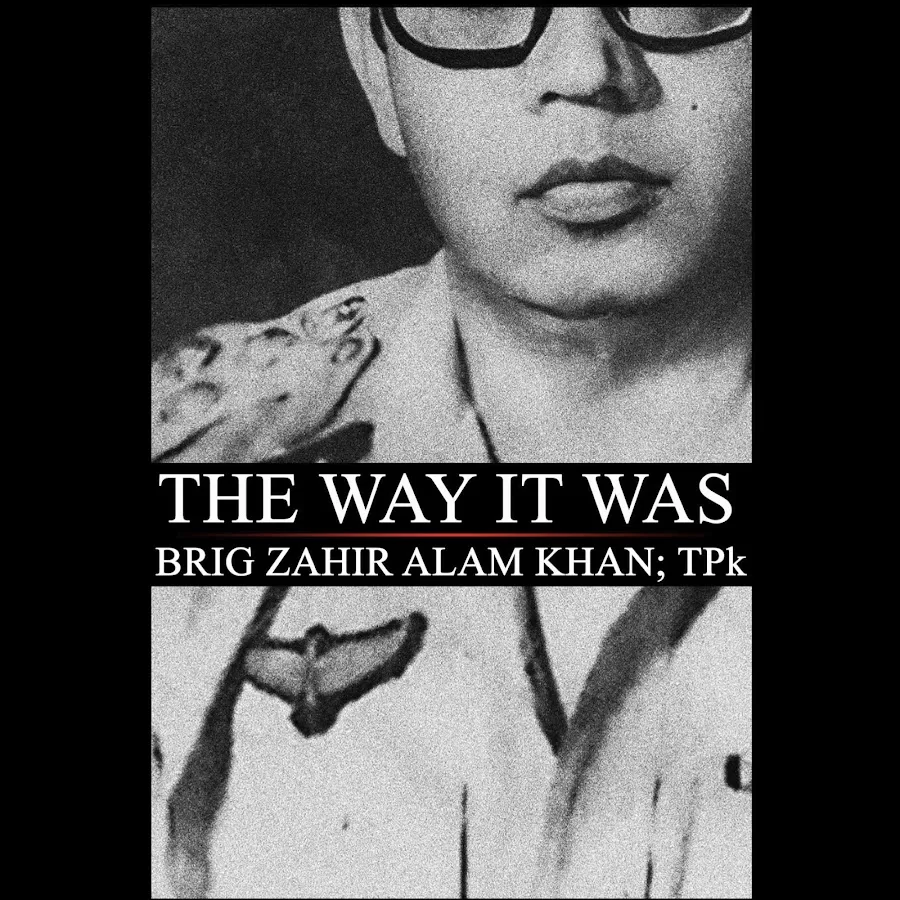
My deep gratitude and appreciation to Mr Haris Alam Khan4 for designing the jacket in ‘Black and White’ colour scheme. This also depicts the life philosophy of Brig Z.A. Khan; he believed in Tither/or’ and there was no grey area that he floated: so is the theme of this book.
Foreword

Maj Gen A.O. Mitha, HJ, SPK, SQA, (Retd)
From the original book that was published in 1998.
This book is a about soldiering in the Pakistan Army from the days less than two years after the creation of Pakistan. It is an autobiography that describes the various stages in an officer’s career, it analyses the training, tactics, methods and discusses the shortcomings in retrospect.
Several themes run through the book. It describes working and living conditions of officers and the men, the training imparted to the army and where and how mistakes were made in the concept of operations and methods of training. It describes the attitude of officers, the relationship between seniors and juniors, and the demand of some seniors for personal loyalty over loyalty to the army and the country.
In the description of the 1965 war with India the book digresses from an autobiography but discusses the war in a perspective that makes it thought-provoking and soul searching.
The 1971 Rajasthan operation is described in detail, this is the first time that this has been written about and it should also provoke some serious thinking.
Throughout the book there is an undercurrent implying that the administrative and legal powers of senior’s officers is excessive and is misused because it is without checks and balances, and the right of defence.
The Pakistan Army, in the book, has not been made out to be an army of perfect soldiers and officers or full of self-sacrificing heroes but a fighting army that reflects the society and culture as it has developed since the creation of Pakistan.
The book is interesting and should appeal to soldiers and civilians alike.
Early Life and Education
Background
I appeared for the Senior Cambridge and the European High School examinations in December 1945 and passed both. After the examinations were over and before the results were announced, I sent for the application forms for the Indian Military Academy and was disappointed to find that I would have to wait for over two years before I became eligible to apply.
At this time, my father, who was serving in the Indian Army, in the Corps of Engineers, in FM Slim’s 14th Army HQ at Rangoon, was transferred to Singapore, On his way to Madras, where he was to board a ship for Singapore, he came to Bangalore, where our family had resided since 1941 when my father was called up for service in the Army and was posted to Iraq. One of the problems that he had to resolve was my further education. I informed him that I had decided to join the army and did not wish to go to college. He told me that he wanted me to be an engineer and since I was not old enough to join the army, I had to decide which college I would like to go to. He said I could not sit at home doing nothing for two years and should go to Aligarh where he and my uncle band been educated. I argued for a local college and he agreed because I was the eldest and was expected to look after the family in his absence. I joined St. Joseph’s College in Bangalore in the first year.
In Dec 1946, my father was reverted to his civil job in the Survey of India and was posted to Rawalpindi with the summer headquarters at Murree. Since the schools and colleges in Murree opened in March he asked us to move to Murree in the first week of March. All our belongings were packed, the furniture, collected over years, was divided into three lots; one was returned to my grandmother, another was auctioned at throw away prices, much to my mother’s annoyance and the third lot booked by train to Rawalpindi.
We boarded the train from Bangalore to Bombay, with all our friends at the railway station to see us off, promises were made to write and hands were waved. The train steamed out of the station creating a distance between us and Bangalore, where we had lived for over five years and carried away happy memories of our life there.
Life at Bangalore
We had lived on the perimeter of the cantonment, a few minutes by bicycle and we were out of the town and in the open country side. There were lakes, wells and streams to swim in, birds and animals to shoot and all sorts of things to do, from flying kites to collecting human skeletons from a Hindu cremation ground. On one occasion my younger brother, Shuaib, found a fine specimen of a human skull and brought it home to put it in his shelf in the clothes cupboard that he shared, my mother opened the shelf and out fell a human skull. Shuaib was called and ordered to get rid of it, he took it outside and hid it under the water meter cover. After hiding it, every little while he would go and look under the cover, my sister noticed this and looked under the cover, there were loud shrieks and Shuaib was suitably disciplined.
On cycles we ranged up to Mysore, the State capital, with its palace, a temple on a hill, the Maharaja’s stable with elephants and zebras, the Krishnarajasagra Dam with its colored fountains and to Seringapatam, the capital of Tipu Sultan. One year our school, Bishop Cotton’s, arranged a trip to the jungle on the border of Mysore State. We went by train and then by bus to a rest house on the bank of the river kaveri at a place called Fraserpet. For this trip we had contributed the princely amount of twenty rupees and food items. At the rest house we were met by an Englishman called Maddock who had a plantation across the river from the rest house and lived there with his wife. He had settled at Fraserpet after the First World War and had a lot of stories about the jungle. One story he told us was about a rogue elephant that he was called upon to kill, he tracked it for two days without catching up with it. On the third day le stopped to have his afternoon meal. He and the shikari accompanying him left their rifles propped against a tree and started eating. He said that suddenly the elephant that he had been tracking charged out of the bamboo and lantana bushes, picked up the weapons with its trunk, threw them into the bushes and then attacked him. The elephant first thrashed him with its trunk, then tried to stomp him, then attacked him with its tusks and finally picked him up and threw him into the bushes. The local hunter who had accompanied him had safely climbed a tree. He showed us the scars on his body and we were duly impressed.
The next day he took us into the jungle, we saw plenty of deer but no tigers and elephants. At one place he suddenly told us to be quiet and stand against tree trunks. We wondered and obeyed. The ground under our feet shook, there was a sound of hooves and a herd of bison thundered past. Late in the afternoon he shot a deer and we all gathered around it. One of the boys went up to the carcass and touched it with his foot. Much to our surprise there was instant hubbub amongst the villagers who had accompanied us. Mr. Maddock explained that the deer had been defiled and would not be touched by the villagers and people of another caste would have to be sent to collect it.
Bangalore was a large military cantonment. There was an Officers Training School (OTC), a lot of British and Indian troops, Italian prisoners of war who roamed the streets without escort, and later the United States Army and Air Force personnel arrived in large numbers. The Americans became very popular with the Anglo-Indian population and were well liked by all the people that they came in contact with due to their generosity with chocolates and similar items which were not locally available. One peculiarity of the Americans used to be that they would stand on the pavement leaning against the shop walls and watch the street scene.
In the cantonment where we lived, there were either retired English or Anglo-Indian couples or army wives with husbands either posted away all over the world or prisoners of war or missing in action. We, twelve to sixteen years old, were under our mothers’ care who do not have any control when you are out of the house. Keeping ourselves busy required ingenuity and there was no lack of it. No garden or backyard with a fruit tree was safe from us. There was a large lake near our house, we discovered that snakes came to the water’s edge to catch frogs and devised a system of shooting snakes with air guns under torch light. The poor snakes, especially the ones with frogs half swallowed, did not stand a chance, one night we killed fifty six.

Memorable Train Journey
The end of the Second World War brought major changes. The Americans and the Italians disappeared, the American radio station closed down, some people moved away but the biggest change was that our friends who only had mothers suddenly had fathers. We were adjusting to these changes when we were also required to move. We packed and caught a train, as the train steamed north, little did we realize that we were lucky in moving when we did and that the world as we knew it was about to go crazy and change entirely in a few months.
After half a day and a night we reached Victoria Terminus in Bombay. On that day there were communal riots, and though we had a whole day to spend in Bombay, we could not leave the railway station. In the evening we boarded the Frontier Mail, the next day in the late afternoon the train passed through a city made out of red marble, whereas the rest of India was drab khaki mud colored. We also found several compartments full of school children returning to Lawrence College in Murree which we were also to join.
At the dawn of the second day the train halted at New Delhi, the station was deserted, and inquiry from the railway officials on the platform produced the information that the Sikhs were rioting in the Punjab and the train would not go any further. The only evidence of rioting I could find was one man on the platform bleeding from his back. After waiting for some time word spread that the train would continue on its journey with its vacuum brake system disconnected so that it could not be stopped between stations. When the train moved out after a few hours we could see Sikhs marching in single file with swords and spears. Jullundur (now called Jalandhar) was on fire and so was Amritsar, Lahore was reached at night, the station was dark, the train arrived at Rawalpindi early in the morning. My father was at the railway station to receive us and told us that there had been rioting in Rawalpindi and Murree, a lot of buildings had been burnt, there was curfew in Rawalpindi and we would have to move into a hotel till the curfew was lifted and the road to Murree opened.
The Beautiful Koh-Murree
We moved to the Mall Hotel, where my father was staying and had booked rooms for us. We stayed in the hotel for about a week. The curfew continued, columns of smoke would rise and word would spread that so and so Sikh or Hindu’s business premise or house had been burnt. Word also came from Murree that hundreds of houses belonging to Hindus and Sikhs had been burnt. Gurkha6 soldiers wandered on the streets and roads of Rawalpindi, when they saw a Sikh he was stopped and searched. Usually a Sikh, on spotting the Gurkhas, ran, was chased a short distance, caught and searched and a sword of sorts, placed up his sleeve, was found and he was marched off, unceremoniously.
After we had been about a week in Rawalpindi it was decided to move to Murree. We went by bus. In those days there were two bus companies that operated between Rawalpindi and Murree, one was called Murree Hill Transport and had its buses painted a light green colour, the other one was called Pindi-Murree Transport and its buses were painted red. We boarded the bus in the Cantonment and went through the city which ended well before the present Satellite Town. The first stop after the city was the “Seventeen Mile Stone”7, a barrier stopped the traffic and a notice informed everybody that a toll had to be paid. In case of bus passengers, it was included in the fare.
At this stop boiled eggs were sold which were bought and eaten as ritual. After a halt of about a half hour the bus continued its journey. The climb to Murree began, the bus engine whined as the bus spun around the hairpin bends. The hillside was covered with shrubs and as the bus gained altitude, the shrubs changed to pine trees. We passed places whose names sounded strange at that time but will remain with us all our lives, Tret, Company Bagh, Charrapani, Ghora Gali, Sunny Bank. When we arrived at the Murree bus station our luggage was unloaded and Kashmiri porters called “hathos” were hired. We went up a steep climb to the Mall, past the General Post Office to a small house that my father had rented on an annual basis. We saw snow for the first time and shivered in the cold.
As soon as Lawrence College opened my brothers Firoz, Shuaib and I joined it, my sister Bilquis joined St. Deny’s and my brothers Shamim and Shamoon joined Jesus and Mary’s Convent.

Lawrence College Ghorha Gali
Lawrence College, when we went there in March 1947, consisted of teachers training college, called Chelmsford Training College, usually referred to as the CTC, the intermediate college section, referred to as the College, the boys school and the girls school. The students were largely children of Anglo-Indian employees of the railways, telephone and telegraph department etc. from northern India extending to Bombay. In the teachers training college there were no Indians, in the college section about half the students were Indians and these had joined Lawrence College only for the Intermediate classes and had not studied in the school section. Khaquan Abbasi, who joined the Pakistan Air Force, retired as a Air Commodore, became a MNA and a Minister, Mohammad Riaz Khan, Abbasi’s cousin, who joined the Pakistan Army and became a Major General, were the senior students and remained till the Intermediate examination of 1947. In our Intermediate class there was Akram Hussain Syed, who joined the Pakistan Army and retired as a brigadier, Shaukat Ali Ghauree, who also joined the Pakistan Army and retired as a lieutenant colonel and M.A. Dodhy who became a doctor. Besides the Muslim students there were three Indian Christians and one Hindu. The Indians lived in rooms separate from the Anglo-Indians.
After the riots in early March, Murree remained peaceful. With the announcement that India would be partitioned the Hindus and the Sikhs quietly moved away. There were newspaper and radio reports of massacres and migration of Hindus and Sikhs from the areas that were to constitute Pakistan and of Muslims from India. Schools and colleges closed elsewhere but Lawrence College was not affected, the students remained unconcerned and waited for the school year to end so that they could go home.
The Independence
On August 14, 1947 we became independent. With independence, we who had been Indians became Pakistanis, nobody felt any different. On Eid day, soon after Independence Day, Eid prayers were offered with Gurkha soldiers deployed and machine guns covering the congregation on the Murree football ground. The maulvi and the congregation thanked God for the independence and prayed for a prosperous Pakistan.
A few days after the Independence Day, the Muslim Staff of the Survey of India, who had opted for Pakistan, started arriving. My father became responsible for the reception and housing them. Houses belonging to Hindus and Sikhs, lying closed and abandoned were opened and handed over. Many of them, in 1962, were to buy these houses. In the Survey Department the changes were dramatic, suddenly the British were gone, the top posts were still with a few of them but the senior posts that were normally held by the British were opened to Pakistanis. For some the benefits of independence were immediate.
The First Indo-Pak War-1947/48
In Oct the Kashmir war started. We could see fires burning in the villages in the distant Kashmir Hills and stories of atrocities committed by the Kashmir Maharaja’s troops spread. Bands of tribesmen on their way to fight in Kashmir passed through Murree. One weekend we had come home to Murree, at about 11 P.M., an aircraft was heard circling over Murree, ominously the air raid warning siren sounded. A little later there were loud explosions, the Indian Air Force had bombed us. The consequences of the bombing were seen the next morning. The bombing aircraft had dropped its bombs on the convoy moving on the Rawalpindi-Murree road, between Clifden and Murree, the bombs landing safely in the British graveyard.
On the day of the bombing, a well-known mullah had delivered a speech from the steps of the General Post Office in Murree, and told the people that the war in Kashmir was a Jehad. After the bombing a lot of people started leaving Murree. They left by bus, walked a portion of the road damaged by a landslide, their belonging carried by coolies, vehicles waiting on the other side took them away from the war zone. The mulla was said to have been the first man out.
Life At Murree
In the last week of November, students of Bishop Cotton’s, Simla, who were due to appear in the Senior Cambridge examination came to Lawrence College. Omar Ali Khan, who had been with me in Bishop Cotton’s, Bangalore, was one of them. The school year of 1947 ended in December, with the announcements that the CTC, the College section and the girls school would be closed down, a lot of the staff would not return. Only we, the Intermediate Class students who had to appear in the Intermediate examination in 1948 would return to complete our curriculum and appear in the examination.
As a hill station, Murree had a season, 15 April to 15 September. In April when the heat in the plains of the Punjab and the Frontier started becoming oppressive, the rich in the cities and landlords in the rural areas moved to Murree. There were very few cars, most people came by bus, some could afford a taxi. Houses were hired for the season, hotel rooms could be taken for shorter periods. The British Army had the ‘Uniacke Club’ for other ranks and the ‘Lady Robert’s Home’ for officers to spend their leave. No vehicles were permitted on the Mall Road, everyone walked or rode a rickshaw pulled by Kashmiris. The town had an air of a holiday every day. Everyone paraded on the Mall in the morning and then again in the evening with spells in the cafes. The same faces, the same groups trailing one another, children riding donkeys and adults riding ponies, could be seen monotonously. On weekends boys from Lawrence College, girls from St Deny’s and the convent would join the promenade. After spending nearly six months, doing nothing, in September the crowd would start thinning out and by October the Survey Department, the Army and government offices staff would only be left. The winter of 1947-48 we spent in Murree which was deserted after sunset, we moved into a house near the Survey of Pakistan office so that my father would not have to walk a long distance in the cold and the snow.
Survey Expeditions
That winter the Survey Party that my father was in charge of, was given the task of surveying the area of Rawalpindi, Campbellpur, Tallagang, Musa Khel, Mianwali, Kalabagh and Isakhel. Since the college was closed and I had nothing to do, I accompanied my father when he went on an inspection tour. When I was about five years old, I had accompanied my father during a mapping season, the area was around a place called Jhersuguda, in Orissa. At that time everyone walked, the baggage was loaded on camels, I was included in the baggage and had a seat on a camel. The terrain being surveyed was usually jungle and sometimes where the camp was established, the orderly assigned to me used to show me the pug marks of the wild animals that had visited the camp during the night. Bears used to be the most frequent visitors at night and troops of monkeys and langurs during the day. In West Pakistan the terrain was the arid broken country of northern Punjab. There was practically no wildlife. Movement was by motor vehicles called “weapon carriers’, bought by the Indian Government, from the US army surplus.
For the first part of the inspection tour we camped in Rawalpindi on the rifle ranges which were off Peshawar Road, near the present Radio Pakistan, some days the Army would bang away at the butts. Rawalpindi Cantonment with four English cinema houses, no hustle and bustle, was a quiet town except for bands of tribesmen, who were either on their way to Kashmir or were returning from Kashmir, they roamed the streets armed with their rifles and sometimes fired a shot. After a few days we left for Campbellpur by the Sind Express, we boarded a first class four-berth compartment whose sole occupant was a second lieutenant from 11 (Prince Albert Victor’s Own) Cavalry, a group of tribesmen, finding the compartment half empty, trooped in and ousted everyone from the window seats. The tribesmen talked to each other in their own language which at times seemed as if they were quarrelling rather than talking. Between Rawalpindi and Golra one of the tribesmen saw a dog some distance from the railway track, he fired at it with his rifle and missed, this drew a big laugh from the others and they promptly opened fire on the dog. The tribesmen on the other side of the compartment, as if not to be outdone, also opened fire. This continued till they were tired of the game.
Campbellpur10 consisted of a railway station, a small market and a small cantonment, on the whole it was boring. Our next stop was Pindi Gheb, on the bank of the Soan River, from there we moved to Musa Khel and then on to Mianwali. We arrived at the Mianwali Rest House in the evening, the next morning there were police and a crowd in the Rest House. We were informed that about a dozen people had been murdered during the night. Some official explained that Mianwali had the highest murder rate in the world. Next we went to the barrage at Kalabagh, there seemed to be some survey problem with the canal off-take and the left bank of the canal was flooded. The last place we went to was Isa Khel, a railway station and sand dunes.
1948 came and with it snow, we looked forward to the show as we expected a lot of fun. I found an old toboggan and bought it, but “When the snow came we found that it was only enough for snowball lights and ended our hopes of winter sports. In January Gandhi was shot dead and there was a sigh of relief when it was learnt that his killer was a Hindu.

Back to School
In March Lawrence College opened and we trooped back, Shamim joined us in the newly created Junior School. Some boys from the Royal Indian Military College (RIMC) and Sam Brownes, Dehra Dun, joined Lawrence College. Ahmad Kamal, Ahmad Nawaz, the Isanis, Mahmood Kamal, to name a few from RIMC and Zafar Meyer and his brothers came from Sam Brownes, Dehra Dun. The Meyer line of brothers became as long a line as our Alam Khan line’. To impress the new comers, an initiation programme was organized in which the finale was the branding of the new entrants with a knife cooled in snow. The person being initiated was made to feel the heat from a hot knife held near the body and then suddenly the spot was touched with the ice cold knife. This procedure brought a loud scream from the victim and it took him sometime to discover that he had not been branded.
For those of us waiting for our Intermediate examination, the stay was short; in April we moved down to Gordon College in Rawalpindi. The living accommodation, feeding arrangements and toilets really surprised us. The college feeding arrangements did not cater for any breakfast, for this we went to a milk shop near the college and drank a glass of hot milk. Our stay lasted about two weeks in which the examination was held, and after the examination we went home to await the results.
In June 1948 the Intermediate examination results were announced. I got a second division, missing a first by five marks and getting zero in Urdu. The problem of what I was to do next arose again, in May I became eligible to appear for the Army, but when I applied for the second PMA course I was told to come back when I was older. Applied for the Navy, passed the competitive examination in the second position and went to the Inter-Services Selection Board at Kohat and was told that the result would be sent to Naval HQ, Karachi, and would be intimated by them. I received no intimation. My father was still against my joining the Army and wanted me to continue my college education. In September my father moved to his winter camp, this time to Hyderabad, in Sind, where the survey work for the building of the new barrage at Hyderabad was to be started. My mother and my younger brothers not in Lawrence College accompanied my father. My brothers in Lawrence College and my sister in St. Deny’s were to join them when their schools closed. For a few days I accompanied my father on his tour of the Hyderabad – Badin area which was to be irrigated by the new barrage planned on the Indus at Hyderabad, later to be named the Ghulam Mohammad Barrage. The area was completely barren except for the land alongside the Phuleli inundation canal, built some hundreds of years ago. In 1948, some six years after the Hur operations were started by the British, the Hurs were still considered active and movement usually stopped after sunset, though the Hyderabad – Badin area was not a Hur area.
My father had requested the authorities for a house and a magnificent building, in what is now known as ‘Pucca Qilla’, was given to him on a temporary basis. The next year when we returned the building was in shambles, the refugees had occupied it and removed everything except the walls of the building.

Army – A No Go Territory
Several months after my Intermediate examination results had been announced, I was still avoiding going to college but finally my father decided that I had to go. I then spent a day seeking admission in colleges of Karachi but all the colleges informed me that I was late and could not get admission. I then went to Lahore where both Government College and Forman Christian College were willing to accept me. I decided on FC College because it had better accommodation.
I joined FC College, Kennedy Hall, in October 1948 and spent six months there. The teaching technique of the college was of indicating important passages from the prescribed books and asking the students to memorize them for examination purposes. Even in applied and pure mathematics which were my subjects, one had to memorize which formula had to be applied to which problem, no method of reasoning was indicated. Because of laziness, loitering over breakfast in the cafeteria etc. I soon had a poor attendance record and it was becoming apparent that I was not going to qualify the third year to go to the final year. At the end of the year the Army asked for applications for the 3rd PMA and the 1st OTS courses, I applied for the 3rd PMA Course and was selected for the 4th PMA.
In our batch at the Inter-Services Selection Board three of us were selected, Raza Khan, later Lieutenant Colonel; Tahir, later Colonel, Signal Corps, for the 3rd PMA course and myself for the 1st Pre-cadet Training School Course which was to be the 4th PMA course. The Pre-Cadet Training School was to be set up at Quetta, when I received the call-up letter from the Army to report to the PCTS at Quetta I left Forman Christian College and went home to spend the few days I had before my reporting date of 1st April 1949.
I arrived at our house in Hyderabad and surprised my parents by announcing that I had joined the army and was on my way to Quetta. My father, unexpectedly got very annoyed and told me to go back to college. He told me that he had served in the army and that temperamentally I was unsuitable, I was inclined to question authority and would be a misfit in the army.
My father had volunteered in 1936 to serve in the Indian Army as a reserve officer, his terms of service were that he would be called to colors in the event of a war and commissioned as a lieutenant in the Corps of Engineers for employment in the Field Survey Units at Army Headquarters. He was called up in August 1941, received a fortnight’s training at Risalpur and was sent to Iraq. In Iraq his commander was Brigadier Haney of the Royal Engineers with whom my father had had differences previously. Haney was a major seconded to the Survey of India, he was my father’s superior and had been rude to my father while carrying out an inspection, my father had threatened to take off a shoe and beat him with it. My father was transferred to another survey unit then but found himself serving under Haney in the army. For two years wherever Brigadier Haney was posted he had my father posted under him and lost no opportunity to give my father a dressing down. After the Japanese inflicted a defeat on the British in Burma, volunteers were called to fight on the Burma front. My father volunteered, he joined the 14th Army headquarters at Comilla, and went all the way to Rangoon, he was mentioned in dispatches and as a major commanded a Field Survey Company. After the war ended he was posted to Singapore from where he reverted to the Survey of India and was posted to Rawalpindi. With this background he disliked the armed forces and tried to dissuade every one of us from joining the armed forces but all his sons joined the armed forces, Firoz, Shamim, Aijaz, Javed and joined the army, Shuaib, Aftab and Mushtaq went to the Pakistan Air Force and Shamoon joined the Pakistan Navy (PN).