


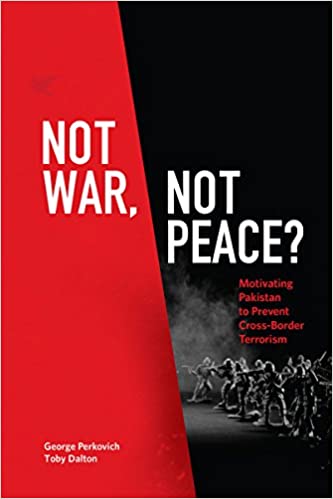
The questions of peace and its association to the subcontinent have always remained the gravitation points of international debate on South Asia in light of the protracted Indo-Pak conflict. An extensive two-sided hostility introduced the nuclear arms race in the region in which India’s detonation of nuclear devices forced Pakistan to announce its nuclear weapon status. The nuclearization of the subcontinent intensified the discussion on the regional environment of South Asia caused by national stances of New Delhi and Islamabad. Post-nuclearized wave of crisis between India and Pakistan alarmed the intellectual bells of international strategic community and the scholarly arguments of different regions encircled the South Asian politics. A recently published book co-authored by two scholars from Washington-based policy research centre, Carnegie Endowment for International Peace, tries to present a different picture of South Asian security environment.
George Perkovich is the Ken Olivier and Angela Nomellini Chair and Vice President for Studies at the Centre. The other writer, Toby Dalton, is co-director of the Nuclear Policy Program at same centre. Both authors attempt to analyse the violent and non-violent, covert and overt policy options available for India to prevent the South Asian wave of terrorism originating from Pakistan in their combined work under Not War, Not Peace. The book is divided into six chapters covering different topics. Each chapter tries to discuss in detail every probable scenario for India in which New Delhi attempts to change Pakistan’s behaviour in the regional politics. The discussion of both writers, Perkovich and Dalton, attempts to proclaim India as a victim of regional politics which are mainly created by Pakistan. Moreover, the analysis of both writers attempt to shift the burden of ongoing South Asian dispute on Islamabad’s shoulders by calling Pakistan a state reluctant or unwilling for generating enough initiatives for regional peace.
The book is an endeavour to explore the chances of peace in South Asia in the existence of nuclear capable New Delhi and Islamabad. The first chapter of the book explains a comparative survey of decision making mechanisms in both India and Pakistan after formally introducing the relevance of perplexing ‘not war, not peace’ situation to South Asian security environment. The subsequent chapters analyse five different situations involving Proactive Strategy inherited in Cold Start doctrine in chapter two, Air Power option analogous to Israeli and American airborne operations in chapter three, options of Covert Operations for launching of sub-conventional activities in chapter four, and Nuclear Capabilities along with Non-Violent Compellence in five and six chapters. While discussing all possible options or adoptable strategies, two main questions lead the core debate of the book: How should India respond to Pakistan’s launching of sub-conventional attacks, and, what are the cost-benefits values of each attack for India? The answers to these two questions drive the discussions in different directions while presenting the diverse views of civilians and retired military officials from India and Pakistan.

Both writers rightly highlight the main issue of peace shoes significance has diminished in the South Asian war-prone atmosphere, but the scholarly dimension of revisiting the hostile attributes of Indo-Pak conflict lack a balanced approach in the book. A brief examination of history presents substantial evidences of Pakistan’s efforts in introducing of long term chances for peace in the region. The leading state officials from Pakistan initially coined the idea of creating South Asia as a Nuclear Weapon Free Zone (NWFZ) which was ruined by India’s self-proclaimed peaceful nuclear explosions in 1974. Moreover, India’s belligerent role during the East Pakistan crisis witnessed New Delhi’s continuation of pugnacious policies toward bordering nations. The persistent growth of India’s nuclear journey starting from Buddha’s Smile (1974) to Buddha’s Laugh (1998) sparked an unending nuclear race in the region. Later on, the post-nuclearized development during Prime Minster Singh’s administration placed India closer to Bush administration and both states successfully concluded a nuclear deal in 2005 as a part of larger Washington-New Delhi strategic bilateralism. The actual strength of Indo-US nuclear deal is ignored in the study of Perkovich and Dalton. In addition to United States, India’s increasing strategic interaction cemented in military-to-military relations with Israel, South Korea, Japan, and Russia cannot simply be ignored. India, as a recipient of technologically advanced weapons from multiple directions has clearly pronounced its hostile ambition in the South Asian region. The connections of Indian military-industrial complex with the outside world are, no doubt, a direct threat to the peace in South Asia, but strangely enough the ever swelling conventional and non-conventional military capabilities of New Delhi have remained an unnoticed feature in this book.
The question of terrorism and its relevance to Pakistan is inadequately addressed by both authors. The problem of terrorism is unambiguously attached to Pakistan in the book without calculating Islamabad’s potential in the US-led war on terrorism. Pakistan is a frontline state in war on terror and has scarified its social and economic infrastructures, and Islamabad’s efforts in the counterterrorism domain have been outrightly disregarded by Carnegie’s two writers. The writers’ unwillingness to critically analyse India’s bellicose position in South Asian strategic landscape shows their India-centric intellectual compromises which has weakened the convincible logic of arguments contained in their book. A loosely structured lens of ‘rouge actor’ model adopted by George Perkovich and Toby Dalton for looking toward Pakistan presents the one-sided picture of India-Pakistan conflict.
The main theme of the book revolves around the unattainable dream of peace, but the examination of responsible actors for failing in the efforts for generating peace contains insubstantial considerations of two authors. The problematic South Asian security environment rooted in the protracted New Delhi-Islamabad rivalry has become a topic of immense importance, but lacks appositely a balanced approach of the international community. The book Not War, Not Peace comprises comprehensive intellectual inquiries of two well-known authors and no doubt, eminent researchers who surprisingly display a different side of the Indo-Pak hostility but the fragile contents of their book contain inappropriate and illogical arguments.