


In the chronicles of South Asian security crises, the recent Pakistan-India crisis between April and May 2025 marks a watershed moment. Operation Marka-e-Haq (War of Righteousness) from the Pakistan side was triggered after India’s baseless allegations against Pakistan for the so-called Pahalgam incident. This incident was a chain of miscalculations, misinformation and militarism ended in a decisive counter-response from the Pakistan Operation.
This operation was not only military maneuver but it was a strategic, moral and doctrinal rebuttal to a facade that was pursued to deceive the world and malign Pakistan. The crisis started with a known Indian script, a terror incident in Indian Illegally Occupied Jammu & Kashmir (IIOJK), rapidly followed by accusations against Pakistan without evidence, investigation and international consultation. However, the Pahalgam incident bore a mysterious resemblance to the 1995 Al-Faran hostage crisis, where six Western tourists were abducted in Kashmir by a group calling itself Al-Faran. One was later beheaded, and the rest were never found. The episode, long shrouded in mystery, was re-examined in ‘The Meadows’ by Adrian Levy and Cathy Scott-Clark which revealed how Indian intelligence agencies have manipulated the crisis for political gain, allowing it to unfold to serve broader strategic objectives. This incident, like Pahalgam saw India cast blame outward while suppressing critical scrutiny and international verification. Such patterns underscore a troubling legacy of false flag operations cloaked in counterterror narratives. After this incident what followed was Operation Sindoor, a so-called “counter-terrorism” campaign that involved standoff missile and drone strikes on Pakistani territory, leading to the death of innocent civilians, women, children, elderly, whose only crime was to live near a frontier India chose to violate. India always dressed itself as the perennial victim, but in reality an accuser and executioner, one that bypasses international norms and verification mechanisms. This time its mask slipped. The world began to notice the wolf beneath the wool which is a Hindutva-driven polity that has long used militarism and media manipulation to divert attention from its occupation of Kashmir and suppression of minorities.
However, Pakistan’s response came not in rage but in resolve. On May 10, 2025 under the broader umbrella of MARKA-E-HAQ, the Pakistani armed forces initiated operation BUNYAN-UM-MARSOOS, ‘a comprehensive, multi-domain operation rooted in deterrence logic and strategic maturity.’ The message lies under it was clear, Pakistan is not Gaza. Nor is it Iran. It is a nuclear-armed state with the will, the unity and the capability to defend its sovereignty and exact retribution when provoked.
However, contrary to India’s delusion of a “new normal”, a term arrogantly used to describe cross-border strikes below the nuclear threshold, Marka-e-Haq has revealed a more sobering reality that deterrence in South Asia is intact, layered and alive. India’s gamble to dominate escalation failed militarily, diplomatically and psychologically. Instead of establishing dominance, it exposed its strategic frailty. Pakistan’s response wasn’t just reactive, it was doctrinal. Pakistan showed a display of unprecedented tri-services coordination, Pakistan military launched precision strikes across various Indian military installations, 26 high-value targets were neutralized. These included Brahmos missile depots at Beas and Nagrota, S-400 air defense systems at Adampur and Bhuj, forward brigade HQs at KG Top and Naushera and airbases from Suratgarh to Srinagar. Longrange Fatah-1 and Fatah-2 missiles, loitering munitions and precision-guided artillery underscored the technological maturity of Pakistan’s conventional deterrence.
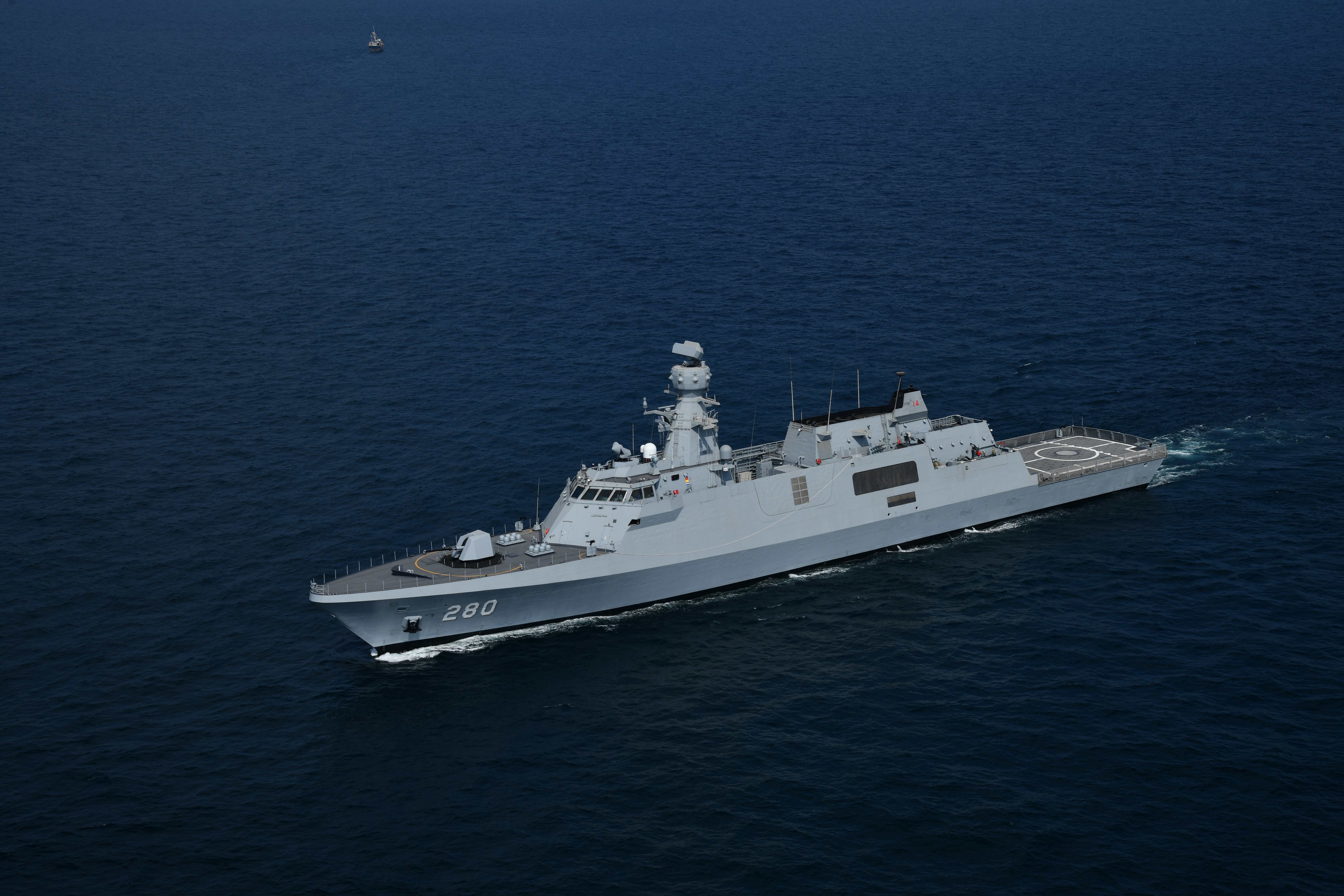
Pakistan Air Force’s execution was surgical, it leveraged standoff capabilities to avoid intensification while delivering strategic effects. Pakistan Navy maintained full-spectrum readiness in maritime zones as well by asserting domain awareness and deterring any naval adventurism. Cyber operations further reinforced this multidimensional deterrence by disabling Indian command and control networks, disrupting surveillance grids and revealing the hollowness of India’s hybrid narrative. Pakistan’s drones patrolled Indian skies, reaching as far as New Delhi not to strike, but to signal capability. Moreover, it wasn’t a war of vanity. It was calibrated restraint from Pakistan’s side by avoiding civilian targets, minimizing collateral damage and drawing clear lines between deterrence and escalation. Pakistan’s response was designed to inflict costs on military enablers of aggression, not to score political points but to deliver justice.
Operation Marka-e-Haq delivered what the Pakistani people were promised, ‘retribution for the blood of innocents.’ Additionally, it was a textbook lesson in modern warfare, a blend of kinetic, cyber, space and psychological operations executed with coherence, clarity and constitutional legitimacy. It was a moral campaign against a deceptive narrative and the battle of truth against propaganda.
Pakistan, despite being under siege from both sides facing kinetic strikes in the east and terrorism in the west, responded with composure. Everyone should be clear that restraint is not retreat. Silence is not incapacity. Pakistan chose not to escalate indiscriminately not out of fear, but because it understands what war means in the nuclear age. The world must take note that there is no space for conventional war between nuclear-armed adversaries. To create one is to invite catastrophe. India’s strikes under a nuclear umbrella, hybrid offensives and rhetorical brinkmanship are outliers in global nuclear conduct but not a model to emulate. The lesson of Marka-e-Haq is as much for the international community as it is for India. Pakistan will respond decisively, proportionately and lawfully, when provoked. Yet, it will do so while preserving the sanctity of international norms, avoiding civilian harm and keeping firebreaks between conventional and nuclear domains. India’s desire to reshape the regional order through aggression and misinformation has backfired. Its image as a responsible actor is in shambles. Strategic autonomy has given way to dependence on external mediation. Its doctrine of “surgical strikes” and “escalation dominance” lies in ruins.
For peace to endure in South Asia, it is imperative to recognize that deterrence must be mutual, justice must be pursued through dialogue and the disputed status of Kashmir must not be erased through denial or repression. Marka-e-Haq was not just a military operation rather it was a statement, “statement to India, a statement to Israel, whose recent regional militarism may have inspired India’s gambit.” And a statement to the world that Pakistan may be silent but it is not sleeping, it is not weak. It will not be Gaza. It will not be Iran. It will be Pakistan, a state which is resolute, rational and ready. As the dust settles, one truth stands tall, deterrence was not broken but it was enforced.