




Abstract
The end of the Second World War did not bring peace—it ushered in the Cold War, a conflict that rewired the European psyche around the threat of nuclear annihilation. While Switzerland’s 370,000 shelters and Finland’s underground cities dominate contemporary discourse, one European nation achieved a density unmatched in human history: Albania, where dictator Enver Hoxha constructed up to 750,000 bunkers—approximately one for every four citizens. This article maps Europe’s enduring obsession with underground protection, examining how wartime trauma, Cold War geopolitics, and recent Russian aggression have shaped a continent built, quite literally, for survival, while exploring the emerging international standards that now guide protective shelter design.
1. Introduction: The Subterranean Turn
The threat of nuclear war during the Cold War led nations to build nuclear bunkers for their populace. Across Europe, a profound psychological shift occurred: the Lebensraum (living space) fixation on horizontal territory was inverted into a vertical, subterranean fixation on spaces of survival. The bunker became the architectural expression of a continent that had learned, through two devastating wars, that peace was never permanent.
Scholarly work on the global circulation of the bunker since 1945 examines how its spaces and imaginaries continue to be adapted as global responses to various legacies of the Cold War today. Europe became the laboratory for this experiment in underground living—a laboratory with no single blueprint.
2. Albania: Europe’s Most Fortified Nation
No discussion of European bunker obsession is complete without Albania. Under the 40-year rule of Dictator Enver Hoxha, this small Balkan nation—Europe’s most isolated country during the Cold War—undertook the most extensive bunker-building programme in human history.
2.1 The Scale of Bunkerisation
Between 1967 and 1986, the Albanian government carried out a policy of “bunkerisation” that saw the construction of between 600,000 and 750,000 bunkers across the country. At its peak between 1967 and 1985, Albania reached a density of six bunkers per square kilometre—translating to approximately one bunker for every four Albanian citizens. Today, more than 173,000 of these concrete structures remain scattered across mountains, fields, cities and coastal areas.
The bunkers ranged from small infantry pillboxes to massive subterranean complexes. The most infamous—Facility 0774, now known as Bunk’Art 1—was built covertly between 1972 and 1978. This five-level underground shelter sprawls over 2,685 square metres and contains more than 300 rooms, including a 200-seat hall, a cinema, and accommodation designed to sustain the country’s general staff—enough food, water and fuel for a full year.
2.2 The Paranoia behind the Concrete
Hoxha’s bunker programme reflected a regime consumed by isolation and fear. He broke with the Soviet Union in 1961, withdrew Albania from the Warsaw Pact in 1968, and broke with China in 1979. Convinced that both American imperialism and Soviet social-imperialism sought to destroy his socialist state, Hoxha ordered bunkers built in every corner of the country—from mountain passes to city streets.
The cost was staggering. Albania dedicated major resources to fortifications while facing acute shortages in housing, healthcare and education. Construction accidents killed 70 to 100 workers per year. Factories operated 24 hours a day, seven days a week, from 1976 until 1989, with workers on three rotating shifts—each making different parts so no one person knew the full constructional details. As one field engineer recalled, workers were regularly given false air raid alarms “to condition their thoughts”.
2.3 The Legacy
The bunkers were never used for their intended purpose. Following the fall of communism in 1992, most fell into dereliction. Today, many have been repurposed—as cafes, homes, restaurants, swimming pools, barns, and even bridges. Bunk’Art 1 now serves as a museum preserving memories of the communist period. As one observer noted, Albanians have become so accustomed to their presence that they are “much the same as a Londoner with red telephone boxes or New Yorkers with yellow cabs”.
Albania’s experience offers a cautionary tale: bunkerisation without proportion is not resilience—it is paranoia fossilised in concrete.
3. Switzerland: The Gold Standard of Civil Protection
In stark contrast to Albania’s chaotic proliferation, Switzerland built a systematic, legally mandated network. With 8.8 million inhabitants, Switzerland is home to more than 370,000 nuclear bunker—enough to shelter every resident, including foreigners and refugees.
The Federal Law of October 4, 1963, on civil protection constructions requires a shelter in every new dwelling. Those who opt out pay a tax of CHF400 to CHF800 (€437 to €874) per person. Shelters must be accessible within 30 minutes on foot in flat areas and 60 minutes in mountainous regions. Public structures—car parks, motorway tunnels, underground hospitals—are designed with sliding armoured doors to convert into airtight bunkers accommodating thousands.
Switzerland has gained a “gold standard” reputation for designing and equipping underground bomb shelters. Since Russia’s invasion of Ukraine, the government has launched a 220 million Swiss franc upgrade of ageing structures. As Louis-Henri Delarageaz, civil protection commander for the Vaud canton, put it: “In Switzerland we have foresight. There’s a Latin adage that says: ‘If you want peace, prepare for war'”.
4. The Nordic Model: Finland and Sweden
Finland has built 50,000 civil defence shelters, with 4.8 million of its 5.5 million population having access. Developers are required to construct a bomb shelter for any building over 1,250 square metres. Helsinki features 5,500 nuclear-proof bunkers sheltering nearly one million people—exceeding its population of 675,000.
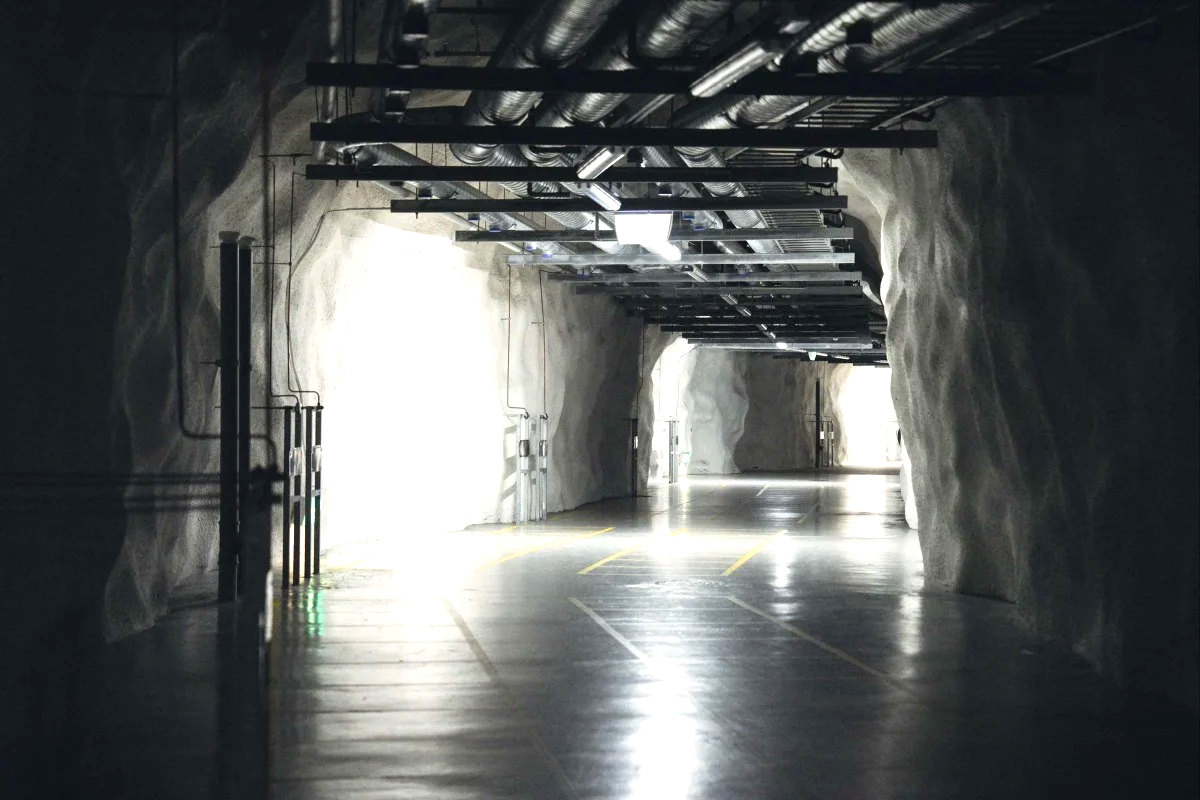
The Luola Sports and Event Centre in Kuopio—just 100 miles from the Russian border—exemplifies Finland’s “dual-use” philosophy. Its 13,780 square-metres footprint houses volleyball courts, dance studios, and gyms, alongside storage containing helmets, gas masks and iodine tablets. In 72 hours, it converts to an airtight bunker protecting nearly 7,000 people.
Sweden boasts 64,000 shelters protecting 7 million people—over two-thirds of its 10.5 million population. Following Russia’s annexation of Crimea, Sweden reactivated its “total defence” strategy. After joining NATO in March 2024, its Civil Contingencies Agency announced a 100 million krona (£7.7 million) investment to modernise its nuclear shelters.
5. The United Kingdom and Continental Revival
The United Kingdom has 276 nuclear bunkers, with 14 in central London and 47 in the surrounding area. Most were constructed between the 1950s and 1980s.
The Russo-Ukrainian war has reawakened Europe’s bunker obsession. In January 2025, Norway reintroduced a Cold War-era mandate requiring air raid shelters in all new residential buildings. Germany is actively debating civilian bunker construction. The European Union has urged residents to maintain 72-hour emergency stockpiles.
6. International Standards: The Emergence of ISO 22359
Until recently, no universal code existed for nuclear shelter design. Individual nations relied on domestic standards: Germany’s DIN 1045, the US Handbook of NBC Weapon Fundamentals, China’s GB 50038-2005, and Switzerland’s civil protection ordinance.
In December 2025, the International Organization for Standardization (ISO) published ISO 22359: Security and resilience — Hardened protective shelters — Guidelines, addressing this gap. This was followed by ISO/TS 22359-2:2026 in March 2026, which describes functional requirements and verification methods for protective equipment. The standard covers six functional categories:
1. Blast protection
2. Gas tightness
3. Tightness of penetrations
4. Ground shock isolation
5. CBRN (Chemical, Biological, Radiological, Nuclear) protection
6. Carbon dioxide removal and oxygen addition
The standard is intended for architects and engineers designing hardened protective shelters, industry producing equipment, and procurement organisations. While it does not cover structural shells or HVAC systems, it establishes the first globally recognised benchmark for shelter protective equipment.
7. Conclusion
From Albania’s 750,000 bunkers—one for every four citizens—to Switzerland’s 370,000 shelters, from Finland’s underground cities to the UK’s 276 nuclear refuges, Europe has built an invisible fortress beneath its feet. This subterranean infrastructure embodies a continent’s collective trauma and its enduring determination to survive.
Albania offers a warning: bunkerisation without proportion is not resilience but paranoia. Switzerland offers a model: systematic, legally mandated, and regularly maintained. ISO 22359 now offers a universal standard—the first international code for protective shelter design.
For Pakistan, the lessons of Europe are no longer academic. The 2025 hostilities with India—which saw missiles strike civilian settlements in six locations, killing and injuring dozens—and the 12-day Israel-Iran war, during which Iran suffered over 600 deaths while Israel’s shelter network kept its toll below 40, have made the question of civilian protection immediate. The contrast is stark: Israel’s shelters saved lives; Iran’s absence of a civilian shelter network left its population exposed. Pakistan, with its own history of cross-border volatility and its proximity to an increasingly unstable region, cannot afford to remain in Iran’s position.
There are signs of movement. Punjab has begun revising its 1981 War Book to consider underground shelters in residential areas and possible amendments to building by-laws. The federal government has approved a nationwide plan for underground shelters, mandating them in new schools and hospitals and directing the Engineer-in-Chief to cover the remaining 40 per cent of the population along the Line of Control. The Federal Board of Revenue has been asked to propose incentives for private builders.
Yet these measures remain fragmented, reactive, and concentrated in the border regions. The threat of aerial attack and missile strikes is not confined to the LoC. Pakistan’s major urban centres—Karachi, Lahore, Islamabad—remain unprotected, and the building codes that govern their construction still contain no requirement for blast-resistant basements, hardened safe rooms, or dual-use community shelters. As one Dawn editorial observed, many countries in South Asia “still rely on outdated air raid shelters built during past wars,” lacking adequate ventilation, sanitation, and blast resistance.
The question for Pakistan is not whether it can afford to build resilience, but whether it can afford not to. Europe’s bunker obsession is not paranoia—it is the hard-won wisdom of a continent that has learned, through blood and rubble, that preparedness is the price of survival. Pakistan must now decide whether it will follow Albania’s path of disproportionate bunkerisation, Switzerland’s path of systematic legal mandate, or a third path—one that integrates protective infrastructure into the fabric of ordinary housing, making resilience a standard, not a luxury. The choice is not between bunkers and no bunkers. It is between learning from history and repeating its costs.
References
1. BBC News. (2014, November 22). Albania opens huge Cold War bunker. https://www.bbc.com/news/world-europe-30160201[reference:68]
2. BBC News. (2019, February 11). The Albanian bunkers built in the midst of the Cold War. https://www.bbc.com/news/in-pictures-47157127[reference:69]
3. BBC Future. (2018, June 25). The nuclear bunker in ‘Europe’s North Korea’. https://www.bbc.com/future/article/20180622-the-nuclear-bunker-in-europes-north-korea[reference:70]
4. RTSH English. (2026, July 8). SciencePost.fr highlights Albania’s bunker history and their transformation into memory sites. https://rtsh.al[reference:71]
5. Swissinfo. (2026, June 10). Switzerland turns nuclear shelters into wine cellars or party rooms. https://www.swissinfo.ch[reference:72]
6. Hindustan Times. (2024, December 13). Switzerland plans revamp of Cold War-era nuclear bunker network. https://www.hindustantimes.com[reference:73]
7. Corriere della Sera. (2025, October 28). La Svizzera prepara i bunker sotterranei in caso di attacco della Russia. https://www.corriere.it[reference:74]
8. ISO/TS 22359-2:2026. (2026, March 5). Security and resilience — Hardened protective shelters — Part 2: Requirements for shelter protective equipment. International Organization for Standardization. https://www.iso.org[reference:75]
9. Wikipedia. (n.d.). Bunkers in Albania. https://en.wikipedia.org/wiki/Albanian_Bunkers[reference:76]
10. NewsBreak. (2026, May 12). Albania’s Bunker Obsession: The Dictator Who Built 750,000 Concrete Bunkers. https://local.newsbreak.com[reference:77]
11. McCarthy, W. W. (2013). Principles of Protection: U.S. Handbook of NBC Weapon Fundamentals and Shelter Engineering Design Standards.
12. Dawn. (2025, July 10). Air raid shelters. https://www.dawn.com/news/amp/1923252