




TECHNOLOGY | SAFETY & SECURITY | NATIONAL INFRASTRUCTURE
The Control Room, A Nerve Centre Of Modern Security Operations
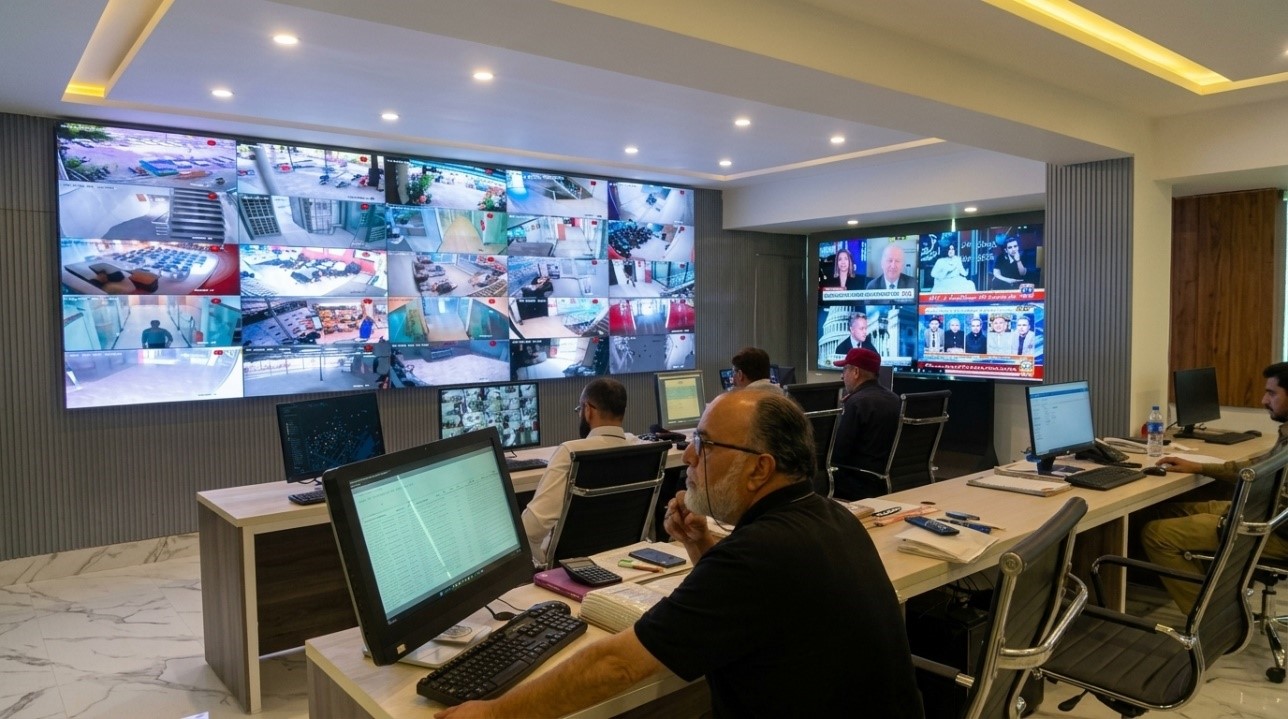
In safety and security operations management, the control room has become the single most consequential piece of infrastructure an organization can build. Guards, cameras, sensors, patrol vehicles and response teams are all necessary but on their own they generate activity rather than assurance. What converts them into a functioning security system is a place where everything they see arrives together, is interpreted by trained people defined procedures and is turned into action that can be measured afterwards. The modern control room is that place.
The high-technology control room differs from the traditional monitoring station in three respects. First, it is integrated: alarms, video, access control, fleet and personnel tracking are consolidated into one operating picture instead of a wall of unrelated portals. Second, it is intelligent: artificial intelligence performs the triage that human attention cannot sustain across hundreds of feeds, escalating what matters and suppressing what does not. Third, it is accountable: every alert, decision, dispatch and closure is timestamped and recorded, so that performance can be examined rather than asserted.
For governments institutions, utilities and large enterprises alike, that combination has changed what good looks like. Security is no longer judged by the number of cameras installed or officers deployed, but by how quickly a threat is detected, how reliably it is escalated, how fast a response reaches the scene and how completely the whole sequence can be evidenced. Centralized command is what makes those four things possible at the same time.
“Security is no longer judged by how much equipment is installed, but by how quickly what it sees becomes accountable action.”
How Pathfinder SMS Manages Its Security Operations
It is against this backdrop that SMS Services, a Pathfinder Group company, has established its own state-of-the-art Centralized Control Room and it is a proud moment for the Group to mark its inauguration as a significant initiative towards smarter, faster and more integrated operations.
The design philosophy behind the facility, the technologies now running on its floor and the operating discipline it is built to sustain. This milestone reflects the Group’s commitment to leveraging technology, real-time intelligence and centralized command to enhance operational efficiency, safety and security.
Today, a growing share of the company’s nationwide operations is managed from this facility. From centralized monitoring to real-time response and informed decision-making, it brings multiple operations together under one intelligent command framework: AI and IoT-based safety and security, AI-based surveillance, incident handling and rapid response, vehicle tracking and personnel and response-team tracking, all on the same floor and under the same procedures.
The Operating Model: Sense, Interpret, Decide, Act
The facility is designed as four connected layers rather than as a collection of systems placed side by side.
Sense. IoT devices, alarm panels, access control points, cameras and tracking units across client sites and fleets transmit continuously into the Control Room. The estate is deliberately heterogeneous: the design assumption is that organizations already own equipment from several vendors, and that value comes from unifying it rather than replacing it.
Interpret. AI models filter, classify and correlate. Video analytics distinguish a person from a shadow; sensor logic distinguishes a genuine breach from a swinging gate; correlation rules link an alarm at a perimeter with a vehicle that has stopped nearby. This layer does not replace judgement, it protects it, by ensuring that the events reaching an operator are worth their attention.
Decide. Operators work to standard operating procedures that define verification, classification, escalation and authority at each level of severity, so that decisions under pressure follow a rehearsed pattern rather than individual improvisation.
Act. Response is dispatched from the same console on which the event was seen, to the team best positioned to reach it and is tracked to closure. The full timeline detection, verification, dispatch, arrival, resolution is logged as evidence.
Capabilities on the Floor
AI & IoT-Based Safety and Security
Connected devices across sites feed continuously into the Control Room: intrusion detection, access control, fire and environmental sensors, equipment health and alarm points. AI models sitting above these feeds separate genuine events from routine noise the single most important determinant of whether a monitoring operation remains effective as it scales.
AI-Based Surveillance
Video becomes an active layer rather than an archive. Motion and intrusion detection, loitering and perimeter-breach alerts and object and behaviour recognition flag conditions as they develop and escalate them to the operator’s console in real time shifting the value of surveillance from forensic review to prevention.
Incident Handling and Rapid Response
Every event follows a defined path: detection, verification, classification, dispatch and closure. Response is coordinated from a single point of command and each incident is logged end to end. Response is measured in minutes and every decision carries an audit trail behind it.
Vehicle Tracking
Fleets are monitored live location, route, speed, halts and deviations supporting security assurance, driver discipline and logistics efficiency alike. Route and geofence alerts allow intervention while a journey is still in progress rather than after it has ended, which is the difference between prevention and investigation.
Person and Response-Team Tracking
Visibility extends to people. Guard-tour verification, officer check-ins and live response-team positioning mean the Control Room knows who is where, who is nearest to an unfolding incident and who is available to be tasked. This protects deployed personnel as much as it serves the client.
Informed Decision-Making
Above the live operational layer sits reporting and analytics event trends, response times, site-level performance and recurring risk patterns. Operational data becomes management evidence: where to place resources, which sites carry disproportionate risk and whether performance is improving or merely being asserted.
What It Means Across Sectors
The framework is deliberately sector-neutral in design and sector-specific in application.
Government & public sector. Unified oversight of dispersed offices, facilities and public assets, with verified incident records suitable for institutional reporting and inter-agency coordination.
Critical installations. Layered perimeter awareness, access discipline and rehearsed escalation, supported by tamper-evident logging of every event and every action taken in response.
Energy & utilities. Protection of distributed infrastructure substations, feeders, towers and remote sites where the cost of an undetected event is measured in outage, loss and public consequence rather than in equipment alone.
Corporate, Industrial & Financial. Consistent standards of monitoring across plants, warehouses and branch networks, with head-office visibility of what is actually happening at each location rather than what is reported monthly.
Transport and logistics. Cargo and fleet security combined with route efficiency, so that the same investment serves both loss prevention and operating cost.
Technology, Governance & Trust
A facility of this nature holds sensitive information about clients, sites, movements and people. That responsibility has shaped the design as strongly as the technology has. Access to the Control Room and to its data is role-based and logged. Client information is segregated, so that visibility follows contractual boundaries rather than convenience. Operator actions are recorded, which protects clients and operators equally. Redundancy in power, connectivity, and storage is treated as a baseline requirement rather than an enhancement, because a command facility that is unavailable during a crisis is worse than none at all.
Equally deliberate is the decision to keep human judgement at the centre. Automation determines what deserves attention; trained people determine what to do about it. In safety and security operations, that boundary is not a limitation of the technology it is the correct division of labour and it is where accountability properly rests.
The People Behind the Screens
The most easily overlooked component of a control room is the operator. Screens do not create outcomes; trained and supported teams do. Selection, procedural training, shift discipline, escalation drills and continuous review of handled incidents are what convert a well-equipped facility into a reliable one. The investment in this facility has therefore been as much in operating procedure and training as in hardware and software.
A Step Towards a Connected Future
This inauguration is a beginning rather than a conclusion. The facility establishes the model the technology stack, the operating procedures and the command culture that will extend through the company’s regional control room programme, progressively connecting operations nationwide into one coherent operating picture, with regional facilities able to support one another and to maintain continuity.
The wider opportunity is national in character. As organizations across government institutions, utilities and industry modernize their operations, the decisive advantage will belong not to those who deploy the most devices, but to those who can convert what those devices see into timely, accountable action. Interoperability, common standards and disciplined command will matter more than any individual technology.
A great step forward in building a more connected, responsive and technology-driven future and an invitation to partners across sectors to build that future alongside us.
One Command. One View. Smarter Operations.
About SMS Services
SMS Services (Pvt) Ltd, a Pathfinder Group company, delivers AI and IoT-based safety, security, surveillance, fleet management and digital infrastructure solutions to government, industrial and commercial clients across Pakistan.