

An evolving synopsis from Mideast to South Asia
Franz Kafka, a German-Jewish Czech writer of repute, was quite farsighted as he penned an unfinished fiction story about a badger in his novel ‘The Burrow’. Therein, in his imaginary description, he noted that the polyphyletic creature becomes obsessed with securing itself against imagined threats. While not sleeping a wink, it builds more walls, digs more holes and in doing so the labyrinth becomes an entrapment for the animal itself. As he keeps on waiting for the threat to appear that never does, yet the fear lives on.
The synopsis can be a great copyright for what is evolving today in the realpolitik of the nation-state system. States are hungry for power, and in pursuit are out to obliterate the pivotal framework of Westphalian statehood. Thus, wars, aggressions and terrorism – both by state and non-state actors, is the order of the day. What is missing, however, is an end to the threat factor: as it neither dawns in full spectrum nor fades away for a perpetual peace. In this seesaw of madness, states and individuals become a prisoner of their own captivity, as is the case in a fractured unipolar polar world that is rapidly paving way to multilateralism.
Security syndrome is all about the thought-process, ideologue and the tangible means to hold on to it. While the Post-Bretton Woods system is all about geo-economics and supremacy of the US dollar, it has led to multilateral security alliances. The Middle East, especially, came under the United States tutelage literally, as the Jewish state’s allied-ally status with Trans-Atlantic superpower shaped gunboat diplomacy that is still in vogue. The Arab and Muslim states desperately sought the security umbrella from Washington as they feared Tehran under the clergy-led revolutionary regime. Since then there is no looking back.
The post US-Israel aggression over Iran has, however, changed the entire security paradigm, and for good. What was unthinkable is now a ground reality. The sanctions-laden Islamic Republic has prevailed over the sole superpower whose military might was supposed to be intangible and invincible. The warfare modus operandi of Iran has surprised all pundits of doom who had written off Tehran as a footnote if faced with American-Israeli onslaught. Iran’s sophisticated missile and drone program, coupled with its human resilience, was found to be a toast of bravery. The flip side, nonetheless, was too toiling: the Arab Gulf States were on the receiving end from the Islamic Republic as they housed American military bases.
Fast Forward: the dawn of reality among the Sheikhdoms is one of inward-looking, and formulating a defensive strategy that has lesser or no reliance on American artillery and hardware. Without uttering too many words, most of the GCC states have bid adieu to proactive military alignment with the US, and the vibrant bases on their respective soils are in retreat. Likewise, the Pentagon too seems to have eaten the humble pie and is preparing for a post-Americana equation in the Middle East. This, however, will not have an impact on Israeli muscles as they will be supplemented by the US at any cost.
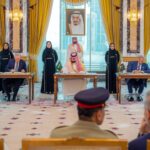
This is where the Makkah Joint Defence Agreement surfaces as a new deterrent, and one that is envisaged purely for stability and not for ulterior designs against any state of the region. Saudi Arabia, Turkiye and Pakistan are its basic trilateral members, soon to be apparently joined by Egypt, Jordan and Kuwait. This compliments Pakistan’s rise as a net-security provider in the region and beyond. It came into being at a time when the Mideast was in revulsion, and the conventional security calculus had gone for a toss. At the same time, it also endorses Pakistan’s defence capabilities and the beauty of the understanding is that it is smartly silent on the nuclear profile. Keeping it in ambiguity is by design as any over-reading of this non-conventional muscle would be a problem-multiplier.
Pakistan, thus, having offered its military shield to an oil-rich OPEC state of the Muslim world and a middle power of NATO alignment has done a great service for regional harmony. This is in need of being read in the backdrop of the Islamabad Memorandum of Understanding between arch-foes, the US and Iran, a document that still reverberates with its peace dynamics despite having been violated by either side. Last but not least, the fact that Tehran had complimented the Makkah paradigm of understanding and sees it as a positive development to keep extra-territorial forces away from meddling in the region’s volatility is a masterpiece of diplomacy.
If the new security abstract is to be summarised, it is evident that pieces of puzzles have been aptly joined in for crafting a caricature that is indigenous, reliable and mutually stakes-laden. Another aspect that is worth pondering is that warring sides had walked extra miles to reach out to their respective adversaries for ushering in a thaw. Such as Iran talking at length with Qatar and Saudi Arabia, Abu Dhabi mending fences with Tehran, and Oman, Iran and Turkiye broadening their strategic understanding for a safely managed region, especially over the Straits of Hormuz, Bab El-Mandeb and the Arabian Sea. This is some smart diplomacy, to say the least.
This is where a new dimension is in need of being addressed by Pakistan and the Gulf States for wider tranquility. The eastern and western frontiers of Pakistan are not only posing an existential threat but also possess the potential to ignite into some devastating clash among the titans. India and Pakistan have just had a brawl as they fought a four-day war in June 2025, detrimental to not only their bilateral prospects but also for the region at large. Likewise, Kabul’s adamant attitude and its refusal to act against the terror infrastructure holed on its soil has stalled geo-economics for more than 2 billion people, rendering BRI and other big-ticket projects to a naught.
A consortium of regional states, especially from Central Asia and the Gulf, must opt for some tactful mediation to prevail over Kabul, New Delhi and Islamabad to take to the table for a grand dialogue with the express intent of normalizing their relations. This troika deal will be as important as the Makkah configuration, and must surface sooner than later. Pakistan and India having been unable to see from the same prism, coupled with the myopic approach of Taliban 2.0 towards Islamabad, it would be a win-win situation for prosperous and influential Mideast countries to broker a tête-à-tête between Delhi and Islamabad. Normalizing diplomatic relations, reopening of aviation and trade services, and resumption of people-to-people contacts are indispensable between India and Pakistan. Napoleon Bonaparte was wise as he said, “one has to live with geography”. Alas, we are ignorant of it even after turning octogenarian.
The Gulf States and Iran are nevertheless quick to watch their steps despite prolonged bad-blood. Now is the time for India and Pakistan to get real and start talking. The badgers in South Asia are more miserable and blind-folded, and must start thinking beyond security.