





Governance, Innovation & National Security in the age of Artificial Intelligence (AI) with the Faculty and Probationary Officers of the 54th Common Civil Services Academy
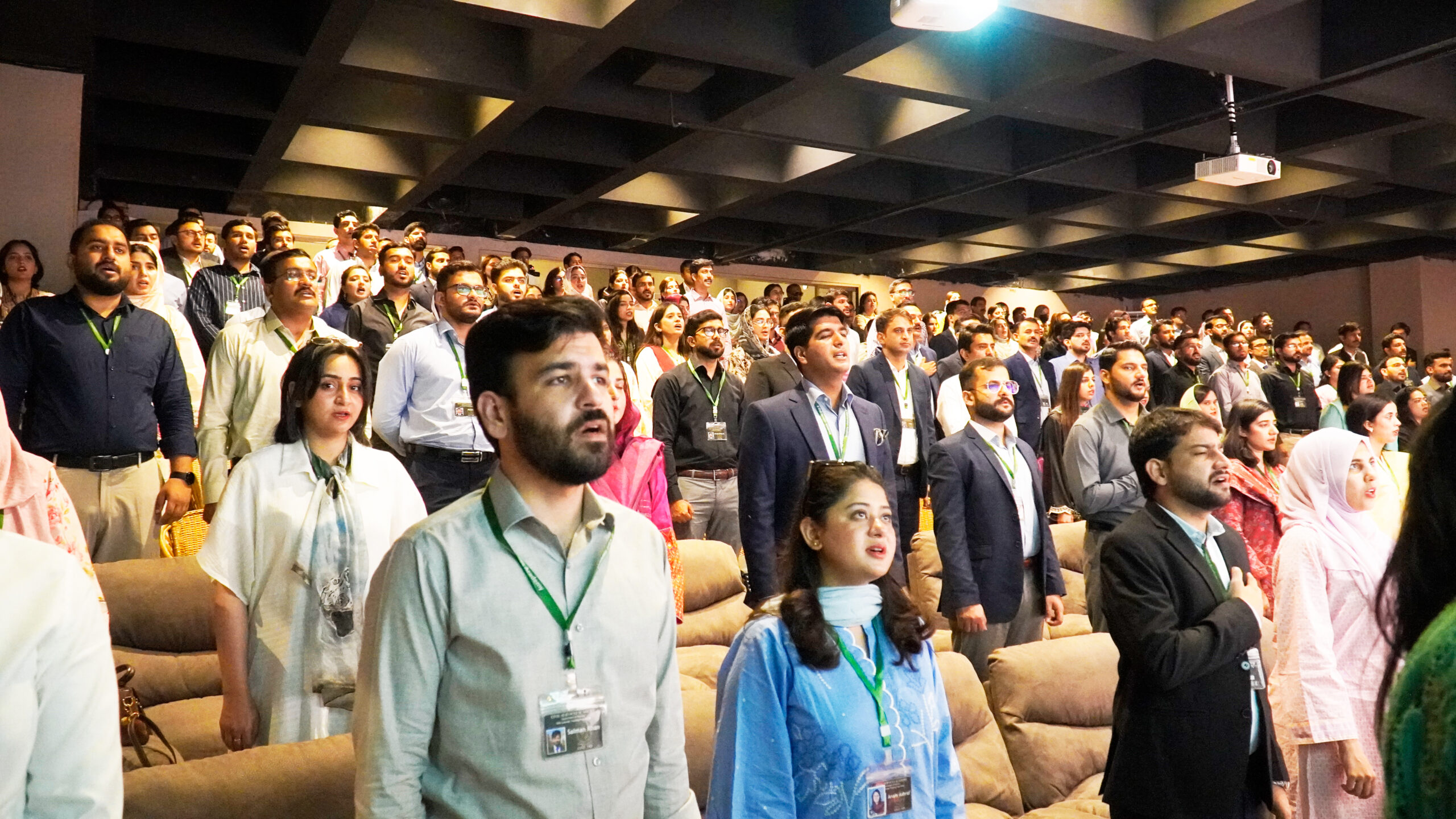
PATHFINDER GROUP, under the leadership of Co-Chairman Ikram Sehgal, hosted a gathering titled “Transforming the Leaders: Governance, Innovation & National Security in the Age of Artificial Intelligence” on 16th August 2026 at AmaaniBagh, Islamabad, for the faculty and probationary officers of the 54th Common Civil Services Academy, Lahore. The event brought together senior PATHFINDER GROUP leadership, Civil Services Academy officials, and subject-matter experts to engage the next generation of civil servants on how artificial intelligence is reshaping governance, innovation, and national security. Structured around themes including building a national innovation ecosystem, skills and employment, and leadership in an age of transformation, the event aimed to equip probationary officers with the perspective and tools needed to navigate a rapidly evolving technological and policy landscape as future custodians of the Pakistani state.
SESSION ONE
Sehrish Mustafa (Moderator): We are especially honored to have with us the faculty members and probationary officers of the Civil Services Academy, the future leaders who will shape how Pakistan governs, innovates, and secures itself in an era of artificial intelligence.
Ladies and gentlemen, this is an era in which the strength of a state will be measured not only by the resources it commands, but also by the speed, intelligence, and adaptability with which it governs. Artificial intelligence is fundamentally reshaping the relationship between technology, society, and the state, transforming how decisions are made, economies compete, conflicts are fought or resolved, and national security is understood. For the civil servants who will soon carry the responsibility of translating policy into governance, the challenge is therefore much larger than simply learning how to use new technologies. It is about understanding how AI can make governance more responsive without making it less accountable; how innovation can strengthen institutions without weakening human judgment; and, most importantly, how national security can be protected in a world where power increasingly belongs to those who can turn information into insight, and insight into action.
This seminar is an opportunity to engage with these questions at precisely the right moment, because the future of governance depends on the quality, vision, and courage of those entrusted with the responsibility to govern. With that, I would like to invite Air Cdre (Retd) Khalid Banuri, Principal Advisor of Pathfinder CITADEL, to formally welcome you all and open the session.
He has over 44 years of diverse experience in public service, aviation, training, education, and outreach. He has contributed significantly to national and international policymaking and has represented Pakistan on various global forums. In recognition of his outstanding contributions, the Government of Pakistan has honored him with two prestigious awards: the civil award of Sitara-e-Imtiaz for excellence in policy analysis, and Sitara-e-Imtiaz (M) for his dedicated services to the Pakistan Air Force.
Air Cdr (Retd) Khalid Banuri, Principal Advisor Pathfinder CITADEL: There are 217 probationary officers in this room today, men and women who, out of what is arguably one of the most competitive processes in this country, were chosen to run Pakistan’s state machinery for the next 30 years.
Let that sink in for a moment. Somewhere between the CSS examination hall and this auditorium, you crossed a threshold that most of your classmates from universities, from colleges, and from your own hometowns did not. You are no longer just bright young Pakistanis. As of this training cycle, you are the custodians-in-waiting of the Pakistani state. So, the question I want to open with is not what you will do in the government. It is what kind of officer will the age you are entering demand of you? Because the age you are entering is not the one your seniors trained for. It is not even the one that I trained for. I come from an older generation. It’s an age where the file on your desk may have been drafted, in part, by a machine, and the decision on it still has to be yours. Human decisions, with challenges, with pitfalls, and with consequences.
CITADEL does not exist in isolation. It sits inside something larger: The PATHFINDER GROUP, one of Pakistan’s oldest and largest private-sector groups, a distinguished Pakistani conglomerate known for its strategic ventures and commitment to national development, with roots that go back to when private enterprise in this country still had to prove that it could be trusted with things that the state usually kept close.
From end-to-end solutions to security needs and finance, and now technology, the PATHFINDER GROUP operates across four divisions. Each one is a small case study in how a private Pakistani enterprise has tried to fill gaps that matter for national resilience. Remaining true to its motto, “Empowering Challenge into Opportunity,” this strategy combines infrastructure, human development, and digital change. Together, these divisions don’t just envision a stronger Pakistan; they actively build it, empowering every sector that they touch to rise, innovate, and thrive by combining business success with social progress.
PATHFINDER GROUP not only shapes industries but also plays a significant role in Pakistan’s future in a challenging and competitive world. So, first, the Security Services Division. Two companies sit here: Security and Management Services Pvt Ltd (SMS), which handles physical security on the ground, guarding institutions, facilities, and people across the country; and Wackenhut Pakistan Pvt Ltd, which specializes in secure vaults and the safe movement of cash and valuables. These two companies represent the largest private security footprint in Pakistan. In a country where security is often framed as purely a state function, here is a private-sector that has spent decades building trust as a security provider.
Second, the Financial Services and Technology Division. Two companies: Virtual Remittance Gateway (VRG), aiming for a revolution in digital affairs. It focuses on financial inclusion and is Pakistan’s first payment system operator. Its electronic payment gateway enables “Interoperability” between telecoms and banks for the first time in Pakistan. Under the Asaan Mobile Account (AMA) scheme, it provides accessible and simplified banking for people who have historically been locked out of the formal financial system, NEARLY 15 million of them. This is financial inclusion built by the private sector for a population where a huge share of citizens remains unbanked or underbanked. iPath, the other company, stands at the forefront of technological innovation in fintech, delivering an advanced suite of products in health tech, electronic health record integration platforms, and cloud-enabled, generative-AI-powered interoperability for ease of healthcare operations, and so forth.
The third is the PathfinderCare Foundation. It is the corporate social responsibility architecture. It includes Providentia Books Foundation (PBF), a nonprofit promoting literacy, access to knowledge, and a culture of learning among children in need. It has donated over 100,000 books across 15 cities. ElenaCare, which runs a cottage-industry and women’s empowerment program through the Kashmala Family Welfare Center (KFWC), provides hope, dignity, and empowerment, leading from skills to self-reliance. ElenaCare further provides comprehensive benefits for both serving and deceased employees of the PATHFINDER GROUP. And then there is the Pathfinder Interfaith Harmony Initiative (PIFHI), working on one of the most under-discussed but urgent dimensions of Pakistan’s social fabric, religious harmony and coexistence. It has a vision for a future where all Pakistanis, irrespective of their faith, live together in peace and harmony. The Digital Revolution Division (DRD): SMS Services and SMS Technologies, the entities responsible for meeting Pakistan’s emerging technology needs, from digital transformation to tech-enabled services. SMS Services is the technology backbone of the division, with end-to-end digital solutions across industries, including the Internet of Things (IOT), Cybersecurity, Cloud Computing, and Enterprise Software Development. The company is a comprehensive enabler. SMS Technologies complements this work, focusing on telecom and digital infrastructure development. It provides AI-driven optimization and reliable continuity.
And now, the newest member of this family is “The Center for Innovation, Technological Advancement, Digital Entrepreneurs, and Leadership (CITADEL)”. If all the other divisions of Pathfinder represent what Pathfinder does, CITADEL represents what Pathfinder believes about the future. Innovation, entrepreneurship, and leadership can no longer be treated as three separate conversations. They have to be integrated because the problems of this decade from AI governance to youth unemployment to national security in a digitized world are integrated problems. CITADEL is Pathfinder’s answer to that integration challenge. With hubs here in Islamabad and Karachi, it is designed to be a catalyst for change.
You’re sitting inside an organization that has spent decades building expertise in security and finance and has now made a very deliberate bet that Pakistan’s next frontier lies at the intersection of innovation, technology, and leadership. That bet is called CITADEL. There’s a line that I keep thinking about from Peter Drucker: “The greatest danger in times of turbulence is not the turbulence; it is to act with yesterday’s logic.” That’s the challenge that all of you will have. This seminar is designed to help you avoid.
Transforming Leaders, Governance, Innovation, and National Security in the Age of AI. Notice the structure of that title. It’s not AI and governance. It’s not innovation and national security. It’s three domains: Governance, Innovation, and National Security, bound together with one accelerant: Artificial Intelligence (AI). That’s deliberate because, increasingly, in the world that you’re about to serve in, these three domains are not separate portfolios. They are three lenses on the same reality.
In SESSION ONE, Director Bilal Akram will introduce the institution that has shaped you over these past months. A useful reminder, I think, before anything else, of the institutional DNA you will carry into the government. Then, three interesting tracks. First is the Innovation Ecosystem. Pakistan does not lack ideas or talent. Ask anyone who has spent time with our startup founders or our university tech incubators. What we have historically lacked is an ecosystem: Capital, Mentorship, Regulatory Clarity, and Market Access, the connective tissue between a good idea and a functional enterprise. As future civil servants, many of you will, at some point, either regulate this ecosystem or be asked to enable it. Understanding how it actually works, not how it looks on paper, will matter more than you think.
The second is Skills, Training and Employment. Pakistan’s median age is roughly 20 years. And that is either the greatest asset this country has ever had or the greatest challenge that it has ever faced. Which one it becomes depends almost entirely on whether we can convert a youth bulge into a skilled, employed workforce. You will inherit ministries, departments, and districts where this exact calculus plays out in real budget lines and real unemployment numbers.
The third topic that we’ll be tackling in this session is Leadership in the age of Transformation. This one is about you directly. Leadership theory built for a stable, predictable, bureaucratic environment does not translate cleanly to one where technology cycles are shorter than policy cycles. So, the officer who will lead well in 2026 needs to be comfortable with the ambiguity that officers of earlier generations rarely faced.
SESSION TWO shifts from ecosystem-level themes to Pathfinder’s own lived experience. Three of our speakers will walk you through Pathfinder’s CSR and social-impact work, financial inclusion, and women’s empowerment, as well as women’s stability and security. The focus on these must not be as corporate case studies, but as templates, because a great deal of what the state tries to achieve through policy, PATHFINDER GROUP has achieved through its operations on the ground, with its own resources and its own accountability. There will be a panel discussion on AI Governance and Ethics, with four scholars and experts who have spent their professional lives thinking about exactly the question this seminar is built around: How does a state govern a technology that is evolving faster than the institutions meant to govern it?
Every generation of civil servants inherits a version of the same question: How do you serve a state whose challenges are changing faster than its rulebook? Your seniors answered that question for the era of nationalization, then privatization, then digitization, and you will answer it for the era of artificial intelligence.
There’s a phrase that is often attributed to Alvin Toffler, the author of Future Shock: “The illiterates of the 21st century will not be those who cannot read and write, but those who cannot learn, unlearn, and relearn.” You already proved you can learn. That’s how you got into the academy. Today is about unlearning and relearning.
Sehrish Mustafa (Moderator): It is now my pleasure to invite Muhammad Bilal Akram. He is currently serving as the Director of Administration and Finance at the Civil Services Academy. He has 27 years of public service experience and has held several key positions, including Director External Audit, Director Audit, Federal Government and Controller, Local Audit, Defence Services of Pakistan.
Muhammad Bilal Akram, Director Admin and Finance, Civil Services Academy: I am grateful to Sir Ikram Sehgal for hosting us here today. Sir, you have always been warm and welcoming to us, whether in Karachi or Lahore. In Karachi, I remember Mr Sehgal was the first one to welcome the senior Civil Servants from Bangladesh. That was the day when we started our journey, and so today is the day when we are starting this Islamabad study tour for the 54th CTP. We are also expecting the second batch of Bangladeshi civil servants. So, we look forward to the same guidance and mentorship from him.
The Civil Services Academy has been there since 1973, and we have two campuses. One is at Mall Road, which is called the Civil Services Academy PAS Campus, and the second is a 70-acre facility at Walton Campus, where we cater to the needs of the federal government for both pre-service as well as post-service training for the officers of the federal government.
The officers sitting here represent all 12 federal services of Pakistan. The last three years have been a transformational journey for the Civil Services Academy itself. From an inward-looking organization, from a closed organization, it has transformed into an outward-looking organization. We believe that knowledge is our main capital, and we identify ourselves as a knowledge-based organization where we receive these knowledge workers, harness them, and convert them into knowledge professionals and, thereafter, knowledge managers.
This approach has brought us here today, because a hallmark of our training principle is that we are engaged in networking and interacting only with organizations and individuals who we consider to be better than us. And what better place to start than with the PATHFINDER GROUP, which has its footprint all across the country, covering almost 75 cities in the country. I have been reading your documents, and you call it a family. You have around 12000 people in your workforce. Hats off to you. We will be learning organizational behavior from Sir Ikram Sehgal, as well as how we can grow further. And when I talk about better individuals, there is no better role model than you. Eighty years of age, you have served in the Pakistan Army, then here, then in Bangladesh. You have seen ups and downs, and you are here. Now, you are again seeing history reviving itself. We are very grateful to you, and we will be here all day long.
Once again, thank you from myself and from the Director General, Civil Services Academy. One more thing that I would like to say is that, as you know, the Director General, Civil Services Academy, has been conferred the Sitara-e-Imtiaz by the Government of Pakistan. So, I congratulate you all, and I would also like to congratulate all the faculty, because it is not just his pride; it is also something that we share.
Sehrish Mustafa: It is my honor to invite Air Vice Marshal (Retd) Asad Ikram, President Pathfinder CITADEL, to share his remarks. He has been instrumental in establishing key organizations and initiatives, including the Navigation Systems Department at the Advanced Engineering Research Organization, the Telecom and Marketing Department at LT Engineering Limited, and aviation research, innovation, and development initiatives at the Pakistan Aeronautical Complex. For his commendable services over the years, he is a recipient of the Sitara-e-Imtiaz and Tamgha-e-Imtiaz.
AVM (Retd) Asad Ikram, President Pathfinder CITADEL: I want to talk about something that will shape almost every file that crosses your desk over the course of your career: innovation and the ecosystem that makes it possible. You’ll hear the word “innovation” used loosely in press releases, in slogans, and in strategy documents. My goal today is to leave you with a sharper, more useful understanding of it: what it actually means, why it matters for a country’s growth, where Pakistan stands today, and most importantly, what role you, as public servants, can play in it. This isn’t an abstract or academic topic. The policies you’ll write, the budgets you’ll approve, and the approvals you’ll sign over the next few decades will either open the door for innovation in Pakistan or quietly close it.
First, we’ll define innovation. Second, we’ll look at why innovation matters for a country’s growth. Third, we’ll widen the lens. Innovation isn’t just apps and gadgets. It spans a much wider spectrum than most people assume. Fourth, we’ll talk about what makes innovation flourish and what quietly kills it. Fifth, we’ll turn to Pakistan: where we stand today and where the bright spots are. And we’ll close with the part that matters most for this room: what government is, and what you can actually do about it.
So, let’s clear up a common confusion. Invention and innovation are not the same thing, and mixing them up leads to bad policy. Invention is the act of discovery, creating something new that didn’t exist before. It can be brilliant. It can also go absolutely nowhere. Patents expire in filing cabinets all the time. History is full of inventions that never become innovations. Innovation is different. It’s the act of delivery: taking that new idea and successfully putting it to use at scale in a way that creates real value for money and real value for real people. It needs a market. It needs a user. It needs a business model or a delivery mechanism; in government’s case, a policy that does get implemented.
Think of the steam engine. Early prototypes were invented decades before they changed the world. What actually transformed was innovation: the factory systems, the railways, and the business models that put that invention to work. Why does this distinction matter for you? Because a lot of well-intentioned government schemes stop at invention funding a prototype, a pilot, or a proof of concept and declare victory. The most important job is innovation: getting that idea adopted, scaled, and sustained. That’s the job we should be judging ourselves against. It’s very important to note that innovation and GDP per capita are strongly coupled. Switzerland has a much higher GDP per capita compared to other countries. Countries like South Korea and China are quickly working hard to get there. We are, unfortunately, way behind. But this chart should keep reminding us that the core of economic well-being is innovation.
So, why does any of this matter for a country’s growth? Research and development (R&D) spending as a share of GDP across a set of comparator countries: South Korea sits at the top at 5.2% of GDP, the highest research intensity in the world. The United States and China follow. Then look at where India, Bangladesh and Pakistan sit as a fraction of that. Pakistan is at the very bottom, at just 2%. This isn’t a coincidence. It maps almost exactly onto each country’s economic trajectory.
South Korea in the 1960s was one of the poorest countries on earth, poorer than many African nations at the time and dependent on foreign aid. Within a couple of generations, sustained state-backed investment in Research and development (R&D) and innovation, especially in electronics and semiconductors, turned it into one of the most advanced economies in the world. The lesson for anyone sitting in a finance or planning role is that R&D and innovation spending usually gets treated as a discretionary cost something you cut first when budgets tighten. The evidence says the opposite. It’s one of the highest-return investments a state can make in its own future, and countries that treat it that way compound the benefits for decades to come.
A few more examples to make this concrete. South Korea, as we just discussed, used state-backed R&D that produced globally competitive electronics and semiconductor firms. Israel took a different path: a deep-tech research culture, a lot of it originating in defense and military R&D, that spun out into one of the densest startup ecosystems in the world. It earned the name “Startup Nation” and has among the highest venture-capital investment per capita anywhere. China advanced from manufacturing into high technology through sustained, deliberate state investment. It’s now the world’s largest filer of patents and a global leader in electric vehicles and new technology. And notice the last row, Pakistan. We don’t have to look only at faraway success stories. Our own IT and IT-enabled services hit a record $3.8 billion in exports last fiscal year, up 18% in a single year. And the government is targeting $15 billion by 2030. That is an innovation success story happening in our own backyard, built on young, English-speaking, digitally skilled talent, largely without heavy state Research and development (R&D) spending. Imagine what’s possible if you back it properly.
When most people hear “innovation,” they picture an app, a gadget, or a piece of technology. That’s far too narrow, and it’s a mistake I would ask you to specifically avoid because it leads people to think that innovation belongs only to the IT ministry or tech startups. Innovation spans at least six domains: Technological innovation, the products and platforms most people think of. Business-model innovation: new ways of creating and capturing value, like ride-hailing or mobile banking, often using existing technology in a new way. Process innovation, simply doing something faster or leaner, like a digitized customs process. Social innovation: new solutions to social problems, like telehealth reaching rural areas. I was in Karachi the other day and happened to meet a company that is running a virtual hospital. Imagine a virtual hospital. They have no buildings. They just have a pool of doctors on their panel. They have ambulances on the panel. They have pharmacies on the panel. And frugal or grassroots innovation: low-cost, locally adapted solutions built for resource-constrained settings, which is often where Pakistani engineers excel. So, what is frugal innovation? It is ‘Jugaad.’ The reason this matters for you specifically is that public-sector innovation is its own category on this list. You don’t need to wait for a tech solution to walk in the door. The way you redesign a process or form a service-delivery model is an act of innovation. So, what actually determines whether innovation happens in a given country? Research and cross-country comparisons converge on a fairly consistent list of enablers and an equally consistent list of barriers. On the enabling side: (1) Quality education and strong STEM skills, because innovation ultimately runs on human capital. (2) Access to risk capital, credit, and early-stage funding. (3) Strong intellectual-property protection and predictable rule of law, so innovators trust that their work won’t simply be copied. (4) Ease of doing business. Every unnecessary regulatory step is friction that kills momentum. (5) A culture that tolerates failure, because most innovation attempts fail. Punishing failure just teaches people not to try and (6) Close collaboration between academia, industry, and government, what’s sometimes called the Triple Helix.
On the barrier side, you’ll notice it’s often the mirror image: (1) Brain drain (2) Chronic underinvestment in R&D (3) Limited access to finance. (4) Weak IP enforcement and (5) A risk-averse, hierarchical, blame-avoiding culture.
Using the Global Innovation Index, Pakistan improved steadily from 2020 to 2022, climbing from 107th to 87th. Real, measurable progress. But since then, we have slipped back down to 99th out of 139 economies in the 2025 ranking. That’s a warning sign worth sitting with. Gains in this space aren’t permanent. They have to be actively defended.
Pakistan ranks 124th in its innovation inputs the things that go in, for example, education, infrastructure, capital, and institutions. But fortunately, it ranks much better, at 75th, in innovation outputs, what actually comes out the other end. It means that Pakistani talent and Pakistani entrepreneurs are punching well above their weight, producing results despite a weak enabling environment, not because of a strong one. Imagine what our output ranking would be like if our input ranking also matched it. That gap is, in a very real sense, the opportunity sitting on the table for policymakers in this room.
IT and IT-enabled services have grown from $2.6 billion to $3.8 billion in just two years, an 18% jump in the most recent year alone. That sector is now the third-largest source of foreign exchange for the country, and the government has set a target of $15 billion by 2030. This didn’t happen by accident. It happened alongside a set of institutions that most of you will encounter or work with over your careers. The National Incubation Centers, government-backed startup incubators in major cities; Ignite – National Technology Fund, which channels public money into R&D, tech skills, and early-stage startups; P@SHA, the Pakistan Software Houses Association, which represents the sector’s voice in policy conversations; and a growing number of university incubators alongside the Board of Investment and the Special Investment Facilitation Council (SIFC). You will likely interact with at least one of them at some point in your career, whether in a finance, commerce, or IT-adjacent posting. So, what’s holding that momentum back from being even bigger?
Six things: 1. R&D spending. As you saw earlier, the state addresses 0.16% of GDP, less than half the global average and among the lowest in the region. 2. Persistent brain drain. Many of our best graduates and engineers leave for better opportunities abroad. 3. Policy inconsistency. Industry bodies like P@SHA have specifically and repeatedly asked for a long-term, predictable tax and compliance regime because uncertainty is as damaging as high taxes. 4. Limited venture and growth capital. Plenty of seed-stage support exists, but startups struggle to raise money once they need to scale. And that’s one of the things CITADEL does: it helps startups scale. 5. Weak university-industry linkages. Research too often stays inside the university and never becomes a product or a company. And lastly, regulatory and bureaucratic delays. Slow approvals quietly discourage both entrepreneurship and foreign investment. Now, all of these are fixable. Every one of them is a policy lever, not a law of nature. What can actually be done about it?
Fund and protect R&D, and just as importantly, shield that funding from being the first thing cut when budgets tighten across political cycles. Rationalize regulation, simplify approvals, and consider regulatory sandboxes that let new technologies and business models be tested safely before full-scale rules are written. Drive innovation through public procurement. Public procurement is an enormous, underused lever. Government can create early demand for local innovative solutions simply by choosing to buy them. And this is done all over the world. Invest in STEAM and digital skills, building the talent pipeline from school through university, so the input side of the Global Innovation Index starts closing. Widen access to capital through grants, matching funds, and credit guarantees that de-risk lending to startups and Small and Medium-sized Enterprises (SMEs). And deliver policy consistency, giving industry the predictable, long-term rules, it needs to actually plan and invest. Notice that almost none of these levers sit exclusively with any one office. They sit with finance, commerce, education, regulatory bodies, and provincial administrations. Which means wherever you are eventually posted, you will likely have a hand on one of these six levers.
Innovation is a national discipline, not the responsibility of one ministry or institution. Public servants can enable it through everyday work — policies, budgets, procurement, and service redesign. Four key calls to action: support evidence-based and consistent policy; use public procurement to create demand for local innovation; treat approval turnaround time as seriously as accuracy; and view routine service delivery as a space for innovation. Pakistan’s innovation outputs already exceed its inputs. Closing that gap means not just administering the state, but building its future.
Sehrish Mustafa (Moderator): It is my pleasure to invite a female leader to speak on Skills, Training, and Employment. Ms Gulmina Bilal is a former Chairperson of the National Vocational and Technical Training Commission (NAVTTC) and the first woman to lead Pakistan’s premier skills-development institution. With over 25 years of experience in the development sector, she is an internationally recognized expert in workforce development, technical and vocational education, peacebuilding, countering violent extremism, governance, communication, and capacity building.
Gulmina Bilal, former Chairperson of NAVTTC: Yesterday, I was listening and also watching television and looking at the Tamghas and the Sitaras. I was wondering when Ikram Sehgal would get a Tamgha or a Sitara. Then I made a mental note: I am willing to bet that Mr Sehgal would have been offered one, and he would have said, “I don’t want it.” Because I think the real Tamghas and the real Sitaras that Mr Ikram Sehgal has actually curated and nurtured are not just his companies. That is the corporate part of it.
In this very hall, on his 80th birthday a few weeks ago, I saw the Pathfinder family children wearing T-shirts saying, “Happy Birthday, Co-Chairman.” I think that is the real Sitara. That is the real Tamgha that Mr Sehgal has achieved, values, and also adores.
You must have read up about AmaaniBagh, the PATHFINDER GROUP, and Ikram Sehgal. But one of the first things that comes to my mind when I think of Mr Sehgal is the word “Engineer.” Although he is not an engineer, I have always believed that he engineers bridge-building. He engineers conversations between the public and private sectors, between the private corporate sector and students. Those conversations need to happen on various platforms, and they need to happen often, so that the gaps between the public and private sectors, between the public-private and corporate sectors, between the public-private and development sectors, and between the public-private and media sectors can be bridged. That requires bridge-building.
I had the pleasure of visiting the beautiful Academy, NAVTTC, about three years ago, and I had to explain what NAVTTC is. It is the government regulatory authority overseeing all technical and vocational education and training in Pakistan. This means that, like the Pakistan Electronic Media Regulatory Authority (PEMRA), NAVTTC has a regulatory role. PEMRA regulates your television channels, while PMDC regulates your medical schools and colleges. Similarly, NAVTTC is the relevant government regulatory authority for technical and vocational education and training. After the 18th Amendment, your sub-sectors, the Punjab Technical Education and Vocational Training Authority (TEVTA), Sindh TEVTA, Balochistan TEVTA, and KP TEVTA, became its affiliate partners. Before the 18th Amendment, they were subordinate. Now, after the 18th Amendment, we call them affiliate partners. But the notion that NAVTTC is only about technical skills is incorrect. The primary work of the regulatory authority includes certification, accreditation, and all related functions. However, in people’s minds, this responsibility and role of NAVTTC are not clear.
The people in NAVTTC’s own headquarters have also forgotten that we are basically a regulator. A lot of the personnel think they are there because of the Prime Minister’s Skills Development Programme, which is going on throughout the country, from Kashmore to Bajaur. So, its conception, its funding, and all the perks and privileges that come with the funding are associated with it. So, this is what NAVTTC is. I was the Chairperson, and I was appointed only as a technocrat. After two and a half years, I was asked to resign, so I stepped down. I am also the Chairperson of China Global Professional International Certification. I am the Chairperson for these certifications for Pakistan, Singapore, Malaysia and Uzbekistan.
In Pakistan, we, as parents, as children, and as public policymakers, need to step out of what I call “degree illusion.” Everyone will teach you how to push a file. As AVM Asad Ikram said, increase the turnaround time and all that. But you, as a young officer, also have the responsibility to push up the career ladder. And how will that happen? It will happen when it works well. In our country, with all the training that we have, you can see the batches of different Prime Minister programmes. Then we have the Summer of Code programmes, which are related to IT, and all the different programmes.
What is our challenge? We are training and recruiting for today. We are not recruiting or looking at what the Gulf countries would be needing in 2028, or what China would be looking for in 2028. They are not able to employ your young people in the numbers in which young people are joining the labour market. So, we have to look overseas and, obviously, consider the whole remittance debate. We need labour-market demand and labour-market intelligence. Based on the present demand, and most importantly, the forecasted demand, you then train, add value in terms of practical skills, and, very importantly, provide international certification.
What is the need? There is an international certification for carpentry, which we have introduced in NAVTTC, but it needs to be scaled up. Does the name make a difference or not? Our certification is not standardized; it is not benchmarked against a certain quality standard. So, we have to address that. That is where our people suffer. As AVM Asad Ikram also talked about brain drain. The highly qualified constitute 2.7% of the entire brain drain, while 4% are highly skilled. The unskilled constitute 50.3%. So, they will bring more money for themselves and their families. They make up 75% of the brain drain. I mean, there is nothing wrong with being a driver or being a labourer, but when you look at the economic mobility of the individual or of the country, is this really a figure that we are comfortable with? Again, certification is important because of your syllabus. At NAVTTC, the syllabus was updated for the first time since 2011 and brought up to July 2024, but syllabus revision remains slow and local subject expertise is limited. The focus is on international employability, since that is where the income is, and on building value addition for young people.
Domestic employment also needs attention, and forums like this can help connect government with industrial associations and small traders, skillingpakistan.gov.pk is a district-level mapping tool showing that every district already has technical institutes — boys, girls, and co-educational — but none are operating at full capacity. We need to strengthen coordination and bridge silos rather than create new institutions. I am interested in knowing what will happen five days from now, ten years from now, and what Serbia is going to do. What will Bulgaria need? I had the Ambassador of Tajikistan ask for 600 Urdu teachers. This is a demand that no Overseas Employment Promoters (OEPs) will give you.
As young officers, when you look at your districts, also understand that there are various requirements. Sialkot and Lahore would be different in the skills that are needed. Gujrat and Gujranwala would be different in the skills that you can export. We need to have a nuanced understanding of employment and unemployment figures.
I will leave you with one figure. I started with degree delusion, and I’m going to end with degree delusion. These are government figures; these are not my figures. People who have university degrees, including Master’s degrees, have an unemployment rate of 21.8%. If you consider both males and females, the figure gets even more dismal. Rather than only pursuing degrees, I ask you to think of one question: What value addition, in terms of today’s economy, tomorrow’s economy, and the day-after-tomorrow’s economy, can I create by developing an ecosystem and a level playing field for different kinds of skills? I’ll end by saying that we all live in the “share the CV” culture. Your child has a degree, but no one will tell you about the importance or value of that degree; they will simply ask you to share the CV. We have to move away from this elitist concept of education and think of vocational training and vocational education as value additions for our economies.
Sehrish Mustafa (Moderator): It is my honor to invite Azam Jameel, special advisor to the CEO of Hashoo Group, to share his remarks on leadership in an age of transformation. He is a seasoned hospitality, tourism and management professional with over 50 years of experience across the hospitality, tourism, marketing, operations, training and development sectors.
Azam Jameel, Special Advisor to the CEO, Education Hashoo Group: My lesson to the CSA officers is that people will not listen to you; they will only watch you. They will watch how you lead your life. So, don’t give lectures. What you are is what you are.
I’m a corporate trainer in Pakistan, and do you know what the most demanding subjects are? Leadership, conflict management, teamwork, communication skills. There should be zero demand for these. Should I have to teach you leadership or conflict management? Didn’t you learn these things at home? This is not a part of education; this is a part of upbringing. When our grandmother used to say, “When someone is speaking, don’t keep interrupting and babbling,” we didn’t listen to Grandma.
About 55 years ago, I completed my BA. Back in those days, having a BA was considered quite a big achievement. So, when I came home after taking my BA final examination, Mr Faiz Ahmed was sitting there with my father. He asked me, “Where have you come from?” I replied, “I’ve just come back after taking my BA final examination.” Then he asked, “Have you studied Urdu literature?” I said, “No, sir.” He replied, “Oh, so you’re illiterate!” And he was absolutely right! But today, Mr Faiz would be happy that an illiterate person is teaching CSP officers.
You will never know when you become a leader. Never. Nobody will tell you. People will feel your leadership. You will never have the word “Leader” written alongside your title. I have been working for 55 years, and the word “Leader” has never been attached to my name, nor will it ever be. Leadership is not a collection of skills; it is a collection of habits. Management will always be about what you do, whereas leadership is simply about who you are. What are you? What have you brought with you from home? Nobody had to teach you communication. Nobody had to teach you about conflict, fighting, or arguments, or tell you that these are bad things and should not be done. The compass was invented 1700 years before the watch. Your direction is far more important than your time. Stop looking at the watch. The watch is just a tool. What should you focus on? Your direction.
Think about an orange. If you squeeze an orange, what comes out of it? Orange juice. You can squeeze it in the evening, and orange juice will come out. You can squeeze it tomorrow, and the same thing will happen. Why does the orange juice come out? Because it was already inside the orange. Life will squeeze you tomorrow. And when life squeezes you, what will come out from inside you? Anger? Arrogance? Revenge? Or will humility come out? Love? Compassion? Whatever is inside you will come out. Stop blaming other people for what you are. What you have inside, it will eventually come out. If you have kindness inside you, kindness will come out. The biggest mistake your generation is making is that you think every problem lies outside of you. I am fed up with hearing, “There is no merit in Pakistan. There is no system.” Fine, I accept it: there is no merit, and there is no proper system. Now tell me, what are you going to do? Are you going to ruin your life because of it, or are you going to say, “Despite all of this, I am going to do something in my life”? I am very happy with whatever little I have achieved. Not because all these negative things were absent from my life; I achieved them despite these negative things. And that’s the challenge you have to face.
You all are waiting for a knock on the door that says, “Come out, Pakistan has recovered.” That’s not happening. You have to contribute to the country. Should I ask that labourer who doesn’t know whether his children will sleep hungry at night?
I became a minister. I also played tennis for the Pakistan national team for six years. I have taught music to Junaid Jamshed. So, I have done a lot of work. You would also have to do a lot of work. The country is in your hands.
I will tell you a small story. There was an old man in a village. The children didn’t like him, and they didn’t like him because he used to have an answer to every question. People don’t like people who have answers to all the questions. So, they said, “We have to teach that old man a lesson.” And they made a very good plan. They brought a small bird and said, “Let’s keep this bird in our hands. We will ask the old man, ‘If you are this clever, tell us, is this bird dead or alive?’ If he says it is alive, then we will press our hands and kill it. He will become a liar, and we will be truthful. And if he says it is dead, then we will simply let it go. So, in both cases, we win.” So, they brought the small bird, searched for the old man, and asked him, “If you are this smart, clever, and intelligent, tell us: is this bird dead or alive?” And you know what he said? He said, “It’s in your hands.” So, this country, Pakistan, is in your hands.
SESSION TWO
Sehrish Mustafa (Moderator): As institutions grow, their responsibility extends beyond business and performance to creating meaningful and lasting impact in society. PATHFINDER GROUP has consistently viewed corporate social responsibility not merely as philanthropy but as a commitment to empowering communities, investing in people and contributing to a more inclusive and resilient Pakistan. It is now my pleasure to invite Brig (Retd) Mujahid Alam, CEO, PathfinderCare Foundation, to share his remarks on CSR and social impact.
Brig (Retd) Mujahid Alam has served for 32 years in the Pakistan Army in senior command staff and diplomatic roles, including military attaché to the UK and Sweden. He spent 13 years with the UN in senior peacemaking, political affairs, conflict resolution, human rights and training appointments while also contributing to the UN Arms Trade Treaty process. He later served as Principal of Lawrence College, Murree from 2013 to 2024, leading major academic and institutional improvements.
Brig (Retd) Mujahid Alam, CEO PathfinderCare Foundation: Looking at this room, I see something much more important than a group of young civil servants undergoing training. I see the future trustees and sentinels of the state. You come from every part of the country. You will go on to serve in different ministries, departments and institutions of the federal and provincial governments. You will serve in cities and towns, in the federal capital and in the remotest districts. You will deal with all dimensions and aspects of national life, including education, health, finance, administration, law and order, everything that falls into this. In other words, you will have the opportunity to touch the lives of millions of Pakistanis. That is an extraordinary privilege, but it is also an extraordinary responsibility. You are not merely preparing to occupy positions in government. You are preparing to become custodians of Pakistan’s destiny. Your decisions, integrity, courage, competence and sense of public service will affect not only individual citizens, but institutions and ultimately the direction of the country.
Pakistan’s challenge is not a lack of potential. We do not lack talent; we do not lack intelligent young people, and we do not lack natural resources. What we have lacked for far too long is the ability to translate our enormous potential into sustained national progress. We have often produced good policies but failed in implementation. We have created institutions but allowed them to weaken. We have launched programs but failed to sustain them, and perhaps most importantly, we have allowed generations of Pakistani children to grow up without the education, skills and opportunities they deserve. This cannot continue. The responsibility for changing this reality does not belong to government alone. It belongs to all of us. You are entering public service at a particularly important moment in Pakistan’s history. The traditional concept of a civil servant was largely that of an administrator. That role remains important, but the modern civil servant must be much more. You must be a problem solver, facilitator, innovator, bridge builder and catalyst for development. The challenges facing Pakistan are too large and too complex. Government needs responsible partners: business, academia, civil society, philanthropists, communities and citizens. And this is where I believe corporate social responsibility can become a powerful instrument of national development.
You all are living in a special time of your life. The choices you make, the habits you form, the goals you set and the opportunities you take shall shape the rest of your life’s journey. I would like to explain this with a powerful analogy from Shakespeare’s play ‘Julius Caesar.’ And I’m sure those of you who are students of English literature would know. Shakespeare said, there is a tide in the affairs of men which, taken at the flood, leads on to fortune. Omitted all the voyage of their life is bound in shallows and miseries. On such a full sea are we now afloat, and we must take the current when it serves or lose our ventures. Brutus says this to Cassius in the play, urging him to seize the moment and act decisively. It is a powerful analogy about recognizing and taking advantage of opportunities when they arise. It suggests that there are pivotal moments in life, like the one you are going through now. Pivotal moments in life when the opportunity for success is ripe. And if one seizes these moments, they can lead to great success. It is a powerful metaphor about timing and decision-making. The time you are passing through now, the present time of your life, a crucial period, is like Shakespeare’s tide. On the sea full of opportunities for all of you, for acquiring knowledge, learning new skills, developing leadership qualities, and meaningful growth of personality and strengthening your character.
You see, at certain moments in history, we are reminded that the true measure of a life is not found in wealth accumulated or titles earned, but in the quiet legacy of goodness that we leave behind. Every once in a while, a leader emerges whose vision goes far beyond boardrooms and balance sheets. A leader whose heart beats for people, for dignity, and for humanity itself. Today, as we speak about the CSR journey of the PATHFINDER GROUP, we are really recognizing the compassion and moral courage of one man, Co-Chairman of the PATHFINDER GROUP, Ikram Sehgal. His vision has not only shaped organizations, but it has touched lives, opened doors, and given hope where hope was fading.
At PATHFINDER GROUP, CSR is not merely a public obligation. It is a core organizational philosophy that begins with our own people. We have developed several initiatives in areas where we believe Pakistan needs sustained commitment rather than occasional charity. Our work includes education, social welfare, women’s empowerment, interfaith harmony, youth development, and community welfare. Our objective is to build institutions, create opportunities, and develop partnerships that can produce lasting impact. Of all these areas, I would place education at the very top. Pakistan cannot become a country where children remain outside the education system. I’m sure you all will agree with this. Education is not simply another social sector issue. It is connected directly with economic growth, employment, innovation, social stability, national security, and the future of democracy. PATHFINDER GROUP has been involved in initiatives aimed at expanding access to knowledge and improving educational opportunities. We have also supported the development of innovative educational concepts, including technology, entrepreneurship, and leadership programs for young people. One of them is the Providentia Books Foundation (PBF). We have donated and collected more than 132000 books, both curriculum and library books, and donated over 108000 books to underprivileged schools all over the country. There is another project that we support. There is a wonderful cadet college at Jajja, near Rawalpindi, and the children, mainly of the junior staff of the company, are studying there. All their fees, tuition, uniform, everything is taken care of by the PATHFINDER GROUP. 70 of the boys and girls have already done their FSC from there and gone on to colleges and universities, including very prestigious colleges and universities in Pakistan, as well as abroad, including even Harvard University. They are now working as professionals, engineers, and doctors and in various other fields. At present, 35 young students are also studying there.
Business cannot solve Pakistan’s education crisis by itself. The government cannot solve it by itself, and NGOs cannot solve it by themselves. We need a national partnership. And this is where I see a potentially transformative role for all of you sitting here. When you leave this academy, you will be uniquely positioned. You will have authority and access. You will gain institutional knowledge and establish networks across government. You will be present where decisions are made and problems arise, both within Pakistan and abroad. You’ll observe the country from grassroots to higher levels, understanding the issues faced by ordinary people. With this insight, you’ll be able to connect those needs to the appropriate people and institutions capable of providing solutions.
Now, I will talk about PATHFINDER GROUP’s unique geographical presence. This is another reason why I believe a partnership between PATHFINDER GROUP and Pakistan’s future civil servants can be particularly meaningful. PATHFINDER GROUP is uniquely positioned by having an extensive presence all across Pakistan, with operations and personnel in approximately 80 cities and towns of Pakistan. That gives us something very valuable. Eyes, ears, and people on the ground. You, meanwhile, will have an extensive presence through the machinery of government. This creates the possibility of something much larger than conventional CSR. It creates the unique possibility of government plus business community partnerships operating at the grassroots level. That is how small initiatives become a national movement. And let me clarify that at PATHFINDER GROUP, we have no vested or profit-making interest in this CSR. It is only a contribution and effort towards nation building.
Another area to which PATHFINDER GROUP attaches great importance is interfaith harmony. Pakistan belongs to all its citizens. Our constitution recognizes the rights of citizens of different faiths and our history contains many examples of communities living and working together. But harmony does not happen automatically. It must be cultivated. Young people must learn respect for differences. They must understand that diversity need not produce division. The Pathfinder Interfaith Harmony Initiative (PIFHI) seeks to build bridges between communities through dialogue, education, and engagement. Future administrators have an important role in ensuring that every citizen feels the state belongs to them and protects their dignity and rights. Today, a group of university students from Peshawar led by Ms Manmeet Kaur, a young Sikh woman on the advisory council, has joined us. The advisory council includes 23 members from all faiths, and the students represent Sikh, Hindu, Christian, and Muslim communities.
No country can progress while half its population is unable to realize its full potential. Women’s empowerment therefore cannot be treated as merely a social sector slogan. It is an economic and national development imperative. Education, vocational training, entrepreneurship, access to finance, employment opportunities, and protection of dignity can transform not only individual women, but entire families and communities. PATHFINDER GROUP has supported initiatives aimed at women’s welfare and empowerment. We have Kashmala Family Welfare Center (KFWC) near Pabbi at a village called Choki Mamrez, which is doing wonderful work. More than 20000 young women and girls are beneficiaries. They have been trained in different skills, including basket-making, sewing/stitching and other income-generating skills. They are also provided with free health care. Another welfare center for women is also coming up in southern Punjab.
Now social welfare should also move beyond occasional charity. Giving someone a meal today is important, but helping that person acquire the skills and opportunity to earn a livelihood tomorrow is transformative. The objective should be to move people from dependency to dignity, from vulnerability to opportunity. That requires sustainable programs, institutional partnerships, and careful measurement of outcomes. This is the kind of CSR that we should collectively strive for. And this is exactly what PATHFINDER GROUP is doing for its almost 12,000-plus employees and their families.
I just want to quickly mention that whenever an employee unfortunately dies, either on duty or otherwise, if he passes away on duty, the widow is provided with full salary for two years, and the eldest son, as soon as he becomes 18 years of age, is guaranteed employment in the company. All the funeral expenses, etc., are taken care of, and if not on duty, then for 18 months, the salary is provided, and then for the next six months, half salary is provided, and again, guaranteed employment. To the best of my knowledge, no other business group in Pakistan provides this kind of care and compassion to its employees.
I’m not asking you to become philanthropists. I’m asking you to become partners. Wherever you are posted, I would encourage you to ask yourself three questions. First, what is the most serious problem the people I serve are facing? Not the problem that appears in the file, but the problem that exists on the ground. Second, what resources already exist to address it? Government resources, private sector resources, community resources, philanthropic resources, academic expertise, and technology. Third, who can I bring together to solve it? That is the modern civil servant’s role, not merely to administer resources, but to mobilize society. When you are posted in the field, do not think, I’ve been sent here for two or three years. Think, what can I change here that will still be working 20, 30 years after I have left? That is the difference between occupying a position and leaving a legacy. Build systems, build institutions, develop people, create partnerships, train successors, and measure results.
I am reminded of a beautiful and profound saying of Mark Twain, “The two most important days of your life are the day you were born, and the day you find out why you were born.” This powerful statement emphasizes the significance of existence, self-discovery and purpose. It represents the moment you uncover your true calling or reason for being. Do you want to lead a meaningful life or a meaningless life? Each one of you has to find your own answer to the question of why you were born. And I’m sure every one of you wants to lead a meaningful life.
I believe PATHFINDER GROUP and the young officers sitting before me can develop an entirely new model of partnership. You will bring public authority plus institutional knowledge plus national reach. PATHFINDER GROUP can bring private sector capacity, operational presence, plus networks, plus resources, and experience in CSR, and young Pakistanis can bring energy, creativity, and ambition. Put all of this together, and we have something extraordinarily powerful. You are the generation that can change the trajectory. Previous generations have achieved much. Pakistan has survived wars, economic crises, political upheavals, and enormous challenges. We have built industries, universities, infrastructure, and institutions. But we must also acknowledge honestly that many of our fundamental problems have remained unresolved for decades. We cannot simply pass these problems from one generation to the next. Your generation has to break that cycle. The challenges before Pakistan may sometimes appear like the highest mountains. They are steep, they are difficult, and some have resisted every attempt to climb them for decades. But mountains are not conquered in a single step. They are conquered by choosing the summit, the goals, the objectives, preparing properly, working together sincerely, and taking one determined step after another. You have the opportunity to climb those mountains, and PATHFINDER GROUP is prepared to climb with you.
Together we can scale the highest mountains. Together we can take on the problems that previous generations were unable to resolve. Together we can ensure that a child in a remote Pakistani town receives the same opportunity to learn, grow, and succeed as a child in Karachi, Lahore, and Islamabad. Together we can build bridges between communities. Together we can empower women. Together we can create opportunity for our youth. Together we can transform CSR from scattered acts of charity into a national force for development. We can deliver something that Pakistan desperately needs, a future worthy of the extraordinary potential of its people.
I leave you with one simple challenge. Do not wait for someone else to change Pakistan. You are entering public service with the authority to make a difference. Use it wisely, use it honestly, and use it courageously, and wherever you are posted, leave Pakistan a little better than you found it. Pakistan’s future is not something that will happen to us. It is something that we must build together. You are going to be the best catalysts, the best agents of change for Pakistan. Go to your posts, assume responsibilities, boldly face the challenges, and remember the last two verses of the famous poem Invictus by William Ernest Henley, who said, I am the master of my fate and I am the captain of my soul. And almost a century later, in a very different cultural and philosophical tradition, Allama Iqbal expressed a remarkably similar parallel idea. Translated simply, the destiny of nations lies in the hands of individuals; every individual is a star in the destiny of the nation.
Sehrish Mustafa (Moderator): You reminded us what building responsible institutions truly means. And now it is time to hear from an executive of PATHFINDER GROUP who is transforming the landscape of digital finance in Pakistan. He has been at the forefront of driving financial inclusion and building interoperable ecosystems that empower underserved communities, especially women, by giving them direct access to the digital economy. Please welcome the CEO of Virtual Remittances Gateway, Muhammad Salman Ali.
Muhammad Salman Ali, CEO, Virtual Remittance Gateway (VRG): There is a lot of discussion on how we can uplift a person. Through quality education, training, financial access, and so on. I am particularly talking about the low-income people in Pakistan. Let me give you a very interesting fact. Within the PATHFINDER GROUP, we have a company called Virtual Remittances Gateway (VRG). Its purpose and mission are financial inclusion through empowerment. We have two licenses, and nobody else in Pakistan has these two licenses to operate as an aggregator of telecom companies and banks. No company in Pakistan, except VRG, has them. We have been invited by the World Bank, the Ministry of Finance, the State Bank, the PTA, and many other organizations. But in Pakistan, we are still talking about 5G.
So, there is a technology called USSD. For the first time in Pakistan, we have developed a platform using this technology. The platform is technically and operationally owned by us, but it is governed by the Central Bank, the State Bank, the PTA, the Ministry of Interior, the Ministry of Finance, and the World Bank. The people who own USSD, the telecom companies, did not want it to be extended or provided to every Pakistani across Pakistan. We fought that war and the internal battles associated with it. My humble request to all of you is: end these bureaucracies when you go back to your posts. Do it for the betterment of the people. We launched this service with the collaboration of the State Bank and other stakeholders, and over the last four years, we have successfully acquired nearly 15 million accounts—an achievement unique in the world. This accomplishment has been recognized and awarded by the World Economic Forum three times, and also acknowledged by the World Bank and UNDP.
Women’s empowerment is one of the biggest achievements. In Pakistan today, only 18% of traditional accounts are held by women. But on our platform, out of nearly 15 million accounts, 36% belong to women. I can tell you, based on my data analytics, about the women in FATA who are at home: what transactions they are making at the moment, at what time of the month they make them, how many transactions they have made, and how much money they need over the course of the month. With this information, I can lend to them. This is the grassroots-level enablement that we have achieved.
I can easily talk about AI, cryptocurrencies and stable coins but as long as you do not enable people at the grassroots level, believe me, you cannot uplift the economy. There was a very important factor in this whole journey, and that was that we were repeatedly asked, “What is the purpose of doing this?” We want to give people financial access because they deal in cash.” Now the number of transactions is in billions of rupees. Many people have Easy Money and valid cash accounts. They are one-to-one. If it is a valid account, it is a valid cash account. If it is Easy Money, it is an Easy Cash account. This is the first telco- and bank-agnostic system in Pakistan through which you can open a bank account with any bank. This is the mission that we have carried forward for the last four years. And now, it is your time to carry this mission forward. Go to your respective domains and educate people. Tell them that this service is for them. There are millions of accounts that we still need to onboard. I cannot do this alone. I need your help. You will be the ambassadors of these initiatives. You will carry this forward. I cannot do this alone. PATHFINDER GROUP has done a lot. It acquired the license and built the technology.
The good news is that behind this technology, behind this amazing technological platform, there are all Pakistanis. The average age of the team is 27. I will tell you that we have even written our own encryption library. We have not used anything external. This is the strength we have in Pakistan, in our youth.
Pakistan has a big challenge: agricultural inclusion. There are 1.2 or 1.3 million farmers and growers in Pakistan. They have the same problem of not having smartphones. They are far away, and they do not have internet access. They cannot take a loan. They go to the branch to take a loan. They ask for Rs. 5 lac or Rs. 2 lacs. What we have done is very simple: we have brought all those farmers and growers onto our platform. They can access it directly through their mobile phones. You can switch off your internet, dial *2262# and open your account in two minutes without producing any documents. This service is enabled today. Through this service, we have enabled all those farmers so that, without having to provide any documentation, they can request a loan from ZTBL. Within four hours, if their loan is approved, they receive the money in their account. If it is rejected, they do not have to go anywhere. Along with that, bill payments, fund transfers, and everything else are covered. We have eliminated middlemen. We have made the life of a poor person easier. This is real enablement.
We have around 55 million SMEs, Merchants, as we call them. They contribute 40% of Pakistan’s GDP. It is interesting when I go to the State Bank and see that there is a drive for digitization. I am sorry if anyone from the State Bank is here, but please put QR codes everywhere. Go and scan, just like in India, and the payment will be made. But what about the remaining 53% who own feature phones? How will they make payments? I cannot scan a QR code with a feature phone, nor are there internet facilities. So, how will you do it? Again, we use the same USSD platform. Dial *2262#, proceed to the menu, select merchant payment, and under the QR code option, there is an eight-digit till number. Enter that number, and the store details will be presented to the user. That’s how we have enabled a person to make merchant payments.
We need to understand that unless the grassroots level is enabled, we can never achieve true digitalization. Then comes the data: what intelligence can we build on this data? You can introduce AI models and provide real-time short-term loans according to people’s needs. A lot can be done. The State Bank, under the National Financial Inclusion Strategy 2024–2028, has developed a strategy based on the data we have, focusing on how to provide accessibility and financial inclusion for farmers.
There is another very interesting topic. There are only around 22000 bank branches in Pakistan. So, what if I want to do banking after 5 pm? Or what if I want to transact money through a bank? How do I do that? All the shops close at 11 pm. Where will these shop owners take the cash that they have with them? Do they have a cash-in point? Bank branches close at a set time. So, in Pakistan, there are around 700000 banking agents. Unfortunately, agents dedicated to EasyPaisa and JazzCash look after their respective networks. There is no interoperability. We launched “Agent Interoperability” in November 2025, allowing customers to use accounts with any bank or wallet, including JazzCash, EasyPaisa, UBL Omni, and HBL Konnect. By presenting their biometrics at an EasyPaisa agent, they can transfer money into or out of their account in real time. In that sense, we have expanded the effective reach of banking from around 21000 branches to 721000 access points in Pakistan.
Today, Foodpanda has 22000 riders, and these 22000 riders do cash-ins at 11 pm and then cash-outs at 11 am for the amount they have to submit to the company. Wherever and whenever you join an institution, anytime payments are being made, remember that digitization should not be done only through smart apps. You have to work according to the realities on the ground.
We are eager to launch the National Fuel Pass System, which was developed as part of governance and fuel-supply chain reform. Today, a person with four vehicles can receive 60 litres for each vehicle, while a poor person may receive only 40 litres. That is not fair, because subsidies should be based on income.
The Government of Pakistan is working with VRG and the PATHFINDER GROUP to implement this system. We have developed a solution: dial 9771 to see how many vehicles are registered against your National Identity Card and what your fuel quota is. Then, at any fuel station, dial 9772 to generate a code that can be presented at the station to obtain fuel. Once the quota has been used, additional fuel can be obtained under the applicable rules. This will help to manage rising fuel prices. To control fuel consumption, usage must be rationalized, and that is only possible through a system like this. Through our platform, around 20 million vehicles will have rationalized fuel usage, and based on that data, around 22000 petrol pumps are being automated for this purpose.
We want to make life easier and better for the poor, so that they can get cheaper fuel prices and the full quota they require. That is all that we have done here. These are a few projects that we are working on. But again, I must say that you are the ambassadors. You have to take this forward wherever you go, particularly in government institutions. This is a mission that needs to be carried forward. But please understand and think about the poor people of Pakistan. Think about the low-income workers of Pakistan. We need to elevate those people.
I have worked closely with Sir Ikram Sehgal for 11 years. He never seeks to be the king; he is a remarkable kingmaker. He prepares people, sends them into the open market, and then continues to support them. I am one example of that. Wherever I go, whether at the World Economic Forum or elsewhere, I am recognized because of him.
We speak on brain drain, but CITADEL is not about brain drain; it is about an “up-bring train.” Look at the PATHFINDER GROUP. Many people have been sent abroad for specialized training and have returned to serve this country. Many others have even given up immigration opportunities to work on important projects and noble causes.
This country needs your prayers and your efforts. Pakistan is beautiful, and there is so much to do and so many opportunities ahead. I have shown you many of the things that still need to be done. Let us do it together. The PATHFINDER GROUP is waiting for you. Let us join hands and work together.
Sehrish Mustafa (Moderator): True empowerment is not about just earning a seat at the table; it is about commanding the room through decades of proven impact. I would like to invite another executive from PATHFINDER GROUP. She joined PATHFINDER GROUP just a year back. She brings 17 years of impactful experience from the Pakistan Steel Mills and currently serves a vital role as the General Manager, Central Business Development Unit (CBDU), PSO to Co-Chairman and Manager, Business Development.
Tahira Shakeel, PSO to Co-Chairman, GM Business Development, PATHFINDER GROUP: The PATHFINDER GROUP strongly supports employees and their families through policies focused on financial stability and security. We observed that the number of widows in our country is high due to various reasons, including violence and health issues. We gained first-hand experience of the plight of widows through one of our security companies, SMS, which was established in 1987. Due to both work-related violence and stress, we had more widows than normal. While we had insurance coverage for them, we found that vulnerable widows were easy targets for relatives who promised them rich returns if they invested their insurance money in their “schemes.” Needless to say, within a year or so, most of them were penniless and in a very difficult situation, eventually returning to us and requesting help.
Separately, one of our companies, VRG, became involved in a World Bank programme on “Financial Inclusion and Women’s Empowerment.” We started working on women’s empowerment and financial inclusion. While we are also working with them under ElenaCare in the areas of education and health, we realized that we had to do something to provide financial stability and security as well. The aspect of empowerment that we often overlook is financial security and protection, especially when a family suddenly loses its primary breadwinner. Our policies are designed to ensure that families are not left helpless after the loss of the breadwinner. These may sound like numbers, but behind every number is a purpose. Our policy is meant to give a woman time to grieve, time to adjust, and time to plan, without being forced into difficult financial decisions immediately, when she is most vulnerable after losing her husband. And that, to me, is what a woman truly needs: security and stability. It is not simply about making a woman strong. We must give her the time, security, and financial resources to believe that she can stand strong.
It means giving her the confidence to make decisions about her children’s education, her finances, her home, and her family’s future with dignity and independence. It is about how the organization stands beside the family when they need support the most. At PATHFINDER GROUP, we don’t just employ people; we stand by the families behind them. That is our vision of women’s empowerment: not just opportunity, but financial security, dignity, confidence and the freedom to build a better future.
PATHFINDER GROUP’s approach to women’s empowerment goes beyond the workplace. It provides widows with financial security and long-term support following the loss of an employee. In the case of natural death, the widow receives 100% of the employee’s salary for six months, followed by 50% of the salary for the next 18 months. This provides financial stability for two years. After that, the insurance amount is paid, helping the widow make better financial decisions. The insurance support is Rs 500000. In the case of violent death, the widow receives the full salary for two years and half the salary until the eldest child reaches 18 years of age. If the widow has no child, she receives half the salary for the rest of her life. Furthermore, when the eldest child turns 18, Pathfinder offers the child a job opportunity. The insurance support in this case is Rs. 500,000 plus an additional Rs. 300,000 for the widow.
These policies provide financial stability, dignity, and independence. They ensure that women and families are not left helpless after the loss of a breadwinner. True women’s empowerment means giving women the security and confidence to make decisions about their future.
Panel Discussion on AI Governance and Ethics
Sehrish Mustafa (Moderator): To moderate the panel discussion on AI Governance and Ethics, it is my pleasure to invite Air Cdre (Retd) Farhan Ahmed, Director, Pathfinder CITADEL, along with the distinguished panelists.
Air Cdre Farhan Ahmed has over 32 years of service in the Pakistan Air Force and has played a pivotal role in advancing the aerospace and innovation landscape. As Managing Partner of Innovator Garage International, he has led transformative initiatives in innovation, human capital development, and project management. In recognition of his exemplary services to the nation, he has been awarded the prestigious Sitara-e-Imtiaz (Military) and Tamgha-e-Imtiaz (Military).
Our first panelist is Dr Yasir Ayaz, Chairman and Central Project Director of the National Centre of Artificial Intelligence and Professor of AI and Robotics at NUST. His expertise spans artificial intelligence, robotic intelligence systems, automation, AI research, and emerging technologies, with extensive experience in leading national and international AI research projects.
Mr Azhar Zia-ur-Rehman is an international AI governance consultant. He is an international consultant and expert in AI governance, technology governance, management systems, digital transformation, risk management, and responsible AI adoption. His current work focuses particularly on helping governments and organizations develop frameworks, processes, and measurable systems for the ethical and effective institutionalization of artificial intelligence.
The female speaker on the panel, Ms Mahnoor Salman. She is Manager, Training at Pathfinder CITADEL. She is a technology and AI professional working in training, artificial intelligence, data analytics, digital transformation, and emerging technologies. Her experience includes delivering training on artificial intelligence, data science, prompt engineering, and digital transformation, with a focus on helping organizations and professionals, particularly, adopt and utilize artificial intelligence technologies.
Air Cdre (Retd) Farhan Ahmed, Director, Pathfinder CITADEL: Whether we like it or not, we are confronted with, or augmented by, technology. How you perceive it is entirely up to you. Is the technology we know as AI a technology that impacts everything? Initially, we had the Industrial Revolution, followed by locomotive and nuclear technologies, and then information technology. You know that all these technologies impacted, augmented, or altered the course of various technological domains in which all of you are going to work in the future.
But there is a kind of technology that impacts the entirety of the system. There is a technology that, if left unattended or not fully embraced, could probably threaten, and rather definitely threaten our national security. That is why today we are here to talk about AI ethics and AI governance. This gathering is particularly appropriate because these are the gentlemen and ladies who will not only envision what AI ethics and governance are all about, but will also make them happen on the ground.
In the simplest terms, how do you define AI ethics? And what is so unethical about AI that we are talking about AI ethics today?
Azhar Zia-ur-Rehman: What is unethical about AI, possibly? AI consists of three things. The first is the platform. The second is the data. The third is the algorithm. So, what is happening within the platform? You don’t know, because it is a machine. You don’t know what is happening inside it, and something unethical could be happening.
The second thing is data. Where did the data come from? Who brought the data? Who is using the data, and how? That could be unethical. The collection of the data and the use of the data could be unethical. The danger of being unethical is very high because data governance and data architecture as subjects are not taught in 99% of universities. Data governance is not taught anywhere in Pakistan. Data architecture, whether as a technical subject or as a management subject, is not taught anywhere in Pakistan. That makes it much more dangerous to use data in an AI system.
The third element is the algorithm. Who made the algorithm? What is the algorithm? Is it fair to everybody? We don’t know. And we cannot know how that algorithm is being used. So, these are the three areas where ethics can go wrong. That is what is so dangerous about AI and ethics.
Air Cdre (Retd) Farhan Ahmed: Now, Dr Yasir, as a matter of fact, you’ve been a practitioner of AI, developing AI and everything. You have also very recently rolled out the first sovereign AI of Pakistan, as I understand it. How do you marry AI ethics with governance? As I understand it, one is very much linked to the other and cannot exist without it.
Dr Yasir Ayaz: Just like technology, when you are crossing the academic barrier, at that time you are somewhere around Technology Readiness Level 3, and you are yet to be sandbox-tested when you get into the field.
I think that, first of all, ethics is important in anything and everything we have in life. For example, if you have a glass of water in your hand and you pour the water onto somebody else, that is something unethical. So, the more powerful the entity you are dealing with, the more critical the ethics surrounding it become. Then you can think about where there is a need for governance. For example, if you say an abusive word to somebody, that might not require governance or a law. If, for example, you speak ill of someone on the street, the Government of Pakistan may not put you in jail for that. But if you slap someone, harm someone, or damage someone in some capacity, then definitely the law and governance step in. This is because AI is a very significant technology that the world is dealing with right now, and it has a lot of power associated with it. This is why there is a need for ethics. This is why there is a need for governance. And this is very much similar to any other technology that we put out there. We have a car that is going on the road. If the car hits someone, it can lead to an accident. Similarly, AI is inherently a good technology. It is not something that we have a reason to distrust or anything like that. But if you want to use it the right way, ethics and governance become important.
The second reason for ethics and governance is compliance. For instance, when we make a product and aim to deploy it somewhere in Europe, the United States, or Japan, we need to understand how they look at the ethics and governance standards of artificial intelligence. Is the product compliant with those governance standards? This is the law of the land and how the people of that particular area view it. If you are able to make the product comply with those standards, then you are able to capture global markets.
Air Cdre (Retd) Farhan Ahmed: Ms Mahnoor, what is the training domain that you deal in? Where do we stand in the training domain? How are we training enough people to understand the matrix of ethics and the things that follow, such as governance tools?
Ms Mahnoor Salman: I think right now, the benchmark for using AI is that we are using some tools like ChatGPT and AI platforms by simply prompting them and getting the output. But for the next generation of AI users, we need to have a framework that can govern whether we are using these tools ethically. For example, the first questions that every AI-literate person should ask are: When should I actually use the tool? What type of data am I putting into it? Can I actually trust the output that is generated? And who is going to be responsible for it? We have to keep these questions in mind to ensure that we are using the tools responsibly. They can be any tools. They can be local tools or foreign tools. The important thing is that we use them ethically.
Air Cdre (Retd) Farhan Ahmed: Sir Azhar has written about AI ethics in his two books. What I need to know is, if an industry wants to implement AI ethics within its own domain or country, and if we take it to a larger scale, what is the framework? What are the steps? Just for the understanding of someone who is very new to AI, in the simplest possible words, what steps need to be taken to adopt AI ethics?
Azhar Zia-ur-Rehman: In fact, one of my books lays down this framework. It is a framework of 16 steps based on Lean Six Sigma and standards for governance. It is a 16-step framework in which you go from Step 0 to Step 15. At each step, I have defined what you have to do, how you have to do it, what documents you have to produce, and what should be included in those documents. That framework is based on Lean Six Sigma and the Open Group Architecture Framework (TOGAF), both of which are highly recognized industry standards. I have been teaching this framework worldwide, especially in the Gulf, and I am also launching it with CITADEL in Pakistan.
Air Cdre (Retd) Farhan Ahmed: This is purely in the governance domain. Europe enacted AI legislation somewhere around 2024. America is probably still grappling with it. China has its own approach, and we have also rolled out our AI policy. As we understand, this technology will impact all countries simultaneously. We can’t have rules and governance operating in silos. So, is there any pathway or effort to develop something like an IAEA-type authority at the UN level or at some international forum, through which internationally recognized rules can be developed and implemented?
Dr Yasir Ayaz: Actually, before most of the policies started coming out, policy itself existed in very few areas. In fact, the United States has also developed a strategy document. The strategy document that came out in 2025 specifically carries the motto of “winning the race.” If you look at the Chinese approach, it is expressed in a similar connotation. Europe looks at it in a slightly different manner, in which they try to be more restrictive when it comes to data sharing, what kind of data is shared and with whom. This is why most of the apps running in Europe have specialized versions that are made to operate in Europe rather than in America or other countries. China is relatively closed. Facebook and other platforms do not really operate there. They have their own search engines, their own social media, and their own communication tools, such as WeChat. So, there are silos; there is no denying that.
At the global level, UNESCO started the process of developing a global standard-setting instrument. In three stages, they came up with a policy that provides guidelines for countries on the principles they can consider when developing rules for the governance and implementation of artificial intelligence, especially at the state level. This is a broad document that provides overall guidance on how to apply AI and how to approach data in general. I was also part of the development of this document. Initially, it started with only 16 or 17 people, most of whom were from Europe, one from Africa, and none from Pakistan at that time.
For the first standard-setting instrument, there were then two stages of negotiations in which we participated at both the Pakistan and Asia-Pacific levels. What we observed was that different countries view AI differently. For example, some countries argue that data should be freely available for research, demographic analysis, and other purposes, which can also generate valuable market insights. As the banking sector noted, if you know which woman needs what level of financing, you can tailor an offer accordingly. But the question remains: is it ethical to use information you already have to infer something personal about someone and then use that insight to market a product to her? These are the ethical principles we must consider, along with how states regulate them.
This is why global standards and compliance matter. In Pakistan, the Ministry of IT has introduced an AI policy, but it is still quite general. AI ethics also differ from one domain to another. In healthcare, for example, the level of accuracy required and the demographics on which an AI system is trained may be very different.
And if you decide not to use AI, the consequences are still real. For instance, if you take a parent to a hospital and that parent has an allergy, most hospitals still lack tools to tell you whether a prescribed medicine could trigger an adverse reaction. These incidents do happen.
More recently, there has been a new method of vaccine design that uses generative AI. This technology can design vaccines not just for one virus, but for an entire family of viruses. The need and urgency to equip yourself with artificial intelligence is therefore very high. If you do not keep up with artificial intelligence, you will fall behind. In the beginning, every country that wants to move forward usually keeps its ethical standards broad and open, allowing it to collect and harness data and apply it across various domains. The more you restrict it, the slower your progress becomes. This is something we have to keep in mind.
If we say AI is evil and we don’t want to have anything to do with it. Well, you have already done something with it. Since this morning, if you have taken even a glance at social media, you have used AI. If you have used Google, you have used AI. Even if you are using your phone book, for example, saving a contact on your phone and having it copied into Google somewhere, you are already using AI. It is just that you are using someone else’s AI. And let’s say that you choose not to adopt AI in your particular circle. You are simply giving your information to somebody else. If AI leads to governance, then if you do not make AI, you will be governed by somebody else’s AI. Then don’t live in a paradise thinking that you have everything in your own hands, because somebody else may have control over your data. Even your mind can be influenced by what they show you, and at what particular point in time, on social media. This is why, when the genie is out of the bottle, it is very important to have a little genie of your own as well.
Air Cdre (Retd) Farhan Ahmed: As I understand it so far, the genie is already out, and the genie is already too damn powerful. Unless we find our own tools to control and harness this genie, we will probably either be engulfed by it or integrated into it.
We talk about AI ethics, and we talk about AI governance. All the rules that have been made so far are obligatory, not necessarily compulsory, whatever has been made so far. How comfortable do you feel while using AI and exposing yourself to AI? I would say we are giving up a lot of ourselves. We live in an age where you have to have certain guardrails for your personal privacy. How do you look at it from this point of view?
Ms Mahnoor Salman: I think, just as Dr Yasir mentioned, it is inevitable that we cannot avoid AI. We are exposed to it at every point, and we are even unintentionally using it. So, I think that, at both the individual and organizational levels, we need to develop AI enablement guidelines. So far, we have seen organizations and even departments developing AI privacy policies and restrictive-use policies for AI. We need to encourage people and individuals by giving them awareness of what these tools actually do with their data, and then ultimately let them decide whether they want to use them for productive purposes. At an individual level, what we can do is give people awareness about these foreign tools and local tools, what they do with their data, and what type of usage policies they have. Then we can provide them with guidelines to use these tools responsibly. Ultimately, the difference we will see across organizations and departments will be between someone who knows how to use AI at a role-based competency level and someone who is not using it at all.
Q&A Session
Question: Much like diamonds are expected to cut diamonds, wouldn’t AI need to become a self-regulating tool, specifically because human nature compels that every time guidelines are given, we’re more prone to finding workarounds than to adhering to guidelines. So, wouldn’t the AI need to be the one to suggest that it cannot suggest policy or something of such nature that has such an impact on people itself and can only guide to what could be the possible alternatives?
Dr Yasir Ayaz: AI is better at adhering to guidelines compared to humans, because AI, by definition, you can teach it some rules which are the governing principles, and it does not go beyond that. You can also very easily build guardrails around, for example, if you don’t want, for example, hallucinations, a popular aspect in large-language models. So, there are very simple ways in which you can build tools that prevent you from hallucinating. Also, there are tools like NER, which is called Named Entity Replacement. You have to locally implement them. But for example, if you want to use an international model for your own simple use, you can use NER for that. The guidelines: you can trust AI to better follow guidelines compared to any human. This is since 1933 when the word robot was coined for the first time. So that’s essentially the idea that was behind it: a machine that actually follows your command. And the intelligence aspect of the robot is a soft bot or embodied AI, as we call it in the present day. So, this is actually the concept of artificial intelligence. And AI is built upon principles that it will follow the rules that you give to it. You just have to make sure that you give it the right rules. If you have the wrong people giving rules to AI, then you’re in a bit of a problem.
Question: How is the PATHFINDER GROUP using AI in its operations and management?
Shakeel Ahmed, CEO, SMS Services: PATHFINDER GROUP has recently digitalized all its business processes, and we are using AI across our operations. We provide security services and are also engaged in the cash-in-transit business. To give you an example, in our cash-in-transit operations, we have vehicles that transport cash from one location to another, providing this service to almost all major banks.One way we use AI is for route optimization. When a vehicle is traveling from Point A to Point B, we use AI to determine the most efficient route, allowing the vehicle to reach its destination in the minimum possible time while making optimal use of available resources.
Similarly, AI is being used in other areas, including procurement. For example, based on predictive analysis, AI can help us determine whether we should purchase a particular piece of equipment now or whether it would be more appropriate to purchase it in the near future. There are many other applications as well. We are using AI in almost every aspect of our operations.
Air Cdre (Retd) Farhan Ahmed: Just to sum it up, PATHFINDER GROUP began as a security services company, but today it is much more than a conventional security service. It has evolved into a complete, AI-driven security ecosystem, covering everything from surveillance and threat detection to the execution of countermeasures.The entire process is AI-driven, including threat generation, control, detection, and response. From the initial stage of detecting a threat to its eventual execution and mitigation, we follow an integrated AI chain. Imran, perhaps you could share a few of the initiatives we introduced at CITADEL, particularly regarding the use of AI and how we differentiate it from conventional automation.
Imran Jatala, Vice President, Pathfinder CITADEL: At CITADEL, we have three verticals: training, startups, and consulting.We use AI tools such as ChatGPT, Claude and Z.ai in almost everything we do, including creating documents and drafting emails. The next level is automating complete workflows. For example, in the morning, instead of manually checking emails, AI-powered bots can perform the entire process. They can read emails, sort them according to the priority rules that you set, and even respond to emails for which you want to send a generic reply.
Similarly, different workflows within an organization can be automated. This is where AI becomes particularly useful. AI is increasingly evolving into what we call “virtual employees” or AI agents. This technology is not something that is coming in the future; it is already here.
Salman Ali, CEO, VRG: I am going to discuss two practical cases of AI that we have implemented in the Asaan Mobile Account (AMA) scheme. We have nearly 15 million accounts, which means we have access to a substantial amount of data, including telecommunications and banking data. Based on this data, we have developed behavioral analysis systems.We analyze users’ transaction patterns throughout the month. For example, we analyze how users’ financial needs and transaction patterns vary across the first, middle, and final ten days of the month. This helps us estimate the amount they may need for utility bills, school fees, and other expenses. If a scheduled payment has not been made by a certain point in the month, the system can indicate a likely cash shortfall, send an alert to the bank, and initiate a microloan offer. If the user accepts, the loan amount can be disbursed automatically.
Another important application is our new ‘Fraud Shield.’ Using extensive data on transaction patterns, channels, accounts, and user behavior, we can determine a person’s usual operating profile and whether a transaction fits that pattern. Before the bank processes a transaction, the system assesses it and flags any suspicious activity. The alert then appears in a bank portal, where the user has about one minute to approve or reject it. If rejected, the case is automatically resolved. These are practical examples of how AI can be applied to data. We have implemented two such use cases so far. Although the product has not yet been marketed because it is proprietary to VRG, it is a strong practical example of AI in action.
Question: What do you recommend for AI regulation in the private sector versus the government sector, particularly in the context of Pakistan’s low spending on R&D and the lack of indigenous AI tools?
Azhar Zia-ur-Rehman: I will talk about regulation first. We have an extreme example in Europe. The European Union AI Act was introduced approximately two and a half years ago and became operational recently. It is often regarded as an example of overregulation. Last week, a new standard was also introduced in Europe defining how the use of AI should be audited.Europe may therefore represent an extreme case of regulation, and we need to be careful about following such an approach.
In Pakistan, we do not yet have comprehensive AI regulation, but we need to prepare for it. One important area is training. We will need thousands of auditors, yet there is currently no university in Pakistan that specifically teaches technology auditing. Therefore, one way we can prepare is by developing a large pool of professionals trained to audit AI systems. This could be an important step toward preparing Pakistan for AI governance.
Dr Yasir Ayaz: For the private sector in particular, governance needs to establish the overall framework within which the private sector operates. However, I think the first guideline, which goes beyond the distinction between government and private-sector organizations, is the privacy and protection of individuals’ data.Interestingly, I did not fully appreciate this before we started marketing our tools internationally, but I found that there is a significant demand for sovereign AI tools, even in the world’s most advanced economies. Organizations recognize that if, for example, 98 percent of professionals are already using AI, the challenge will not necessarily be getting employees to use AI. By the time people enter the workplace, they will already be using AI and bringing AI-generated material with them.The real challenge will be preventing employees from entering sensitive organizational data into external AI systems. The second challenge is ensuring that appropriate guardrails are in place when employees use systems such as ChatGPT to generate recommendations. These guardrails are necessary to prevent hallucinations and to ensure that information already present in the system does not inadvertently influence or appear in organizational documents.
We recently saw an incident in which a European minister reportedly read out a ChatGPT prompt during a speech. Such incidents demonstrate that people do not always know how to use AI appropriately.Therefore, the first requirement is sovereign infrastructure. In Pakistan, several sovereign AI infrastructure projects have been initiated. However, they are not yet at the level required to meet current needs. Projects such as SKI 47 and others have recently been unveiled, but more needs to be done.Second, we need indigenous software. Simply having GPUs does not make a country technologically sovereign. Third, we need to train AI systems according to our own rules, regulations and national laws, and ensure that these systems are continuously updated to reflect changes in governance and legislation.
To give an example, there was an earlier question from someone from the Inland Revenue Service. One case study worth examining is the National Accountability Bureau, where artificial intelligence has been implemented using sovereign local infrastructure and locally developed software.The AI system can take, for example, a handwritten application in Urdu submitted by an ordinary citizen. The application is scanned, automatically converted into digital text and translated into English through optical character recognition, without relying on an international service. The system can then automatically complete the relevant forms and apply the applicable rules, regulations and laws.It can also link the application with hundreds or even thousands of other applications to build a case automatically. It can identify patterns, draw conclusions and provide recommendations to the relevant officer. As a result, an officer can process the information within seconds.For example, financial data analysis tasks that previously took three to four months were completed in approximately 18 to 20 seconds during the first phase of beta testing. This is locally developed AI and does not depend on foreign models. It is Pakistan’s first fully sovereign, agentic decision-support system currently operating in Pakistan.
The private sector, of course, also has an interest in adopting such systems. Beyond corporate governance, companies must comply with relevant national regulations while also pursuing their commercial objectives. As Salman Sahib pointed out, companies have specific strategies for promoting their businesses and increasing profitability.They therefore need to consider economic factors, emerging global trends and technological developments and make informed business decisions. These considerations will vary from one company to another. The healthcare sector, for example, will have different requirements from the financial sector or investment banking.
In addition to governance requirements, private-sector organizations also have commercial and profit-making considerations. Regulators, meanwhile, need to monitor international technological trends and develop new governance standards accordingly. We need to ensure that governance evolves alongside technology rather than falling behind it.
Air Cdre (Retd) Farhan Ahmed: AI is relevant to almost everything, from academia and defence to diplomacy, industry and virtually every aspect of our lives. Whether we like it or not, AI is going to shape our future.But let us remember one thing: this is a technology that can empower us. We should therefore embrace it and move forward to make Pakistan sovereign in AI. We truly believe that AI sovereignty is a matter of national security and is something that needs to be addressed and safeguarded by each one of us.So, let us not restrict this technology. Let us open it up to everyone, embrace it, educate ourselves about it, and adapt ourselves to adopt this technology.
Sehrish Mustafa (Moderator): I would like to invite Dr Faisal Zahoor, Director of the Pakistan Administrative Service (PAS) at the Civil Services Academy (CSA). He has been associated with the Academy’s training programmes for more than two decades, including the Common Training Programme for newly inducted civil servants. He has also represented the Civil Services Academy in various professional and institutional engagements focused on public administration and governance.
Dr Faisal Zahoor, Director PAS, CSA: As civil servants, you should facilitate the people who are working to innovate in Pakistan and contribute to the development of the country. Instead of becoming an obstacle to their efforts, you should become their facilitators. If someone wants to establish a legitimate business, create employment opportunities and contribute to the development of the country, then, as civil servants, we should cooperate with them within the law. Wherever we can facilitate them, we should do so. This is particularly important because, ultimately, businesses create employment, generate economic activity, and contribute to the development of the country.
It has been my 27th year in the civil service, and I have worked in different provinces as well as in the federal government. During this time, I have heard many complaints from people, particularly businesspeople and ordinary citizens, that government officials do not always treat them appropriately, that there is a lack of accessibility, and that there are unnecessary delays in completing work that should be done immediately. Therefore, I would encourage all of you to take this message seriously and ensure that, throughout your careers, you remain accessible to the people and responsive to their legitimate needs.
You have now been with the Civil Services Academy for the past five months, and as part of your training, we have also attached you to Akhuwat. You have visited Akhuwat households, lived with ordinary people, and gained a better understanding of the issues and challenges faced by the common citizen. You have also taught in government schools. These experiences are important because they allow you to understand society beyond official files, offices, and government institutions. They allow you to see firsthand the challenges faced by ordinary people and to understand what they expect from the state and its institutions. In this context, the practical lecture on leadership that Sir Sehgal delivered today also needs to be understood in depth. He delivered it in a very light and engaging manner, drawing upon his extensive experience, but there were many important lessons embedded in what he shared with you. We should take all these lessons seriously and try to implement the message conveyed today. As civil servants, we should facilitate people, support legitimate businesses and help those who are making genuine efforts to contribute to the country’s economic and social development.
Apart from that, you have also seen the organization’s CSR initiatives. Its work for its employees, women’s empowerment, and interfaith harmony is truly worthy of admiration. Sir, I would also like to mention that our Director General, Mr Farhan Aziz Khawaja, has initiated a transformation at the Civil Services Academy in accordance with his vision. We have introduced a number of new initiatives and established different societies, including a Women’s Empowerment Society and an Interfaith Harmony Society. With the permission of our Director General, I would like to propose that we collaborate with you in these areas. The work that you are doing at your level should be combined with our efforts at the Academy. From the very beginning of their training, our civil servants should develop a passion for serving society, and this commitment should continue throughout their professional careers. Wherever you are working, whether in a government department, an institution, a district administration, or the federal government, you should facilitate people and organizations that are contributing positively to the country. You should ensure that the passion and commitment developed during your training at the Academy remain with you throughout your service. Today, many of you may also have encountered ideas and perspectives that challenged some of your previous assumptions. Insha’Allah, you will take away new knowledge, skills and messages from today’s programme and try to implement them practically in your professional lives.
Sir, I would like to thank you and your entire team. All of them are highly skilled professionals, and they have shared the essence of what they have learned throughout their professional lives. You have introduced us to the work of your three divisions, the Foundation, and the various initiatives being undertaken by the PATHFINDER GROUP. In addition, the discussion on artificial intelligence was a valuable learning experience for all of us. It provided our probationary officers with an opportunity to understand how technology, innovation and AI can contribute to institutional development, governance and national progress. I hope that the lessons shared today will remain with our officers and that they will carry these ideas forward into their respective fields of service.
Sehrish Mustafa (Moderator): I would like to invite a visionary leader whose guidance has been pivotal in bridging innovation, security and entrepreneurship in Pakistan. He is a distinguished defence analyst, security expert, business leader and former Pakistan Army officer, recognized as the first prisoner of war to escape from India in 1971. He is a regular speaker at defence institutions and international think tanks. He serves on several prominent national and international boards, including PACI, the Swiss-Asian Chamber of Commerce, the East-West Institute and other leading organizations. He is also the only businessman to have hosted the PAKISTAN BREAKFAST at the World Economic Forum (WEF) in DAVOS for 22 years. Please welcome the Co-Chairman of PATHFINDER GROUP, Ikram Sehgal.
Ikram Sehgal, Co-Chairman PATHFINDER GROUP: The probationers of the 54th Common, you are actually not common. You are uncommon because by dint of merit you have come through a very exhaustive selection process into the Civil Services Academy. This is only the beginning of a long journey. I really did not think, as I passed my 80th birthday almost a month ago, that I would be given this opportunity to speak to what I call the other side of Pakistan’s talent pool, the Gen Z, because you are the future of Pakistan. There is no doubt that you are very much the future of Pakistan. It is up to you how you take that responsibility forward.
I am very grateful to Dr Shabbir Zaidi and DG CSA, Mr Farhan Aziz Khawaja, for having invited me to speak to a smaller group a few days ago. At that time, I discovered certain common themes and certain things that I had not even thought about before, but which could be very important for us in the future. One of those things is that about 40 years ago, I decided never to do business with the government. Never. I have not had a single contract with the government. All my business has been in the private sector. The next thing I decided to do was to become involved in the corporate social sector, which has already been explained to you in detail, so I will not go into it again. It was then a revelation for me to see many of the same principles reflected in the Civil Services Academy. I thought to myself that I can honestly come to you and say that there is no corporate profit motive or greed involved here because I do not do business with the government. You want to serve the people; you want to bring the people of Pakistan the level of service that they require from you. So, how can we support you without any element of personal or corporate greed? I believe that this can form a beautiful relationship. It is now up to your DG, your faculty and our people to determine how to make that relationship work and how to take it forward. Make no mistake: you are the future of Pakistan, and I do not say that lightly. I say this because I want to tell you a little bit about where I come from.
At one time, I was a blue-eyed boy of the Army. I went through various training programmes and used to excel in them. Ultimately, as an infantry officer, I got an opportunity to go far ahead of my service level and join Army Aviation for some time. I flew helicopters. I escaped from India, becoming the first Pakistani prisoner of war to escape from there. At that time, I was rightly considered a hero. But there was a problem, and it was a huge one. My father was Punjabi, and my mother was Bengali. When I told people that they could not kill my mother’s people in the way they were doing, they decided that I must have been brainwashed. I was therefore sent back to an infantry unit. At that time, the 44 Punjab (now 4 Sindh), and I fought the war with them.
My commanding officer told me that I would either die as a captain or leave the Army as a captain, but after the war I would not remain there. That was on 27 November 1971. On 13 December 1971, the same officer, one of the bravest men this country has ever seen and one of the most decorated soldiers of the Pakistan Army, Brig Taj, who had been decorated in 1965 and again in 1971, took his rank off at five o’clock in the morning and placed it on my shoulders, giving me a battlefield promotion to the rank of Major. He told me that they had taken away a Sitara-e-Jurat from me when I deserved one and that, because my mother was Bengali, they would never give me one. But he said, “I will give you something that they can never take away from you.” He therefore gave me a battlefield promotion to the rank of Major and renamed my rifle company “Sehgal Company.” Today, that battalion is the SARMAST BATTALION, now 4 Sindh, still carries the name Sehgal Company. That is the reward I want. I want recognition from the unit and from the rifle company that I commanded in battle, where bullets were flying around us. That is the recognition I value. I do not want recognition given to me for reasons that have nothing to do with merit or service.
My mother was in Lahore Cantt; being a Bengali, she was isolated and very few people visited her. I must mention, however, that the mother of Shabbir Sharif, Nishan-e-Haider, who was a very close friend of mine, used to visit my mother all the time. She would tell her, “Don’t worry, I am here for you.” My father, when he went to the mosque, would be told by people, “He is the father of a traitor.”
When I came out of the Army, I decided not to stay in this Pakistan. I had escaped from a prisoner-of-war camp, and my Sitara-e-Jurat had been taken away, although I received a battlefield promotion to Major. I stood first out of 3,500 officers in the Captain-to-Major promotion examination. I also stood first in the Staff College entrance examination out of 300 officers, yet I was not sent to Staff College, Camberley. How could they have the son of a Bengali going to Staff College, Camberley? My father therefore told me to leave. Fortunately, Sheikh Zayed used to come to Rahim Yar Khan, and I used to fly him in the helicopter. I got my first job within ten days. He asked me to come over because the UAE did not have an aviation industry at that time and there were only one or two helicopters. He told me to come and fly for him. I thought about it, but then I decided not to go. My wife almost had a heart attack when I turned down that job because it offered thousands of dirhams, while I had no money. I did not even have enough money to buy milk for my 25-day-old son, who today is the Chairman of the company. I decided to stay in Pakistan and work to make it a better country. This is my dream, and these are the people who love me. This unit has given me everything; even today, it carries my name through Sehgal Company and remembers the service I rendered. Institutions matter; individuals do not. So, I decided to stay in Pakistan, and what you see today is what was built from the day when I did not even have money to buy milk for my son.
Pakistan can give you opportunities, and you are part of that dream. I am not merely saying these words. You can make that dream of turning Pakistan into the leading country in the region come true. We have everything. We have the best possible geographical location. We have minerals. We have manpower. We have everything in our favor, except the leadership that is necessary to harness these resources. People such as Khalid Banuri, Asad Ikram, Farhan, and Imran Jattala are concentrating on providing that leadership and creating the necessary environment for innovation and development. With the right leadership, you will go places.
We do a lot of work that people do not even know about, and I do not even want to talk about all of it. For example, for the last 30 years, on Sundays, we have provided 130 Christian churches with facilities free of cost. We do not publicize it. Similarly, we do not publicize our nearly 15 million accounts. Why should we publicize everything we do? If someone finds out about it, they can tell us to shut it down. We simply keep quiet and keep working. But I do not expect you to remain quiet when it comes to making a difference in Pakistan. I request that you, the uncommon people who make up the 54th Common, believe that you can make a difference. But that difference must come from within you when you do not merely obey the wording of the law but also obey the spirit of the law.
I genuinely look forward to working with you. Our people are already working with different institutions, and I hope this relationship will continue. I am 80 years old, and life is full of unexpected challenges. People often ask me what I have achieved. Let me tell you what I consider an achievement. Leaving everything else aside, I think the first thing you must do as a human being is similar to what happens in an aircraft when the oxygen masks come down, and your child is sitting next to you. You are told to put the oxygen mask on yourself first and then give one to your child. Why? Because you have to ensure that you are all right before you can help someone else. The first thing I did was to make myself financially secure and ensure that my family was secure. After that, I did what Islam teaches us to do: look after everyone else. If you are sincere about it, you will be able to do it. You will be able to go out and make a difference.
I wish that we could establish a formal relationship between us so that people from the Civil Services Academy continue to come back to us and we can remain engaged with one another. Please remember again that there is no profit motive in this. This is about service to the nation. If you can do it, and if you can develop genuine private-sector initiatives that serve the people, perhaps we can encourage other people, the wealthy industrialists, the wealthy landowners and others with resources, to do something in their own areas to uplift ordinary people. Ultimately, it is the poorest of the poor whom you have to look after. This is what you have heard about when we talked about the widows whom we support and the many other initiatives that we undertake.