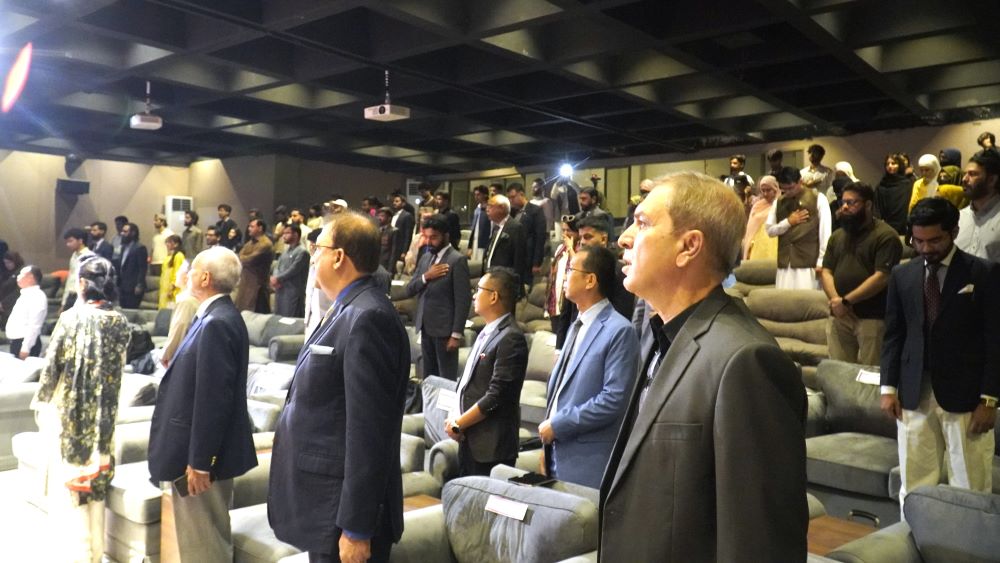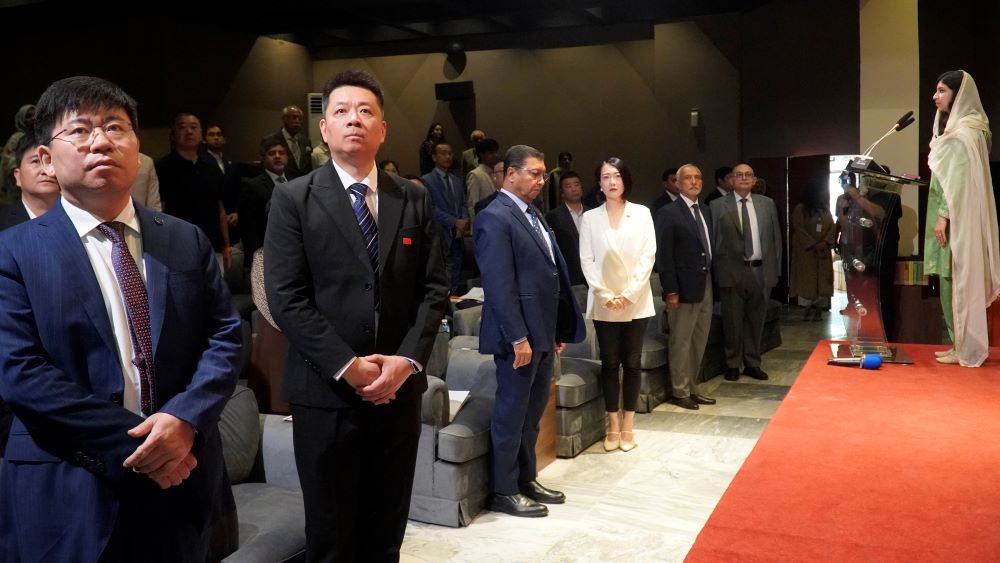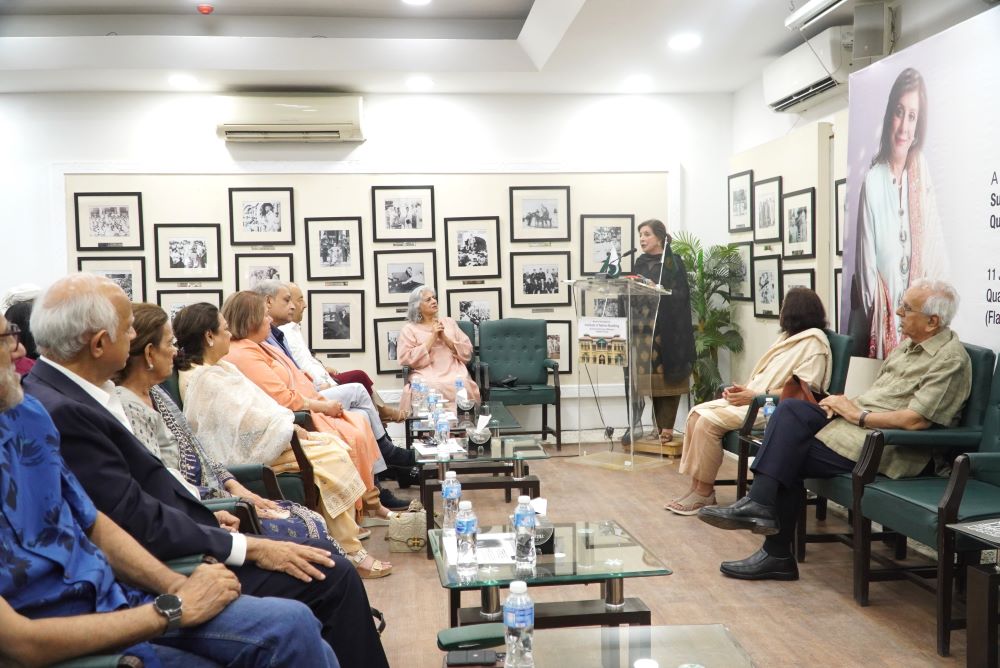





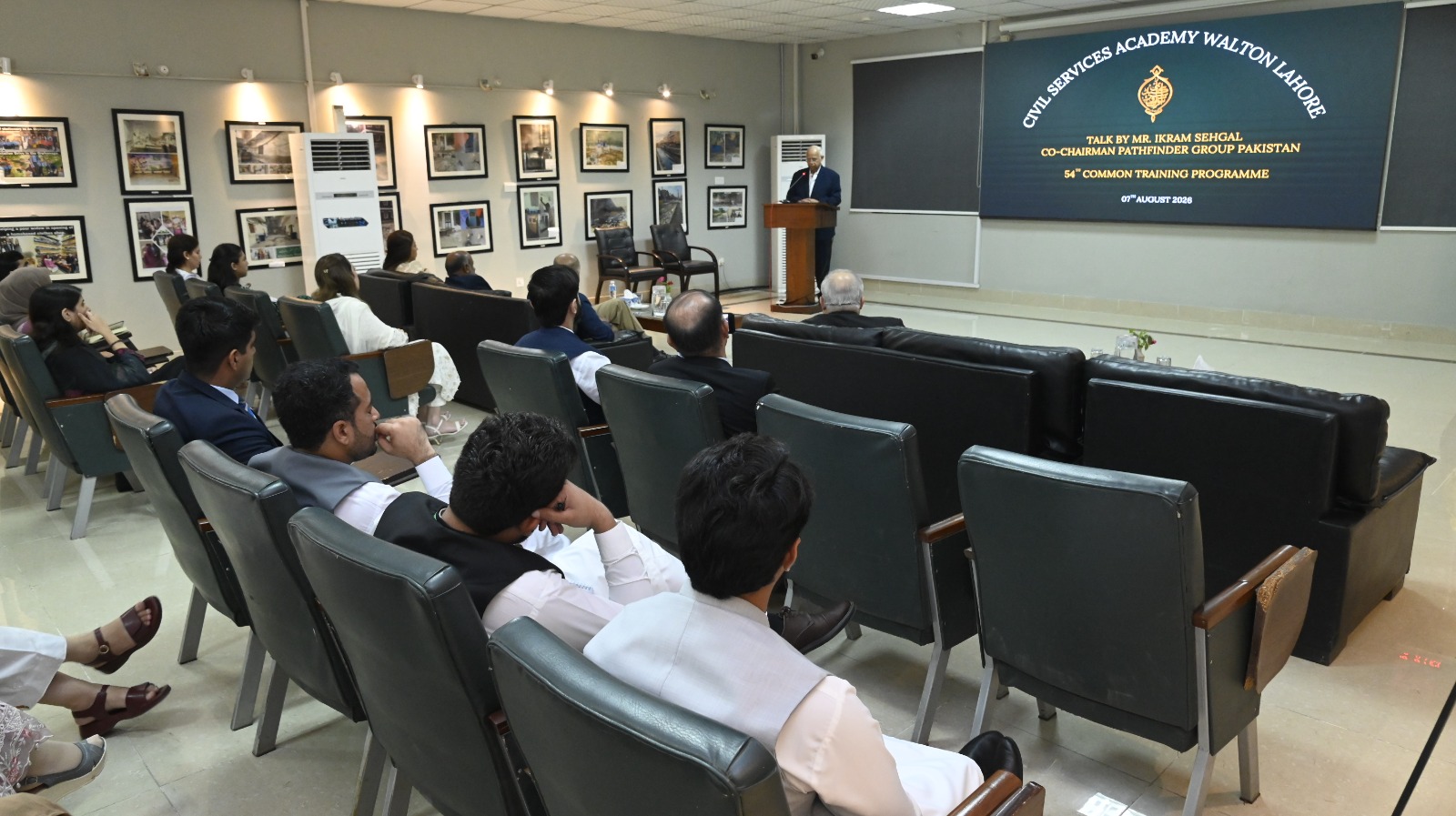
Ikram Sehgal, Co-Chairman Pathfinder Group:
We are all Pakistanis here, all part of one nation. I was very encouraged by what I saw here today. A lot of what has been spoken here today is close to my heart, and I want to add to what the Director General and the Director said to me before we came here. What is it that we want you to be? We want you to be STREET SMART, in two words. You’ve got the education. You’ve got the background. But how are you going to affect the lives of the people of Pakistan, the downtrodden people of Pakistan, without being STREET SMART about their actual requirements, and about how you fulfill them? I am amazed at some of the things we have in common.
Let me first go backwards a little. In our group, we had the Enhanced Harmony Division (EHD), which is divided into four parts: the Providentia Books Foundation, the ElenaCare, the Pathfinder Interfaith Harmony Initiative (PIFHI), and the Kashmala Family Welfare Centre (KFWC) we havenow grouped it as PathfinderCare Foundation. All of this was originally done without any real organization, ideas that simply came up along the way, and now we are bringing them together under one umbrella organization. The person who heads this effort is Brig Mujahid Alam. He was the Principal of Lawrence College Murree for several years, and was an outstanding military officer who served with the United Nations for about 15 years. He then came back and served at Lawrence College Murree for 11 years, and at my request he joined us to help shape our CSR activity into something structured and meaningful. Why CSR? I came from a privileged family, and from that privileged background I went into the Pakistan Military Academy. We graduated a little earlier than planned; we were in the Academy in 1965 when the war broke out, so we graduated early. Many of us had actually finished our academic coursework, but we did not receive our actual degrees until 30 years later. So, when people used to ask me about my educational background, I would tell them this: in the Military Academy, we did a 9-mile run carrying a big pack on the back and a rifle. On the eighth mile, there was a place called Ilyasi Masjid having a spring with cold water about 800 yards from the finish line. We used to joke that we were “educated drinking the water of Ilyasi Masjid”, and to some extent, that was true.
You are not like us in that sense. You have had the advantage of a tremendous educational background, and your greatest advantage is being at a tremendous institution like this. I am very impressed by what I have seen here, and I don’t think it is well known enough outside these walls. I believe we need to make it more apparent. Seeing is believing, and people must know that those who are going to help them and improve their lives have gone through a process that takes them from the classroom and shapes them into being STREET SMART. That is very important. Some people may call this propaganda, but it is not; it is a reality that needs to be portrayed and told.
I would like to touch on a few fundamental points, without going into too much detail.
I am very happy to see a large number of female candidates here. This country will go nowhere until it makes its female population part of the national process.
Let me give you one statistic: today there are approximately 250 million people in Pakistan. Of these, about 120 million are adults. Of that adult population, would you believe it, 70% do not have bank accounts. With 70% lacking bank accounts, how can we expect them to have financial access? And without financial access, how can we expect our economy to become truly international?
I am fortunate to own the two largest private security companies in Pakistan – Security & Management Services (SMS) and Wackenhut Pakistan – employing about 12,000 people. I am very lucky. I started this journey as I was saying that I came from a privileged family, but I truly learned what privilege meant only after I became a prisoner of war. I went from being the blue-eyed boy of the army, an infantry officer who later spent some years in aviation, flying several aircraft, from 1969 to 1971 to something very different. At the time, the advanced helicopters newly inducted into the country were French Alouette IIIs. There were 12 helicopters and just nine pilots (most became Maj Gens later, one even Lt Gen) The pilot senior to me was about five years my senior, the rest were even 10 – 12 years my senior. I since was the only bachelor among them, I flew a great deal. We were often flying the top military and civil hierarchy, as well as visiting dignitaries from outside the country. We were living quite a life. And then I found myself an Indian prisoner of war, in an Indian camp, where the food they gave me, daal (lentils) and chapati (flatbread), was simply thrown onto the floor, and I was told to eat it from there. I went hungry for a few days before I finally began eating again. But I learned a great deal from that experience: what it means to go from a life of privilege to being told to eat daal off the floor.
There was another factor in all this, not unimportant, that I would like to mention. My father was from West Pakistan, and my mother was from Bangladesh. My father used to speak proudly about how a Punjabi had married a Bengali, but this created real problems for us in 1971. My mother, living here at the time, was isolated; people would say, “She is Bengali, don’t talk to her,” and so on. One of my best friends, Shabbir Sharif – who was later awarded the Nishan-e-Haider – his mother who lived close bycame daily to visit and check on my mother. So, there were good people too, even in the midst of that isolation. When I escaped from India as a prisoner of war, I was the first to do so. I thought of myself as a hero, and at first I was treated like one. But when I began speaking about the wrongdoings committed during the war in East Pakistan, I quickly went from hero to zero my interrogators first tried to dissuade me and then said I had been brainwashed. Even my father was sent to speak with me. My nickname is Chand, so he said, “Chand, why are you doing this?” I told him, “Daddy, there’s a difference between you and me. Your mother is Punjabi, and my mother is Bengali; that’s the difference.” I was then posted on 27 Nov 71 to a unit newly raised 44 Punjab under difficult circumstances. On 13 Dec 71 early in the morning, I received from my CO, Lt Col (later Brig) Muhammad Taj (SJ & Bar), one of the most decorated officers of the Army and one of the bravest, a battlefield promotion to the rank of Major. My company was renamed the “Sehgal Company”, and it is still called that today. When I stood first in the Captain-to-Major promotion exam, out of 3,500 officers in 1973, and then stood first again out of 300 officers in the subsequent Staff College Entrance Exam someone decided I must be a traitor. Because otherwise they would have had to send me outside the country to Staff College Camberley in UK. They threw me out of the army. At that point I genuinely wanted to leave the country. I remember thinking, “What is left for me here? This is not my country. My country was one whole country.”
But two things kept me from leaving. First, my father, my poor proud father, whose son was being called a traitor. And second, my unit, the 44 Punjab (Now 4 Sindh). In the two years I served with them, the love and loyalty I received was enormous, and it made me turn around and commit myself to this country, to do anything I could for it. I still have many friends from that time, people like Gen. Ali Kuli, Gen. Raheel Sharif, Gen. Waheed Kakar, and Gen. Aslam Baig, but you know how people can be, and how things can change.
Today I run a company of over 12,000 people, and I started it with 11,000 rupees. I believe my country has the best people in the world. Let me tell you what we have done as a result of that belief. The minimum salary for guards at my company is 50,000 rupees, not including insurance, EOBI, social security, provident fund, and so on. We noticed that when a guard dies, his widow faces the biggest problem, because her monthly household income simply stops. We found a solution for this: one approach for a normal death, and another for a death by violence, such as if a guard is shot in front of a bank or killed in a bomb blast. In such cases, the company provides the widow with six months of full salary, followed by 18 months at half salary, in addition to insurance. This kind of support is not seen anywhere else in the world, and we hope other companies in Pakistan will follow suit.
The second initiative we undertook was including women in the process of opening bank accounts. Why shouldn’t a woman have her own bank account? But how can she fill out a six-page form to open one if she isn’t educated? There is a World Bank scheme for financial inclusion and women’s empowerment, and we invested significant resources into building a platform called Asaan Mobile Account (AMA). This platform is unlike anything else in the world; it doesn’t require internet access, it is connected to 16 banks, and it allows anyone to open a bank account in under two minutes using a simple mobile phone, just by dialing *2262#. Today, we have 15 million bank accounts on this platform. Of the adult population with bank accounts in Pakistan overall, 82% are male, and only 18% are female, but on our platform, 38% of accounts belong to women. Women are increasingly coming into the financial system, and this country cannot succeed unless we bring more women into financial inclusion. This country will not move forward without a stronger economy, so we have to think of innovative solutions like this.
My son, Mashallah, is one of the top lawyers in the United States. His children were born there and attend the best schools. My eldest granddaughter is going to Cornell University, has already completed her first year. My son used to do “pro bono” public service work as the head of TCF USA, raising funds for the cause. He persuaded Pakistanis in the US to donate 10 million dollars annually. My daughter-in-law Kashmala has raised the donations toUS 20 million dollars.
My eldest granddaughter, Amaani Sehgal, used to come to Pakistan and teach at TCF schools, where she noticed that the children did not have books. So at the age of 14 she founded the Providentia Books Foundation, which collects thousands of books from well-resourced schools like Beaconhouse, Roots Millennium, and The Foundation Public School etc and distributes them to underprivileged students across different parts of Pakistan.
My other granddaughter, Elena, studies at The Brearley School in New York City, one of the best schools in the country. There, she has friends of different faiths. Together with her Hindu, Jewish, and Christian friends, she founded The Agape Project at the age of 14. Every Saturday, the four of them would get together, make sandwiches and cookies, and distribute them to homes around the neighborhood. The Mayor of New York Mamdani sb even gave them a $2,000 grant for the project and thereare today more than 50 good volunteers who gather every Saturday morning in Manhattan. Inspired by this, in Pakistan we established the Pathfinder Interfaith Harmony Initiative (PIFHI). Our other project, ElenaCare, looks after the welfare and medical needs of our employees. In Jajja, there is a Cadet College run by Lt Gen Lehrasab Khan, one of the bravest most honorable soldiers of this country, 45 children of our employees are currently boarding and studying there. We also have a large number of employees’ children studying in day schools, over 500 children in total, with all of their educational expenses funded entirely by the company.
I would also like to tell you about our latest project, the Center for Innovation, Technological Advancement, Digital Entrepreneurs and Leadership (CITADEL). CITADEL is led by a group of individuals from the Air Force: Air Vice Marshal (Retd) Asad Ikram, Air Commodore (Retd) Farhan Ahmed, Air Commodore (Retd) Khalid Banuri, and Imran Jattala. For the first time, CITADEL took local startups to the World Economic Forum (WEF) in DAVOS this year, where our company – as a private-sector organization without any government support – has hosted the “PAKISTAN BREAKFAST” at WEF for the last 22 years. This year, we decided to take local startups with us. Out of a group of 200 startups that competed, we narrowed it down to eight, and we took those eight to DAVOS, presenting each one to international investors.
We plan to expand this initiative to the OIC’s COMSTECH in Islamabad, with whom we are already working. In our most recent startup competition, we had over 216 applicants, 52 of whom came from other countries, Bangladesh, Indonesia, Malaysia, Iran and others. We intend to continue growing CITADEL, and I would ask you to give some time to Air Vice Marshal Asad Ikram, who can come and give you a presentation on what we can do together; that, too, will be part of our CSR effort.
I can tell you this much: this country has youth second to none. When IIT was established in India, the person behind it was a Dogra, from the family of the Maharaja of Kashmir. He became a friend of mine, and in 1999 I asked him to help set up an equivalent institute here in Pakistan. He declined. When I asked why, he said it is very simple: “Your youth is far better than ours in India. If I give you this expertise now, you will be far ahead of us.” And it’s true, our youth truly are exceptional. It is simply a matter of unlocking that potential and taking it to the next level. I would like to invite you to come and spend some time with us at our auditorium in AmaaniBagh, on the way to Murree, where we regularly arrange seminars and events. We will arrange transportation; coasters will take you from here to the auditorium and back. Spend a day with us. Students from universities in Peshawar, Gujrat, Mardan, and Islamabad already join us regularly for our seminars and events, but we have never had the opportunity to host people like you. Give us one day from your life as a civil service officer, and let’s explore together where we can take Pakistan. I have just turned 80 years old, and one thing I have learned, one of the great blessings of being a Muslim, is contentment.
Let me share something I learned while flying aircraft. The first thing they tell you in aviation is that if the oxygen mask drops and you have a child sitting next to you, you put your own mask on first, before helping the child. It may seem heartless toward the child, but it isn’t; you still take care of the child, but practically speaking, you must first ensure you yourself are capable of helping. That is how I have come to understand Islam in practice:
“first take care of yourself, then secure your family,
and after that, do whatever you can for your people”.
That is the practical path.
You can do anything for yourself but what you are doing for others? Asim fellow Gallians and myself from use to go to the Pakistan Military Academy where 30 to 40 students from Hasanabdal, 30 to 40 from Military College, similarly from PAF College Sargodha and others from GG. We use to get top positions with 4 to 5 other students. But when it comes to swimming we use to drown. No problem, least I can do, built a swimming pool at Lawrence College. But it didn’t stop there, you imagine swimming pool located at an altitude of approximately 6000 feet, helping student develop greater cardiovascular endurance and stamina like Ethiopian long distant runners. Eventually they will be best swimmers in the world from Lawrence College. This is wrong that alone person can do everything, Ikram Sehgal cannot do everything, I can onlygive a gem of an idea, but it’s the team of experts who delivers.
I want to tell you about Zakia. She came to me a while back and told me that she used to work in healthcare, but after marriage she moved to her village, and once her children had grown up, she started selling medicines from a small shop in her home. Women from her village, which was quite large, would come to her with stomach pain, headaches, and other ailments, and she would help them. I began giving her 25,000 rupees every month to support this work. Sometime later, she came back and told me that women in her area made baskets, which they sold for just 12 rupees each. She said that if she were given the right materials, she could help them sell the baskets at a much higher price, while also creating employment for women in need. These women used to make 5,000 to 10,000 baskets a month at 12 rupees per piece; now, they make the same volume of baskets but sell them at 40 rupees each. After some more time, she came to me again and said she wanted to start a small business, so I gave her ten sewing machines, now she has more than 100.
Later, she told me there was no place for women to get salon services, no one to help brides prepare for their weddings, so she started teaching women about salon work. Then she pointed out that women’s husbands often wouldn’t let them go to the dentist, and that there was no dental clinic nearby even though 30 to 32 women a week needed one, so we set up a dental clinic as well. That is how the Kashmala Family Welfare Center came about, in Pabbi, KPK. You too can support her and help improve the lives of the women around her. Just look at how much a single woman can accomplish for her community.
You truly are the custodians of the best of the best. You are the future maturity of this country. What you do to make yourselves, and others, street smart will change the destiny of our nation. It won’t be classroom education alone, or grand ceremonies, that make the difference.
I want to return to my favorite subject: Pakistan. I want to talk about Pakistan-Bangladesh relations: My father raised the East Bengal Regiment and this unit gave two Presidents Gen Ziaur Rahman and Gen Hussain Muhammad Ershad, and Chief of Army Staff Gen KM Shafiullah, actually three COASs. When Tarique Rahman was born, I was adjutant to Maj Zia. He told me, “Come with me, Chand,” I drove him from Joydebpur about 26 miles away to see the baby, who is now the PM of Bangladesh.
Some people ask me about Pakistan and Bangladesh,
my reply is what I hadwritten 40 years ago,
TWO COUNTRIES ONE NATION.
How do we make that a reality? Visa-free travel. No visa requirement at all, just come. If there’s an issue with a particular individual, send that person back, but otherwise, no visa should be required. No tariffs either. Our cotton, textiles, and rice would go there; their tea, among other things, would come here. We don’t need to overthink the economics of it; we already have complementary economies. We don’t need elaborate protocols. We can simply do it. Two countries, one nation. Keep it simple. I apologize if this sounds blunt, but I live by the KISS principle: “Keep It Simple, Stupid”. It teaches you a great deal.
With that, I must take my leave. Please consider having me back. I would like to ask the Director General to let me bring you all to our facility at AmaaniBagh Angoori, Islamabad; we will cover the transportation. Come spend a day with us. Let us show you what the private sector can do, and let us interact and build on this relationship together.
In closing, thank you for this honor, and thank you for having me here today. I want to leave you with one final thought: you have received such a fine education — make the most of it. In the army, we complete two years of training at PMA; some of us go on to serve abroad, and some of us are martyred. But you — you carry a certain maturity. Use that maturity well. I cannot fully express my admiration for what I have seen here today. It has truly been outstanding. Thank you for this opportunity.