


A legacy of Strategy, Skill and New Normal
The Indo-Pak war of 1965 remains one of the most defining episodes of Pakistan’s history. While many historians term the culmination of this conflict as a stalemate, yet containing a bigger belligerent was a victory for the Pakistani nation and its armed forces. During this test of resilience, PAF and its stellar performance against a three times larger Indian Air Force (IAF) have been acknowledged by military historians as well as Air Marshal of the IAF Arjun Singh himself, who acknowledged PAF to be a ‘formidable opponent’. This war is often remembered through competing national narratives of claims and victories, yet there is an established military reality: a numerically smaller Air Force did prevent a bigger opponent from achieving any type of aerial leverage. PAF’s achievements validated such air warfare strategies in South Asia that continue to resonate to date in the form of a new normal re-established in the recent May 2025, four-day war with India.
PAF’s advantage in all conflicts to date can be attributed to its doctrine, which embodies readiness, professionalism, training and a visionary command structure capable of making timely strategic and operational decisions. The Air Force prepared by Air Marshal Asghar Khan went into action under the dynamic leadership of Air Marshal Nur Khan, both of whom emphasised preparedness and an offensive state of mind rather than waiting passively for a bigger enemy to dictate the ‘TEMPO’. Air Marshal Nur Khan inherited the institution just 43 days before the war and led from the front by flying combat missions himself and implemented his strategy of seizing the initiative through surprise. The most significant decision came on the evening of 6 September 1965 to launch coordinated strikes against IAF airfields and radar installations to disrupt IAF’s ability to generate sorties.
This was one of the first new norms created by the conflict: a smaller air force could compensate for numerical inferiority by attacking the opponent’s operating system rather than merely defending its own territory
The conflict also showed that technology mattered, but by itself it was not decisive. Aircraft performance had to be matched by pilot proficiency, tactical discipline, maintenance standards and command & control systems. The Manohar Parrikar Institute for Defence Studies and Analyses (MP-IDSA) in its research on ‘Air Power in the Indo-Pakistan war 1965’ concluded that PAF enjoyed a qualitative and technological advantage over IAF despite being outnumbered by a considerable margin.
This could be termed as the second norm: qualitative superiority can narrow the gap created by numerical inferiority, but only when it is supported by training and operational discipline.
Air denial means preventing the enemy from using airpower freely, even if one cannot destroy the enemy’s air force or control every part of the sky. PAF successfully protected its key bases, supported Pakistani ground forces, intercepted Indian formations and destroyed IAF assets on the ground, thus imposing high costs on Indian operations. The war therefore demonstrated that a smaller force could make air superiority prohibitively expensive for a larger opponent.
This was a third norm: the objective of a smaller air force need not be continuous air superiority; denying the adversary operational freedom may be sufficient to achieve strategic effects.
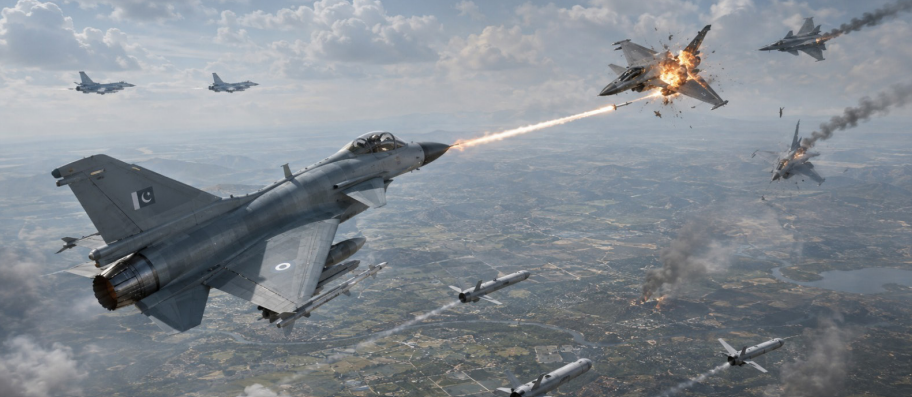
These golden rules and norms have continued to evolve with PAF’s quest in one form or the other till the highly talked about India-Pakistan four-day war, Marka-e-Haq in May 2025. This was the most significant conflict between the two nuclear-armed adversaries since the USSR vs China conflict of 1969. The aerial battle of 57 minutes crossed the previous thresholds of intensity and consequences, bringing all BVR concepts alive for the designers, operators and defence analysts alike. The kill chain mechanism, the results, the systems in play and professional virtuosity that cut to size a belligerent state with delusional thoughts and hardline concepts. The conflict outcome brought to light a new normal and glaring lessons varying in nature and impacts, both at the tactical and strategic levels. Above all, it reestablished the efficacy of Air power as an important tool of statecraft, deterrence and policy framework.
With the downing of seven IAF aircraft, including four Rafales, in the very first hour of war, the escalation ladder started to show its prominence with clear signs of diplomacy in play, with the US in the lead role. Blinded by the fog of war, the partisan Indian media generated unprecedented levels of disinformation, especially after the flop aerial performance on 7 May by the IAF, which shattered the godly image of ‘Rafael the saviour ’. This four-day war with no movement of troops on the ground or the naval assets at sea continued to use Air power in a multi-domain operations format through ISR platforms, manned fighter aircraft, swarm drones, UAVs, and surface-to-surface missiles. Airpower changed the dimension of conflict as a preferred weapon of first choice in pursuit of defined goals: to deter, deny and destroy the enemy designs. In fact, it was the new normal of asserting minimum credible deterrence through a convincing Air battle victory.
In the broader context of the May 2025 War, two narratives emerged as the new normal: Changing operational dynamics and Sensitized strategic impact. Let us briefly examine how conflict dynamics are changing in the region and adapting to newer trends.
On 7 May 2025, following the Israeli style of belligerence, the IAF carried out a preemptive strike across the international border. The aggressors used long-range weapons, considering the platforms safe inside their own territory; however, the Chief of Air Staff (CAS) PAF changed the rules of engagement, and PAF shot down seven IAF aircraft well inside Indian territory, achieving the longest BVR kills of over 180 km. As a consequence, the IAF changed its strategy by focusing more on the use of unmanned projectiles to afford time for introspection. Soon, waves of drone swarms and long-range vectors from ground and air were launched, and the war came to cities before it could reach the borders. This was an outcome of a new paradigm for penetrating the enemy’s OODA loop: ‘The kill chain.’ This creates an environment in a competitive space where time, information, and resilience dictate the outcome of a high-intensity conflict. This aspect is traditionally linear and somewhat predictable. PAF employed its assets on the concept of an integrated kill chain and additionally utilised a few facets of the ‘kill web’ concept, which is AI-driven, network-centric and decentralised for more resilience. Accordingly, assets swap roles on the move and are techier, with satellites feeding real-time data and recon-birds providing the ISR to AWACS for dissemination to fighters, bombers and drones in parallel. The whole system is knit like a web and constantly reconfiguring. Add to this a counter-adversary Kill Chain capability, i.e blinding satellites, spoofing GPS and hacking datalink capable of blindsiding any modern Air Force. It now becomes easier to go through the narration of what happened in those crucial 54 minutes on 7 May 2025.
Most of the Rafale were flying in offensive mode, equipped with Meteor BVRAAM, backed by SU-30 Flankers carrying Derby BVR missiles and Spice 2000 LGBs. When the IAF released bombs and missiles, it was taken as an act of violation against the sovereignty of Pakistani Airspace. ‘Kill them, kill them, don’t let them enter even an inch into Pakistan,’ was the famous command to all operators on the radio by the CAS himself. Waiting for this moment, the highly skilled PAF pilots went in for the BVR shots on locked targets. In parallel, the datalink was broken to sever the enemy’s situational awareness through jamming by assets deployed tactically through gathered electronic signature footprint from across the border. The entire burden of controlling a large number of aircraft in the air fell on the enemy’s ground-based radar controllers, who had to manage several aircraft in a highly dynamic environment, particularly as they were being engaged and shot down in rapid succession. Even the Rafael’s cutting-edge Spectra self-protection suite could not detect being targeted because the J-10C AESA radar fired missiles in passive modes through data link information. These tactics never instigated enemy radar warning receivers at long enough ranges to take evasive actions and only warned the pilots in the terminal phase for a sure kill.
Throughout this period, the PAF effectively denied IAF the use of its satellites through indigenously developed EW warfare systems, which jammed downlinks and disrupted the GPS signals. At the same time, PAF cyber warriors launched a sweeping offensive, crippling 96 per cent of India’s social networks, penetrating critical national systems to disrupt railways, banks, energy grids, flashing messages across CCTVs, and targeting critical nodes to cause electricity blackouts across vast regions of India.
This was the first time an Air Force had synced Kinetic ops with Cyber ops, thus creating a classic multi-domain kill chain environment: The Real New Normal.
At the strategic level, what started as a four-day conflict turned into the most intensive war in decades between the two rival nuclear States. The spate of violence with increasing intensity alarmed the world, initiating intra-crisis diplomacy vertically. In diplomatic overtures, the Iranian Foreign Minister passed meaningful messages during his visit to both capitals at the onset of hostilities. The Saudi Foreign Minister did the same in the immediate aftermath of the Iranian visit, professing restraint. China played a meaningful role in encouraging restraint for peace. The US offered both countries trade deals/tariff threats and assistance in starting constructive talks to avoid future conflicts. Pakistan also designated a national security advisor to activate the then dormant channel that had played a role in defusing prior periods of tension. During all this mayhem, news that Pakistan’s Prime Minister had called a meeting of the National Command Authority sounded alarms for the first time as the most overt nuclear signalling in any such conflict. Although denied by Pakistan’s Defence Minister, it could have been a catalyst to stir the influencers and offenders alike. Such was the scale of impact and its far-reaching implications that the President of the United States himself was compelled to announce a ‘FULL AND IMMEDIATE CEASEFIRE’, an outcome India, out of evident embarrassment, publicly disowned even as it quietly acquiesced to it. While still in a state of denial, India apparently calculated that the political advantages of further entanglement were not worth the continued persistence of a costly and dangerous crisis. While such a swift culmination was without precedent, both sides ultimately accepted the US-facilitated ceasefire. It is said that a ceasefire is not a peace pact but a temporary halt. This crisis and its end scheme will provide the foundation upon which the next crisis may unfold, or subside due to forecasted implications, especially when the end was confusing and surprising, which is yet another ‘New Normal’.
The foundation of the New Normal of South Asian Aerial combat was certainly established in the 1965 war. Facing an adversary equipped with vast resources, the PAF refused to fight a passive, defensive campaign. Instead, it pioneered the doctrine of aggressive, pre-emptive counter-air strikes with surprise as a secret weapon. The legendary dogfights over Sargodha and Peshawar shattered the myth that numerical superiority dictates the outcome of an air war. When subsequent arms embargoes threatened to ground the fleet, PAF diversified procurement lines. This forced transition laid the grounds for an enduring operational philosophy of self-reliance born out of geopolitical necessity. The modern era has seen PAF evolve from an air-centric force into an all-domain powerhouse.
By mastering Electromagnetic spectrum and blending Cyber warfare capabilities, PAF has neutralised long-range enemy air defences and high-end aerial platforms. The current norm is no longer about who has the most expensive jets: it is about who has the will, owns the Data Links, source codes and fastest decision-making loop.