




Sehrish Mustafa (Moderator):
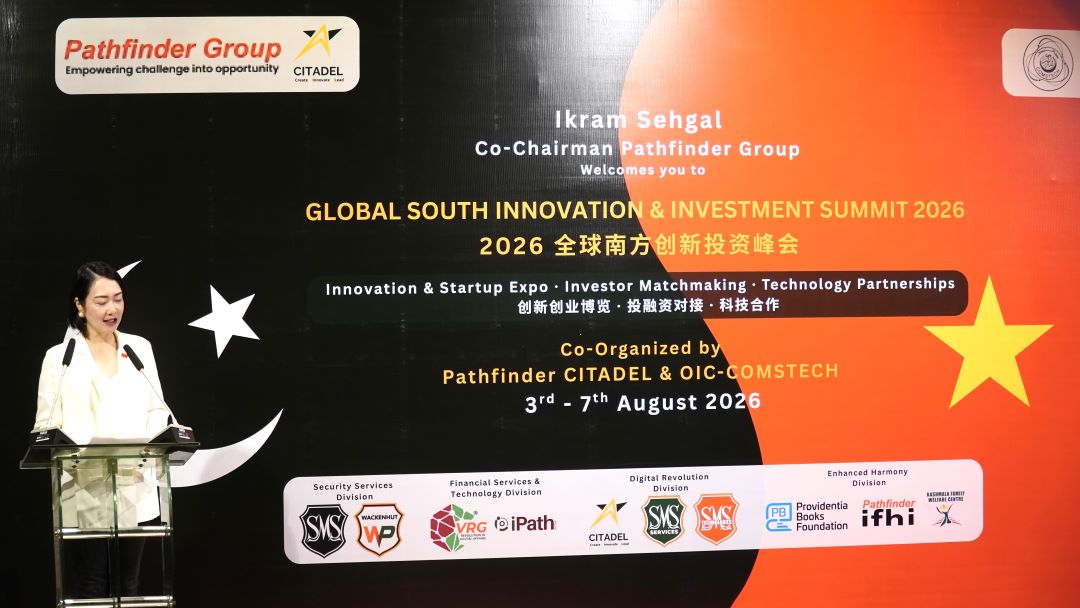
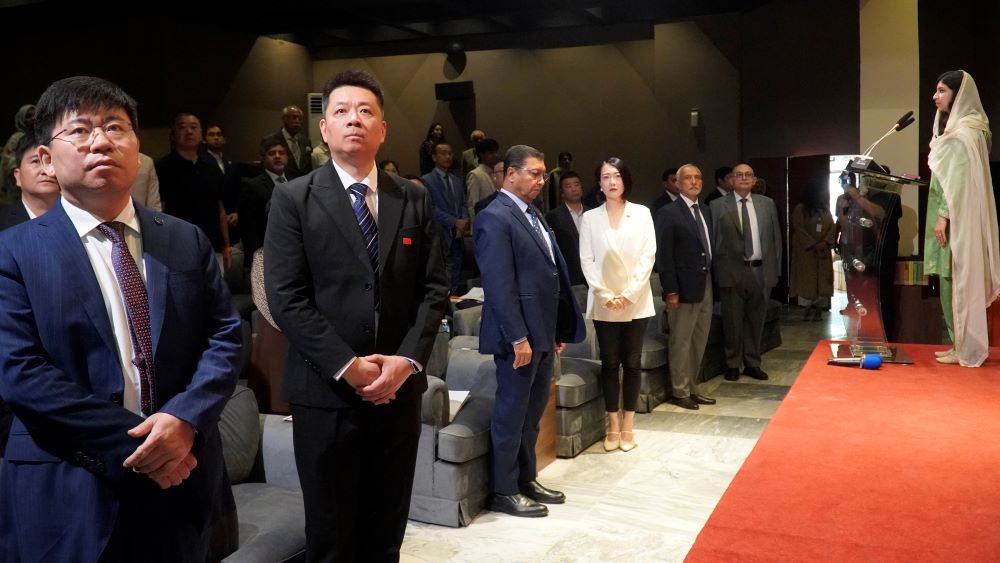
Esteemed delegates from China and Pakistan. On behalf of Pathfinder Group, it is my great honor to welcome you all today to Day 2 of the Global South Innovation and Investment Summit 2026 at AmaaniBagh. Following the remarkable success of yesterday’s inaugural sessions, where we brought together industry leaders, investors, development partners, and technology pioneers who together initiated a meaningful dialogue, we now turn our attention from vision to action, the most dynamic and interactive phase. The ideas and partnerships developed on day one will evolve into tangible opportunities through the Startup Expo inauguration, where groundbreaking ventures from Pakistan will showcase their innovations. The pitch arena, where promising entrepreneurs will present transformative solutions to this esteemed audience of investors and experts, and most importantly, the Investor Group Huddles designed to encourage focused discussions, strategic matchmaking, and high-impact investment partnerships.
To formally begin the session and set the tone for today’s event, I would like to invite Air Cmdre (Retd) Khalid Banuri. Himself a man of vision, Mr Banuri holds a diverse experience of over four decades in public service, fighter jet aviation, training and education, outreach and leadership.
Air Cmdre (Retd) Khalid Banuri, Principal Advisor, Pathfinder CITADEL:
Distinguished guests, honorable members of the Chinese delegation, esteemed founders, investors, ladies and gentlemen, good morning. It is my distinct pleasure to welcome you all to Day 2 of Global South Innovation and Investment Summit 2026. Yesterday we set the stage with powerful conversations among thought leaders about the technological ecosystem of the Global South. Today we move from dialogue to action. I extend a very special welcome once again to our distinguished delegation from the Commercial Cultural Association of China (CCAC). Your continued presence here is a testament to the seriousness of purpose with which you approach collaboration with Pakistan. We are truly grateful for your engagement and look forward to deepening the bonds between our nations.
Yesterday we spoke of the immense potential that exists within the Global South. Today I want to talk about the imperative to turn that potential into reality, and to do so with a sense of urgency. The world is not waiting for us. The technological race is accelerating. Those who move first will define the rules of engagement. Pakistan and China have a historic friendship, a strategic partnership, and now a unique opportunity to co-create a technological ecosystem that benefits not just our two countries but the entire Global South. But potential without execution is merely a promise. We need time-bound strategies. We need concrete roadmaps. We need to move beyond memoranda of understanding and into memoranda of implementation. The time for talk is giving way to the time for tangible outcomes. Pakistan is a market of over 240 million people with a young, digitally savvy population and a rapidly growing startup ecosystem. Our founders have proven their mettle on global stages like Davos. Our innovators are solving real-world problems in fintech, health tech, artificial intelligence and climate technology. The talent is here. The ambition is here. The opportunities are here, and we are open for business.
For Chinese companies, Pakistan offers a strategic gateway to South Asia, Central Asia and the Middle East. The Pakistan-China Economic Corridor (CPEC) has already laid the physical infrastructure. What we are building today is the digital infrastructure. The partnerships, the investment flows and the innovation networks that will define the next phase of our relationship. At the heart of this ecosystem is the Pathfinder Group. As you see, Pathfinder Group is not just a business conglomerate, it is an institution committed to Pakistan’s progress. Various Pathfinder Group divisions offer comprehensive solutions that can serve as a launchpad for Chinese companies entering the Pakistani market.
Security Services Division (SSD), end-to-end security solutions ensuring a safe and stable environment for business operations. Financial Services and Technology Division (FSTD), fintech innovation that enables seamless digital transactions and financial inclusion. Enhanced Harmony Division (EHD), social welfare and community development programs that foster goodwill, inclusive growth with the potential to evolve our mutual understanding of our various cultures. Digital Revolution Division (DRD), cutting-edge digital transformation capabilities across sectors. Whether it is secure commerce, electric vehicles, artificial intelligence applications, or integrated security solutions, Pathfinder Group divisions offer the infrastructure, expertise, or the reach to make partnerships successful and sustainable.
And then there is CITADEL, the Centre for Innovation, Technological Development, Digital Entrepreneurs and Leadership. CITADEL is our engine of connectivity, it sits at the intersection of academia, industry and startups. It is the bridge that brings Pakistani innovation to the world and brings the world to Pakistan. Through CITADEL, we are creating a vibrant ecosystem where Pakistani and Chinese companies can connect, collaborate and co-create. We are building a platform for knowledge exchange, technology transfer, and joint ventures. CITADEL is not just an institution; it is a movement. Now this brings me to today’s agenda, the heart of this summit’s action-oriented spirit. Today, we formally inaugurate the Pakistani Startup Expo Pavilion. The pavilion is a showcase of the best and brightest of Pakistan’s startup ecosystem. Our founders have been working tirelessly to build solutions that address local and global challenges. They are ready to present their ideas, their products, and their vision to potential investors and partners from China and beyond. We will also witness the pitch arena where selected startups will present their cases to a panel of investors and industry experts. This is where ideas meet capital, and dreams meet opportunity. Following the pitches, we shall have the investor group huddles, focused, intimate sessions where investors can engage directly with the founders, ask the tough questions, and explore the synergies that lead to deals.
Throughout the day, we will facilitate one-on-one meetings between Pakistani companies and potential Chinese partners. These are the conversations that matter. These are the relationships that will build the future. These informal discussions are often where the most transformative partnerships are born. Personally, I was quite struck by something we heard in the concluding keynote address yesterday by the President CITADEL regarding the three immediate steps that could be taken. Joint research and development, regulatory sandboxes, and data sovereignty partnerships. On each of these, we would like to hear more today.
To our Chinese friends, I say this: Pakistan is ready. Our startups are ready. Our companies are ready. The Pathfinder Group and CITADEL are ready to facilitate, to connect and to collaborate. The time to work with Pakistan is now, as the market is ripe, the talent is abundant, the ecosystem is growing, and the doors are wide open, always wide open for Chinese friends.
To the Pakistani founders, I say this: the world is watching. You have proven yourself on the global stage. Now is the time to convert that recognition into investment, scale, and lasting partnerships. Show our Chinese guests the creativity, resilience and innovation that defines Pakistan’s entrepreneurial spirit. The summit is not just a few days of discussions; it is about launching a movement towards South-South cooperation that is practical, productive and profitable. With the active participation of the CCAC, the support of OIC COMSTECH and the leadership of the Pathfinder Group and CITADEL, I am confident that we will not just talk about possibilities; we will create them.
So, let the pitches begin, let the connections flourish, let the partnerships take root. Welcome everyone to day two. Let us make it count.
Sehrish Mustafa (Moderator):
Now, it is my distinct honor to introduce you to Ms Rachel Wu, Chen Xi. She is the Deputy Secretary-General, China Business Culture Research Society; CEO, BSFL Culture, Education and Technology Group; and Executive Principal, Beijing Experimental Foreign Language School. She is a Senior Representative of the Commercial Culture Association of China. She will provide the delegation’s strategic perspective on cooperation with Pakistan.
Ms Rachel Wu, Deputy Secretary-General, China Business Culture Research Society:
Ladies and gentlemen, good morning. I am Rachel Wu from CCAC. I am very happy to stand here today, and it is a great honour to be here with you. I love Pakistan, I love the food, and I love the people. That is why today I am wearing traditional Pakistani clothes (Rachel was wearing Shalwar Qameez).
First of all, I would like to thank OIC-COMSTECH, Pathfinder CITADEL Group, and all those who have worked so hard to make this meeting possible. Ladies and gentlemen, today is my 10th day in Pakistan, and I can already feel the friendliness, enthusiasm, openness, and tolerance of this country. At yesterday’s meeting, our Chinese business partners also had a lot of positive impressions. Since last night, I have been communicating with each of our business partners from China and asking them, “What do you think of Pakistan?” Interestingly, on the night of August 2, we went to the airport to receive our Chinese business partners. At that time, they were still a little nervous because they did not know much about Pakistan and there were differences in the information they had received. However, after spending a day here yesterday, communicating with local friends and experiencing the city of Islamabad, they all felt that Pakistan is a very good country and Islamabad is a very good city. We have met many wonderful people, and we believe that Pakistan has tremendous opportunities.
Pakistan may now be on the road that China travelled in the past. What we experienced is something that many countries have experienced as well. China is now becoming stronger and more open, and Pakistan can certainly achieve the same. CCAC and I are willing to do our best to bring more Chinese entrepreneurs from different sectors to Pakistan and to promote deeper and more effective communication with all sectors of Pakistani society.
Last night, a gentleman shared a story with me over dinner. Many years ago, he travelled to a city in China called Dalian. At that time, taxis were the main means of transportation, and travelling by taxi at night cost more. However, he was surprised that the only English word the local Chinese taxi driver knew was “brother.” When our Pakistani friend got out of the car, the Chinese taxi driver did not charge him. He simply said, “Brother.” That small gesture left a lasting impression on him, and he remembered it for many years.
On the second day after arriving in Pakistan, something very interesting happened to me. I went to a shopping mall and wanted to order some juice, but I did not know how to say it. So, I asked a gentleman sitting nearby to help me order the juice. He said yes, and he even offered to pay for me. It was a very, very kind gesture. I want to say that the friendship between China and Pakistan is long-lasting, and we are very confident about the future of this relationship. This time, the Chinese companies we have brought with us represent a range of sectors, including new energy, energy storage, smart manufacturing, finance, and other fields. In the future, we will bring even more entrepreneurs to Pakistan. As the gentleman who spoke before me said, the door is wide open for our Chinese friends. I would also like to say that the door is open to our Pakistani friends.
Sehrish Mustafa (Moderator):
Rachel, you touched our hearts. And yes, Pakistani people are famous for their hospitality. Let’s move to the next speaker, Air Cmdre (Retd) Farhan Ahmed. He is the director of Pathfinder CITADEL. He will introduce you to the pitching format and also give an overview of today’s session.
Air Cmdre Farhan Ahmed brings over 32 years of distinguished service in the Pakistan Air Force and has played a pivotal role in advancing Pakistan’s aerospace and innovation landscape. As managing partner of Innovator Garage International, he has led transformative initiatives in innovation, human capital development, and project management. In recognition of his exemplary services, he has been awarded the prestigious Sitar-e-Imtiaz Military and Tamga Imtiaz.
Air Cmdre (Retd) Farhan Ahmed, Director Pathfinder CITADEL:
Assalam-o-Alaikum and Ni Hao to all our friends. As we have already discussed collaboration, cooperation, and integration between the two peoples, seeing Ms Wu wearing our traditional dress today, I would say that this collaboration and cooperation are already happening, and it has, in fact, already begun.
Thank you very much for honoring our traditional dress. It is so nice of you.
Ladies and gentlemen, Sir Khalid has already explained and elaborated on the programme that we undertake as CITADEL. Our main endeavour is to empower our youth, provide them with a pathway, to help them break the chains of this periphery, look ahead and look forward, explore more markets, more avenues, and more opportunities, and transform their potential into reality. We must cherish all these achievements, celebrate their success, and make every effort to take them forward.
In the same endeavour, this year in January, we took around eight of our STARTUPS to the World Economic Forum (WEF), and that was a major undertaking. In the history of the World Economic Forum, no company or country had ever done this before. We showcased our youth and their potential at the WEF, and I am very pleased to announce that the World Economic Forum was so appreciative of this endeavour that they invited Pathfinder CITADEL to participate in all their sessions held throughout the year around the world. We were invited to the WEF RIYADH Spring Session, for which we actually conducted a competition and selected the STARTUPS that were going to pitch there. However, because of the war in the Middle East, that session had been postponed.
Nevertheless, another DAVOS is coming, another challenge is coming, and another milestone awaits us and all of you. As for China, I spent around a year and a half there, and as Ms Rachel talked about the hospitality of Pakistan, well, ladies and gentlemen, let me tell you that, if not better, the Chinese are equally exceptional in their hospitality. I had a wonderful time in China, and wherever you go, as she said, they do not simply address you as gentleman, lady, sir, madam, or anything like that. There is one word that you hear from them: “Péngyou” (friend, companion). That is what we are to each other, and that is the very reason why such a high-level delegation is sitting in front of you today—to listen to you and to see where you stand.
They are ready, and we are ready, to collaborate and cooperate, take this mission forward, and strengthen our joint endeavour to strengthen the Global South. As was discussed in yesterday’s session, Western progress and technological advancements are, if not declining, at least receding. The next era of this century, rather, belongs to the Global South, led by China. Therefore, as they say, let us take this collaboration forward, strengthen it further, and build upon it.
Ladies and gentlemen, let me introduce the STARTUPS. We conducted a competition involving around 350 STARTUPS. After a lengthy process of internal and external due diligence, we selected 13 or 14 of them. They are the best in their respective fields. They are working in agriculture, deep tech, AI/ML, education, cybersecurity, and many other areas. All of these STARTUPS will come forward one by one today. They will pitch their ideas, explain the problems they are solving, and share their stories with you. I request the worthy delegation, as well as all the investors and businesspeople sitting here, to identify and select the STARTUPS with which you would like to collaborate. Please listen to these short pitches. They have been given only three minutes each. Listen to them, assess their ideas and potential, and select the ones you would like to engage with. From there, we will take them to the huddle rooms, where you can have one-to-one meetings with them.
Well, gentlemen, I now request my colleagues to begin introducing the STARTUPS, and they will come forward and pitch their ideas to you.
Sarah Tims, Community & Events Manager, Pathfinder CITADEL:
Welcome back from the tea break. We’re going to be starting the startup elevator pitches. I would like to introduce Muhammad Kamran Khan, founder of AquaTech Fisheries, to please begin.
Muhammad Kamran Khan, Founder, AquaTech Fisheries:
My name is Kaman Khan, and I am the founder of AquaTech Fisheries Pakistan. Pakistan’s aquaculture sector is worth around one trillion rupees, but it is struggling significantly.
We have a tremendous opportunity in the aquaculture sector because we have abundant resources. We have around 1,100 kilometres of coastline, water resources, reservoirs, and dams. However, our farmers are struggling with fish farming because they are using high-cost feed and poor-quality fish seed. As a result, productivity remains low because they also lack the necessary technical assistance. We consume a lot of land, water, and feed, but our production remains one of the lowest in the world.
AquaTech Fisheries provides a solution for fish farmers through a technology called Biofloc Technology. With the help of this technology, we recycle the water and fish waste and convert it into organic biomass. As a result, farmers can use 90% less land, 80% less water, and 30–40% less feed while achieving double the production compared to conventional farming, and they can achieve this within approximately one-quarter of the time.
China has some of the leading technologies in aquaculture equipment, technology, and automation. It also has extensive expertise in fish feed formulation and seed production. Pakistan presents a significant opportunity, as we have a population of 240 million, a large workforce, a huge domestic market, and four distinct seasons. We have two sets of strengths: Chinese strengths and Pakistani strengths. If we combine these two strengths, we can transform this challenging situation into an opportunity to develop Pakistan’s aquaculture sector, turn it into an export-oriented industry, and generate profits for both sides. If Pakistan develops this sector, we can also process our fish and export it to regional markets.
Sarah Tims:
Now I’d like to call upon Muhammad Hamid Saeed, the founder and CEO of Printable.
Muhammad Hamid Saeed, Founder and CEO, Printable:
I’m Dr Hamid Saeed, representing Printable.pk, Pakistan’s largest online design, print, and packaging marketplace. The problem we are solving is that Pakistan alone has a printing market worth around $500 billion, while globally, the market is worth more than $995 billion. The print-on-demand business is growing day by day, and Printable.pk is also increasing its share in this growing market.
Our team collectively has more than six decades of experience in the printing industry. We have a team of qualified professionals with expertise in the printing market, management, and related industries such as logistics and e-commerce. Printable.pk addresses this challenge through an online marketplace, which is available at www.printable.pk. We have generated significant traction to date, including millions of Pakistani rupees in revenue, and we have also been recognized as three-time P@SHA ICT Award winners in Pakistan. In addition, we have received several international awards, including the Epic Business Award in the UK and the Entrepreneur of the Year Award in Malaysia.
Printable.pk is now looking to expand its presence into different regions, including Malaysia, China, Turkey, and Sri Lanka.
Sarah Tims:
Next, I’d like to call upon Mr Khawaja Muqeet Hussain, founder of NerdFlow.
Khawaja Muqeet Hussain, Founder, NerdFlow:
Every business owner thinks that their biggest risk is their competition, but it’s not. Their biggest risk is work slipping through the cracks. When a company’s entire process is built on manual coordination, messages get missed, follow-ups get delayed, and humans make mistakes. But this isn’t a people problem; this is an operational problem.
My name is Khawaja Muqeet. I am the founder of NerdFlow, and we are building operational intelligence AI that knows your business as well as you do. The issue is not a lack of tools; companies already have too many of them. The problem is that these tools don’t communicate with each other. They are not intelligent, and they can’t think. NerdFlow is building a 24/7 AI workforce. We target operationally intensive departments such as sales, customer support, and HR. We deploy AI agents across each department, all connected through a singular brain, an AI layer built on top of a company’s operational layer. It is AI that knows your business.
But whose departments am I talking about? Who are we building this for? Enterprise AI companies are building solutions for the Fortune 500, while consumer AI companies are building solutions for individuals. We are targeting the mid-market. We are targeting millions of mid-market businesses across the world that generate between $5 million and $55 million in annual revenue. The mid-market comprises businesses that represent the most dominant hiring sector in many emerging markets and economies, making it one of the most important and rapidly growing segments. The great thing about NerdFlow is that this isn’t theoretical. This isn’t based on hopes and dreams. We have been building since January, and we launched three months ago. Our AI agents have been deployed across around 80 agencies so far. We have generated approximately $25,000 in monthly recurring revenue, and we are targeting $100,000 in monthly recurring revenue by the end of Q4. Our AI agents, particularly those focused on customer support, are currently handling more than 500 properties. NerdFlow firmly believes that one day, every business will run on AI. NerdFlow is trying to build the system that businesses will eventually run on.
Sarah Tims:
I’d like to invite Muhammad Tayyab Yamin, founder of Titano.
Muhammad Tayyab Yamin, Founder, Titano:
Ni Hao. I’m the founder of Titano Private Limited. We are building the future of the world. How are we building the future of the world? We are developing robots and unmanned systems, which also include aerial drones and maritime drones. We have integrated artificial intelligence with robots and unmanned systems for a variety of purposes. For example, these systems can be used for military applications, logistics, and several other areas.
On the battlefield, our systems can be used for operations such as cable laying, emergency extraction of personnel, and other critical missions. As an R&D-focused organization, we are also able to manufacture more than 90% of our components in-house, which gives us greater control over our technology and development processes.
At this stage, we are looking for collaborations and investments, both in technology and market expansion. We are looking forward to expanding into the Middle East and, beyond that, into Europe, with the help of strategic collaborations and partnerships.
Sarah Tims:
Now I’d like to call upon Miss Zunaira Omar, founder of CMOontheGO.
Zunaira Omar, Founder, CMOontheGO:
Globally, 50 million STARTUPS fail, and it’s not necessarily because they have a bad idea. It is simply because they often do not have the resources to onboard a senior marketing professional. We have built a multi-agentic AI marketing brain that provides businesses of all sizes with professional-level marketing strategies within minutes, at a cost they can afford.
I have been a marketer for the last 20 years and have personally launched 100 SaaS go-to-market strategies across MENA, North America, and Australia. My co-founder has consulted with Fortune 100 companies and GV Tech. CMOontheGo is no longer just a vision. Since our beta launch in November 2025, we have onboarded close to 250 B2B users, signed 40 letters of intent (LOIs), and generated recurring monthly revenue.
We have also onboarded our first Saudi agency client, and we have been selected for the Qatar Science and Technology Incubation Program as well as Plug and Play Ventures in Los Angeles. We recently had the opportunity to visit Hong Kong and exhibit our platform at LEAP East.
We were also present at the Gulf Connect launch, which aims to connect China with Pakistan and the Gulf.
So, this is not just a one-market story. We plan to build a bridge between the Gulf, Pakistan, and China, and we are here to make that vision a reality. We are currently raising $250,000, and we are looking for investors, partners, and collaborators who can help us expand into China and connect with the Gulf market.
Sarah Tims:
Now I’d like to call upon Mr Faisal Saeed, member of Technology Solutions.
Faisal Saeed, Member, Technology Solutions:
Ni Hao. I’m representing Technology Solutions, and I’m here to present our product, which is called Coherent. Healthcare IT is a billion-dollar market, and we all know that most startups operating in healthcare IT are building Electronic Medical Record (EMR) systems that are either clinical- or hospital-based. However, there is a gap: these systems are often standalone and are not connected with each other.
We need a platform that provides a unified and integrated solution capable of connecting different EMR systems. That is where Coherent comes in. We are developing an AI-powered platform that goes beyond being just an EMR system. It provides a solution that integrates healthcare provider systems, facility management systems, and clinical systems, while also incorporating AI-powered clinical tools.
That is what Coherent is working on, and we have been in the industry for the last 10 years. We have a presence in both the US and UAE markets. We have several ideas and opportunities that require further investment, and we are therefore looking forward to potential investors, collaborations, and partnerships.
Sarah Tims: I’d like to call upon Mr Shazaib Ijaz, founder of GenImage.
Shazaib Ijaz, Founder, GenImage:
Hello everyone, GenImage is a product-based AI startup. Everyone in this room has probably used AI image or video generation tools online. However, the problem you may have faced is that AI often feels like a black box. You provide a prompt and wait for the output, so there is more reliance on luck and less control over the final result. As a result, users often become frustrated because they have to repeatedly try different prompts to get the output they want. That’s where GenImage comes in. We build pipelines and workflows that improve the accuracy of AI-generated content and help users achieve results closer to what they actually want. Our platform provides features such as aspect-ratio controls and negative prompts, which allow users to eliminate elements they do not want in the output. In this way, we focus on backend optimization to give users greater control and consistency.
Our product has already demonstrated strong traction in the market. So far, we have generated more than $16,000 in revenue, primarily from Tier-1 markets such as the USA and UK. Our business model is based on recurring subscriptions, and we have grown by more than 78% over the last quarter. We have also received an acquisition offer from Rounds.com.
China is a very large market, with more than one billion people, and it has a unique digital ecosystem. We would definitely like to explore opportunities in the Chinese market. With a proven product and a scalable business model, I believe GenImage has the potential to become a highly scalable engine.
Sarah Tims:
Next up is Mr Maaz Ali, founder of Vector AI.
Maaz Ali, Founder, Vector AI:
Dear leaders, distinguished guests, ladies and gentlemen, and friends, hello everyone. You may be wondering how I can speak Chinese. Actually, what I eat most often in Islamabad is Lanzhou beef noodles.
They are very delicious! But, to be honest, Beijing is my second home. I lived there for four years, from 2016 to 2020. I studied at the Pakistan Embassy and took the Beijing subway every day, using Lines 1 and 10. At that time, I was still a student. I bought a pair of shoes through Instagram, these shoes.
The brand was called Yeezy. Now and then, I would take the train from Xiaohuang to Chaoyang. Under the China World Trade Center, there was a legendary shop selling all kinds of goods. For a few months, I earned 6,000 yuan. That was the highest amount I had ever earned in my life, and I am proud of it. This was the first lesson Beijing taught me: if you find a problem, just do it.
My Chinese teacher taught me the second lesson. Her name was Echo Che, and I respect her tremendously because she was the person who taught me so much about Chinese culture. She used to say, “Yi Cun Guang Yin Yi Cun Jin, Cun Jin Nan Mai Cun Guang Yin.”
For everyone who may not understand, this is a very important lesson that she taught me. It means that an inch of time is worth an inch of gold, but an inch of gold cannot buy an inch of time. The importance of time and the importance of acting quickly are among the most valuable lessons I learned in China.
I’ll now switch back to my natural habitat of speaking English because I have tried my best to justify speaking Chinese today. I hope I did well!
What does my company do? It does pretty much the same thing I learned in Beijing: we save time for businesses, enterprises, and companies by helping them transition from being AI-absent to being AI-native.
What does that mean, and what does that look like? We have prepared a newsletter for you that we launched earlier this morning, especially for this occasion. It is written in Mandarin so that you can understand exactly what we do.
I’m not here to talk about all the operations of the company or what exactly we do, because all of that has already been mentioned in the newsletter. My goal today was to build a connection, and I think I have achieved that.
Sehrish Mustafa (Moderator):
Welcome back, everyone, after an impactful investor group huddle session. As we continue this journey, let us celebrate not only innovation but also our collective ambition to build a more connected, resilient, and prosperous Global South, where entrepreneurship, technology, and investment converge to create solutions with global impact.
With that, I would like to invite Air Vice Marshal (Retd) Asad Ikram, President of Pathfinder CITADEL, to please come up to the stage and share his remarks on empowering Pakistan’s innovation potential.
AVM (Retd) Asad Ikram, President, Pathfinder CITADEL:
Excellencies, distinguished investors, brilliant founders, dear friends, good afternoon, Ni Hao. Yesterday in this very hall, we talked about tides, we talked about macroeconomics, we talked about geopolitical windows and strategic road maps.
It was high level. It was analytical. It was necessary. But today was different. Today we felt the actual current. Walking through the startup expo, listening to the pitches, watching the intense, rigorous conversations in the investor hurdles, I didn’t just see a conference. I saw an ecosystem breathing. I saw the future being negotiated. One handshake, one term sheet at a time, Insha Allah.
So, as we bring this remarkable conference to a close, my first and most profound note of thanks goes to the founders and entrepreneurs. To the young Pakistani and global south innovators who stood today on the stage, thank you. You pitched AI models, fintech solutions, clean energy breakthroughs and agriculture. You stood before some of the most sophisticated investors in the world. And you did not flinch. You’re not just participating in the global economy, you’re actually rewriting its code. Thank you for your grit, your brilliance, and your refusal to accept the status quo.
My second thank goes to our investors, our corporate leaders, with a special nod to the esteemed Chinese delegation. In the world of venture capital and private equity, time is the most valuable asset you have. You did not just fly in to give us keynotes and leave. You sat in those investor hurdles and asked the hard questions, especially Madam Wu. Thank you for your hard questions. You scrutinized the unit economics, you came to do business. Thank you for bringing your capital, but more importantly, thank you for bringing your operational expertise and your belief in the global south’s potential. Thirdly, I must thank the organizers, the volunteers, and interpreters. A summit to this scale, bridging languages, cultures, and complex tech sectors does not happen by accident. To the unsung heroes who made the coffee, fixed the microphones, and ensured everything ran with clockwork precision, we owe you an immense debt of gratitude. Friends, if day one was the why and the what, day two was the who and how; we arrived here with a question. Can Pakistan and China, can the broader global south truly build an interconnected tech ecosystem that rivals the legacy systems of the West? I believe the answer was given today. When Chinese deep tech meets Pakistani agile execution, when Chinese manufacturing scale meets global south market access, the math can work.
The synergy is real. The conversations that started in these formal sessions will hopefully continue later over dinner, and more importantly, they will continue next week in boardrooms across China and Pakistan. The seeds planted at this conference will grow into the unicorns of the next decade hopefully.
It has been an absolute privilege to speak and be a part of these historic two days with a heart full of gratitude and a mind excited for the future we’re building together. It’s my official duty and my profound honor to declare this conference closed today. But that’s not the end. Please, we are here for the next few more days, and we will get to meet again in a few days to work out more details. Thank you very much. May our partnerships be prosperous and may our friendship continue to flourish.