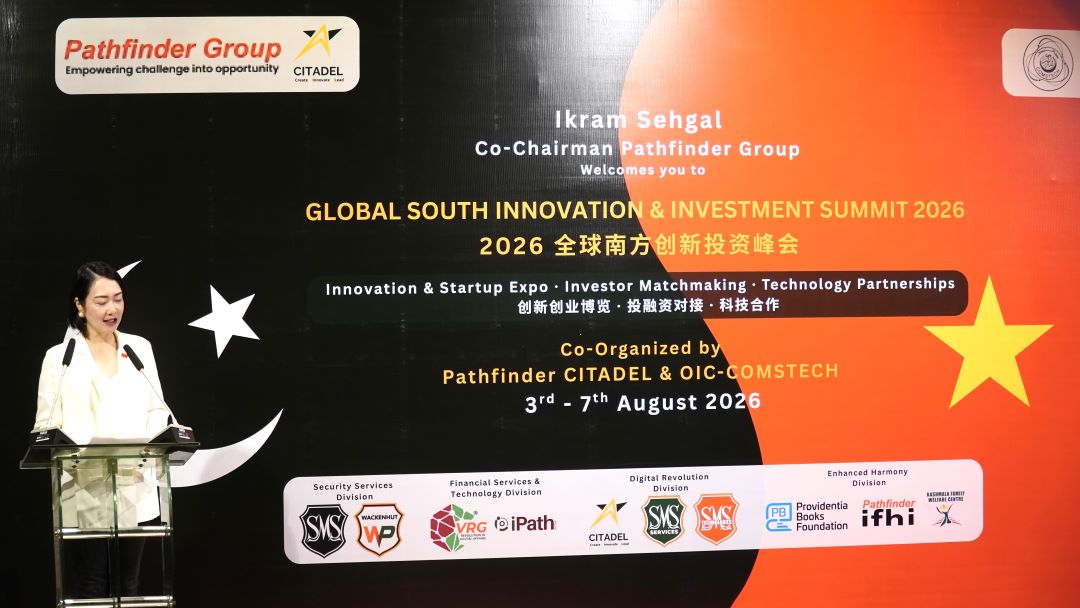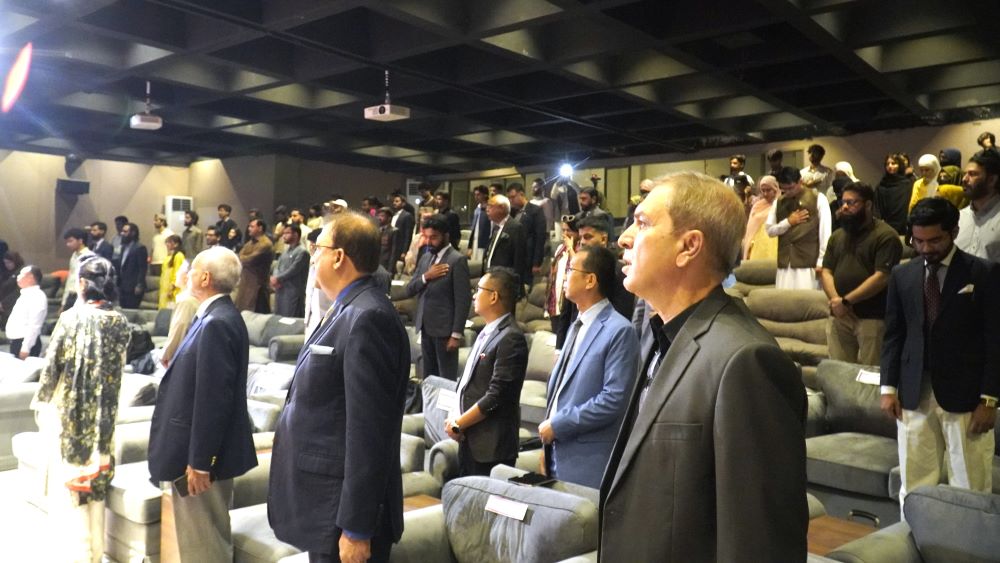


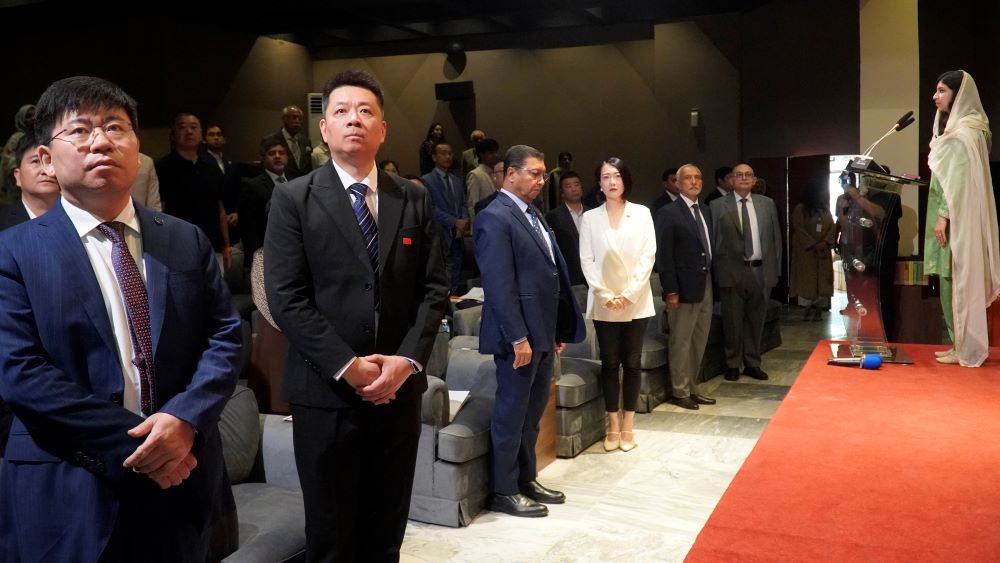
Pathfinder CITADEL and OIC COMSTECH co-organized the 2-day Global South Innovation & Investment Summit 2026 at AmaaniBagh Angoori in Islamabad, bringing together policymakers, technologists, and business leaders to advance economic cooperation across the Global South. The summit drew a distinguished gathering of delegates, including a 15-member delegation from the Commercial Cultural Association of China (CCAC), underscoring the strong cross-border ties between Pakistan and China. Framed around the themes of collaboration over competition and innovation as a bridge between nations, the summit aimed to spotlight the region’s youthful populations, expanding digital economies, and entrepreneurial energy as driving forces in shaping the next wave of global technological and economic transformation.
Session One
Sehrish Mustafa (Moderator):
Today we are gathered here to redefine the future of economic cooperation. In an era when technology has become the driving force behind prosperity, resilience, and global competitiveness, the Global South possesses an unprecedented opportunity to shape the next wave of transformative growth. Our youthful populations, expanding digital economies, entrepreneurial spirit, and emerging markets are no longer participants in the global innovation ecosystem; they are becoming its architects. Every great movement begins with a shared vision.
Today, the vision is one of collaboration over competition, partnership over isolation and innovation as a bridge connecting nations, industries and people to commence the Global South Innovation and Investment Summit 2026 formally. It is my great privilege to introduce you to Air Cdre (Retd) Khalid Banuri, Principal Adviser, Pathfinder CITADEL. He has 44 years of diverse experience in public service, aviation, training, education, and outreach. He has contributed significantly to national and international policymaking and has represented Pakistan on various global forums. In recognition of his outstanding contributions, the government of Pakistan has honoured him with two prestigious awards, a civil award of Sitara-e-Imtiaz for excellence in policy analysis and a military award for his dedicated services to the Pakistan Air Force.
Air Cdre (Retd) Khalid Banuri, Principal Advisor Pathfinder CITADEL:
Honourable Chief Guest, Excellencies, distinguished guests, honourable members of the visiting Chinese delegation, ladies and gentlemen. Good morning, Ni Hao, and a very warm welcome to the beautiful city of Islamabad. It is my proud privilege to welcome you all as we open the Global South Innovation and Investment Summit 2026. We open today’s activities dedicated to the thought leaders of the technological ecosystem in the Global South. I must commence by thanking our co-organisers, OIC COMSTECH, for their invaluable partnership in bringing this vision to life. This collaboration embodies the spirit of South cooperation that is central to our mission today.
Our chief guest is Dr Iqbal Choudhary, the Honourable Coordinator General of OIC COMSTECH and with his and OIC COMSTECH’s support, we connect with several countries across Asia, Africa and the Middle East. I would fail in my duty if I did not mention Dr Shahid Mahmud, Advisor, COMSTECH, the moving spirit behind this conference who requires, I reckon, no introduction for this audience. As you would notice, there are other institutions from the public and private sectors who are in support of this event simply because they see how important it is to connect from within the Global South. I extend a special welcome to our international delegates who have travelled to Pakistan to be part of this significant dialogue.
A particularly warm welcome to the delegation from the Commercial Cultural Association of China (CCAC) or the China Business Culture Society, as they call it. Your presence here is a powerful symbol of the cross-border collaboration we seek to foster, and we are deeply appreciative and thankful for your participation.
Ladies and gentlemen, we are privileged to have a strong 15-member delegation from the CCAC. During the course of this summit, we shall get to hear from several of them, to which we look forward. As you might have noticed from the program, we shall be honoured to hear from two eminent deputy secretaries-general of the CCAC later in this session. Mr Ang Li and Ms Wu Rachel, to you and to the eminent delegates from China, we extend a very warm welcome.
Allow me to briefly introduce the driving force behind this initiative from the Pathfinder side. CITADEL is the Centre for Innovation, Technological Advancement, Digital Entrepreneurs, and Leadership. It is a subsidiary of the Pathfinder Group. Pathfinder Group is a distinguished Pakistani conglomerate known for its strategic ventures and commitment to national development. Symbolizing inclusion, innovation, and social harmony as part of its corporate social responsibility, Pathfinder Group is a diverse organisation that contributes to the country’s development with full solutions on security, including physical and electronic security, finance, technology, and social welfare. Its main divisions – Security Services Division (SSD), Finance Services and Technology Division (FSTD), Enhanced Harmony Division (EHD) and Digital Revolution Division (DRD) – show a clear strategy for national progress. This strategy combines infrastructure, human development and digital change. Together, these divisions not only envision a stronger Pakistan, they actively build it – empowering every sector that they touch to rise, innovate, and thrive. By combining business success with social progress, Pathfinder Group not only shapes industries, but also plays a significant role in Pakistan’s future in a challenging and competitive world. Before we go to the substance of the summit itself, let us take a quick look at a glimpse of what Pathfinder Group does in support of its motto: empowering challenge into opportunity. (Played video on Pathfinder Group)
Ladies and gentlemen, Pathfinder Group provides a full range of services in various sectors. Our forte that started with physical security providing physical securities and also electronic security in all domains, actually led to several other capabilities being built and a glimpse of that you have seen; more of that you’ll be able to hear from our respective directors.
Let us now turn to the heart of why we are here today. Why a summit focused on the Global South and why in Islamabad? The answer lies in a profound and urgent opportunity. The Global South is at a pivotal moment. We stand on the cusp of a new era where technology can be a great equaliser, a tool for leapfrogging traditional development pathways. However, this potential is threatened by a growing artificial intelligence divide, a digital chasm that mirrors and threatens to deepen existing global inequalities. For many countries, the challenge is not whether AI and emerging technologies will shape the future, they will, but whether we will have the capacity, the agency, and the right partnerships to shape them in a way that advances our respective development priorities. This summit is our response to that challenge. It is a declaration that the nations of the global south will not be passive recipients of technology but active architects of digital destiny, mutual digital destiny. We are hosting this conference in Pakistan because we are witnessing a powerful surge of innovation and entrepreneurial energy across our country. Pakistani startups are not just local success stories, they are making waves at the global stage. This year, eight of Pakistan’s most promising startups were showcased at the World Economic Forum (WEF) at DAVOS, Switzerland, at the PAKISTAN PAVILION hosted by the Pathfinder Group. From AI and fintech to health and climate tech, these founders demonstrated the immense potential and creativity within our borders. This moment of global visibility is not an end in itself but a beginning. The objective is to translate that international exposure into concrete outcomes, investment, market access and partnerships.
This summit is designed to be a direct bridge for the momentum of DAVOS to the practical reality of collaboration in the South. Our goal is to move from dialogue to deal-making. The Global South Innovation Investment Summit is a platform for investor matchmaking and encouraging technology partnerships. We are here to foster South and triangular cooperation, pooling expertise, data and financial models to create shared public goods. Whether you are a venture capitalist looking for the next unicorn, a startup founder seeking scale or a corporation seeking a strategic partner, this is the place to be. This is where you would come across win-win solutions, win for both sides, for technological advancement and better business opportunities.
In conclusion, this summit is not just another conference; it is a strategic forum to build a resilient and self-reliant innovation ecosystem for the whole Global South. We are incredibly proud to host our Chinese guests here in Islamabad and all of the other guests as well. A city that is poised to be a focal point for this dialogue on emerging technologies and digital transformation. Islamabad dialogue is the buzzword in the geopolitical arena. As you know, with the active participation of our distinguished guests, including our friends from the Commercial Culture Association of China, the support of OIC COMSTECH, and the leadership of the Pathfinder Group and CITADEL, I’m confident that we will forge the partnerships and pathways that will define the next decades for our nations. Thank you, ladies and gentlemen. I look forward to very fruitful discussions today, and let the games begin, as they say.
Sehrish Mustafa (Moderator):
Now I would like to invite Engr Dr Shahid Mahmud. He is a senior policy and technology advisor at OIC COMSTECH. He has over 42 years of experience in telecommunications, IT, and media infrastructure. Please welcome Engr Dr Shahid Mahmud.
Engineer Dr Shahid Mahmud, Honorary Senior Advisor, OIC-COMSTECH:
First of all, allow me to address Maj Gen Shakeel Sahab, Khalid Banuri Sab, Asad Ikram Sab, the senior management, Farhan Sab, Imran Jattala and the teams for putting this whole program together, they have been working on this. We had limited time, but with the presence of all our distinguished Chinese guests, thanks to Mr Li Ang, Miss Wu, Mr Pan and all of those who traveled last night and arrived in the city of Islamabad. It is indeed heartwarming to see this collaboration start this morning in the presence of our future, the youth of Pakistan, who are looking at solutions that we can create as elders and as those who have done something in life for them.
We are living in, like the Chinese say, very interesting times. These interesting times are changing because of not only the geopolitical that we have around us, but also because of what the future world would look like with the current US-Iran affair. I don’t call it a war; they claim it to be a war, but it is something that has taken a country that was under sanctions for 47 years, taking on simultaneously military power like the US and also engaging in their bases in five or six countries in the region. This is something like if you go back in history you will see how the Ottoman Empire, the Persian Empire and then the Western Empire came and how these empires have stood there and obviously we cannot forget what the Chinese Empire has done. The most interesting factor in this is that all of a sudden warfare has also now become 100% technologically dependent. It was always mechanically and technologically dependent. But today, with AI, with technologies that are looking at space and with all other factors that are in play, especially rocketry, which started as space exploration, gives us a completely new framework and that new framework is: once this political shift takes place, what will happen?
I was fortunate to be in Beijing on 3 September when the military parade took place in Beijing. I said to myself that not only was I fortunate, but I was also looking at history take a new shape because, at that time, Mr Xi Jinping was addressing the world with the Chinese military on display and their air power, yet in the presence of 24 world leaders. On one hand was President Kim, on the other hand was President Putin, and including our Prime Minister Shehbaz Sharif Sab and others. And that was a titanic shift in my heart, who had been studying the world and the global powers, and what the future held. The difference being that even though that parade was being done in a military environment, the message was very clear that the Chinese people believe that the future of the world lies in caring for humanity and progressing with basic science and technological innovation. And that is what I think: if you look at their five-year plans, currently the 15th five-year plan, it focuses on how we can use technology to save not only the earth and its resources but also how to look at the galaxy and the universe and the future. And with that technology, how can we do better for people? Because we will add another two billion people to the face of this earth in the next 75 years. The shift will change to Africa and Asia. And once this happens, the global shift will truly take place. Iran is a part of this new scheme of things.
Now, as Pakistan, we are fortunate to be neighbours not only to Iran but to China, Afghanistan and India. India will be 1.5 billion people. China, with its shrinking population, will still be a force in the world from what they have gained by shared hard work – the only nation in the world that eradicated poverty. The only nation in the world that talks of peace and business and ethics and looking at nature in a manner that it brings harmony to the world and to the earth. So, there is a lot to be learned. I am hoping that with this very small effort, I must thank Mr Li Ang and Miss Wu and Mr Pan and all of the Chinese delegates who are here, who are from different businesses but understand not only globally how businesses are done but how the Chinese have put it together as supply chains as innovation, as entrepreneurs and there is a lot that we can learn and work with them. They desire to work with Pakistanis so that we can excel in all fields that they represent, and this, I think, is a great contribution that they could have done and can do and are doing by their sheer presence. So I hope today’s events will start the show, and thank you once again, Dr Iqbal, for all your support and the Pathfinder Group management, Maj Gen Shakeel, Brig Mujahid Sab; I must recognize you as one of the teachers and mentors that every one of us has to know. To all the youngsters, I must say that you are fortunate; I wish that when I was your age, we got exposure to such things.
Sehrish Mustafa (Moderator):
Now, we will move on to our distinguished international delegation from China.
First, I would like to introduce Mr Li Ang. He is the Deputy Secretary General of the China Business Culture Research Society and the Deputy Secretary General of the China Association for the Promotion of Western Development. Mr Li has eight years of experience in marketing management at foreign-invested enterprises and twelve years of experience in government affairs and public relations.
Mr Li Ang, Deputy Secretary General of the China Business Culture Research Society:
Dear members of the OIC COMSTECH, representatives of the CCAC, esteemed government officials, investors, scientists, innovators, entrepreneurs, business leaders, ladies and gentlemen, and friends, good morning. It is a great honour to be here in beautiful Pakistan to participate in the 2026 Global Southern Innovation Investment Summit, which focuses on the Global Southern Ecological System. Today, we gather in the spirit of sincere friendship and warm expectations. We are here to launch an initiative that emphasises not only ideological exchanges but also practical actions. This summit is co-organised by the OIC COMSTECH and the CCAC. The four key themes of the summit- innovation, entrepreneurship, investment, financing, and technology cooperation- are connected through one-on-one discussions aimed at building an international platform for positive interaction, two-way communication, pragmatic cooperation, and mutual benefits. On behalf of the Chinese business delegation, I would like to express my sincere gratitude to the OIC COMSTECH, the CCAC, the relevant departments of the Pakistani government, collaborating institutions, and the leaders in all sectors who have tirelessly worked to promote friendship between our eight countries and foster economic, technological, and commercial cooperation. I also wish to express my deep respect for the leaders of Pakistan.
The culture of Pakistan is known for its warm hospitality, dignity, generosity, and respect for guests, which fosters true friendship. This atmosphere makes us feel at home. Chinese culture also values sincerity, harmony, knowledge, diligence, loyalty, and the long-standing friendship between our peoples. Both nations respect families, communities, and education, and we believe that trust is built through practical actions. These shared values remind us that long-term partnerships are founded not only on contracts but also on cultural understanding, mutual respect, and trust.
Pakistan and China are bonded by mountains and rivers, standing as the most reliable friends. Over the past 75 years, the two countries have faced many challenges together and have established a unique and enduring strategic partnership. As the China-Pakistan Economic Corridor (CPEC) continues to be built and bilateral free trade agreements continue to create opportunities, the economic and trade cooperation between the two countries is deepening day by day. New cooperation areas continue to expand and achieve important results.
China has long been an important source of investment for Pakistan, a trading partner, and a development partner. The two countries have established a strong partnership, fostering cooperation that yields tangible benefits for their people and encourages industrial transformation and upgrades. This summit serves as a vital platform for cultural exchange, technological innovation, investment collaboration, and economic resilience. The CCAC has long dedicated itself to bridging Chinese and foreign business relations, supporting responsible international partnerships, and promoting business resilience. The Standing Committee on Scientific and Technological Cooperation (COMSTECH) has actively facilitated the exchange of science, technology, innovation, and knowledge among its member states. The initiator group has united organisations, enterprises, and investors to enhance dialogue and implementation. This collective effort has laid the groundwork for pragmatic cooperation among Pakistan, China, and the member states of the Islamic Cooperation Organisation.
At the core of this summit is a straightforward yet crucial concept: science generates knowledge and new possibilities; technology transforms that knowledge into practical capabilities; and innovation utilises these capabilities to meet real-world needs. Entrepreneurship turns good ideas into companies that can develop, create jobs, and serve society. For entrepreneurship to flourish, there must be a connection between science, technology, innovation, and businesses. While universities and researchers can generate excellent ideas, without entrepreneurs, companies, investors, manufacturing capabilities, and market channels, many of these ideas risk remaining in the experimental or prototype phase. Businesses understand market needs, but if they cannot connect with research resources, it can be challenging to enhance productivity and develop superior products. Entrepreneurs have talent and courage, but without patience, capital, guidance from mentors, policy support, technical partners, and client channels, achieving significant growth often proves difficult. This is why we collaborate to shorten the distance from research to market, from invention to investment, and from entrepreneurship to large-scale development.
We hope scientists will comprehend industry needs, businesses will acquire new knowledge and technology, investors will discover credible opportunities, and entrepreneurs will find the essential partners they require.
When these groups are genuinely connected, research can evolve into practical solutions, technology can translate into operational productivity, innovation can generate commercial and social value, and new enterprises can foster employment, boost exports, and promote sustainable development. This connection is vital for the Global South. Our country possesses a rich talent pool, robust research capabilities, abundant natural and industrial resources, a continuously expanding market, and a powerful vision for development.
However, these advantages are not always effectively integrated. Scientists may have solutions but struggle to find business partners. Enterprises might need specific technologies but are unaware of where to source them. Entrepreneurs may possess promising ideas yet lack funding and manufacturing resources. Investors could identify potential opportunities but require reliable local institutions and dependable transportation routes. The purpose of this summit is to bridge these gaps. We aim to foster collaborations in technological and ecological systems, innovative projects, and entrepreneurship. The agenda includes discussions about investors, establishing direct connections, conducting institutional and industrial investigations, and facilitating one-on-one talks. Each of these steps will help us recognise new opportunities, discover capable partners, align common interests and goals, and discuss practical next steps. Our goal extends beyond enhancing visibility; we seek to ensure credible execution and measurable long-term results. The Chinese companies visiting Pakistan come from diverse and excellent sectors, including new energy, storage, commerce, finance, technological innovation, and advanced manufacturing. They come with a commitment to sincere cooperation, mature professional skills, and practical implementation. Pakistan boasts significant regional advantages, abundant resources, a talented youth population, and vast industrial potential. Key opportunity areas include infrastructure upgrades, green energy, specialised agriculture, increased exports, mineral resource development, digital and financial technology, and industrial modernisation. Simultaneously, Chinese companies possess a broad industrial chain, extensive project experience, and strong technical and practical capabilities. The strengths and needs of both sides are highly complementary, providing a solid foundation for deepening cooperation.
However, all collaboration must respect Pakistan’s laws and focus on developmental and cultural values, national dignity, and long-term interests. Our objective extends beyond trade; we aim to build a partnership based on shared knowledge, opportunity, responsibility, and profit. Through face-to-face interactions, we can learn from one another, share experiences, and connect real needs with practical capabilities. We look forward to strengthening policy communication with relevant departments in Pakistan to cultivate a cooperative business environment supportive of corporate responsibility. Furthermore, we anticipate deeper engagement among Pakistani enterprises, startups, universities, research institutions, and investors. By leveraging our respective advantages and concentrating on key areas, we can explore long-term mutually beneficial cooperation models. We have consistently adhered to principles of mutual benefit, openness, inclusiveness, pragmatism, and shared long-term cooperation. A well-known concept in Chinese culture is that sustainable cooperation should empower all parties to continually create value rather than merely achieving temporary results. Thus, we are committed not only to promoting projects and trade but also to sharing appropriate technologies, cultivating skills, exchanging experiences, and learning from one another. This approach will support Pakistan in enhancing its innovative ecosystem, stimulating economic activity, and contributing to self-determination and sustainable development. We hope this summit establishes a standardised communication and cooperation mechanism to connect research institutions and enterprises, startups and investors, and facilitate collaboration between Pakistan and China, as well as with international partners. Our goal is to promote high-quality projects and enterprises from cooperative intentions to actual implementation, deepening, warming, innovating, and strengthening the China-Pakistan partnership. The friendship between China and Pakistan is deeply rooted in the hearts of the people of both nations. The prospects for cooperation between our countries are vast. We believe that with strong support from both governments and the collective efforts of research institutions, enterprises, investors, entrepreneurs, and all sectors of society, we can fully harness our potential for collaboration, broaden cooperation across various fields, and jointly write a new chapter in the economies and relationships between technology and business. Finally, I sincerely wish the Global South Innovation Investment Summit 2026 every success. May the friendship between Pakistan and China endure for generations. I wish all guests and partners success in their endeavours. Let this summit transform our knowledge into opportunities, innovation into enterprise, and partnership into shared prosperity. Thank you.
Sehrish Mustafa (Moderator):
I would now like to invite Miss Wu Rachel Chenxi to the stage. She is the Deputy Secretary General of the China Business Culture Research Society, the CEO of BSFL Culture Education and Technology Group, and the Executive Principal of the Beijing Experimental Foreign Language School. As a senior representative of the CCAC, she offers the delegation a strategic perspective on cooperation with Pakistan. Miss Rachel has 16 years of experience in the news media industry and 10 years in the academic education sector. Please join me in welcoming Miss Rachel.
Rachel Wu Chen Xi, Deputy Secretary-General, China Business Culture Research Society:
I am one of the founders of the Chinese Cultural Research Association (also called CCAC). Today, I am honoured to be part of the Global Southern Innovation & Investment Summit 2026. This event is special because it brings together people from all over the world who share a common desire: to transform friendship, knowledge, and opportunities into meaningful cooperation. First, I would like to extend a warm welcome to all Chinese entrepreneurs. Thank you for taking the time to join us in Pakistan with sincerity, confidence, and a spirit of collaboration. Your participation is a crucial foundation for this summit. The open and honest exchanges that occur here will make this event truly meaningful. A heartfelt thank you to all our friends from China.
I would also like to express my sincere gratitude to the organisers of this event: OIC COMSTECH and Pathfinder CITADEL. Thank you for your excellent organisational work, thoughtful arrangements, and warm hospitality. You have built a strong bridge between science, technology, innovation, investment, and corporate cooperation. Without your hard work, confidence, and commitment, we would not have such a high-level platform for dialogue and exchange. Thank you as well to Dr Iqbal, Dr Shahid Mahmud, the senior management team of Pathfinder CITADEL, all our visiting guests, and all members of the Chinese delegation. A special thank you to Dr Shahid Mahmud; you have been a catalyst for our efforts. Thank you for everything you have done for us. I also want to acknowledge all the individuals who contributed to making this wonderful journey possible. Everyone who worked diligently for this event has made today’s gathering achievable.
The China Commercial Cultural Research Association, CCAC, is dedicated to promoting the understanding and responsibility of commercial culture while fostering constructive international exchange. We strive to connect Chinese companies and institutions with those in other countries, along with entrepreneurs, investors, and society at large. We encourage companies to understand local cultures, communicate effectively, fulfill their commitments with respect, and focus on establishing long-term cooperative relationships. For the CCAC, commerce goes beyond just transactions and contracts. Commercial culture shapes how we build trust, uphold commitments, resolve differences, and share values. Understanding cultural nuances is not merely a matter of detail; it is a vital foundation for successful and sustainable cooperation.
This summit focuses on technology, innovation, investment, and development. In every laboratory, project, investment, and at the core of every company are the people involved. Science progresses through the sharing of knowledge, technology gains significance by addressing people’s challenges, and companies thrive due to mutual trust. Investment creates lasting positive value when grounded in these principles.
Therefore, the relationships between people transcend mere innovation; they embody the potential of innovation to foster development. Every connection forms an opportunity which develops into a relationship, solidifies into trust, and ultimately leads to cooperation and effective solutions. When we approach each other with respect and genuinely seek to understand each other’s needs, we can establish true trust.
Technology and commerce can lead to dignified education, employment, broader development opportunities, vibrant communities, and improved quality of life. This is why we unite institutions, scientists, investors, companies, and entrepreneurs.
We do not wish for exceptional creativity and enterprises to exist in isolation. We reject the notion that commercial success should be measured solely by short-term profits. Instead, we aspire for knowledge to serve people, technology to enhance lives, investment to generate opportunities, and companies to contribute to our shared prosperity. Cooperation not only fosters entrepreneurship but also enhances people’s happiness.
China and Pakistan have faced many challenges together, and we look forward to supporting one another. Therefore, our discussions today revolve not just around commerce, but also the continuation of friendship and the opening of new avenues for collaboration. I hope every participant can seize this opportunity to express themselves while also listening to others. It’s essential to introduce your enterprises and to gain a deeper understanding of your partners. Let’s not only contemplate the kinds of trade we can engage in, but also think creatively about what we can accomplish together to improve people’s lives. If we approach our future exchanges with openness and sincerity, this summit will not only be a successful event but also the foundation for reliable partnerships and a new starting point for joint efforts. Our collaboration will focus on creating a more innovative, inclusive, and prosperous future for Pakistan, China, and the broader global South.
Finally, I sincerely wish for the complete success of the Global South Innovation Investment Summit 2026. I hope that the friendship between China and Pakistan continues to flourish. I wish all our guests good health and successful careers. May every connection we establish today lead to innovation, development, and prosperity for everyone involved. This is my first visit to Pakistan, and I have genuinely fallen in love with this country. Thank you.
Sehrish Mustafa (Moderator):
It was wonderful, Rachel. And now it is my distinct honour to introduce you to our worthy chief guest, HE Prof Dr Muhammad Iqbal Choudhary. He is a globally recognised scholar and leader in science diplomacy.
He has established several research centers in Pakistan and helped to set up research units in Africa and South and Central Asia. His scientific and capacity-building contributions have been recognised by prestigious national and international awards and honours and fellowships of several academies of science. He is the recipient of some of the highest civil awards of Pakistan, including Hilal-e-Imtiaz, Sitara-e-Imtiaz, and Tamgha-e-Imtiaz. He’s also a proud Mustafa (peace be upon him) Prize Laureate, one of the most prestigious international awards in science and technology in the Muslim world.
Please welcome this worthy chief guest, HE Prof Dr Muhammad Iqbal Choudhary, Coordinator General of OIC COMSTECH, the Standing Committee on Scientific and Technological Cooperation of the Organisation of Islamic Cooperation.
HE Prof Dr Muhammad Iqbal Choudhary, Coordinator General OIC COMSTECH:
You know, speaking after a wonderful panel of speakers. I must say that it was a sheer joy to listen, brother Shahid; both of you and I were especially fascinated by the way you actually linked scientific research of my dear brother, Mr Li Ang, the Deputy Secretary General of China Business Culture Research Society. Your speech was a complete delight because you have taken a transformative and translative approach to how scientific research can be translated into products and services which can benefit and benefit for all. When I was introduced, she (moderator) very kindly mentioned my humble contributions in establishing research centers, but I think my greatest discovery was Professor Dr Shahid Mahmud. I’ll tell you with absolute honesty that whenever I need to show the best face of Pakistan, I showcase Dr Shahid. I request him to go and travel to places and represent this beautiful country of ours.
I would like to appreciate Pathfinder CITADEL, an absolutely wonderful organisation with a futuristic view, and we are absolutely proud of being your partner in a very humble capacity, and we are trying to take this mission beyond the borders of Pakistan at a much larger scale.
Ladies and gentlemen, I represent OIC COMSTECH. It is an organisation of the Organisation of Islamic Cooperation; is an organization comprising of 57 countries on four continents, with a population of 2.1 billion people. If you collectively take the Muslim population in non-OIC countries, we are talking about 2.6 billion people. So over 1/4 of humanity adheres to the faith called Islam, and they have a shared vision, a shared worldview, and also a shared destiny. This is also a very important landmass from Suriname and Guyana in South America all the way to Papua New Guinea in the east. The unbroken land of the OIC is an extremely important region not only because of the human capital it possesses but also because of its tremendous natural resources and the capacity to move forward in the future.
Ladies and gentlemen, the OIC world has tremendous resources. You name it: some of the largest reserves of oil and natural gas, coal, gold, copper, phosphate, critical minerals, solar energy and, as a favourite subject of my dear brother Dr Shahid, biodiversity. The tropical OIC, expanding from South America to tropical Africa all the way to Southeast Asia, is the hotspot of some of the largest biodiversity reserves in the world, which is a wealth. On top of it, this region has the most important asset, and that is a youthful population. According to the latest survey of the Organisation of Islamic Cooperation, 381 million individuals are below the age of 25 years. This is what I consider the greatest asset of the Organisation of Islamic Cooperation, the second largest political forum after the United Nations. But despite all these human and natural resources, the OIC region is among the most underdeveloped regions of the world, facing major challenges ranging from violent conflict to climate vulnerabilities, from youth unemployment to systemic discrimination against women’s education. From energy crisis to food and water insecurity. From biodiversity loss to very rich cultural heritage. From a post-colonial, rotten, outdated education system to the lack of an enabling environment for youth empowerment and innovation and most recently systemic genocide of women and children in Gaza, an unprovoked war against a sovereign nation. Amidst it, challenges to the multipolar world, particularly the rise of China in the global arena, bring new opportunities for the OIC region. China is now seamlessly integrated into the OIC system. Since 2018, China has had a special representation.
China has appointed a permanent representative in the OIC, and China, daily, is in negotiation and discussion with the OIC; that is one of the greatest strengths and perhaps the most important milestone in the history of the organisation, and this is a tremendous opportunity for us. I’m sure that we will discuss all of this.
The global economy is no longer developing through linear progression. It is being aggressively reorganised by a triad of interconnected frontiers, from AI to deep technologies and many more. These domains play a pivotal role in global innovation, industrial revolution, and economic transformation. COMSTECH’s mission, which Dr Shahid leads, is to integrate all these technologies with the system in which we work.
We have many challenges, but we certainly have lots of opportunities. The convergence of these technologies holds the power to bridge our development gaps, which are huge. We are strategically harnessing this triad to restructure our labour market and systematically unlock sovereign enterprise value across the Muslim world.
I don’t want to go into the domain of technology because this is not my ballgame. I am a laboratory scientist working in the field of chemistry. But one thing I certainly understand, there are several future paradigms which people have developed in parallel and many of them are also extremely contradictory. I would like to refer to an American futurist, one of the most influential futurists who is also a technology expert, Ray Kurzweil, and he looked through the lens of technology and considered technology as an equaliser. He considered that technology would eventually help humanity develop, and he wrote a very famous book called Singularity. Singularity means that when humans and machine will integrate together and emerge as a power that is going to be transformative in nature. He thinks that the world would be a better place to live with technology integration. He thinks that technology will help in solving many of the enduring problems, from climate to poverty. But this is a very Western view, to be honest. It is from the lens of an American, from the lens of a technologist, from the lens of someone who works at Amazon and Microsoft later, and he looked into the world from a very different perspective. The context is very different.
On the other hand, there are many futurists like Ziauddin Sardar, one of our own from Middlesex University. The director of the Future Research Centre there. He looks into the world as contradictory, chaotic, and complex. He thinks that the world is going to be an extremely difficult place. And when you combine those with what Yuval Noah Harari mentioned from a historian’s perspective, the introduction of technologies can be the greatest divide in the history of the world. Technologies would create an augmented, upgraded human race and marginalize the left-out part of humanity, a majority of them, and this is what eventually these different paradigms run in parallel somewhere in between the Muslim world has to navigate through. We need to find a way where we can benefit our younger people, where we can see the future in a much clearer way.
This summit is certainly extremely important. Bringing the top leadership from China to Pakistan and then gathering our younger generation, our younger innovators, younger entrepreneurs in one hall is a great contribution of Dr Shahid together with Pathfinder CITADEL.
I think these brainstormings are extremely important. I’m not really sure how we can influence the policies in the Muslim world, but we can be a force which can contribute to change, and this is exactly what I really expect from this very important conference, this summit. Let me assure you that on the platform of OIC COMSTECH we are doing our own bit. For instance, we are an inter-government organization; we are capable of connecting to the governments; we can connect with the institutions, and we can engage with the individuals. Having them together, we can have some influence on policy. We can have influence on institutionally strengthening and bringing individuals who can contribute to this entire process of change.
OIC COMSTECH has many programs, and you can always Google that, but perhaps the most important one which I would like to present to you is the OIC Technology Portal. We are the custodian of the OIC Technology and Innovation Portal, which provides us the opportunity of showcasing or what is developed in our universities and research centers and also to provide the opportunity for entrepreneurs to showcase what they have developed on their own innovative skills.
This is a platform which can showcase, which is capable of showcasing what exists. Along with it we also have a portal which is called expert service. So wherever needed, COMSTECH will be able to provide experts in different domains and many other programs, with hundreds of technology-based programs which we have initiated.
I would like to end my remarks with a very enduring and extremely profound feeling for China.
You know, I visited China back in 1987 when many of you were not born, and perhaps your parents were not really born. I was at Cornell and I was a PhD postdoc, in fact and my research group had a very famous professor called Professor Jon Clardy who is now the head of the Harvard Medical School, he brought the entire group, of which I was a member and I visited China in 1987 and have seen China going through a transformation, I mean absolutely unparalleled nature This is exactly what Dr Shahid said. You know, never in the history of humanity have we seen a transformation like what China was able to do. That miracle can happen in other places. We have to understand what the Chinese model is, and we need to work together with the Chinese model.
The Western powers are rotten, they are actually going down with every passing day. Their morality collapsed and their power diminished. And this is just a matter of time. As Ziauddin Sadar said, the old orthodoxies are dying. A new one is about to be born, and we are all here to celebrate the birth of a new paradigm.
Session 2
Sehrish Mustafa (Moderator):
It is my distinct privilege to introduce Air Vice Marshal (Retd) Asad Ikram, President of Pathfinder CITADEL. Throughout his distinguished career, he has played an instrumental role in establishing several key organizations and initiatives, including the Navigation Systems Department at the Advanced Engineering Research Organization, the Telecommunications and Marketing Department at LT Engineering Limited, and aviation research, innovation, and development programs at the Pakistan Aeronautical Complex. In recognition of his meritorious services, he was awarded the Sitara-e-Imtiaz.
AVM Asad Ikram, President, Pathfinder CITADEL:
Mr Lee, Dr Shahid, Ladies and gentlemen, Assalam-o-Alaikum. Ni hao. In Chinese strategic thought, there is a profound concept known as “Shi,” which broadly refers to strategic momentum or the prevailing tide of events.
The greatest military leaders and most successful investors do not resist this tide; they recognize when it shifts and position themselves accordingly.
Today, I am here to convey that the momentum of the global economic order has shifted, and Pakistan stands at the center of this transformation. My message is simple: Why Pakistan? Why now? And why does this represent a time-sensitive opportunity that Chinese investors cannot afford to overlook? Let us consider the realities of the world in 2026. Geo-economic fragmentation has become the new normal. For China, the Malacca Dilemma is no longer a theoretical concern discussed only in policy circles; it is an operational challenge requiring timely and practical solutions. This is where Pakistan assumes critical importance. Pakistan is not merely China’s neighbor; it is a geographical fulcrum of the Eurasian landmass. To its west and southwest lies the energy-rich Gulf, to its north Central Asia, and to its East India.
Over the past decade, China and Pakistan have established the physical foundations of a new trade architecture through the China Pakistan Economic Corridor (CPEC). While the first phase of CPEC focused primarily on infrastructure development, the second phase is centered on industrialization. Pakistan is now positioned to become an offshore manufacturing hub that can strengthen Chinese supply chains and reduce their exposure to contested maritime chokepoints.
In an increasingly fragmented world, Pakistan offers China something exceptionally valuable: a sovereign and deeply committed strategic partner with reliable overland connectivity.
I know what some of you may be thinking: Is Pakistan stable enough for my capital? My response is simple: you are looking in the rear-view mirror. Pakistan in 2026 is not the Pakistan of 2023. The country has passed through a painful but necessary economic inflection point and is now entering a new phase of opportunity.
First, Pakistan’s demographic dividend is coming into force. With a median age of just 22, Pakistan offers far more than cost-effective labor. It possesses a large, English-speaking and increasingly technology-driven workforce. For Chinese companies seeking to expand AI and e-commerce operations into the Middle East and Central Asia, Pakistan offers both engineering talent and a valuable cultural bridge.
Second, structural reforms are beginning to take root. Pakistan’s special economic zones are progressing beyond the planning stage. Tax incentives have been streamlined, the full repatriation of capital has been facilitated, and one-window operations have been introduced. At the same time, the energy sector is gradually shifting towards localized solar and wind solutions, helping make the cost of doing business more competitive.
Third, the economic proposition has fundamentally changed. The case for investing in Pakistan in 2026 is no longer centered on aid; it is built on co-production. It brings together Chinese capital and machinery with Pakistani labor, talent, and market access to manufacture goods for export to the Gulf and beyond. This brings me to the most critical part of my address. In both business and statecraft, windows of opportunity do not remain open indefinitely. Global supply chains are undergoing profound restructuring, and if Chinese capital hesitates, this window may close.
Competitors are already moving. Vietnam, India and the Gulf states are aggressively attracting manufacturing investment and developing logistics hubs to position themselves at the center of the emerging global economy
If Pakistan fails to secure its share of this shifting capital, it risks being relegated to a secondary role. If Pakistan loses this opportunity, China also risks losing its most viable overland alternative for strengthening supply-chain resilience. This opportunity is governed by three ticking clocks. The first is the macroeconomic stability clock. Pakistan has successfully negotiated its IMF program and secured crucial debt rollovers. However, this period of stability must be supported by sustained investment if it is to translate into structural growth. Without investment, stabilization alone cannot deliver lasting economic progress.
The second is the infrastructure competition clock. Within the next three to four years, competing ports and rail networks in the Gulf and India are expected to reach greater operational maturity. The first-mover advantage offered by Gwadar, as a central component of CPEC, must therefore be consolidated before alternative routes become firmly established.
The third is the technology-transfer clock. The revolutions in artificial intelligence and green energy are unfolding now. If Chinese companies do not establish manufacturing and technology bases in Pakistan soon, the country’s talent pool may instead be developed by Western or other Asian competitors. China and Pakistan often describe themselves as “Iron Brothers,” a term rooted in decades of trust and solidarity. Yet, in 2026, this relationship must evolve further. Iron is strong, but it is also rigid. Our economic partnership must be dynamic, innovative and mutually profitable.
We are not asking Chinese investors to take a leap of faith. We are asking them to recognize tangible opportunities: an electric-vehicle manufacturer establishing an assembly plant to serve a market of 250 million people; a solar-energy company partnering with Pakistan to modernize and green its power grid; or a logistics enterprise helping transform Gwadar into a smart port and a commercially competitive gateway across the Eurasian landmass.
The Government of Pakistan has undertaken significant measures to strengthen security. Protecting Chinese nationals is a sovereign responsibility, and Pakistan remains firmly committed to fulfilling it. The macroeconomic direction is aligned, the opportunities are emerging, and the country is ready to welcome serious investment.
Four decades ago, China recognized its own historic window of opportunity and went on to achieve one of the greatest economic transformations in human history. Today, the Global South is searching for its own path to prosperity.
Why Pakistan? Because geography, demography and strategic connectivity make the case. Why now? Because the cost of hesitation is simply too high. The window is open. The tide is turning. Let us move forward together.
Sehrish Mustafa (Moderator):
It is now my pleasure to introduce another member of the Chinese delegation, Mr Shuyan (Michael) Huang. He is an academic researcher specializing in political science and international political economy. He is currently pursuing his doctorate at the University of Illinois Urbana-Champaign, where his research focuses on international development, governance and institutional development.
Shuyan (Michael) Huang, PhD Researcher, University of Illinois Urbana-Champaign:
I recently became a PhD candidate at the University of Illinois Urbana-Champaign. It is a privilege to be here in Pakistan, and I would especially like to thank Dr Shahid Mahmud for inviting me to share some thoughts. When he told me that he was organizing this event and asked whether I would attend, I simply said, “Why not?” I am grateful to him, Pathfinder CITADEL and OIC-COMSTECH for this opportunity.
I recently returned from Ireland, where one of the smaller yet most memorable moments of my visit was seeing BYD electric vehicles on the road for the first time. I had heard a great deal about them, but having lived in the United States, where Chinese vehicles face significant tariffs, I had never seen one in person. The vehicles appeared modern, sophisticated and perfectly at home on European roads. That sight made a much broader global transformation feel real to me. China is no longer viewed merely as the world’s workshop for inexpensive, low-cost goods, it is increasingly recognized as a global leader in electric vehicles, batteries, solar panels, robotics and artificial intelligence. China’s development is creating new opportunities for investment and industrial cooperation across the developing world. As Chinese companies advance towards higher-value products, they are also establishing broader production networks.
These companies want to operate closer to emerging markets, collaborate with local partners and combine Chinese technology with the skills and resources of other countries.
Economists often compare this process to the “flying geese” model of economic development. As one economy advances, investment, skills and production opportunities spread to partner countries that are prepared to progress alongside it. The central idea is that several countries can upgrade their economies together.
Pakistan is well positioned to participate in this process. It has a market of more than 240 million people, a young population, an established industrial base and a strategic location connecting China, Central Asia, the Middle East and the Arabian Sea. It also has a longstanding relationship with China and growing experience in adapting Chinese technologies to meet the needs of local consumers. For investors from China and other developing economies, this combination makes Pakistan both a promising consumer market and a potential production base.
The clearest evidence of this potential is already visible on Pakistan’s rooftops through the country’s remarkable solar transformation. Only a few years ago, solar power was regarded as a limited alternative energy source. Since then, its adoption has accelerated at an extraordinary pace. A 2025 report found that Pakistan imported more than 16 gigawatts of solar panels from China in the year 2024 alone. To put this figure into perspective, 16 gigawatts is equivalent to nearly 30 million standard 550-watt solar panels. In capacity terms, imports during that single year were equal to approximately half of Pakistan’s recent peak electricity demand. Over five years, Pakistan imported more than 39 gigawatts of solar panels, almost all of them from China. This was equivalent to more than three-quarters of the country’s total installed power-generation capacity at the time.
By late 2025, researchers estimated that approximately 33 gigawatts of solar capacity had already been installed, more than Pakistan’s highest demand from the national grid during the 2023–24 financial year. Few markets anywhere in the world have adopted a major energy technology so rapidly. The deeper lesson lies in how this transformation occurred. China supplied reliable technology at competitive prices and on an enormous scale. Pakistan, in turn, contributed urgent demand, active traders, skilled engineers and technicians, flexible businesses, and consumers willing to invest.
Families wanted to reduce their electricity bills. Farmers needed dependable power for water pumps, while factories required reliable energy to maintain production. Pakistani companies connected these needs with Chinese partners and products, creating an expanding network of distributors, installers, electricians, designers, financiers, and maintenance providers.
This is South–South cooperation in practical form. A technology developed and manufactured at scale in one developing country was adapted, financed, installed and utilized in another. It reached consumers rapidly. Every rooftop represented an individual investment decision, and millions of such decisions collectively produced a national transformation. The benefits extend far beyond individual electricity bills. An analysis by the Centre for Research on Energy and Clean Air estimated that solar power helped Pakistan avoid more than $12 billion in oil and gas imports between 2018 and early 2026. Based on energy prices projected for 2026, the study estimated that Pakistan could save an additional $6.3 billion by the end of the year. Solar energy has reduced demand for imported fuel, eased pressure on foreign-exchange reserves, and made households and businesses more resilient to disruptions in international energy routes. During the recent disruption around the Strait of Hormuz, Pakistan remained exposed to rising fuel prices, but that exposure was lower than it would have been without rooftop solar.
A solar panel installed on a factory roof is therefore more than an environmental asset. It is also a financial asset and an instrument of energy security. The first phase of Pakistan’s solar transformation depended primarily on imported equipment. One recent assessment estimated that approximately 99 per cent of the solar equipment used in Pakistan was imported. This means that the next phase offers investors a clear opportunity to create greater value within Pakistan. Potential areas include the local assembly of inverters and batteries; the production of mounting structures, cables and control systems; the establishment of testing laboratories and repair services; and, eventually, the manufacturing of selected solar-panel components. Further opportunities exist in financing solutions for households and small farms, software for managing power consumption, and integrated systems that combine solar energy, battery storage and grid electricity for industrial users. Investors can now enter a market whose existence and demand have already been demonstrated by consumers.
Energy storage may therefore represent the next major phase of growth. During the first ten months of the 2025–26 financial year, Pakistan’s cumulative solar-panel imports reached approximately 54.7 gigawatts.
Battery imports were also increasing rapidly. In April 2026 alone, lithium-battery imports were valued at nearly $48 million, while the four-year total was projected to approach $250 million, almost six times the level recorded three years earlier. Pakistan’s solar market is consequently evolving beyond the installation of panels. It is moving towards storing, managing, and utilizing electricity around the clock. Solar energy also points towards another major opportunity: electric mobility, including electric vehicles and e-bikes. Pakistan’s EV market remains at an early stage. Estimates for 2025 placed new-energy vehicles at less than three per cent of total car sales. However, this modest starting point should be viewed as significant room for growth. Pakistan’s New Energy Vehicle Policy aims for electric vehicles to account for 30 per cent of new vehicle sales by 2030, supported by the development of 3,000 charging stations. The opportunity is even greater when Pakistan’s vast motorcycle and three-wheeler market is considered.
Electric mobility can substantially reduce daily fuel costs for families, delivery riders and small businesses, creating strong potential demand.
Chinese companies are already helping to build this market. Pakistani consumers can now choose vehicles from BYD, MG, Great Wall Motor and several other Chinese brands. Chinese technology is clearly at the center of Pakistan’s emerging electric-vehicle sector. More importantly, cooperation is progressing from sales towards local production. BYD is developing an assembly plant near Karachi with an annual production capacity of approximately 25,000 vehicles. The project is expected to commence production in 2026. BYD has also discussed increased localization, charging technology, supplier development, and workforce training.
This is precisely the direction Pakistan needs to follow: progressing from importing finished products to assembling them locally, developing domestic suppliers, and building technical skills and, over time, serving export markets. The opportunity extends well beyond solar energy and electric vehicles. The same model can support agricultural machinery, water-management systems, medical devices, factory automation and artificial-intelligence applications.
The formula is straightforward: combine proven technology with substantial unmet demand, a capable local partner, patient investment and dependable after-sales service. Pakistan can also serve as a testing ground and export base for other developing markets.
A product that performs successfully in Karachi, Lahore, Peshawar, or rural Sindh is tested against heat, dust, uneven infrastructure, cost pressures, and diverse consumer requirements.
The knowledge gained from these conditions can be valuable across Central Asia, the Middle East and Africa. Investors who develop solutions in Pakistan can acquire experience and knowledge that may be applied across markets throughout the developing world. China’s advancement up the global value chain is creating space for a broader circle of partners to grow alongside it.
Pakistan possesses the market, strategic location, talent and experience required to become one of those partners. The task now is to transform goodwill into projects and individual projects into sustainable, long-term industrial partnerships. The evidence of this potential is already visible across Pakistan’s rooftops. The next wave of opportunity is moving onto its roads, into its factories and across the wider region.
Sehrish Mustafa (Moderator):
It is now my pleasure to introduce the final speaker from the Chinese delegation, Mr Ashoka JLi, Managing Director for Saudi Arabia, Türkiye and the Caucasus region at Envision Energy Group. With more than 18 years of international leadership experience, he previously served as Managing Director of Zati India, where he received the Group Chairman’s Award twice. He is currently leading local manufacturing and joint-venture initiatives in Saudi Arabia in support of the Kingdom’s Vision 2030.
Ashoka Li, Envision Energy Group:
Thank you to the organizers from CCAC, Pathfinder CITADEL, and OIC-COMSTECH for your warm hospitality. We have had a wonderful experience, and I hope that during the coming days, we will have further opportunities to learn about Pakistan and its people.
I have visited Pakistan several times, and each visit has given me a new perspective. I continue to witness the country’s progress and recognize its considerable potential. On behalf of Envision, I would like to provide a brief introduction to our company. Envision Group operates through several major business divisions: Envision Energy, AESC, EnOS, and Envision Ventures. Envision Energy manufactures wind turbines and battery energy-storage systems. We are also involved in the production of green hydrogen and green ammonia. In Inner Mongolia, we operate one of the world’s largest green ammonia production facilities, with an annual capacity of approximately 320,000 tons in its first phase. Under the second phase, this capacity is expected to increase to 1.5 million tons annually, making it one of the largest green-ammonia facilities in the world. Automotive Energy Supply Corporation (AESC) was acquired from Nissan, a leading Japanese automotive company. Through AESC, we developed the capability to manufacture battery cells and produce batteries for electric vehicles. We currently operate EV-battery manufacturing facilities in several countries, including Japan, the United States, Spain, and France.
In China’s battery industry, the three leading manufacturers are sometimes referred to as “ABC”: A for AESC, B for BYD, and C for CATL. EnOS, headquartered in Singapore is our digital technology and software company. It develops systems that enable wind farms, solar installations, and battery-storage systems to operate in coordination with one another.
This technology functions as a hybrid power-plant controller, integrating and managing the entire energy system through a unified platform. Our final major division is Envision Ventures, headquartered in Shanghai. It serves as the Group’s investment arm, focusing primarily on renewable energy and zero-carbon industries. Envision also operates a Formula E-racing team. Most people are familiar with Formula One, but Formula E represents the future of electric motorsport. Our team won the championship in 2023 and remains a strong contender
The season’s final race will take place in London on 16 August, and I intend to attend. Visitors to our headquarters can also see one of our actual Formula E racing cars displayed in the exhibition hall.
Envision has a substantial global footprint, comprising more than 20 innovation centers and over 60 manufacturing bases.
Our international workforce includes professionals from numerous countries, including Pakistan. Some of our Pakistani employees are currently based in Dubai, which serves as our regional headquarters for the Middle East and Africa. Envision is a truly global company, with centers and operations across Europe, the United States, Japan, Singapore, India, Central Asia and Saudi Arabia. We hold leading market positions in several of these regions. China has approximately 20 major wind-turbine manufacturers. However, Envision Energy alone accounts for approximately 55 percent of China’s wind-turbine exports to international markets, while the remaining manufacturers collectively account for around 45 percent.
At the beginning of this year, Envision surpassed 100 gigawatts of cumulative wind-power capacity delivered worldwide. The figure stood at approximately 102 gigawatts in February and has since risen to around 110 gigawatts. By comparison, Pakistan currently has approximately two gigawatts of installed wind-energy capacity, demonstrating the considerable scope for future development. In India, Envision holds a significant share of the wind-energy market and installs and delivers approximately three gigawatts of capacity annually.
We have also established three manufacturing facilities in different Indian cities. In addition to our manufacturing bases in China and India, we are developing new facilities in Kazakhstan and Saudi Arabia.
As Managing Director for Saudi Arabia, I represent Envision in its local joint venture. We are currently awaiting the approval of government incentives, after which we plan to commence local manufacturing operations in the Kingdom.
Envision also holds a strong position in the battery energy-storage systems market, both in China and internationally. Through AESC, we operate giga factories for electric-vehicle batteries and energy-storage systems in the United States, Spain and France, while continuing to develop additional facilities worldwide. Independent third-party data for 2025 placed Envision among the leading companies in terms of both secured orders and delivered capacity. Our delivery record also shows that Envision makes one of the largest contributions among Chinese original equipment manufacturers operating internationally.
We have established an extensive international service network to support our global customers. This network currently follows a “one plus ten” model and continues to expand. We are now developing a service center in Istanbul, which will make Türkiye the eleventh country in our international service network, expanding the model from “one plus ten” to “one plus eleven.”
These achievements also demonstrate Envision’s strong bankability. Our projects have been supported and financed by several leading international banks and financial institutions, including the European Bank for Reconstruction and Development, the International Finance Corporation and the Asian Development Bank. We have numerous successful reference projects demonstrating the confidence that global financial institutions place in Envision’s technology, delivery capabilities and long-term performance.
Sehrish Mustafa (Moderator):
I would now like to introduce Pathfinder Group, a leading Pakistani corporate organization employing approximately 12,000 people across more than 75 cities and towns. Pathfinder Group has developed a diverse corporate and social-impact ecosystem encompassing security, technology, finance, digital and financial services, interfaith harmony and community development. Together, these initiatives reinforce the Group’s mission to build a safer, smarter and more connected Pakistan. To provide further insight into Pathfinder Group, it is my pleasure to invite Jahangir Javed, COO, Wackenhut Pakistan. He brings more than 17 years of professional experience in operations, training, administration, logistics, organizational development, and project management.
Jahangir Javed, COO, Wackenhut Pakistan:
Pathfinder Group operates through four principal divisions: (1) Security Services Division (2) Financial Services and Technology Division (3) Digital Revolution Division and (4) Enhanced Harmony Division.
The Security Services Division comprises of two companies: (1) Security and Management Services (SMS) and (2) Wackenhut Pakistan. Together, Wackenhut Pakistan and SMS employ more than 12000 people and bring over four decades of business experience in Pakistan. The companies operate through 32 branches, with a presence across five provinces and regions and more than 90 cities and towns nationwide. SMS has managed security services for the United States Embassy and its Consulates in Pakistan for nearly 40 years. It also provides professional guarding services to United Nations agencies, diplomatic missions, and embassies throughout the country. Wackenhut Pakistan operates a nationwide fleet of approximately 450 purpose-built armored vehicles. The company maintains state-of-the-art cash-processing centers in major cities and provides secure courier and air-cargo transportation services.
Its high-value cargo operations are conducted under a specialized license issued by the Pakistan Civil Aviation Authority. As shown on the screen, our armored vehicles are primarily used to transport cash securely for commercial banks and the State Bank of Pakistan. At our cash-processing centers, we receive currency from banks, sort and process it in accordance with central-bank requirements, and deliver it securely to the relevant banks or State Bank offices anywhere in Pakistan.
We also provide airport facilitation and meet-and-greet services. Our personnel receive incoming passengers at airports across Pakistan and offer end-to-end security support, including secure airport transfers, escort services, and close protection. Due to the sensitive nature of cash-in-transit operations, each vehicle is staffed by a four-member armed crew. Pathfinder Group maintains stringent recruitment standards and operates dedicated training facilities in Pakistan’s major cities to ensure that its personnel meet the highest professional and operational requirements.
Our cash-processing centers in Karachi, Lahore and Islamabad operate on behalf of financial institutions. These facilities sort and process currency in accordance with State Bank requirements before delivering it securely to the concerned banks or central-bank offices.
Wackenhut Pakistan also manages the nationwide movement of high-value consignments by air, based on the requirements of its banking clients. In addition, the company provides close-protection and manned-guarding services to various diplomatic missions, including the Japanese and Italian consulates. Through its Facilities Specialist Services Unit, Wackenhut Pakistan also provides blue-collar workforce solutions, building-management services and third-party payroll management. The awards displayed on the screen reflect the experience, professional standards and operational expertise that Wackenhut Pakistan and SMS have developed over the years.
SMS also operates a specialized Recovery and Collection Services Unit. This unit supports institutions and organizations through services such as bad-debt recovery and asset repossession. Its additional capabilities include security audits, risk surveys, background checks, legal assistance for multinational companies, verification of no-objection certificates and educational credentials, employee screening, and vendor verification. Wackenhut Pakistan and SMS serve a diverse portfolio of clients across the country. These include banks, non-banking institutions, multinational companies, diplomatic missions, and other leading organizations. This nationwide presence, combined with more than four decades of experience, enables Pathfinder Group’s Security Services Division to deliver reliable, professional and comprehensive security solutions across Pakistan.
Sehrish Mustafa (Moderator):
We now turn to Pathfinder Group’s Financial Services and Technology Division. It is my pleasure to introduce Muhammad Salman Ali, Chief Executive Officer of Virtual Remittance Gateway (VRG). He brings extensive experience in digital banking, financial technology, and strategic business growth.
He has played a pivotal role in developing modern payment systems and advancing financial inclusion across Pakistan. His leadership and expertise reflect the innovation shaping today’s rapidly evolving digital economy.
Salman Ali, CEO VRG:
Allow me to briefly introduce Virtual Remittance Gateway (VRG). The company was established with a clear vision: to promote financial inclusion and empower women by expanding access to financial services, particularly for low-income communities across Pakistan. Our objective is to make people’s lives easier by providing access to essential financial services, including bank accounts, payments and short-term financing. However, the first and most important challenge is bringing underserved individuals into the formal financial system.
Consider, for example, a cobbler who wants to open a bank account. Traditionally, that individual would have to visit a branch, complete extensive paperwork and satisfy several procedural requirements.
For many low-income citizens, these barriers make formal banking difficult to access. We therefore needed to develop a simpler and more inclusive solution. Working with the World Bank, the United Nations, the Pakistan Telecommunication Authority (PTA), the State Bank of Pakistan (SBP) and the Ministry of Finance, VRG helped develop a platform designed to advance financial inclusion in Pakistan. VRG is the only company in Pakistan to hold both a Payment System Operator license and a Third-Party Service Provider license. Through these licenses, all major telecommunications operators are integrated into a single platform. As a result, approximately 210 million mobile subscribers are connected to our switch, giving VRG an unparalleled foundation for delivering inclusive digital financial services.
In 2023, VRG also became the first company in Pakistan to receive approval from the State Bank of Pakistan to operate entirely through the cloud.
This represents another important milestone in our journey. One of our flagship initiatives is the Asaan Mobile Account (AMA) Scheme, introduced by the State Bank of Pakistan with the support of the World Bank. VRG serves as the scheme’s technical operator. The system is designed to work on even the most basic mobile phone. Users do not require internet access, a smartphone, or a mobile application. The service operates through USSD technology, which is available on standard feature phones. By dialing *2262#, an individual can open an account with any of 16 participating branchless-banking institutions within approximately two minutes, without visiting a branch or submitting physical documents.
Over the past four years, the platform has facilitated the opening of nearly 15 million accounts, contributing significantly to Pakistan’s financial inclusion. Its many-to-many model allows a customer using a SIM from any mobile operator to open an account with any participating bank. This model has received international recognition from the World Economic Forum (WEF) for three consecutive years.
The most encouraging achievement, however, is not simply the number of accounts opened. Of the nearly 15 million accounts created through the platform, approximately 36 per cent belong to women. This represents important progress in bringing women into Pakistan’s formal financial system. Because VRG integrates data from both the telecommunications and banking sectors, the State Bank of Pakistan is also using insights generated by our platform to support policymaking. Data analytics provided by VRG contributed to the development of Pakistan’s National Financial Inclusion Strategy 2024–2028. We are also developing AI-based behavioral models to better understand customers’ financial needs, including the types of services they may require at different times of the month. These insights will enable financial institutions to offer more relevant and timely products. Despite this progress, approximately 55 million adults in Pakistan remain outside the formal financial system. We are working closely with the State Bank of Pakistan to address this challenge, but the targets for the next two years are ambitious. Achieving them will require continued cooperation and support. Our second major area of focus is agriculture. Pakistan is an agricultural economy, with farmers and growers contributing approximately 20 per cent of the country’s GDP. Two years ago, VRG secured a contract with Zarai Taraqiati Bank Limited (ZTBL), Pakistan’s leading agricultural-development bank.
Today, approximately 1.2 million farmers use our platform through basic feature phones, without requiring internet access or a mobile application. Through the platform, farmers can access financial services and apply for agricultural loans. Applications can be assessed within approximately four hours, after which the loan is either declined or approved and deposited directly into the applicant’s account. Under the project’s second phase, we are introducing agricultural advisory services, including weather information, soil assessments and guidance on crop conditions.
These services will help farmers improve productivity, make better decisions and increase their agricultural output. Our third area of focus is Pakistan’s micro, small and medium-sized enterprises. The country has approximately 5.5 million MSMEs, which contribute around 40 per cent of its GDP. Pakistan is currently pursuing an important digital-payments drive, particularly through QR-code-based transactions. However, according to data from the Pakistan Telecommunication Authority, only about 47 percent of the country’s 210 million mobile subscribers use smartphones. This raises an important question: how will the remaining 53 per cent make digital payments to merchants and MSMEs? Our platform provides a practical solution. Customers can use an ordinary feature phone to access the merchant-payment menu and enter the eight-digit Till ID displayed beneath a merchant’s QR code.
This allows them to complete a digital payment without scanning the code, using a smartphone or accessing the internet. VRG introduced this solution in collaboration with the State Bank of Pakistan and several commercial banks. The results have been particularly encouraging in rural areas, where smartphone ownership and internet connectivity remain more limited.
The lesson is simple: digital inclusion should not focus exclusively on 5G technology or sophisticated mobile applications. It must focus on enabling people to participate using the devices and connectivity already available to them. That is precisely what VRG is working to achieve.
Another important initiative is our Interoperable Agent Banking Platform. Pakistan has approximately 18,000 ATMs and 21,000 bank branches, most of which operate between 9:00 a.m. and 5:00 p.m. These operating hours do not always meet the needs of individuals who work late or conduct cash-based businesses. Consider a delivery rider or small vendor who returns home at 11:00 p.m. carrying the day’s earnings. How can that person deposit the money safely when bank branches are closed? The answer lies in Pakistan’s extensive network of approximately 700,000 banking agents. Historically, however, these agents have operated in separate institutional silos. VRG has introduced an interoperable agent-banking platform that connects these networks. A customer of Bank A can now visit an agent affiliated with Bank B to deposit or withdraw funds.
These services are generally available from 8:00 a.m. until midnight, providing customers with far greater accessibility and convenience. Foodpanda provides a useful example. Approximately 32,000 Foodpanda riders associated with HBL Konnect are using this service. Near midnight, we observe substantial volumes of cash-in transactions as riders deposit their daily earnings. The following morning, they withdraw only the limited amount required for settlement, while the remainder stays securely in their accounts. Pakistan’s agent-banking networks currently process approximately 325 million transactions each month while operating largely in institutional silos. Once interoperability is fully implemented, transaction volumes could increase substantially. VRG is working with the Government of Pakistan to expand this platform, strengthen digitization, and complete the country’s broader digital financial ecosystem. The platforms I have presented are particularly relevant to populous developing countries where large segments of society remain underserved by traditional banking systems. In collaboration with the WEF and the Digital Cooperation Organization (DCO), we are working to replicate these models in other developing markets.
Our final major initiative is the National Fuel Pass System, which is being developed with the Government of Pakistan. Regional geopolitical tensions and disruptions to international energy supplies have increased the need for improved fuel management. In response, the Government of Pakistan has introduced a digital platform designed to administer fuel quotas transparently and efficiently. Through the National Fuel Pass System, individuals will be able to register themselves and their vehicles using a simple USSD code. Once registered, the government can allocate a defined fuel quota to each user. At a fuel station, the customer will dial *9772#, redeem the relevant code, and receive fuel within the assigned quota. This system will improve transparency, strengthen quota management, and reduce the potential for misuse. More importantly, it will digitize fuel payments across an ecosystem comprising approximately 20 million vehicles and 20,000 fuel stations throughout Pakistan. The resulting data can also support the development of additional financial services tailored to customers’ needs. Ultimately, all our initiatives share one objective: to make people’s lives easier by bringing them into the formal financial system and providing them with accessible, relevant, and reliable financial services.
Sehrish Mustafa (Moderator):
It is now my pleasure to introduce Shakeel Ahmed, Chief Executive Officer of Pathfinder Group’s Digital Revolution Division. With more than 30 years of experience in the information technology sector, Shakeel Ahmed is a seasoned technology leader specializing in digital transformation, operational efficiency, and sustainable organizational growth.
Shakeel Ahmed, CEO, Digital Revolution Division:
Good afternoon, everyone. I am representing the Digital Revolution Division of Pathfinder Group, of which SMS Services is a key component. We provide digital-transformation solutions for cities, industries, and critical infrastructure.
Our portfolio includes smart safety and security systems, intelligent building-management solutions, smart manufacturing and agricultural technologies, and enterprise resource planning systems. We also provide process automation, business-transformation services, cybersecurity for edge devices, and business-intelligence solutions that enable retailers to better understand their customers. At the center of our portfolio is an integrated ERP solution for safety, security and facility management. We call it the “One IoT Backbone.”
This Building Management System brings energy, security, surveillance, heating, ventilation, and air conditioning, commonly known as HVAC, onto a single platform. It gives organizations greater control over their facilities while reducing operating costs and improving efficiency. The platform consists of several integrated modules. The first is fire and life safety. This module connects fire-alarm control panels to the IoT platform, enabling real-time monitoring and immediate alerts when smoke, fire, or another potential hazard is detected. This allows facility managers to respond promptly before an incident escalates into a disaster.
The second module monitors power and other critical systems. It provides real-time visibility of every power source, including the electricity grid, uninterruptible power supplies, and generator sets. By monitoring these systems through a single interface, the platform can issue early warnings, maximize facility uptime, and reduce the risk of unexpected disruptions.
Another important module focuses on cooling and climate efficiency. Using IoT devices, computer vision, and artificial intelligence, the system can automatically manage environmental conditions throughout a facility. It can be configured using temperature and humidity sensors or according to the number of people present in a particular area. For example, different climate settings can be maintained across multiple zones. If occupancy increases in one area, the system can automatically increase cooling.
When occupancy decreases, it can reduce energy consumption accordingly. This creates a more comfortable environment while improving overall energy efficiency.
The platform also includes smart parking and vehicle-access management. This module gives organizations complete control and visibility over vehicles entering and leaving their parking facilities. Access can be granted through Automated Number Plate Recognition, RFID credentials, or facial-recognition technology. This enables smoother vehicle movement, improves parking efficiency, and ensures that only authorized vehicles and individuals can enter restricted areas. Access control and visitor management form another essential part of the platform.
In large facilities, visitors may otherwise move beyond the areas they are authorized to access. Our solution allows administrators to assign specific access permissions through RFID cards or facial recognition.
For example, if a visitor is authorized to enter only one section of a large compound, the system will restrict access to that designated area. It can also maintain an authorized movement log, giving management greater visibility and control over visitor activity.
The platform further incorporates AI-powered video security. It includes multiple pre-trained artificial-intelligence models capable of analyzing hundreds of patterns and behaviors. These models can identify unusual activity and potential security threats, enabling organizations to respond quickly and strengthen the overall protection of their facilities.
Another module is person tracking and footage logging. Once an individual has been identified for legitimate security monitoring, the system can trace that person’s movement through authorized surveillance zones, retrieve the relevant video recordings, and generate a complete chronological trail of movement across the facility. For perimeter protection, we have developed a solution called “AI and Security in a Box.” This unmanned digital sentry can be integrated with the broader platform and deployed wherever enhanced monitoring is required. The unit does not require conventional wired power or communication infrastructure. It operates through solar energy and includes battery backup for use at night or during cloudy conditions. It is equipped with AI-enabled cameras, a push-to-talk facility, and a pan-tilt-zoom camera capable of providing a 360-degree view. Operators can remotely select a deployed unit, communicate with personnel on the ground, and apply different AI-based monitoring patterns. The solution can protect industrial boundaries, agricultural land, construction sites, farmhouses, and other remote or sensitive locations. We also provide an advanced vehicle-tracking system. Modern vehicles contain numerous sensors that generate valuable operational data. Our platform consolidates this data and applies AI models to provide real-time insights into driver behavior, vehicle performance, and movement patterns. All these capabilities are presented through a single, unified dashboard. Users do not need to move between separate applications. Energy management, critical-power monitoring, visitor management, AI-enabled surveillance, fire and life safety, and vehicle tracking can all be monitored and controlled through one integrated platform.
The solution can be deployed across a wide range of environments, including corporate and commercial buildings, telecommunications facilities, manufacturing plants, critical infrastructure, construction sites, and highways. It provides comprehensive electronic safety, security, and facility-management capabilities regardless of the operating environment. Our solutions are trusted across Pakistan by clients in corporate and commercial real estate, banking and financial services, telecommunications, utilities, manufacturing, retail and residential development.
The market opportunity is substantial. Pakistan’s IoT- and AI-enabled industrial-automation market is projected to reach approximately $2.3 billion by 2029. In addition, physical-security companies generate an estimated $200 million annually through guarding services. As organizations gradually transition from conventional guarding towards technology-enabled security, this represents a significant opportunity for digital transformation. There is also considerable investment in Safe City projects.
The Karachi and Khyber Pakhtunkhwa initiatives alone represent an estimated value of approximately PKR 5.5 to 5.8 billion. This does not include projects in Punjab or the federal capital, where the government is also investing significantly in smart surveillance and public-safety infrastructure.
Why Pathfinder?
Pathfinder Group offers a rare combination of more than four decades of physical-security experience and modern IoT- and AI-based engineering capabilities. This enables us to understand both the operational realities of security and the technologies required to transform it. Our integrated, AI-powered platform addresses a complete range of safety, security, and facility-management requirements. With an established presence in more than 80 cities across Pakistan, we can also provide reliable technical assistance and after-sales support throughout the country.
Most importantly, the solution is scalable. It can be adapted for healthcare, education, manufacturing, commercial facilities, critical infrastructure, and other security-sensitive environments. Whether deployed at a single location or across a nationwide network, the platform can expand according to the client’s operational requirements.
This combination of experience, technology, nationwide presence and scalability makes Pathfinder Group uniquely positioned to support Pakistan’s transition towards smarter, safer and more efficient infrastructure.
Sehrish Mustafa (Moderator):
As we conclude today’s session, it is my pleasure to invite Imran Jattala, Vice President, Pathfinder Citadel, to deliver the closing remarks and provide an overview of tomorrow’s program. Mr Jattala is the founder of the National Incubation Centre for Aerospace Technologies and a prominent figure in the global innovation ecosystem. He is recognized for establishing the first aerospace and deep-technology incubation center in South Asia and the Middle East, as well as for leading major innovation programs across Pakistan and the MENA region.
Imran Jattala, Vice President, Pathfinder CITADEL:
The leadership of Pathfinder Group showcased Pakistan’s considerable potential, while OIC-COMSTECH highlighted what Pakistan and China can achieve together, not only for their respective countries, but for the wider Global South.
Pakistan–China bilateral trade currently stands at approximately $25 billion. However, the potential is significantly greater, and with focused cooperation, we can aim to double this volume over the next three years. As a partner in the Belt and Road Initiative (BRI), Pakistan occupies a strategically important position. Through the China–Pakistan Economic Corridor (CPEC), China can connect with the Middle East, North Africa and, ultimately, Europe.
I would therefore like to address the CCAC leadership and our Chinese delegates directly: Pakistan offers a platform where Chinese companies can introduce advanced technologies, establish joint ventures and develop local manufacturing facilities. From Pakistan, these products and solutions can then be exported to the Middle East, Africa and even Europe.
Why should Chinese companies choose Pakistan when other options are available?
The answer extends beyond Pakistan’s participation in the BRI and the infrastructure developed through CPEC. The relationship between Pakistan and China is supported by deep public goodwill. When our Chinese delegates step outside, they will find genuine warmth and respect for China among the people of Pakistan. The strength of this relationship is also visible in everyday life. Across Islamabad and other cities, Chinese solar panels can be seen on the rooftops of countless homes and businesses. Chinese products are already present in households across Pakistan, supported by strong consumer confidence and goodwill.
Through this summit, we aim to transform that goodwill into meaningful engagement. We want Chinese companies, particularly those represented by this delegation, to establish collaborations and partnerships that ultimately lead to tangible commercial transactions.
The success of a summit should not be measured only by the discussions held during the event. Its true impact lies in the number of connections, partnerships and commercial opportunities that continue to develop after the summit concludes. Pathfinder CITADEL will actively follow the engagements initiated through this platform. We want to support these discussions as they progress from initial interaction to collaboration, and from collaboration to successful transactions. Today, we established the foundation by introducing both sides and highlighting areas of mutual opportunity. Tomorrow, the Startup Expo will bring Pakistani startups and companies together with the Chinese delegation for focused meetings and discussions. We hope these engagements will mark the beginning of meaningful partnerships. More importantly, we intend to sustain these connections beyond the summit and help them mature into long-term commercial and technological collaborations. Once again, I extend my sincere appreciation to everyone who contributed to today’s session, particularly the Coordinator General of OIC-COMSTECH, Dr Shahid, the leadership of Pathfinder Group and Pathfinder CITADEL, all participating organizations and our distinguished Chinese delegation.
Sehrish Mustafa (Moderator):
I would like to invite once again the President of Pathfinder CITADEL, AVM Asad Ikram, to conclude today’s session.
AVM Asad Ikram, President Pathfinder CITADEL:
Mr Lee, Madam Wu Rachel, Dr Shahid, distinguished guests, ladies and gentlemen, Assalam-o-Alaikum and Ni Hao. Once again, I must apologize for appearing before you so frequently today, but that is how the program has been arranged. Excellences, investors, distinguished founders and executives who have contributed throughout the day: this morning, we opened the summit by discussing geopolitics, windows of opportunity, and shifting macroeconomic trends. My purpose this afternoon is to step back, connect the various discussions, and present a strategic roadmap for Pakistan’s technology ecosystem. If we continue to treat these sectors in isolation, we will achieve only incremental growth. If we integrate them, however, we can create a genuine paradigm shift.
This roadmap is built on three interconnected pillars: the foundation, the nervous system, and the brain. The first pillar, the foundation, is energy technology and smart infrastructure. We cannot build a digital economy on an analogue power grid. We cannot train artificial-intelligence models or operate e-commerce fulfilment centers effectively during power outages. Our roadmap must therefore begin by transforming Pakistan’s power sector from basic energy generation into an advanced energy-technology ecosystem. For Chinese investors, this represents an immediate and substantial opportunity. Pakistan requires more than solar panels and wind turbines. It needs smart grids, AI-driven load balancing, and localized battery-storage solutions. We must upgrade the energy infrastructure developed through CPEC into “Energy 2.0”, an ecosystem in which Chinese IoT hardware and software help make Pakistan’s power grid more resilient, efficient, and capable of supporting the data centers of the future.
If energy provides the foundation, what does that foundation support? It supports the second pillar, the nervous system of the economy: fintech and e-commerce. Fintech and e-commerce carry the country’s economic lifeblood. Pakistan has a distinctive demographic profile, with a population of approximately 250 million people, more than 60 per cent of whom are under the age of 30. Until recently, however, a significant proportion of this enormous consumer market remained excluded from the formal economy. Today, as our fintech leaders have explained, Pakistan is making the transition from cash to the cloud. However, our roadmap cannot be limited to replicating Western payment applications. It must focus on interoperability between Chinese and Pakistani payment systems. When Chinese e-commerce companies partner with Pakistani fintech platforms, we can create a seamless and efficient digital trade corridor.
A consumer in Lahore should be able to purchase a product manufactured in Shenzhen, pay through a localized digital wallet, and receive it through a logistics network optimized by Chinese technology.
Fintech should not be used only to digitize Pakistan’s domestic retail sector. It should help digitize the entire China–Pakistan trade corridor by reducing transaction costs, accelerating payments, and overcoming the limitations of slow, conventional banking processes. What, then, drives this nervous system? That brings us to the third pillar, the brain: artificial intelligence and electric mobility. This is where Pakistan can progress from being merely a consumer market to becoming a center of technological creation. Consider electric vehicles.
The global EV market is experiencing intense price competition. Pakistan cannot establish a lasting advantage by simply assembling Chinese electric vehicles and selling them domestically. That would remain a relatively low-margin activity. Pakistan’s strategic roadmap must instead focus on smart mobility as a service. Our ambition should extend beyond placing Chinese batteries in vehicles on Pakistani roads. We should use Pakistan’s complex and densely populated urban environments as testing grounds for smart-mobility systems, autonomous-driving technologies and integrated smart-city solutions. The same principle applies to artificial intelligence.
Pakistan generates substantial volumes of data in Urdu and other regional languages, as well as in agriculture, healthcare and numerous other sectors. For Chinese AI companies seeking to expand into the Middle East, Central Asia and the wider Global South, Pakistan can serve as an indispensable development and testing environment. We should establish joint research and development centers in Islamabad and Karachi.
Pakistani engineers can contribute localized data, linguistic knowledge and contextual understanding, while Chinese partners provide computational capacity, advanced infrastructure and foundational AI models. Together, we can develop artificial intelligence that responds to the realities of the Global South, rather than relying exclusively on systems developed in Silicon Valley that may not fully understand our languages, conditions and priorities. We therefore have the foundation, the nervous system and the brain.
The next question is: how do we implement this roadmap? I propose three immediate priorities for 2026 and beyond.
The first is to move beyond conventional joint ventures towards joint research and development. The era in which Chinese capital merely finances Pakistani sales channels must evolve. We need to create intellectual property together.
Pakistani regulators should facilitate and fast-track proposals from Chinese companies prepared to establish R&D centers, employ local professionals and co-create technology with Pakistani partners. The second priority is the establishment of regulatory sandboxes. To the Pakistani regulators present today, I propose a “test first, regulate intelligently” approach.
We should establish specialized technology zones where Chinese and Pakistani companies can pilot autonomous electric vehicles, test new fintech solutions and deploy artificial intelligence in agriculture and healthcare without being constrained by outdated regulatory frameworks. Such sandboxes would not eliminate oversight.
They would enable regulators and innovators to test new technologies responsibly, understand their implications, and develop appropriate regulations based on evidence. The third priority is the development of data-sovereignty partnerships. Data is one of the most valuable resources of the digital economy. Pakistan welcomes investment in Chinese cloud infrastructure, but our roadmap must ensure that data generated in Pakistan is stored and governed within Pakistan.
This approach will strengthen public trust, protect national security, and create a localized data economy that benefits both Pakistan and China. Excellences, this morning I emphasized that our window of opportunity is time-bound. This afternoon, we have examined some of the tools required to build within that window. Pakistan’s technology ecosystem is not a peripheral market.
It can become the catalyst for the next phase of the China–Pakistan Economic Corridor.
The opportunity lies in combining Chinese hardware, investment, and industrial scale with Pakistani software expertise, youthful talent, and strategic geography. We are not merely attempting to catch up with the digital world. By integrating energy technology, fintech, e-commerce, artificial intelligence, and electric mobility through China-Pakistan cooperation, we can establish a new model of technological development for the Global South. The roadmap is clear. The sectors are aligned. The talent is ready. Let us leave this summit not only with handshakes, but with signed term sheets, actionable partnerships, and a shared commitment to implementation. Let us build the future together. We look forward to another productive and exciting day tomorrow.