



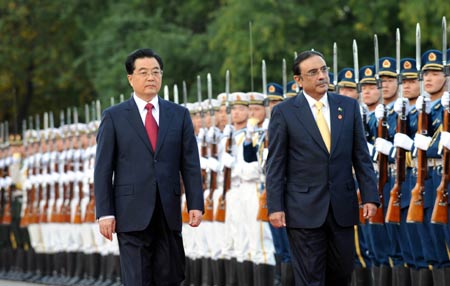
President Asif Ali Zardari recently paid his fourth visit to China within one year of assuming office of the President of Pakistan. This time President Asif Zardari visited Zhejiang and Guangdong provinces of China’s east coast – both these provinces operate large amount of trade with us. President Zardari said that in future Pakistan would be a leading route for world trade and he would like China to take full benefit of his country’s geographical location.
During his visit President Zardari convinced Chinese high officials to extend further energy cooperation between the two countries. Pakistan badly needs to overcome its ongoing severe energy crisis through a long-term up-gradation and diversification of the available power resources. Over eight MoUs in the field of cooperation in education, fisheries, agriculture, hydro dams, and investment were signed during this visit.
He sought Chinese help and diversified expertise in hydro, thermal and solar power generation in Pakistan and invited Chinese firms and corporations to carry out feasibility studies on different projects. The two countries signed a memorandum of understanding for construction of the Bunji dam in the northern area, which would have a capacity of generating 4,000 megawatts of electricity i.e. the biggest energy reservoir in Pakistan. The Three Gorges Project Corporation of China has been assigned to undertake this project on Build, Operate and Transfer (BOT) basis.
| Province | Capacity |
| NWFP | 3767 MW |
| Punjab | 1698 MW |
| AJK | 1036 MW |
| Northern Areas | 94 MW |
| Total | 6595 MW |
| WAPDA (December 2008) | |
| The thermal power generation capacity in Pakistan (2008-09) | |
| Province | Capacity |
| WAPDA | 4900 MW |
| KESC | 1756 MW |
| IPPs | 5859 MW |
| Nuclear power generation plants | 462 MW |
| WAPDA (December 2008) | |
Energy Cooperation
Zardari said Pakistan needed Chinese investments in the agriculture, hydropower and energy sectors, with Pakistan seeking to increase its energy capacity by 10,000 megawatts by 2015. In this visit both countries also signed a US$700 million agreement/deal to build 12 small and medium sized dams for electricity generation in Pakistan. China’s EXIM Bank will finance these projects.
| Province | No. of Dams | Cost /details |
| Balochistan | 4 | Winder Dam worth Rs1.695 billion at Lasbela, Naulong Dam worth Rs10.373 billion at Jhal Magsi, Garuk storage dam costing Rs1.79 billion at Kharan and Pelar storage dam costing Rs1.692 billion at Awaran. |
| Sindh | 2 | Nai Gaj Dam costing Rs16.924 billion at Dadu and Darawat (Baran) Dam costing Rs3.175 billion at Thatta |
| Punjab | 2 | Ghabir Dam worth Rs2.111 billion at Chakwal and Papin costing Rs1.13 billion at Rawalpindi. |
| NWFP | 1 | Daraban Zam Dam with an estimated cost of Rs2.75 billion |
| Source: Planning Commission of Pakistan (August 2009) | ||
Furthermore, China would finance the construction of small dams in Pakistan by providing a credit of $700 million while Pakistan on its part would contribute $300 million. The dams would be constructed in all four provinces and the FATA. These projects would be executed either by the Wapda or jointly by the provincial Irrigation Departments and Wapda. The central government has already allocated Rs276 billion in the Medium Term Development Framework (MTDF) 2005-10 for the development of the water sector. In the first phase, 10 small dams would be constructed in the four provinces as well as FATA while work on remaining ones would be started at a later stage.
During his visit to Hangzhou, capital of Zhejiang province, he urged Chinese entrepreneurs to set up business ventures in Pakistan to boost foreign investment. Forty-three Pakistani companies have already set up businesses in the province. The Economic Cooperation Group of the two countries met recently to implement a five year program to further boost bilateral trade and economic cooperation.
Pakistan signed a large number of memorandums of understanding (MoUs) with various organisations in China during a short span to facilitate investment, trade, transfer of technology and knowledge sharing between the two countries during the visit of President Asif Ali Zardari.
Details
(a) Cooperation in the field of drug regulation between the Drug Control Organisation, Government of Pakistan and State Food and Drug Administration of People’s Republic of China.
(b) Investment promotion cooperation with the investment promotion agency of the ministry of commerce of the People’s Republic of China and the BoI.
(c) A research link has been established between the South China Agricultural University and the Sindh Agriculture University at Tandojam. The MoU aims at capacity building, training of researchers, up-gradation of existing laboratories and to undertake new research projects. It is hoped that such collaboration would help increase Pakistan’s agricultural production, particularly of rice, cotton, sugarcane, and oil seeds.
(d) Cooperation on River Fisheries and related technologies between the Department of Fisheries, Government of Sindh and Pearl River Fisheries Research Institute of Chinese Academy of Fishery Sciences.
(e) Cooperation between the Department of Fisheries, Government of Sindh and South China Sea Fisheries Research Institute of China academy of fishery sciences for cooperation on marine fisheries and related technologies.
(f) Global open trunking architecture (GoTa) for emergency communication and disaster control management in Pakistan was signed between minster of IT and Telecom (National Telecommunication Corporation) and ZTE Corporation People’s Republic of China.
(g) A memorandum of understanding was signed between China Council for the promotion of international trade, Guangdong Sub-Council (China Chamber of International Commerce) and the Board of Investment.
(h) Another MoU was signed between the Ministry of Water & Power and China Three Gorges Dam Project Corporation on Bunji Hydropower project. The project will be developed on BOOT basis envisaging an investment of $7 to 8 billion to produce 7000 to 8000 megawatts of hydel energy.
Volumes of bilateral trade
According to official figures, annual trade between the two countries has already surpassed 7 billion dollars during 2008 and the two sides are aiming to increase that to 15 billion dollars by 2011. With the coming of the agreement on trade in 11 services sectors from October 1, 2009, which was signed in February this year during President Asif Ali Zardari’s visit to China, trade is further going to increase between the two countries. Currently, 70 per cent of Pakistan’s exports to China are cotton yarn and cotton fabric. Pakistan is also keen to promote its other products ranging from mangoes to footballs. Pakistan’s mangoes are the best in the world. The Chinese Government encourages its public and private sector to actively take part in projects based in Pakistan. China’s public and private sector is undertaking over 250 projects in Pakistan from mega to small and from strategic to regular businesses. At present, over 60 Chinese companies already have permanent offices in Pakistan.
Concluding Remarks
Pak-China friendship has a strategic importance and using a holistic approach we could go miles further. Joint ventures, energy cooperation, agricultural productivity, health care, social sector development and above all, political commitment would bring desired dividends for Pakistan in the days to come.