




The Scope of Community Radio in Pakistan
Abstract
The potential of Radio as a tool of social development is being utilized through out the globe, be it the developing or the developed world. It has a long history of penetration at grassroots through community radio in the western world. In Asia, though community radio is comparatively a new arrival, but over the years, community radio broadcasting has found roots and is playing a vital role in the development of small communities. In Pakistan, radio has long remained a state monopoly. After the promulgation of PEMRA Ordinance in the year 2002 the electronic media in private sector is emerging in a fast pace. Besides issuing a large number of licenses for FM radio it is catering to the entertainment needs of urban elites only, while community radio is still remains a far cry in the country. With rampant illiteracy, unemployment, ignorance and multiple social and ethnic issues, the usage of radio as an agent to bring about social change is the demand of the times. Since community radio has the potential of ensuring maximum community participation in the development processes, therefore it is high time Pakistan takes initiatives in this direction.
Introduction
Radio developed in very different ways in different parts of the globe. Before the first radio broadcast in 1920s the world of information and communication was confined to the few literate urban, those who could purchase and read newspapers. The invention of radio virtually radicalized the process of social communication. It was envisaged as a democratic medium also, and was operated and controlled differently in different parts of the world. In the United States it is a synonym for competition and commercialism. In Europe and its colonies including the subcontinent, radio operated under centralized state control. In Canada a combination of the two, a strong centralized State network on the national level and competition and commercialism on the local level. In Latin America they developed a mixture of all, private, church, university, special interest and indigenous people radio stations.1 With the passage of time the models of radio broadcasting kept changing throughout the world.
Decline of Radio in Digital Age
By the end of the last century radio broadcasting appeared to be declining throughout the globe. Overshadowed by the other media that new communication technologies have brought, radio is overlooked in public policy and decision making and often neglected in Plans and Budgets. In Pakistan during the year 1996-97, radio was receiving only 2.43 percent of advertising budget while television was receiving 49.10 percent and print media’s share was 34.8 percent of total advertising revenue.2 The media have changed drastically in the last two decades. The process of globalization has increased the presence of transnational media, brought with it is convergence of technologies and emergence of media industries and multimedia empires. Consequently the new communication environment of the digital age has upset conventional broadcasting systems. Transnational broadcasting operates within political, economic, technological and developmental environment so interconnected as to make individual discussion nearly impossible argues Usha Reddi.3 This phenomenon coupled with the emergence of small but highly political conscious and ethnically based political systems with the break up of bipolar system has given birth to some new questions. The preservation and promotion of indigenous cultures seem threatened in this new media environment which has already resulted in decline of public media and radio may be seen as its first casualty.
When this demise is linked to the process of globalization, it becomes more evident that it is both a corporate form of supranational business operating on global level as it brings corporate idealogy along with it. In this process major social, cultural and institutional changes and the responses of different societies determine their fate and space in it. Their capacity to surf on these waves only depends on their responsiveness. In short, in the arena of communication, these new technologies are transferring a whole set of values, attitudes, institutions and new economic and cultural structures. These structures are keen to transfer knowledge of what new technologies can do to expand audience reach and improve content for a wider audience.4 These new media structures urge the medium to think, write and produce globally for a wider range of audience. The mainstream media throughout the globe has undergone fundamental changes. In the developing world although it has enhanced choices but has also expanded the already existing digital divide between urban and rural, between rich and poor and between accessible and inaccessible. While majority of the people here want such structures which can help them in coming out of their sufferings, neither highly centralized state owned radio nor highly commercial news and entertainment programming can help them in addressing their basic concerns, be these political, economic, social or cultural.
Why Community Radio?
Despite its diverse origin and expanded networks, commercial radio makes very little use of its special opportunities for local communication throughout the world. Normally such stations quickly linked up into networks in order to enlarge their distribution area and advertising revenue. They also have their major focus on easily consumable music programmes. Similarly the public providers or state radios also keep on increasing their coverage area maybe due to political and other reasons and keep the national distribution objective on their priority. A third type of radio therefore emerged in between these two, aiming neither at profit nor at geographical expansion, and has been able to establish itself. These are the stations that emerged on local initiatives by groups or even by individuals. As an alternative to commercial and State radio, the most distinguished characteristic of Community Radio is its commitment to community participation at all levels. The concept behind this type of radio station is to ensure public participation at all possible levels; here listeners are also producers, managers, directors, actors and financers. The popularity of this kind of radio lies in the fact that these are aimed at working for those who are at the margins of society and for those who seek change but are far away from the mainstream media. The role of community radio is to respond to the priorities set by the community, to facilitate their discussions on issues confronting them and to reinforce their social development agenda through communication. These community run and managed radio stations eventually provide voices to the voiceless throughout the world.
Asian Experiences
Today Asia is on the threshold of new media environment heading towards providing a voice to the voiceless through the medium of community radio. This community radio revolution becomes more evident when one finds at least more than 3000 such stations in Thailand, more than 100 in Indonesia and over 100 in India waiting for license in 2005.5 Bangladesh is on way to the road of development through community radio with the approval of community radio installation, broadcast and operation policy in March 2008. The policy document reflects that since these stations will be operated in oral languages of marginalized communities with their full participation and management, therefore they will reflect their hopes and aspirations and also indigenous knowledge and culture will be later combined with the modern knowledge and technologies.6 The first of its kind in South Asia, Sri Lanka’s Mahaweli Community Radio was set up in 1981 by the Sri Lanka Broadcasting Corporation with the assistance provided by UNESCO and Danish International Development Agency. This community radio came into being in realization of the radio’s contribution for the socioeconomic development of the communities settled away from the main urban centers.7 In India, the Supreme Court declared the airwaves as public property in a Hero Cup case in 1995, and ordered both Doordarshan and WorldTel to come to a negotiated agreement about transmitting rights and telecast feed.8 After this historic verdict, community media activists increased their pressure to the government to open up airwaves for community radio broadcasters. According to one estimate, as many as 4000 community radio stations will be needed in the country. According to Ms Vijay Sadhu, a senior radio officer at Asia Pacific Broadcasting Union and a former AIR executive, All India Radio see the community radio sector as playing a supplementary role in last-miles access to remote, rural and marginalized communities.9 Following the public demand, AIR has opened up its transmissions to non-governmental organizations (NGO) which access their frequencies to broadcast programmes produced by the NGOs. Access community programmes like these are playing an important role in many rural areas of India in encouraging women in particular, in taking a more active role in village councils. South Asia however has long lacked community radio but a few attempts have been made in this direction quite recently. Nepal, Indonesia, Malaysia and now Bangladesh are just to mention a few10. Even South Asian media giant India did not have community radio until 2006, when the community radio policy was finally approved by the cabinet. In India community radio has been mobilized mainly by community organizations for participatory development. Pavarala and Malik elaborate the distinctiveness of community radio in India,
‘Community Radio in India is not about playing alternative rock music, it is a source of strength for poor people for addressing their basic needs’11
The authors though admit that community radio should not be seen as a quick solution to long standing complicated community problems but simultaneously they feel that if community radio enhances it can be a tool for development.12 In the absence of alternative media all other media only provide ‘empty entertainment to passive audiences and diminish the freedom and diversity of information… allowing the state and market to have unfettered control over the minds of the people, Pavarala and Malik firmly believe.13 Even in Nepal the community radio is no more a far cry. Nearly four months after successfully pushing the fight against royal dictatorship, community radio in Nepal were at another forefront of revolution by turning the airwaves into an educational medium for constitutional reforms. Several stations in Katmandu and outlying areas have been broadcasting programmes aimed at raising awareness about constitutional issues. The aim was to positively influence the constitution making process by public participation.
In Nepal the media, particularly community radio was at the forefront of the debate about constitution making. The most striking fact is that most of these voices were from grassroots-local citizens in small towns and villages who wanted to have their say.14
Community Radio: Some Western Experiences
Community radio fills the air and reduces the gaps all around the world, not only in so-called developing countries but has played a significant role in accelerating the process of social development in the western world as well. Many groups and individuals around the world have found that radio is a tool that can be used most effectively in encouraging creativity and allowing popular access. Community radio takes on diverse forms depending on the environment it is being operated in, but it always remains a type of radio made to serve people. The World Association of Community Radio AMARC, is an international non-governmental organization serving the community radio movement and uniting community radio workers for the five continents.15
In the USA, this type of radio started as early as 1949. Station KPFA, the first example of so-called community radio was founded in the University of Berkeley at California. The station was founded by a group of pacifists just after World War II as they were disgusted by the way radio had been used to stir up passion of war, and were excited by the idea of using the medium to promote peace and community development. Today the station gets most of its income from listeners and donations. The first and the largest community radio station in US, KPFA accepts no advertising and is being run by donations from listeners and from some other sources. There had been very exciting moments in the long history of the station about its contact with community and conflict with the authority. Many times even the Federal Communication Commission and other authorities tried to revoke the station’s broadcast license.16 Today some 140 such radio stations exist across the country. Similar developments can be seen in Australia and Canada, where such stations are often located outside the urban centers for the particular cultural needs of ethnic minorities. In Canada, Radio Centre-Ville Montreal is a multilingual community radio station that has been broadcasting in seven languages for more than 15 years. Seven ethnic groups meet every day to produce a wide variety of radio broadcasts. The Greek, Portuguese, Chinese, Haitian, Spanish, English and French speaking communities are brought together every day. Other cultural communities such as the Southeast Asian, Filipino, Africans, Irish and Arabic communities also use the airwaves.17 The oldest community radio station in Canada though, is Wawatay Radio Network. Wataway Communication Society, a regional aboriginal-language radio and television networks based in the towns of Sioux Lookout and Moose Factory in the northwestern Ontario. Wataway has been actively engaged in the development of communication technologies for use in native communities in Nishanawbe-Aski since 1974. Presently Wataway’s audience consists primarily of the 20,000 Cree, Oji Cree and Ojibway speaking people residing in this area who receive radio broadcasts distributed by satellite to a network of community stations.18 This station got its start when the northern chiefs decided that something needed to be done about modern communications in their territory, which is fifteen hundred kilometers northeast of Toronto, the Cree Village of Sandy Lake in the boreal forest. The setting up of an experimental station in 1973, by the government funding paved the way for community radio station in this northern territory. Since that time the community radio established throughout the territory have maintained their vital role at the centre of community life19. In the United Kingdom community radio is though a recent arrival, however by now more than 100 community radio stations are operating there.
Another feature of the community- radio model from the west is that it is usually financed by the listeners’ contributions and receives a very little amount of local advertisement.20
Community Radio: A Global Phenomenon
Community radio is a global phenomenon now. People all around the world found community radio that enables them to gain control of a communication tool that permits popular access. Every day people from one end of the planet to the other manage to make radio a collective enterprise devoted to development. Community radio is no more a dream, the medium of communication among the members of marginalized communities in the remote areas, away from main urban centers. In the digital age of today, when the whole communication environment has virtually upset the conventional broadcasting systems all around the world, it has become immensely difficult for the national broadcasters to meet the public obligations. Marc Raboy suggests the following three fold strategy for the broadcasters:
l Think globally, but programme to local needs and interests;
l Target audience as citizens desiring to participate more fully in the public life of their society;
l Be sensitive to expression of social demand, as well as the more obvious economic and political imperatives.21
Neither State owned and controlled broadcasting services nor commercial broadcasting services can achieve these goals. An alternative to commercial and State radio is therefore imperative to achieve the development goals at community level. These small scale community radio networks no doubt have to work with a passion to empower listeners by encouraging and enabling their participation at all levels of broadcasting process. Now this passion has gained such a momentum that one can find community radio operating from Zaire to El Salvador, Russia to Haiti, Peru to Mali, Africa to Mexico, Argentine to Czechoslovakia and Philippines to South Africa, USA, Canada, Australia, and most of South Asia. The community radio operation in the western world is also indicative of the fact that this is not a developing world specific phenomenon.
Radio as Agent of Change in Pakistan 1947-2009
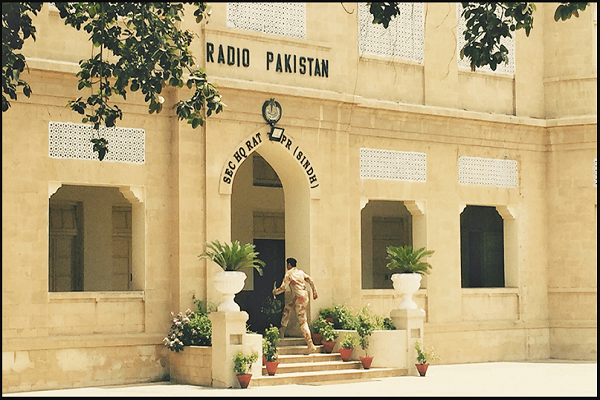
Around 61 years ago, the newly formed state of Pakistan informed the world about its emergence through the airwaves through Radio Pakistan Lahore, one of the three radio stations that Pakistan inherited after the division of subcontinent. Today, the PBC network comprises of 31 stations with 80 percent area and 96.5 percent population coverage22. Radio remained a strictly state monopoly until year 2002. With the promulgation of Pakistan Electronic Media Regulatory Authority Ordinance in 2002, private ownership of radio was made possible. At that time according to one estimate the size of radio audience in the country was 23 million, a little less than half of television audience in the country. Radio was regarded as a medium that had lost audience over the years. Twenty five years ago, radio audience was twice the television audience in the country, the report revealed.23
Frequency Modulated (FM) radio made its debut in Pakistan in the year 1995 as a new cultural form. For the first seven years its access was confined to only three metropolises, Karachi, Lahore and Islamabad under private ownership exclusively granted to only one company. Later on Pakistan Broadcasting Corporation also started FM radio broadcasting under the title of FM101 in October 1998 initially through only three cities, Karachi, Lahore and Islamabad. Today there are eight FM 101 stations and six regular FM stations that provide content exclusively for entertainment.24 After the promulgation of PEMRA Ordinance in the year 2002, this monopoly was challenged by the new FM radio operators entering the field. Up till now 117 FM Radio licenses have been issued, out of which 95 stations are on air in the country.25 The emergence of private electronic media regime in the country marked the conditions for change. The inception of FM Radio in the private sector in Pakistan has brought a revolution in the broadcasting sector of the country. Radio, which was previously regarded as a neglected medium has regained its listenership to a great extent.
Concentration in Major Cities
Most of these channels are operating in major cities and one can find high concentration in cities like Karachi, Lahore and Islamabad. Up till now PEMRA has awarded 117 licenses to operate FM radio stations in the 83 districts of the Country. Out of these 117 licenses, 34 are for seven major cities like Karachi, Lahore, Islamabad, Gujranwala, Multan, Peshawar and Faisalabad, which reflects a high concentration in the major metropolitans.26 Even some companies which previously acquired licenses for smaller cities located near the major metropolitans later got their licenses converted into the metropolitans. On two occasions at least such decisions of the Licensing Authority were highly criticized by the media. The reasons behind these conversions are basically the business concerns of the companies. The advertising revenue in major cities is much greater as compared to small town and cities. The FM radio broadcasting in the Country has had its major focus on Entertainment and Music with some News and Current Affair programmes. The FM radio operation in Pakistan is purely commercial with its major focus on urban youth and basically catering to their entertainment needs.
Radio & Social Change in Pakistan
Radio and other broadcast media are considered to be the important agents of change. Especially in societies where almost all the social indicators portray a negative picture, the role of media in bringing social change becomes immensely important. Even television was introduced in Pakistan to promote awareness, to develop a consciousness about the cultural heritage, social and economic growth of the Country, and to provide a direct linkage with the world. Describing the objectives of Pakistan Television, Aslam Azhar former Chairman and one of the founders of PTV said:
For the unskilled and the jobless there will be programmes to teach them vocation. For the peasant and farmer there will be instructions in the use of new and improved techniques; for the illiterate, television lessons on literacy. The use of television will be geared to the objectives of Country’s education policy.27
What role Pakistan Television has played to achieve its development goals is not a part of this discussion, the point to emphasize here is the capacity of media in bringing changes in society at grassroots’ level has always been realized by the policy makers right from the very beginning. Both Television and Radio in the country had to face the problem of accessibility for a long time. But now running fast on the information highway, converting from analogue to digital and following the emerging patterns of convergence, why are we so unconcerned about the millions who are living in far flung areas, speaking different languages, following different cultural codes and belonging to different sects or following different religions? The answer is very simple: Mainstream media will never be able to give voice to these millions of voiceless due to its ever increasing desire for more audiences and ultimately for more revenue. It has to survive in a highly competitive environment in and around the country. The public service broadcasting or state-run media has its own political and social agenda; its programming cannot reach out to small communities spread over the large terrain of Balochistan, just to quote only one example.
Community Radio: Still a Far Cry in Pakistan
Although the mandate of Pakistan Electronic Media Regulatory Authority (PEMRA) provides room for issuance of licenses for community radio, it has not yet issued any license for it. Some licenses have been issued in the category of specialized subjects for educational institutions only. The main reason behind the denying of licenses for community radio is that the PEMRA Ordinance does not permit granting of license to:
‘A company, the majority of whose shares are owned or controlled by foreign nationals or companies whose management or control is vested in foreign nationals or companies.’28
Whereas the companies willing to start community radio in Pakistan are normally NGOs which most of the time have foreign funding to run their community development projects. The question here is, what is to be done to enable communities to communicate, participate and debate on the issues confronting them. There is no other way in moving towards a more pluralistic society, where languages and cultures are being preserved, respected and promoted by the communities themselves.
For almost fifty five years, the electronic media in Pakistan resisted cultural and ethnic pluralism in a bid to strengthen national integrity. Now, in an era where the very concept of nation-state seems to be shaken by the forces of globalization, it is about time this mind set is reviewed. As a nation-state, Pakistan must learn to respect the cultural and ethnic diversity within its geographical boundaries. This can be through empowering the communities with the objectives to promote and encourage them to solve their problems through communication and participation. The inception of community radio in Pakistan would enable the marginalized communities to interact in their oral languages to transfer indigenous wisdom and preserve their cultures, along with reflecting their hopes and aspirations.
Salient Features of Community Radio
- UNESCO defines community radio as radio run by, for and about a community. This broad principal distinguishes between state-owned or public service broadcasting, commercial broadcasting and community radio.
- Community radio is not-for-profit. This does not mean that community radio cannot engage in revenue generating activities, which tends to be vital for survival and sustainability. This means its main objective is not revenue generation like commercial radio.
- Community radio incorporates open access in some form. In some station all broadcasters are volunteers while at some other it is a mix of volunteers and paid staff. Not only this, it is also managed by the community itself. The communities are involved in active ownership of the station. This is usually done by the community electing a management committee for the station.
- The programming is all about the community, of direct relevance to them. It needs to be community specific.
- The main difference between community radio and state-owned radio is the concept of community ownership. This empowers the community to use this radio for community benefits like, poverty eradication, reducing gender disparities, health, hygiene, and much more.
The only thing to clarify here is that the communities are not necessarily geographically defined; they can be communities of mutual interests, like minorities or immigrants in Pakistan, etc.
Now the time has come that the potential of this popular, accessible, low-cost, medium of communication should be linked with the national development objectives. The medium of FM radio which has a great potential to reach out everywhere in the country should not remain confined to entertainment for urban elites only.
Conclusion
The influx of global media has widened up the range and penetration of media content. It has also enlarged the scope of news as it now addresses greater audiences. There is no doubt that competition has also increased the speed as well as quality. Once the fervor of global media is over, one can easily feel the local issues, problems and realities are fading away from this global media landscape. To practically adopt ‘think global, act local’ slogan, an about turn is needed to reverse this tide. Pakistan is now almost the only South Asian country which has yet to adopt community radio for development. Certainly there are risks and threats of misuse of these stations by some interests groups for which necessary legislation and control mechanism will be required. Pakistan needs to have community radio to counter and fight sectarianism, intolerance, ethnicity, ignorance, hunger, unemployment, feudalism and tribalism rampant in the society. It needs to create awareness about social justice, human rights and gender balance in the communities. Through radio these communities will start understanding each others’ situations better and tackling their problems together. The problem of illegal operators is also a global phenomenon. In Taiwan, during the unrest of 1990s many pirated radio stations were operating who also joined anti-government forces to resist official clampdown against them.29 Also in Thailand more than 3000 illegal community radio stations were operating in 2005 but even then the government was anticipating a bright future for the growth of community radio.30 ‘In Pakistan the airing of illegal FM radio stations from NWFP is one of the biggest challenges for PEMRA. All such illegal FM broadcast were being done by religious seminaries with impunity. PEMRA has adopted a pragmatic approach with close coordination with the frontier government against such illegal FM radios. In its drive, PEMRA managed to close down and seize the equipment of more than 100 illegally operating FM radio stations. Since these FM radio stations are installed mostly in mosques and seminaries, action against them has always been difficult and sensitive. Once removed, such FM stations have the tendency resurface’.31
The most shining example of the role of FM radio for the community was witnessed during the deadly earthquake in October 2005. Almost 10000 people died in the disaster and 15,000 were reported to be injured. Media was also a major casualty of the quake with several journalists killed or missing and newspaper offices and press clubs destroyed, which hindered information access and dissemination. Responding to this challenge, Pakistan Electronic Media Regulatory Authority immediately issued temporary licenses to the stations already operating in the adjoining areas to help affected people through timely and reliable information regarding rescue and rehabilitation processes. The teams of Internews supported women syndicated radio programme ‘meri awaz suno’ broadcast the first detailed report about the disaster on national radio. Radio FM, 99 Buraq FM, Lakki FM88, the team of FM Radio University of Punjab and also of FM radio University of Peshawar actively participated through timely information dissemination in the earth quake hit areas.32 The community radio is a reality and not a delusion any more in Pakistan also. The real issue is political will to develop and streamline such media structures and to link them with development imperatives at grassroots level. The local bodies forum may be used to lay down the foundations of community radio provided their role is properly defined and restricted to minimize state control and maximize community participation. As a nation state, Pakistan should not feel threatened by the cultural expression; it did not do any harm to the former USSR. As a matter of fact real harm inflicted on them was due to their inward looking dictatorial media regime.
End Notes
1. Girade Bruce, A Passion for Radio: Radio Waves and the Community Introduction..www.comunica.org/passion. Electronic Edition, 2001, p, 1.
2. Orient McCANN-ERICKSON, Pakistan Advertising Scene 1997, p, 20.
3. Reddi Usha Vyasulu, Transnational Broadcasting and Multiculturalism, in Michael Richards and David French(eds) Television in Contemporary Asia, Sage Publications London 2000,pp, 71-73
4. Meier Klaus. On line Journalism: Radio and Internet in Asia, Asian Media and Communication Bulletin, Vol, 33, No, 5, ) Sep-Oct 2003, p,10. AMIC Singapore.
5. AMCB, Asians Could Learn From Each Other to Get Peoples Voices On Air, Asian Media and Communication Bulletin, Vol,35, No, 3, 2005,p,10, Singapore.
6. Peoples Republic of Bangladesh, Ministry of Information, policy document on Community Radio March 12th 2008
7. David MJR ‘Mahaweli Community Radio, In A Passion for Radio: Radio Waves and the Community Introduction, Bruce Gerard(ed)..www.comunica.org/passion. Electronic Edition, 2001, p, 10
8. Reddi,op.cit, p74
9. AMCB,op.cit
10. Stiernstedt Fredrik’ Book Review on ‘Other Voices: Struggle for Community Radio in India’ Westminster papers in Communication and Culture, University of Westminster, London,2008,pp,113-116
11. Pavarala Vinod, Malik K.Kanchan Other Voices, The Struggle for Community Radio in India, Sage Publications, London, 2007, p, 178.
12. Ibid, p.162.
13. Ibid, p.105.
14. Nepali Radio Stations Help Bring About Social Change, AMCB, Vol,36, No, 4, July-August 2006,AMIC Singapore,p,17.
15. Delorme Michel, A Network for International Exchange, In A Passion for Radio: Radio Waves and the Community Introduction, Bruce Gerard(ed)..www.comunica.org/passion. Electronic Edition, 2001, p, vi.
16. Thomas Bill, How KPFA Found a New Home, in Gerade Bruce(ed), A Passion for Radio: Radio Waves and the Community Introduction..www.comunica.org/passion. Electronic Edition, 2001, pp, 34-35.
17. Foy, Eric, Barette and Bolvin, ‘Inventing and Experimenting: Radio Centre- Ville’ in Gerade Bruce(ed), A Passion for Radio: Radio Waves and the Community Introduction..www.comunica.org/passion. Electronic Edition, 2001, p, 39
18. Bredin Marian, ‘Transferring Images’ In Howes David (ed) ‘Cross Cultural Consumption Global Market Local Realities’ Rouledge, 1996, p161.
19. Mohr Lavinia, To Tell The People- Wataway Radio Network, in Gerade Bruce(ed), A Passion for Radio: Radio Waves and the Community Introduction..www.comunica.org/passion. Electronic Edition, 2001, pp, 17-18.
20. Schroder Konard, Shelley Monica, Winck Margaret, Aspects of European Cultural Diversity, Rutledge, 1995,p133
21. Raboy Marc, Where does future of public broadcasting lie in the digital age? Media Asia Vol.24, No, 2, 1997, p, 90, AMIC Singapore.
22. Gallup Polls referred on PBC website, www.http://radio.gov.pk dated 2-2-2009
23. Gilani Ijaz Shafi Dr. ‘Market Potential of Electronic Media in Pakistan’, Prospects& Promotion of Electronic Media in Pakistan, Pakistan Electronic Media Regulatory Authoroty.2003, p, 13.
24. PBC website, www.http://radio.gov.pk dated 2-2-2009
25. Executive Summary on PEMRA, Pakistan Electronic Media Regulatory Authority, Islamabad, January 2009.
26. Pakistan Electronic Media Regulatory Authority, the data acquired from PEMRA on 4-2-2009.
27. Azhar, A. ‘Television and Social Responsibility’ PTV Time Traveller 1964-1984, Star Special Report, December 1984,p,47.
28. PEMRA Ordinance Section 25 sub-section(c), Pakistan Electronic Media Regulatory Authority Ordinance-2002 as Amended by the PEMRA (Amendment) ACT, 2007, p, 22.
29. Taiwan Radio Stations Fight Clampdown, AMCB,Vol,24,No,5, Sept-Oct 1994, AMIC, Singapore, p,8.
30. Asians Could Learn From Each Other to Get Peoples’ Voice On Air, AMCB, Vol,35, No, 3, May- June 2005, AMIC Singapore,p,11.
31. PEMRA, January, 2009.
32. Rehmat Adnan, ‘State of Information Access in Quake-Hit Region Dire’ Media Law Bulletin, Issue 3, No,2 2005, Internews&USAID Islamabad, p.2.