





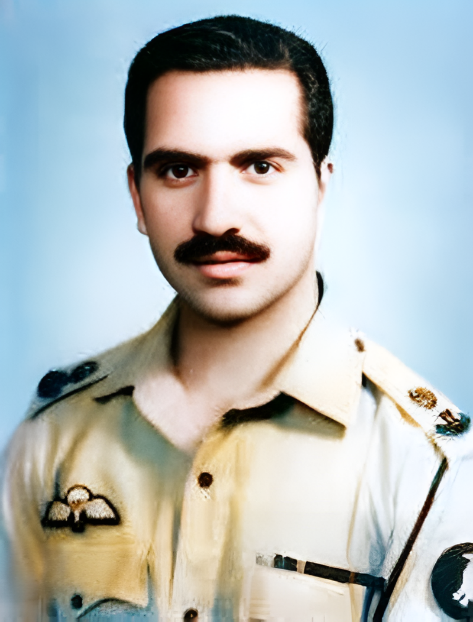
Commemorating our Martyrs always stirs a deep emotion within me. Still, when I look at the innovative young men and women of Pakistan, I feel a profound reassurance that their sacrifice was not in vain. The energy, the potential, and the spark of our youth can transform this country; they deserve global recognition. The soldier on the DJ Cover, Maj Shabbir Sharif Shaheed, obtained Shahadat on Dec 6, 1971 in the Sulemanki Sector. Commissioned into 6FF in 1964 during the 1965 war he was wounded, but hid his injury to lead his men into a perilous military operation with complete disregard to his personal safety. Going behind the enemy, he compelled the Indians to vacate the strong position they were holding, not only by pushing them back but by bringing back his wounded men and a captured artillery piece. He was awarded the Sitara-e-Jurat (SJ) on 3 December 1971. Maj Shabbir, commanding Bravo Company of 6FF, was assigned to take on the critical objectives of Gurmukh Khera and Beriwala areas in the Sulemanki Sector, both formidable objectives for Pakistani’s 105 Independent Brigade. At 1800 hours Maj Shabbir fearlessly led his company with great courage and devotion to duty, regardless of the danger. He crawled past the minefield and cleared the initial enemy post on the home side of the canal. He swam across the water obstacle under heavy enemy fire, climbing the 40 degree 80 feet loose earth slope. He succeeded in clearing the fortified trenched by lobbing hand grenades and occupied the enemy position. The next day, his position came under heavy fire, that failed to dislodge him and his men fighting like devils. Leading a handful of men Shabbir rose to an occasion the nation will never forget. Fighting on the front with his already stretched troops Shabbir Sharif was hit by a burst of secondary gun from a tank turret that proved fatal. He was awarded the Nishan-e-Haider posthumously.
This time we are taking Pakistan’s most promising startups to the global stage at the World Economic Forum (WEF) Annual Meeting 2026 in Davos. A moment of pride to showcase our nation’s remarkable talent and innovation to the world. The Pathfinder CITADEL Startup Challenge has successfully identified and selected eight outstanding startups. This achievement is not merely a recognition of entrepreneurial success – it is a powerful statement of faith in our youth, our ideas, and our collective future. This was not just a competition, but a celebration of persistence, mentorship, and the belief that great ideas, when nurtured, can change the course of economies.
Part of our broader vision: to take Pakistan’s innovation landscape to the global stage, Pathfinder School of Excellence, “Centre for Innovation, Technological Advancement, Digital Entrepreneurship and Leadership” (CITADEL) was established with a mission to transform Pakistan’s talent into tangible impact. It operates through three key verticals: Career Jumpstart, Escape Velocity Accelerator, and Strategic Innovation Consulting, together forming a robust framework that connects skill with opportunity, startups with capital and ideas with execution.
Several weeks ago, when the Pathfinder CITADEL launched a national outreach drive to connect with Pakistan’s vibrant startup ecosystem, founders were reached across universities, co-working spaces and innovation hubs nationwide. The outreach garnered over 200 applications, each showcasing unique problems and solutions. A merit-based evaluation by a panel of external judges led to 60 promising startups being shortlisted. After further deliberations, the top eight were selected to represent Pakistan at Davos.
These eight startups represent diverse sectors that define the future — AI, fintech, climate tech, health tech, and digital education. They are: Edversity (AI-ML), Vector AI (SaaS and AI Solutions), Chrio (Sports Tech), Swich (Fintech), Ekko (Health Tech), AI Team Force (AI-powered SDR platform), Edkasa (Education Tech, a woman-led startup), and AiBL (Health Tech). Each of these startups has demonstrated resilience, innovation, and scalability, the very qualities that position Pakistan as an emerging hub of entrepreneurship. Their selection for Davos is a testament to their talent and to the credibility of the CITADEL ecosystem.
Empowering the Future with Smart Solutions, on November 8, 2025, at AmaaniBagh, celebrated the success of the different divisions of the Pathfinder Group. Highlighted was the Group’s remarkable work in the digital and financial revolution by its Digital Revolution Division (DRD), comprising two dynamic companies: SMS Services (SMSS) (Pvt) Ltd and SMS Technologies (Pvt) Ltd with Shakeel Ahmed as CEO of both DRD and SMSS.
Another division, Enhanced Harmony Division (EHD), was formed to recognize the Group’s sincere and significant achievements under Corporate Social Responsibility (CSR). The EHD consists of two astonishingly remarkable initiatives: Providentia Books Foundation (PBF) and Pathfinder Interfaith Harmony Initiative (PIHI). Brig (Retd) Mujahid Alam is the CEO of PBF and PIHI. I take great pride in my grandchildren, who are dedicated to supporting deserving communities. My eldest granddaughter, Amaani Sehgal, conceived the idea for PBF at the age of 12 and is currently studying at Cornell University. My younger granddaughter, Elena Sehgal, now aged 16, who attends the Brearley School in New York, has made me proud by promoting the concept of interfaith harmony.
I am thankful to all panelists who brought together a holistic discussion on “Driving Digital Transformation in Pakistan: Challenges and Opportunities”. The discussion emphasized shifting national focus from freelancing to strengthening SMEs, recognizing crypto and blockchain as major upcoming disruptors, and acknowledging successful financial inclusion models like Asaan Mobile Account AMA, Easypaisa, etc. I agree with them that Pakistan must integrate AI, blockchain, IoT, and data-driven systems into unified platforms, collaborate with startups, and position its youth to lead globally in the coming digital and crypto-driven economy.
I also want to thank Sultana Siddiqui, Founder of Hum Network, and Chief Justice Saqib Nasir for attending the event. Sultana Siddiqui embodies the soul of Pakistan in a way no technology ever can. Her lifelong commitment to showcasing Pakistan’s cultural strength and nurturing young talent is recognized worldwide. I believe that Artificial Intelligence (AI) cannot replicate the natural intelligence of people like Sultana, those who capture and convey the essence of who we are as a nation. Her early encouragement of startups, long before it became fashionable, is similar to the very initiatives we are now taking to the global stage.
I believe that innovation, digitalization, financial inclusion, and skill development can transform the future of Pakistan. We have taken a step for Pakistan, and the success of these startups is a reaffirmation that Pakistan’s best stories are yet to be written – by the hands and minds of its youth.
The STARLINK-JAZZ connection has been thoroughly researched by Dr Bettina Robotka. While we cannot really ascertain with any certainty all the facts, particularly about off-shore companies in financial safe havens, Dr Bettina Robotka’s article should be a cause of concern for decision-makers in Pakistan to satisfy themselves about the motivation behind the proposal. Pakistan’s nuclear assets are critical to our continued existence as a nation!