



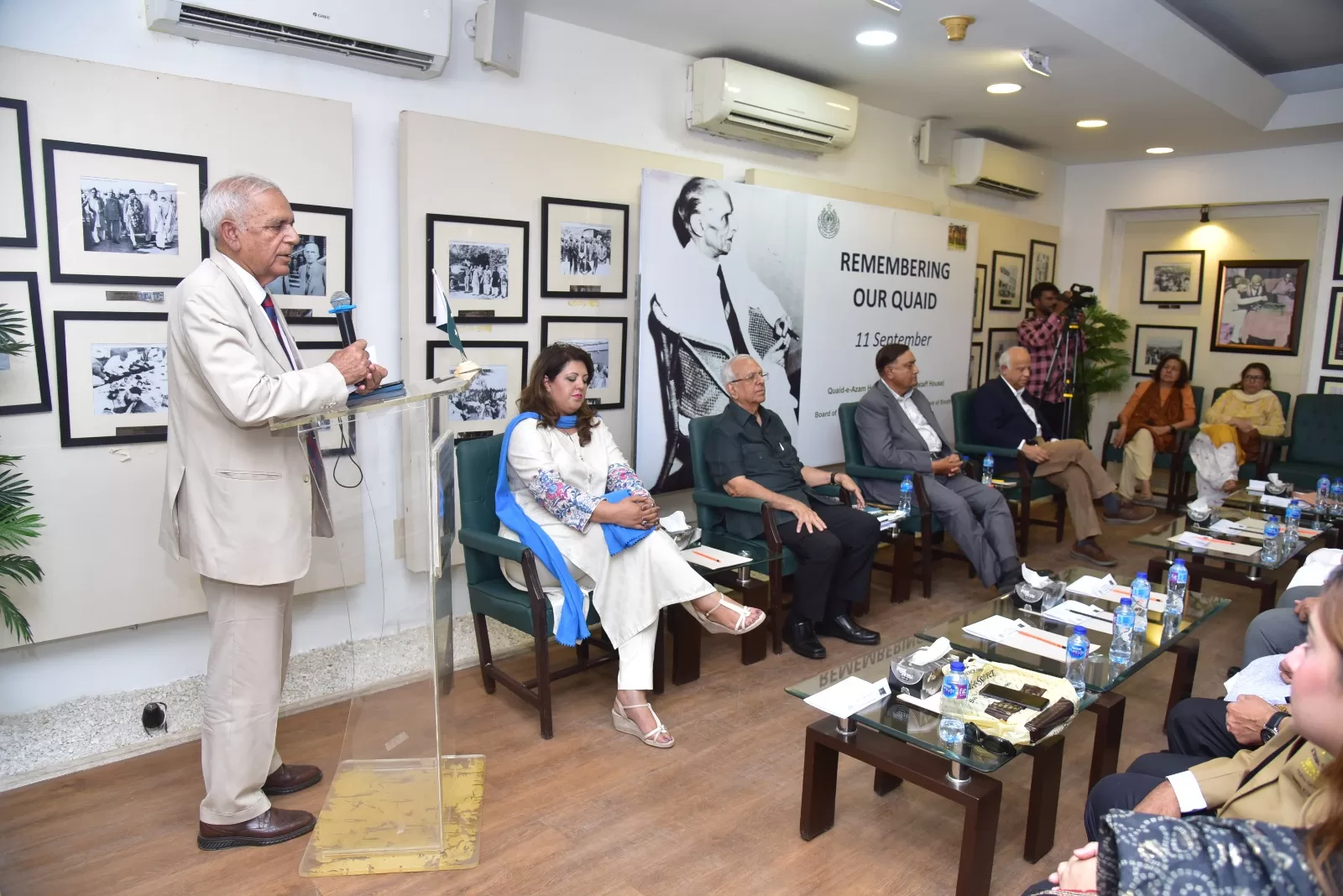
Quaid-e-Azam Muhammad Ali Jinnah’s vision was an undivided Bengal and an undivided Punjab, “two countries one nation,” said the Vice Chairman of the Board of Management Quaid-e-Azam House, Ikram Sehgal.
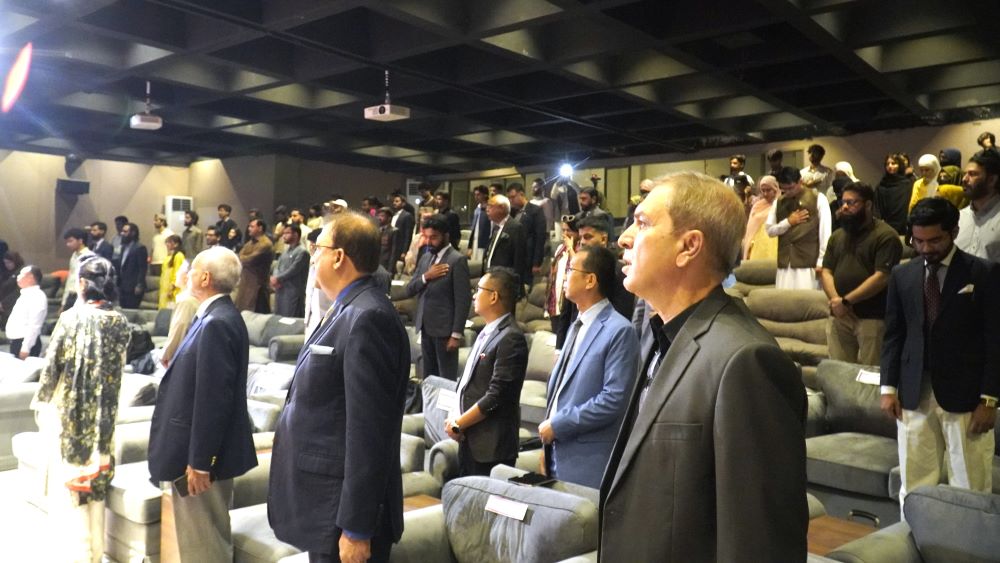
The Board of Management of the Quaid-e-Azam House Museum, formerly Flagstaff House, hosted a special event on 11 September 2024 – Wednesday to honor the 76th death anniversary of Quaid-e-Azam Muhammad Ali Jinnah, the founder of Pakistan. The ceremony, titled “Jinnah’s Legacy and Role of Armed Forces in Pakistan’s Security, Defense, and Regional Stability,” was organized by the Board of Management of the Quaid-e-Azam House Museum.
The event saw the participation of prominent figures, including Senior Vice Chairman, Liaquat H. Merchant (SI), Vice Chairman Board of Management Ikram Sehgal, former Governor Sindh, Lt Gen (Retd) Moinuddin Haidar and Commodore (Retd) Sadeed A. Malik Kashir. City dignitaries and students from various schools also attended. Speaking at the session, Ikram Sehgal said, Quaid-e-Azam founded the Dawn newspaper in Delhi, and then the paper moved to Karachi after Partition. “Today, on 11 September, unfortunately, we find no mention of the Quaid-e-Azam in Dawn.”
He spoke on the Quaid’s strategic vision post-1940. In 1942, he said, Gen Rommel knocked at the doors of Cairo, having defeated the British Indian 8th Army in North Africa Singapore had fallen to the Japanese who were in Burma on their way to India. In 1942, the Japanese created the Indian National Army (INA) in Singapore, with initial leadership under Captain Mohan Singh VC and subsequent leadership under former Congress President Subhash Chandra Bose.
On August 8, 1942, he said Gandhi launched the “Quit India” Movement, demanding the British leave India and stressing that nobody should join the British Indian Armed Forces. The Muslim League found the movement inimical to Muslims’ interests. On August 25, 1942, he said the Quaid-eAzam decided to support the British war effort in their war against Germany along with Hindu Mahasabha and the Communist Party of India. The Muslims joined the British armed forces on the Quaid’s call. This included my father late Col Abdul Majeed Sehgal, who left the King Edward Medical College (KEMC) in the third year to join OTS, Mao.
In 1939, he said, the armed forces of British India were of 100,000 out of which 4,000 were British officers and by the end of the war there were 2.5 million people under arms of which 40 percent were Muslims. He said the sacrifice that the Armed Forces of (future) Pakistan had 30,000 dead and 70,000 injured, and “that is the sacrifice our muslim soldiers in undivided India gave on the call of Quaid-e-Azam.”

Quaid-e-Azam House Museum (Institute of Nation Building)
Because of this sacrifice, when the Congress was compelling the British to keep India undivided, he said, the senior armed officers of the British said that they had a debt of gratitude to the Muslim soldiers who died for them, particularly in their time of need “That is one of the reasons, the sacrifice of the Muslim soldiers of India and mostly from the territory now comprising Pakistan, actually gave birth to this country,” he said, Ikram Sehgal added that this was the FIRST strategic decision Jinnah took in 1942.
When Sher-e-Bangla AK Fazlul Haq, Huseyn Shaheed Suhrawardy, and Abul Hashem came to the Quaid in July 1946 with a proposal for an undivided Bengal, the Quaid mandated Bengal PM AK Fazlul Haq to pursue a united Bengal, which would mean that all of Assam and West Bengal would remain one entity as “totally autonomous region.” Jinnah, he said, also reached out to Punjabi Sikh leader Master Tara Singh, propagating for Sikhistan. Jinnah offered him not to divide Punjab but instead make a Sikhistan and call it Khalistan. That would make the western part comprising Punjab, Sindh, Balochistan, and Frontier (now KPK) also an autonomous region. That was Quaid’s SECOND strategic decision. He said even Lord Mountbatten had a plan for a bigger Pakistan, but Nehru and Congress contrived to change the decision. Sehgal said that had Khalistan been formed, there would not have been a Kashmir dispute on the problems of water referring to Bangladesh’s current uprising, he said Jinnah’s vision of West Bengal was two countries, one nation.
“This is exactly what the Quaid said in 1946 quoting Sher-e-Bangla AK Fazlul Haq, at that time Premier of Bengal,” Ikram Sehgal added that today we are talking about no visas, no tariffs (no customs duty). Once this is done, you still have Pakistan by another name. Speaking on Jinnah’s third vision, Sehgal said that Jinnah accepted the divided Punjab and Bengal. “It’s better to have a truncated moth-eaten Pakistan than nothing at all. That was his (Jinnah’s) THIRD strategic decision,” Sehgal said.