





How Women in Tech is Shaping the Future of Pakistan’s Digital Economy
Pakistan stands at a defining moment in its technological and economic evolution. Digital transformation is no longer a future aspiration; it is an ongoing reality reshaping industry, governments, communities, and the way people live and work. From fintech and artificial intelligence to e-commerce, cybersecurity, digital media, and emerging startup ecosystems, technology has become one of the most powerful drivers of economic growth and social progress.
Yet amid this transformation, a critical challenge remains. While women make up nearly half of Pakistan’s population, they continue to be underrepresented in many of the sectors driving innovation and technological advancement. Their participation in leadership positions, technical roles, entrepreneurial ventures, and decision-making forums remains significantly lower than what the country’s ambitions for growth and competitiveness demand.
Addressing this challenge requires more than policy discussions and good intentions. It requires platforms that create opportunities, foster connections, encourage mentorship, and empower women to engage meaningfully in shaping Pakistan’s future.
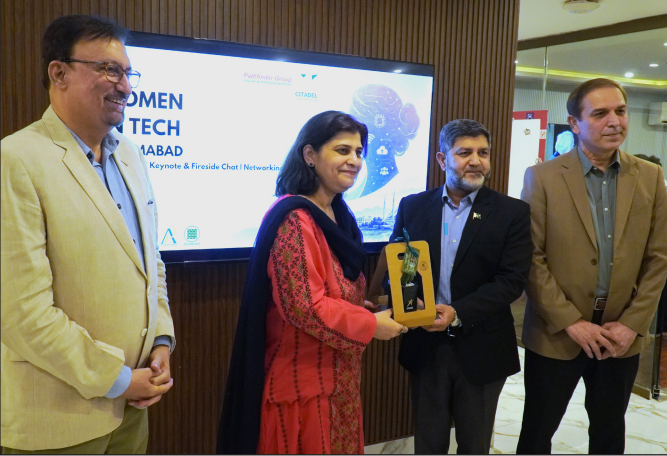
It was with this objective that PATHFINDER CITADEL, the innovation, technology, and skills development platform of Pathfinder Group, hosted Women in Tech – Islamabad, a gathering that brought together women leaders, entrepreneurs, professionals, policymakers, academics, and development practitioners for an evening dedicated to dialogue, collaboration, and community building.
More than a networking event, Women in Tech-Islamabad represented a practical demonstration of a fundamental philosophy of Pathfinder Group. We at Pathfinder truly believe that inclusive growth, sustainable innovation, and national progress can only be achieved when women are empowered to contribute fully and equally to the country’s development journey. For Mr. Ikram Sehgal theCo-Chairman of Pathfinder Group, empowering women is not a matter of inclusion alone; it is a strategic investment in Pakistan’s future.
When barriers are removed and pathways created, women become leaders, innovators, entrepreneurs, and decision-makers who contribute to stronger organizations, more resilient communities, and a more competitive national economy.
A Vision Rooted in Inclusion
For decades, Mr. Ikram Sehgal – Co Chairman Pathfinder Group has consistently advocated for merit-based opportunities, leadership development, and inclusive organizational cultures across the institutions and businesses associated with Pathfinder Group. His vision recognizes a simple but powerful reality: societies and economies perform better when talent is allowed to flourish regardless of gender. Women’s inclusion is not merely a matter of representation; it is a strategic imperative for innovation, competitiveness, and long-term growth.
This philosophy has increasingly become embedded within the initiatives undertaken by Pathfinder Group and CITADEL.
The goal is not simply to discuss inclusion but to actively create platforms where women can build networks, exchange ideas, access opportunities, and develop the leadership capabilities required to succeed in a rapidly changing world. Women in Tech – Islamabad emerged directly from this commitment.
At a time when technology is transforming every sector, from education and healthcare to finance, governance and industry, the event sought to bring together women working across these diverse fields and create meaningful opportunities for engagement and collaboration.
Bringing Diverse Voices Together
One of the defining characteristics of Women in Tech – Islamabad was its cross-sector approach. Unlike traditional industry events that often remain confined within a single professional community, the gathering intentionally brought together participants from the private sector, public institutions, academia, startups, and development organizations.
This diversity reflected an important reality of the modern digital economy: innovation rarely happens in isolation. It thrives when different perspectives, experiences, and disciplines intersect. The evening commenced with opening remarks by Ms. Konain Riaz, COO and Co-Founder of Eleven Creatives, who welcomed participants and set the tone for a conversation centered on leadership, innovation, and collective growth.
The audience was then addressed by Dr. Salma Malik, Associate Professor at Quaid-i-Azam University, who delivered the welcome note and introduced CITADEL’s broader mission of building future-ready talent, fostering innovation, and strengthening Pakistan’s knowledge economy.
Her remarks highlighted the importance of investing in human capital and creating environments where emerging leaders can connect, learn, and contribute to national development.
Women Leading the Digital Future
The keynote address was delivered by Dr. Sonia Saleem, Founder of SET, Chairperson of the Diversity and Inclusion Committee at P@SHA, and one of Pakistan’s most respected voices in digital innovation and inclusion.
Speaking on the theme, “Women Leading the Future of Digital Innovation & Media in Pakistan,” Dr. Sonia Saleem explored the evolving role of women in shaping the country’s digital landscape. Her address underscored the need to move beyond conversations about participation and focus instead on leadership. As Pakistan’s technology sector expands, women must be represented not only within organizations but also within the spaces where strategic decisions are made, products are designed, policies are shaped, and innovation agendas are defined.
She emphasized that diversity and inclusion are no longer peripheral considerations for organizations. They are central drivers of creativity, resilience, and long-term success.
The keynote resonated strongly with participants, many of whom are navigating leadership journeys within sectors undergoing significant technological change.
From Community to Global Impact
A major highlight of the evening was the fireside conversation titled:
“From Community to Global Impact: How Women Are Driving Change Through Technology, Leadership & Collaboration.”
Moderated by Ms. Mahnoor Salman, Manager Trainings at PATHFINDER CITADEL, the discussion brought together three accomplished women leaders whose professional journeys reflect different dimensions of impact and leadership.
Ms. Cynia Ejaz, Head of Learning & Innovation at Telenor Pakistan, shared valuable insights into leadership development, organizational transformation, and the importance of continuous learning in a rapidly evolving technological environment.
Drawing from her experience in building learning ecosystems and driving innovation initiatives, she spoke about the leadership mindsets required to remain relevant in today’s world. She emphasized adaptability, curiosity, and the willingness to embrace change as essential qualities for future leaders.
Representing the entrepreneurial ecosystem, Ms. Lamia Khan, HRTech entrepreneur and Founder of G.O.A.T., discussed how technology is creating new pathways for women to participate in the economy. Her reflections highlighted both the opportunities and challenges facing women entrepreneurs. While technology has significantly lowered barriers to entry and expanded access to markets, networks, and resources, women founders continue to face structural obstacles that require stronger support systems, mentorship opportunities, and access to capital. The discussion also explored how entrepreneurship can become a powerful mechanism for creating opportunities not only for individual founders but also for broader communities. Providing a global perspective, Ms. Shehrbano Jamali, former Curator of the Islamabad Hub of Global Shapers, focused on the relationship between local action and global impact. She reflected on the role of communities, networks, and youth leadership in creating meaningful change. Her experiences demonstrated how local initiatives can connect to international platforms, enabling women and young leaders from Pakistan to engage with global conversations while remaining rooted in their communities. Together, the panelists presented a compelling narrative: leadership is not an individual pursuit. It is built through communities, collaboration, mentorship, and ecosystems that enable others to succeed.
Celebrating Women Entrepreneurs
Innovation thrives when ideas are given opportunities to grow.
Recognizing the importance of entrepreneurship within Pakistan’s evolving economy, the event featured a dedicated PATHFINDER CITADEL Startup Showcase.
The showcase highlighted the journeys of women founders who are building businesses that address real-world challenges while contributing to economic growth and innovation.
Ms. Zunaira Omar Saqib, Founder of CMOontheGO, and Ms. Kashaf Akhtar, Founder of Ecobricks, presented their ventures and shared insights into the entrepreneurial journey.
Their stories reflected the resilience, creativity, and determination increasingly visible within Pakistan’s startup ecosystem. They also served as powerful examples for aspiring entrepreneurs in attendance, demonstrating that innovation can emerge from diverse sectors and backgrounds.
By creating visibility for women-led enterprises, the showcase reinforced one of the event’s central themes: representation matters.
When women see other women leading organizations, launching startups, and driving innovation, it expands perceptions of what is possible and encourages greater participation across the ecosystem.
The Role of Leadership and Institutional Support
The evening concluded with remarks by Chief Guest Ms. Gulmina Bilal, Chairperson of NAVTTC and whose presence underscored the growing importance of skills development within Pakistan’s national agenda.
Her address highlighted the need to prepare women for the future of work by equipping them with relevant skills, digital competencies, and opportunities to participate in emerging industries.
She emphasized that women’s inclusion in technology and innovation is essential not only for gender equality but also for national competitiveness and economic progress.
As technologies continue to reshape labor markets globally, countries that successfully harness the capabilities of their entire population will be best positioned to thrive.
Building Communities, Not Just Events
Perhaps the most important outcome of Women in Tech – Islamabad was not any individual speech or panel discussion.
It was the sense of community that emerged throughout the evening.
The networking session that followed the formal program enabled participants to engage in meaningful conversations, exchange experiences, explore partnerships, and build professional relationships that may continue long after the event itself. In many ways, these connections represent the true value of such initiatives.
Research consistently demonstrates that professional networks play a critical role in career advancement, leadership development, entrepreneurship, and innovation.
Yet women often have fewer opportunities to access influential networks and mentorship ecosystems. Creating spaces where these connections can form is therefore not merely beneficial it is essential.
Looking Ahead
As Pakistan continues its journey toward a knowledge-driven and technology-enabled economy, the need for inclusive innovation ecosystems will become increasingly important. The country’s future competitiveness will depend not only on technological infrastructure and investment but also on its ability to cultivate diverse talent, encourage collaboration, and create opportunities for all segments of society.
Women in Tech – Islamabad demonstrated what such an approach can look like in practice. By bringing together leaders from industry, entrepreneurship, academia, government, and civil society, the event created a platform for dialogue, learning, and collective action. More importantly, it translated a vision of inclusion into a tangible initiative that empowers women to connect, collaborate, and lead. The event forms part of a broader commitment to developing talent, strengthening innovation ecosystems, and creating pathways for future leaders.
It reflects a belief that sustainable progress is achieved when opportunity is expanded, barriers are reduced, and individuals are empowered to realize their potential. Ultimately, the success of Women in Tech – Islamabad reinforces a principle that has long been envisioned by the Pathfinder Group: nations prosper when all of their talent is given the opportunity to contribute.
In an era defined by technology, innovation, and rapid change, empowering women is not simply the right thing to do it is one of the smartest investments Pakistan can make in its future.